Recigarum 1.5 mg film-coated tablets EFG
Spain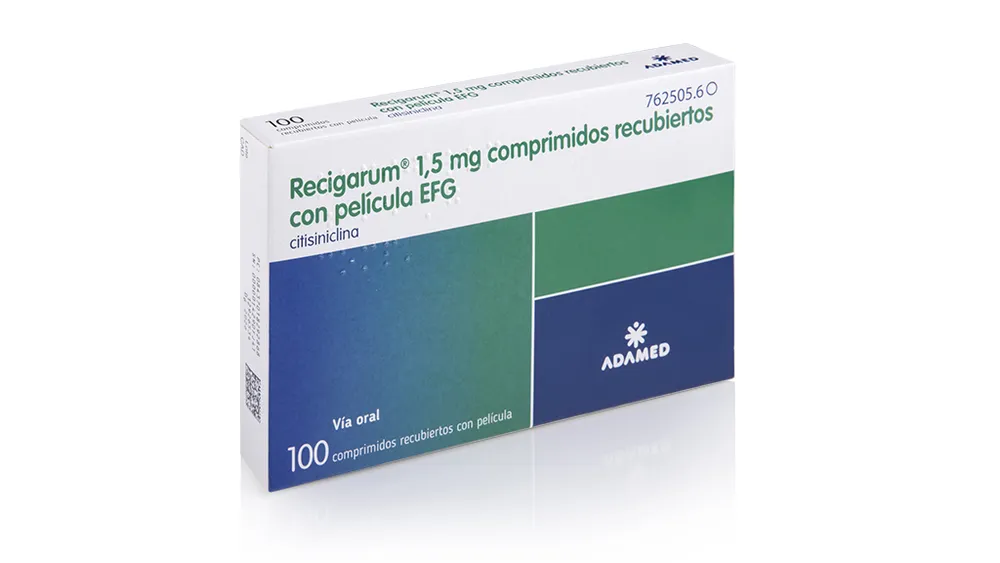
Table of Contents
Package Leaflet: Information for the User
Introduction
Package leaflet: information for the user
Recigarum 1.5 mg film-coated tablets EFG
cytisine
Read the entire leaflet carefully before you start using this medicine, because it contains important information for you.
- Keep this leaflet, as you may need to read it again. If you have any further questions, ask your doctor or pharmacist.
- This medicine has been prescribed for you only, and you should not give it to others, even if they have the same symptoms as you, because it may harm them.
- If you experience any adverse effects, consult your doctor or pharmacist, even if they are effects not listed in this leaflet. See section 4.
Leaflet contents
- What Recigarum is and what it is used for
- What you need to know before using Recigarum
- How to use Recigarum
- Possible adverse effects
- How to store Recigarum
- Contents of the pack and other information
1. What Recigarum is and what it is used for
Recigarum contains the active substance cytisine.
This medicine is used to help adult smokers stop smoking and reduce nicotine cravings in those who wish to quit. The goal of cytisine treatment is the permanent cessation of using products containing nicotine.
Cytisine use allows for a gradual reduction of nicotine dependence without nicotine withdrawal symptoms (for example, depressed mood, irritability, anxiety, difficulty concentrating, insomnia, increased appetite).
2. What you need to know before using Recigarum
Do not use Recigarum
- if you are allergic to cytisine or any of the other ingredients of this medicine (listed in section 6),
- if you have unstable angina,
- if you have a history of recent myocardial infarction,
- if you suffer from clinically significant cardiac arrhythmias,
- if you have recently had a stroke,
- if you are pregnant or breastfeeding.
Warnings and precautions
Consult your doctor or pharmacist before starting to take this medicine.
Cytisine should be used with caution if you have:
- ischemic heart disease,
- heart failure,
- hypertension,
- pheochromocytoma (a tumor of the adrenal gland),
- atherosclerosis (hardening of the arteries) and other peripheral vascular diseases,
- gastric or duodenal ulcer,
- gastroesophageal reflux disease,
- hyperthyroidism (overactive thyroid),
- diabetes,
- schizophrenia,
- renal or hepatic impairment.
Cytisine should only be taken by individuals who are firmly committed to quitting nicotine. Using cytisine without stopping smoking or using nicotine-containing products may worsen the adverse effects of nicotine.
Women of childbearing potential must use effective contraceptive methods. See also the section "Pregnancy and breastfeeding".
Children and adolescents
Due to limited experience, this medicine is not recommended for use in individuals under 18 years of age.
Elderly population
Due to limited clinical experience, cytisine is not recommended for use in patients over 65 years of age.
Patients with hepatic or renal impairment
There is no clinical experience with cytisine in patients with renal or hepatic impairment; therefore, the medicine is not recommended for use in such patients.
Other medicines and Recigarum
Inform your doctor or pharmacist if you are taking, have recently taken, or might need to take any other medicines.
Do not take cytisine together with antituberculosis medications.
In some cases, as a consequence of quitting smoking, with or without cytisine, a dose adjustment of other medicines may be necessary. This adjustment is particularly important if you are taking other medicines containing theophylline (for the treatment of asthma), tacrine (for Alzheimer's disease), clozapine (for schizophrenia), or ropinirole (for the treatment of Parkinson's disease). If you are unsure, consult your doctor or pharmacist.
It is currently unknown whether cytisine may reduce the effectiveness of systemic hormonal contraceptives. If you are using systemic hormonal contraceptives, you should add a second barrier method (e.g., condoms).
Pregnancy and breastfeeding
If you are pregnant or breastfeeding, think you may be pregnant, or are planning to become pregnant, consult your doctor or pharmacist before using this medicine.
Contraception in women
You must use effective contraceptive methods if you are a woman of childbearing potential.
It is currently unknown whether cytisine may reduce the effectiveness of systemic hormonal contraceptives. If you are using systemic hormonal contraceptives, you should add a second barrier method (e.g., condoms).
Ask your doctor for advice.
Pregnancy and breastfeeding
Cytisine is contraindicated during pregnancy and breastfeeding.
Driving and using machines
Cytisine has no influence on the ability to drive or operate machinery.
Quitting smoking
The effects of changes occurring in the body as a result of quitting smoking, with or without cytisine treatment, may alter the mechanism of action of other medicines. Therefore, in some cases, a dose adjustment may be necessary. For further details, see the section "Other medicines and Recigarum".
In some individuals, quitting smoking with or without treatment has been associated with an increased risk of experiencing changes in thought or behavior, feelings of depression and anxiety (including, rarely, suicidal ideation and suicide attempts), and may be associated with worsening of psychiatric disorders. If you have a history of psychiatric disorders, you should discuss this with your doctor.
Recigarum contains aspartame
This medicine contains 0.12 mg of aspartame per film-coated tablet. Aspartame is a source of phenylalanine, which may be harmful if you have phenylketonuria (PKU), a rare genetic disorder in which phenylalanine accumulates because the body cannot properly eliminate it.
3. How to use Recigarum
Follow exactly the instructions for use of this medicine provided by your doctor. If in doubt, consult your doctor or pharmacist again.
One package of Recigarum (100 tablets) is sufficient for a complete treatment. The duration of treatment is 25 days. Recigarum is for oral use and should be taken with an adequate amount of water according to the dosing schedule indicated below.
Treatment days | Recommended dose | Maximum daily dose |
Days 1 to 3 | 1 tablet every 2 hours | 6 tablets |
Days 4 to 12 | 1 tablet every 2.5 hours | 5 tablets |
Days 13 to 16 | 1 tablet every 3 hours | 4 tablets |
Days 17 to 20 | 1 tablet every 5 hours | 3 tablets |
Days 21 to 25 | 1-2 tablets per day | Up to 2 tablets |
The blister pack is labeled with the consecutive days of taking Recigarum.
You must stop smoking no later than the 5th day of treatment. You should not continue smoking during treatment, as this could worsen adverse reactions. In case of treatment failure, it should be discontinued and may be resumed after 2 or 3 months.
Use in children and adolescents
The use of cytisine is not recommended in patients under 18 years of age.
If you use more Recigarum than you should
Symptoms of nicotine poisoning may occur in case of cytisine overdose. Overdose symptoms include, among others, general malaise, nausea, vomiting, increased heart rate, fluctuations in blood pressure, breathing difficulties, blurred vision, and seizures.
If you experience even one of the described symptoms, or any other symptom not mentioned in this leaflet, stop taking cytisine immediately and consult your doctor.
In case of overdose or accidental ingestion, contact your doctor or pharmacist immediately, or call the Toxicology Information Service at telephone number 91 562 04 20, indicating the medication and the amount ingested.
If you forget to use Recigarum
Do not take a double dose to make up for missed doses.
If you have any further questions about the use of this medicine, ask your doctor or pharmacist.
4. Possible adverse effects
Like all medicines, this medicine can cause adverse effects, although not everyone will experience them.
These adverse effects may occur with certain frequencies, defined as follows:
Very common (may affect more than 1 in 10 patients):
- changes in appetite (mainly increase),
- weight gain,
- dizziness,
- irritability,
- mood changes,
- anxiety,
- increased blood pressure (hypertension),
- dry mouth,
- diarrhoea,
- skin rash,
- exhaustion,
- sleep disorders (insomnia, drowsiness, lethargy, abnormal dreams, nightmares),
- headaches,
- increased heart rate,
- nausea,
- taste disturbance,
- heartburn,
- constipation,
- vomiting,
- abdominal pain (especially in the upper abdomen),
- muscle pain.
Common (may affect between 1 and 10 in 100 patients):
- difficulty concentrating,
- slow heart rate,
- abdominal distension,
- burning mouth,
- general malaise.
Uncommon (affects between 1 and 10 in 1,000 patients):
- feeling of heaviness in the head,
- decreased libido,
- tearing,
- dyspnoea,
- increased sputum,
- excessive salivation,
- sweating,
- decreased skin elasticity,
- fatigue,
- increased serum transaminase levels.
Most of the adverse effects mentioned occur at the beginning of treatment and disappear over time. These symptoms may also be due to stopping smoking (withdrawal symptoms) rather than the treatment with cytisine.
Reporting of adverse effects
If you experience any type of adverse effect, consult your doctor or pharmacist, even if it is a possible adverse effect not listed in this leaflet. You may also report them directly via the Spanish Pharmacovigilance System for Human Medicinal Products: www.notificaram.es. By reporting adverse effects, you can help provide more information on the safety of this medicine.
5. Storage of Recigarum
Keep this medicine out of the sight and reach of children.
Store in the original packaging to protect it from light. This medicine does not require any special storage temperature.
Do not use this medicine after the expiry date stated on the packaging and blister after EXP. The expiry date refers to the last day of the month indicated.
Medicines must not be disposed of via wastewater or household waste. Dispose of unused medicines and their packaging at the SIGRE collection point at your pharmacy. If you are unsure, ask your pharmacist how to dispose of medicines and packaging you no longer need. This will help protect the environment.
6. Contents of the pack and other information
Composition of Recigarum
The active substance is citisinicline (formerly called: cytisine). Each film-coated tablet contains 1.5 mg of citisinicline.
The other components are:
Core: hypromellose, mannitol, corn starch, magnesium aluminium silicate, colloidal anhydrous silica, and magnesium stearate.
Coating: hypromellose (E464), microcrystalline cellulose (E460), talc (E553b), glycerol (E422), titanium dioxide (E171), quinoline yellow aluminium lake (E104), indigo carmine aluminium lake (blue 2) (E132), menthol-flavoured powder, and aspartame (E951).
See section 2 "Recigarum contains aspartame".
Appearance of the medicinal product and contents of the pack
Film-coated tablet, round, biconvex, light green to green in colour, with a diameter of 5 mm.
This medicine is available in blister packs containing 100 film-coated tablets.
Marketing Authorization Holder
Adamed Laboratorios, S.L.U.
Calle de las Rosas de Aravaca, 31
2nd floor
28023 – Madrid
Manufacturer
Adamed Pharma S.A.
ul. Marszalka J. Pilsudskiego 5
95-200 Pabianice
Poland
This medicinal product is authorized in the Member States of the European Economic Area under the following names:
Member State | Name of the medicinal product |
Poland | Cytisinicline Pro-Pharma |
Spain | Recigarum 1.5 mg film-coated tablets EFG |
Date of the most recent review of this leaflet: January 2023
Detailed information about this medicine is available on the website of the Spanish Agency for Medicines and Health Products (AEMPS): http://www.aemps.gob.es/