Recarbrío 500 mg/500 mg/250 mg powder for solution for infusion
Spain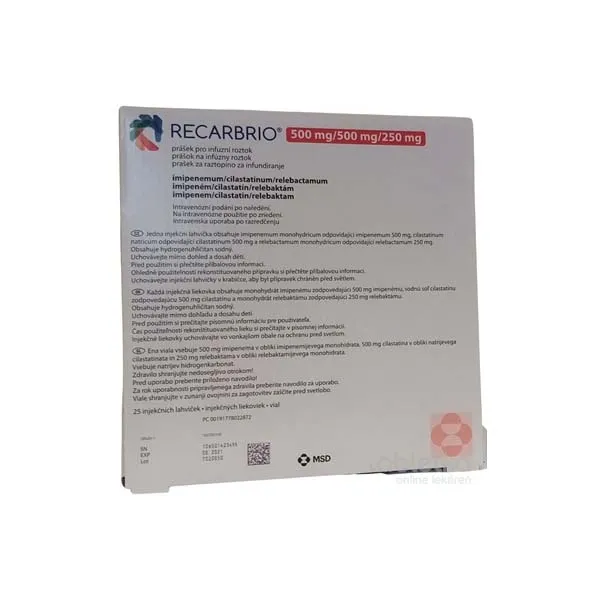
Table of Contents
Package leaflet: Information for the user
Introduction
Package leaflet: information for the user
Recarbrio 500mg/500mg/250mg powder for solution for infusion
imipenem/cilastatin/relebactam
Read all of this leaflet carefully before you start using this medicine, because it contains important information for you.
- Keep this leaflet, as you may need to read it again.
- If you have any questions, ask your doctor or nurse.
- If you experience any adverse reactions, talk to your doctor or nurse, even if they are not listed in this leaflet. See section 4.
Contents of the leaflet
- What Recarbrio is and what it is used for
- What you need to know before using Recarbrio
- How to use Recarbrio
- Possible side effects
- How to store Recarbrio
- Contents of the pack and other information
1. What Recarbrio is and what it is used for
Recarbrio is an antibiotic. It contains the active substances imipenem, cilastatin, and relebactam.
Recarbrio is used in adults and children (from birth up to less than 18 years of age) to treat:
- certain bacterial lung infections (pneumonia)
- bloodstream infections associated with the lung infections mentioned above
- infections caused by bacteria that other antibiotics are unable to destroy
2. What you need to know before using Recarbrio
Do not use Recarbrio
- if you are allergic to imipenem, cilastatin, relebactam, or any of the other components of this medicine (listed in section 6)
- if you are allergic to carbapenem-type antibiotics
- if you have ever had a severe allergic reaction to penicillin-type antibiotics or cephalosporin-type antibiotics.
You must not receive Recarbrio if any of the above apply to you. If you are unsure, consult your doctor or nurse before receiving Recarbrio.
Warnings and precautions
Talk to your doctor or nurse before starting to use Recarbrio if:
- you are allergic to any medicine – especially antibiotics
- you have ever had seizures (convulsions or fits)
- you have ever experienced confusion or muscle contractions with a medicine
- you are taking a medicine containing valproic acid
- you have previously had diarrhoea while receiving antibiotics
- you have kidney problems – your doctor may reduce your dose
Tell your doctor immediately if you experience an allergic reaction, seizures (convulsions or fits), diarrhoea, or develop kidney problems while receiving Recarbrio (see section 3).
Children and adolescents
Do not administer this medicine to children with kidney problems weighing less than 30 kg, children weighing less than 2 kg, or premature infants (less than 37 weeks gestational age). This is because it is not known whether the medicine is safe to use in these patients.
Other medicines and Recarbrio
Tell your doctor or nurse if you are taking, have recently taken, or might need to take any other medicines.
Tell your doctor about all medicines you are receiving, especially if you are taking:
- medicines containing ganciclovir, used to treat certain viral infections
- medicines containing valproic acid or semi-sodium valproate, usually used to treat epilepsy, bipolar disorder, or migraine
- medicines to control blood clotting, such as warfarin
Pregnancy and breastfeeding
If you are pregnant or breastfeeding, think you may be pregnant, or are planning to become pregnant, consult your doctor before using this medicine.
Driving and using machines
Recarbrio may make you feel dizzy, agitated, or cause seizures or convulsions. This could affect your ability to drive or operate machinery.
Recarbrio contains sodium
This medicine contains approximately 37.5 mg of sodium (a main component of table/cooking salt) per vial. This is equivalent to about 2% of the maximum daily recommended intake of sodium for an adult, and should be taken into account if you are on a low-sodium diet.
3. How to use Recarbrio
The recommended dose for adults is one vial (containing 500 mg of imipenem, 500 mg of cilastatin, and 250 mg of relebactam) every 6 hours. It is administered by direct infusion into a vein (“intravenous infusion”). The infusion will last 30 minutes.
For children, your doctor or nurse will determine the appropriate dose and infusion duration based on age and weight.
If you have kidney problems, your doctor may reduce your dose.
The usual treatment course lasts from 5 to 14 days, depending on the type of infection you have and how you respond to treatment.
If you use more Recarbrio than you should
Recarbrio will be administered by a doctor or nurse, so it is unlikely that an incorrect dose will be given. If you think you have been given too much Recarbrio, inform your doctor or nurse immediately.
If you forget to use Recarbrio
Inform your doctor or nurse immediately if you think you have missed a dose of Recarbrio.
If you have any further questions about the use of this medicine, ask your doctor or nurse.
4. Possible adverse effects
Like all medicines, this medicine can cause adverse effects, although not everyone experiences them.
Serious adverse effects
Inform your doctor immediately if you notice any of the following serious adverse effects – the medicine must be discontinued:
- allergic reactions – signs may include hives, swelling of the face, lips, tongue or throat, difficulty breathing or swallowing
- severe skin reactions (e.g. severe rash, skin peeling or blistering)
Other adverse effects
Frequent (may affect more than 1 in 10 people):
- nausea, vomiting
- blood test results that may show changes in the liver
- blood test results that may show an increase in the number of certain types of blood cells called "eosinophils"
- blood test results that may show an increase in certain white blood cells
- rash
- inflammation and pain caused by a blood clot in the vein
Uncommon (may affect up to 1 in 100 people):
- hives
- itching of the skin
- seizures (fits) and nervous system disorders such as tremor
- confusion
- seeing, hearing or feeling things that are not there (hallucinations)
- dizziness, drowsiness
- low blood pressure
- blood test results that may show changes in the kidney
- blood test results that may show a decrease in the number of red blood cells, white blood cells and blood cells called platelets
- blood test results that may show an increase in the number of certain blood cells called platelets
- abnormal function of the kidneys, liver and blood detected in blood tests
- pain, redness or formation of a lump at the site where the medicine was injected
- fever
- blood test results (called Coombs test) showing antibodies that may cause anemia by destroying red blood cells
Rare (may affect up to 1 in 1,000 people):
- fungal infection (candidiasis)
- changes in taste
- brain disease, tingling sensation (pins and needles), localized tremor
- hearing loss
- stained teeth and/or tongue
- inflammation of the colon with severe diarrhea (colitis)
- decrease in white blood cells, which may make it difficult for your body to fight infections
- inflammation of the liver
- liver failure
- inability of the kidneys to perform normal function
- changes in amount of urine, changes in urine color
- skin swelling
- painful rash with flu-like symptoms
- redness and peeling of the skin
Very rare (may affect up to 1 in 10,000 people):
- inflammation of the stomach or intestine (gastroenteritis)
- anemia due to destruction of red blood cells, leading to symptoms such as fatigue and pale skin
- headache
- worsening of a rare condition associated with muscle weakness (worsening of myasthenia gravis)
- spinning sensation (vertigo)
- ringing in the ears (tinnitus)
- irregular heartbeat, strong or rapid heartbeats
- chest discomfort, difficulty breathing, abnormally fast and shallow breathing, pain in the upper part of the spine
- sore throat
- flushing, change in skin color, bluish discoloration of face and lips, changes in skin texture, excessive sweating
- increased saliva production
- inflammation of the intestine with bloody diarrhea (haemorrhagic colitis)
- stomach pain
- heartburn
- red and swollen tongue, excessive growth of normal bumps on the tongue giving it a hairy appearance
- severe loss of liver function due to inflammation (fulminant hepatitis)
- pain in various joints
- itching of the female vulva
- weakness, lack of energy
Frequency not known (frequency cannot be estimated from available data):
- restlessness
- abnormal movements
- jaundice (yellowing of the skin and eyes)
- blood tests showing an increase in a substance called lactate dehydrogenase (LDH), which may indicate tissue damage
Reporting of adverse effects
If you experience any adverse effect, consult your doctor or nurse, even if it is a possible adverse effect not listed in this leaflet. You may also report them directly through the national reporting system included in Appendix V. By reporting adverse effects, you can help provide more information on the safety of this medicine.
5. Conservation of Recarbrio
Keep this medicine out of the sight and reach of children.
Do not use this medicine after the expiry date stated on the packaging after EXP. The expiry date is the last day of the month indicated.
Keep this medicine in the outer packaging to protect it from light.
Medicines should not be disposed of via wastewater. Ask your pharmacist how to properly dispose of any unused medicine and its packaging. This will help protect the environment.
6. Contents of the container and other information
Composition of Recarbrio
- The active substances are imipenem, cilastatin and relebactam. Each vial contains 500 mg of imipenem, 500 mg of cilastatin and 250 mg of relebactam.
- The other component is sodium hydrogen carbonate.
Appearance of the product and contents of the container
Recarbrio is a white to pale yellow powder supplied for solution for infusion in glass vials. The pack size is 25 vials.
Marketing Authorization Holder and Manufacturer
Marketing Authorization Holder | Manufacturer |
Merck Sharp & Dohme B.V. Waarderweg 39 2031 BN Haarlem Netherlands | FAREVA Mirabel Route de Marsat, Riom 63963, Clermont‑Ferrand Cedex 9 France |
You can request further information about this medicinal product by contacting the local representative of the marketing authorization holder:
Belgium/Belgium/Belgium MSD Belgium Tel/Tel: +32(0)27766211 | Lithuania UAB Merck Sharp & Dohme Tel. +370 5 2780 247 |
| Luxembourg/Luxembourg MSD Belgium Tél/Tel: +32(0)27766211 |
Czech Republic Merck Sharp & Dohme s.r.o. Tel.: +420 277 050 000 | Hungary MSD Pharma Hungary Kft. Tel.: +36 1 888 5300 |
Denmark MSD Danmark ApS Tlf.: +45 4482 4000 | Malta Merck Sharp & Dohme Cyprus Limited Tel: 8007 4433 (+356 99917558) |
Germany MSD Sharp & Dohme GmbH Tel.: +49 (0) 89 20 300 4500 | Netherlands Merck Sharp & Dohme B.V. Tel: 0800 9999000 (+31 23 5153153) |
Estonia Merck Sharp & Dohme OÜ Tel: +372 614 4200 | Norway MSD (Norge) AS Tlf: +47 32 20 73 00 |
Greece MSD Α.Φ.Ε.Ε. Tel: +30 210 98 97 300 | Austria Merck Sharp & Dohme Ges.m.b.H. Tel: +43 (0) 1 26 044 |
Spain Merck Sharp & Dohme de España, S.A. Tel: +34 91 321 06 00 | Poland MSD Polska Sp. z o.o. Tel.: +48 22 549 51 00 |
France MSD France Tél: +33 (0)1 80 46 40 40 | Portugal Merck Sharp & Dohme, Lda Tel.: +351 21 4465700 |
Croatia Merck Sharp & Dohme d.o.o. Tel: +385 1 6611 333 | Romania Merck Sharp & Dohme Romania S.R.L. Tel.: +40 21 529 29 00 |
Ireland Merck Sharp & Dohme Ireland (Human Health) Limited Tel: +353 (0)1 2998700 | Slovenia Merck Sharp & Dohme, inovativna zdravila d.o.o. Tel: +386 1 520 4201 |
Iceland Vistor ehf. Tel: +354 535 7000 | Slovakia Merck Sharp & Dohme, s. r. o. Tel.: +421 2 58282010 |
Italy MSD Italia S.r.l. Tel: 800 23 99 89 (+39 06 361911) | Finland MSD Finland Oy Puh/Tel: +358 (0)9 804 650 |
Cyprus Merck Sharp & Dohme Cyprus Limited Tel: 800 00 673 (+357 22866700) | Sweden Merck Sharp & Dohme (Sweden) AB Tel: +46 77 5700488 |
Latvia SIA Merck Sharp & Dohme Latvija Tel.: +371 67025300 |

Date of the most recent review of this leaflet: {MM/YYYY}.
Detailed information on this medicine is available on the European Medicines Agency website: https://www.ema.europa.eu.
<------------------------------------------------------------------------------------------------------------------
This information is intended for healthcare professionals only:
Recarbrio is supplied as a dry powder in a single-dose vial which must be reconstituted and further diluted using aseptic techniques before intravenous infusion, as described below:
Adult patients
To prepare the infusion solution, the contents of the vial should be transferred to 100 ml of an appropriate infusion solution (see Summary of Product Characteristics, sections 6.2 and 6.3): sodium chloride 9 mg/ml (0.9%). In exceptional circumstances where sodium chloride 9 mg/ml (0.9%) cannot be used for clinical reasons, 5% glucose may be used instead. Note that pre-filled infusion bags are overfilled; to achieve the correct concentration, it is essential at this step to ensure exactly 100 ml of diluent is used when only part of the contents of the infusion bag is administered (e.g., in pediatric dosing based on body weight).
- Withdraw 20 ml (2 × 10 ml) of diluent from the appropriate infusion bag and reconstitute the vial with 10 ml of the diluent. The reconstituted suspension must not be administered by direct intravenous infusion.
- After reconstitution, shake the vial well and transfer the resulting suspension to the remaining 80 ml in the infusion bag.
- Add the additional 10 ml of infusion diluent to the vial and shake well to ensure complete transfer of the vial contents; repeat the transfer of the resulting suspension into the infusion solution prior to administration. Mix thoroughly until the final solution is clear.
Adult patients with renal impairment and pediatric patients with renal impairment weighing at least 30 kg
A reduced dose of Recarbrio will be administered according to the patient's CrCl or eGFR, as determined according to the table below.
- Prepare 100 ml of infusion solution as described above for adult patients.
- Select the volume (ml) of the final infusion solution required for the appropriate Recarbrio dose as shown in the table below.
Pediatric patients with normal renal function weighing between 2 kg and less than 30 kg
-
Prepare 100 ml of infusion solution as described above for adult patients.
-
The volume of the final infusion solution (with a concentration of 12.5 mg/ml) to be administered is calculated based on the patient's weight as follows:
-
Infusion volume (ml) = (Weight (kg) × 37.5 mg/kg) / 12.5 mg/ml
-
Note: It will not be necessary to use the entire volume (100 ml) in the infusion bag.
-
Transfer the calculated infusion volume from the prepared 100 ml solution to an appropriately sized infusion bag or to an infusion syringe.
-
The infusion volume should be administered over 60 minutes by intravenous infusion or via syringe pump.
Preparation of intravenous infusion solution of Recarbrio in adults and pediatric patients (weighing at least 30 kg)
Estimated Renal Function (CrCl [mL/min]* or eGFR [mL/min/1.73m²] †) | Dose of Recarbrio (imipenem/cilastatin/relebactam) (mg) | Volume (mL) of solution to withdraw and discard from the preparation | Final infusion volume (mL) required for the dose |
Greater than or equal to 90 | 500/500/250 | N/A | 100 |
Less than 90 to greater than or equal to 60 | 400/400/200 | 20 | 80 |
Less than 60 to greater than or equal to 30 | 300/300/150 | 40 | 60 |
Less than 30 to greater than or equal to 15 or ESRD on hemodialysis | 200/200/100 | 60 | 40 |
*CrCl calculated using the Cockcroft-Gault formula for adult patients | |||
†eGFR calculated using the Schwartz formula for clinical use in pediatric patients weighing ≥ 30 kg |
Reconstituted Recarbrio solutions range from colorless to yellow. Variations in color within this range do not affect the potency of the product. Parenteral medicinal products should be inspected visually for particulate matter and discoloration prior to administration, whenever solution and container permit. Discard if discoloration or visible particles are observed.
Disposal of unused medicine and all materials that have come into contact with it must be carried out in accordance with local regulations.
Compatible Medications
The physical compatibility of Recarbrio with selected injectable medicinal products has been evaluated during Y-site infusion using two commonly used diluents. Compatible medicinal products are listed below with their corresponding compatible diluent (i.e., 5% dextrose for injection or 0.9% sodium chloride for injection). Recarbrio must not be co-administered simultaneously through the same intravenous line (or cannula) with medicinal products not listed below, as compatibility data are not available. Refer to the respective product information of the co-administered medicinal product(s) to confirm compatibility for simultaneous administration. This medicinal product must not be mixed with other medicinal products except those mentioned below.
List of compatible injectable medicinal products for use with 5% dextrose or 0.9% sodium chloride for injection as diluents
- dexmedetomidine
- dopamine
- epinephrine
- fentanyl
- heparin
- midazolam
- norepinephrine
- phenylephrine
Compatible Intravenous Bags and Infusion Equipment Materials
Recarbrio is compatible with the following intravenous bags and infusion equipment materials. Bags or infusion equipment materials not listed below must not be used.
Materials of the intravenous administration container bag
Polyvinyl chloride (PVC) and polyolefin (polypropylene and polyethylene)
Materials of intravenous infusion equipment (including tubing)
PVC + Di-(2-ethylhexyl)phthalate (DEHP) and PVC coated with polyethylene (PE)
Incompatible Medications
Recarbrio for solution for infusion is physically incompatible with propofol in 5% dextrose (also known as glucose) or 0.9% sodium chloride.
After Reconstitution and Dilution
Diluted solutions should be used immediately. The time interval between the start of reconstitution and the end of intravenous infusion must not exceed two hours.