Reblozyl 25 mg powder for injection solution
Spain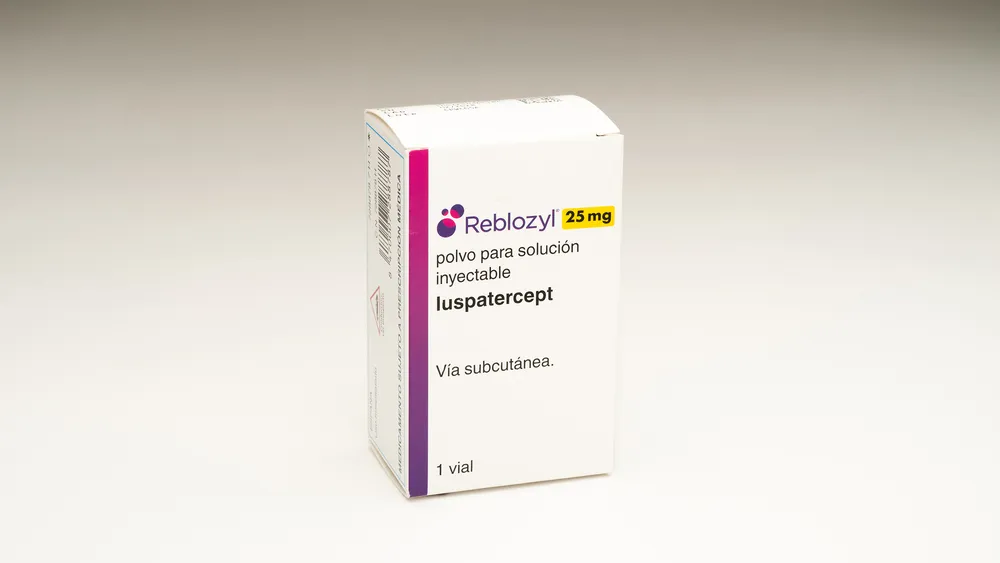
Table of Contents
Patient Information Leaflet
Introduction
Package leaflet: Information for the patient
Reblozyl 25 mg powder for injectable solution
Reblozyl 75 mg powder for injectable solution
luspatercept
This medicinal product is subject to additional monitoring, which will allow for faster detection of new safety information. You can help by reporting any adverse reactions you may experience. Section 4 at the end of this leaflet includes information on how to report adverse reactions.
Read the entire leaflet carefully before receiving this medicine, as it contains important information for you.
- Keep this leaflet, as you may need to read it again.
- If you have any questions, ask your doctor or nurse.
- If you experience any adverse reactions, consult your doctor, even if they are adverse reactions not listed in this leaflet. See section 4.
Leaflet contents
- What Reblozyl is and what it is used for
- What you need to know before being given Reblozyl
- How Reblozyl is administered
- Possible adverse reactions
- How to store Reblozyl
- Contents of the pack and other information
1. What Reblozyl is and what it is used for
Reblozyl contains the active substance luspatercept. It is used for the following:
Myelodysplastic syndromes
Myelodysplastic syndromes (MDS) are a diverse group of blood and bone marrow disorders.
-
Red blood cells are abnormal and do not develop properly.
-
Patients may have various signs and symptoms, including low red blood cell counts (anemia), and may require red blood cell transfusions.
Reblozyl is used in adults with anemia caused by MDS who require red blood cell transfusions. It is used in adults who have already received prior treatment with erythropoietin or who cannot receive such treatments.
Beta thalassemia
Beta thalassemia is an inherited blood disorder.
- It affects the production of haemoglobin.
- Patients may have various signs and symptoms, including low red blood cell counts (anemia), and may require red blood cell transfusions.
Reblozyl is used to treat anaemia in adults with beta thalassemia who may or may not require regular red blood cell transfusions.
How Reblozyl works
Reblozyl improves the body's ability to produce red blood cells. Red blood cells contain haemoglobin, a protein that carries oxygen throughout the body. When the body produces more red blood cells, haemoglobin levels increase.
For patients with MDS and beta thalassemia who require regular blood transfusions
Treatment with Reblozyl may prevent or reduce the need for red blood cell transfusions.
- Red blood cell transfusions can lead to excessive iron levels in the blood and in various organs of the body. This can be harmful in the long term.
For patients with beta thalassemia who do not require regular blood transfusions
Treatment with Reblozyl may improve their anaemia by increasing haemoglobin levels.
2. What you need to know before Reblozyl is administered to you
Do not use Reblozyl
- if you are allergic to luspatercept or to any of the other ingredients of this medicine (listed in section 6)
- if you are pregnant (see pregnancy section)
- if you require treatment for masses producing blood cells outside the bone marrow (extramedullary hematopoietic masses, EMH masses)
Warnings and precautions
Talk to your doctor before starting treatment with this medicine if:
- You have β-thalassemia and have had your spleen removed. You may have an increased risk of blood clot formation. Your doctor will discuss with you other potential factors that may increase this risk, such as:
- hormone replacement therapy or
- a previous blood clot
Your doctor may use preventive measures or medications to reduce the possibility of a blood clot occurring.
- You have severe back pain that does not go away, numbness or weakness, or loss of voluntary movement in legs, hands, or arms, or fecal and urinary incontinence. These may be symptoms of EMH masses and spinal cord compression.
- You have ever had high blood pressure (because Reblozyl may increase it). Your blood pressure will be monitored before each administration of Reblozyl and throughout treatment. Reblozyl will only be administered if your blood pressure is well controlled.
- You have a condition affecting bone strength and health (osteopenia and osteoporosis). You may be at higher risk of bone fractures.
Periodic tests
A blood test will be performed before each administration of this medicine. This is because your doctor needs to confirm that your hemoglobin level is appropriate before administering treatment.
If you have kidney problems, your doctor may perform additional tests.
Children and adolescents
The use of this medicine is not recommended in children and adolescents under 18 years of age.
Other medicines and Reblozyl
Inform your doctor if you are taking, have recently taken, or might need to take any other medicines.
Pregnancy
- Do not use this medicine during pregnancy or within at least 3 months before conception. Reblozyl may harm the unborn baby.
- Your doctor will perform a pregnancy test before starting treatment.
- If you think you may be pregnant or plan to become pregnant, consult your doctor before using this medicine.
Breastfeeding
- You must not breastfeed during treatment with this medicine or for 3 months after the last dose. It is unknown whether this medicine passes into breast milk.
Contraception
- You must use an effective method of contraception during treatment with Reblozyl and for 3 months after receiving your last dose.
Talk to your doctor about contraceptive methods that may be suitable for you during treatment with this medicine.
Fertility
If you are a woman, this medicine may cause fertility problems. That is, it may affect your ability to have a baby. Talk to your doctor before starting this treatment.
Driving and using machines
You may feel tired, dizzy, or faint during treatment with Reblozyl. If you experience these effects, do not drive or operate tools or machinery, and contact your doctor immediately.
Reblozyl contains sodium
This medicine contains less than 1 mmol of sodium (23 mg) per dose; that is, essentially “sodium-free”.
3. How Reblozyl is administered
Before you are given this medicine, your doctor will have carried out a blood test and decided whether you need Reblozyl.
Reblozyl will be given by subcutaneous injection (under the skin).
Dose you will be given
The dose is based on your body weight in kilograms. The injection will be administered by a doctor, nurse, or other healthcare professional.
- The recommended starting dose is 1.0 mg per kilogram of body weight.
- This dose should be given once every three weeks.
- Your doctor will monitor your progress and adjust your dose if necessary.
During treatment with Reblozyl, your doctor will monitor your blood pressure.
Myelodysplastic syndromes
The maximum single dose is 1.75 mg per kilogram of body weight.
Beta thalassemia
The maximum single dose is 1.25 mg per kilogram of body weight.
If you miss a dose
If you miss an injection of Reblozyl or delay a medical appointment, you will receive a Reblozyl injection as soon as possible. After that, your dosing schedule will continue as prescribed (with a minimum of 3 weeks between injections).
If you have any further questions about the use of this medicine, ask your doctor or nurse.
4. Possible adverse effects
Like all medicines, this medicine can cause adverse effects, although not everyone experiences them.
Serious adverse effects
Tell your doctor immediately if you experience any of the following adverse effects:
-
difficulty walking or speaking, dizziness, loss of balance and coordination, numbness or paralysis in the face, arm or leg (often on one side of the body), or blurred vision. These effects may be symptoms of a stroke
-
painful swelling and tightness in the leg or arm (blood clots)
-
severe back pain that does not go away, numbness or weakness, or loss of voluntary movement in legs, hands or arms, fecal or urinary incontinence. These may be symptoms of extramedullary hematopoietic masses (HEM masses) and spinal cord compression
-
swelling of the area around the eyes, face, lips, mouth, tongue or throat
-
allergic reactions
-
rashes
Other adverse effects:
Very common adverse effects (may affect more than 1 in 10 people):
-
chest infection
-
cough
-
difficulty breathing or shortness of breath
-
increased blood pressure without symptoms or associated with headache
-
urinary tract infection
-
upper respiratory tract infection
-
flu or flu-like symptoms
-
dizziness, headache
-
diarrhea, nausea (feeling sick)
-
stomach pain
-
back, bone or joint pain
-
feeling tired or weak
-
difficulty falling asleep or staying asleep
-
changes in blood test results (increased liver enzymes, increased blood creatinine). These may be signs of liver and kidney problems.
Common adverse effects (may affect up to 1 in 10 people):
- fainting, sensation of spinning
- broken bones due to trauma
- nosebleeds
- severe headache on one side of the head
- redness, burning, and pain at the injection site (injection site reactions) or swelling, skin itching (erythema at the injection site)
- high levels of uric acid in the blood (detected in clinical tests)
- foamy urine. This may be a sign of excess protein in the urine (proteinuria and albuminuria)
Reporting of adverse effects
If you experience any type of adverse effect, talk to your doctor or nurse, even if it is a possible adverse effect not listed in this leaflet. You can also report them directly through the national reporting system detailed in Appendix V. By reporting adverse effects, you can help provide more information on the safety of this medicine.
5. Storage of Reblozyl
Keep this medicine out of the sight and reach of children.
Do not use this medicine after the expiry date which is stated on the carton and vial after EXP. The expiry date refers to the last day of the month indicated.
Unopened vials: Store in a refrigerator (between 2 ºC and 8 ºC). Do not freeze. Store in the original packaging to protect from light.
After first opening and reconstitution, Reblozyl should be used immediately. If not used immediately, the reconstituted medicine can be stored for up to 8 hours at room temperature (≤25 ºC) or up to 24 hours between 2 ºC and 8 ºC, when kept in the original packaging.
Do not freeze the reconstituted solution.
Medicines must not be disposed of via wastewater or household waste. Ask your pharmacist how to dispose of medicines and packaging once they are no longer needed. This will help protect the environment.
6. Contents of the pack and other information
Composition of Reblozyl
- The active substance is luspatercept. Each vial contains 25 mg or 75 mg of luspatercept. After reconstitution, each millilitre of solution contains 50 mg of luspatercept.
- The other components are monohydrate citric acid (E330), sodium citrate (E331), polysorbate 80, sucrose, hydrochloric acid (to adjust pH), and sodium hydroxide (to adjust pH).
Appearance of the product and contents of the container
Reblozyl is a white to off-white powder for injectable solution. Reblozyl is supplied in glass vials containing 25 mg or 75 mg of luspatercept.
Each pack contains 1 vial.
Marketing Authorisation Holder
Bristol‑Myers Squibb Pharma EEIG
Plaza 254
Blanchardstown Corporate Park 2
Dublin 15, D15 T867
Ireland
Manufacturer
Celgene Distribution B.V.
Orteliuslaan 1000
3528 BD Utrecht
The Netherlands
Date of the latest revision of this leaflet:
Other sources of information
Detailed information on this medicine is available on the website of the European Medicines Agency: http://www.ema.europa.eu. There are also links to other websites on rare diseases and orphan medicinal products.
This information is intended for healthcare professionals only:
Traceability
In order to improve the traceability of biological medicinal products, the name and batch number of the administered medicinal product should be clearly documented.
Incompatibilities
This medicinal product must not be mixed with other medicinal products except those mentioned in section 6.
Storage of the medicinal product
Unopened vial
Store in a refrigerator (between 2 °C and 8 °C). Do not freeze. Keep in the original packaging to protect from light.
Reconstituted solution
When stored in the original carton, the physicochemical stability of the reconstituted medicinal product during use has been demonstrated for up to 8 hours at room temperature (≤25 °C) or up to 24 hours between 2 °C and 8 °C.
From a microbiological standpoint, the medicinal product should be used immediately. If not used immediately, the storage periods and conditions prior to use are the responsibility of the user and must not exceed 24 hours at temperatures between 2 °C and 8 °C.
Do not freeze the reconstituted solution.
Dosage calculation
The total dose, based on the patient's body weight (kg), is calculated as follows:
Total dose (mg) = dose level (mg/kg) × patient weight (kg), every three weeks.
Reconstitution instructions
Reblozyl is supplied as a lyophilised powder for reconstitution with water for injections (WFI). A graduated syringe must be used during reconstitution to ensure accurate dosing. See Table 1.
Table 1. Reconstitution table for Reblozyl
Presentation | Amount of API required for reconstitution | Concentration after reconstitution (nominal value) |
25 mg vial | 0.68 ml | 50 mg/ml (0.5 ml) |
75 mg vial | 1.6 ml | 50 mg/ml (1.5 ml) |
- Remove the colored cap from the vial and clean the top with an alcohol swab.
- Add WFI to the vial using a properly graduated syringe with a needle, directing the stream toward the lyophilized powder. Allow to stand for one minute.
- Discard the needle and syringe used for reconstitution. Do not use them for subcutaneous injection.
- Gently swirl the vial in a circular motion for 30 seconds. Stop swirling and let the vial stand upright for 30 seconds.
- Inspect the vial to ensure no undissolved powder remains in the solution. If undissolved powder is observed, repeat step 4 until completely dissolved.
- Invert the vial and gently swirl in the inverted position for 30 seconds. Place the vial back in an upright position and let it stand for 30 seconds.
- Repeat step 6 an additional seven times to ensure complete reconstitution of material adhering to the vial walls.
- Visually inspect the reconstituted solution before administration. When properly mixed, the reconstituted Reblozyl solution is a colorless to yellowish, clear to slightly opalescent solution with no visible foreign particles. Do not use if foreign particles or undissolved medication are observed.
- If the reconstituted solution is not used immediately, refer to the previous section, "Conservation of the medicinal product."
Method of administration
If the reconstituted Reblozyl solution has been refrigerated, it should be removed from the refrigerator 15–30 minutes before injection to allow it to reach room temperature. This makes the injection more comfortable.
The maximum recommended volume of medication per injection site is 1.2 mL. If a volume greater than 1.2 mL is required, the total volume of Reblozyl should be divided into injections of similar volume and administered into separate sites within the same anatomical area but on opposite sides of the body. Reconstitute the appropriate number of Reblozyl vials to achieve the desired dose.
Inject Reblozyl subcutaneously in the arm, thigh, or abdomen.
If multiple injections are required, use a new syringe and needle for each subcutaneous injection. Discard any unused portion. Do not administer more than one dose from a single vial.
Disposal
Disposal of unused medicinal product and all materials that have come into contact with it must be carried out in accordance with local regulations.