Reactine cetirizine/pseudoephedrine 5 mg/120 mg prolonged-release tablets
Spain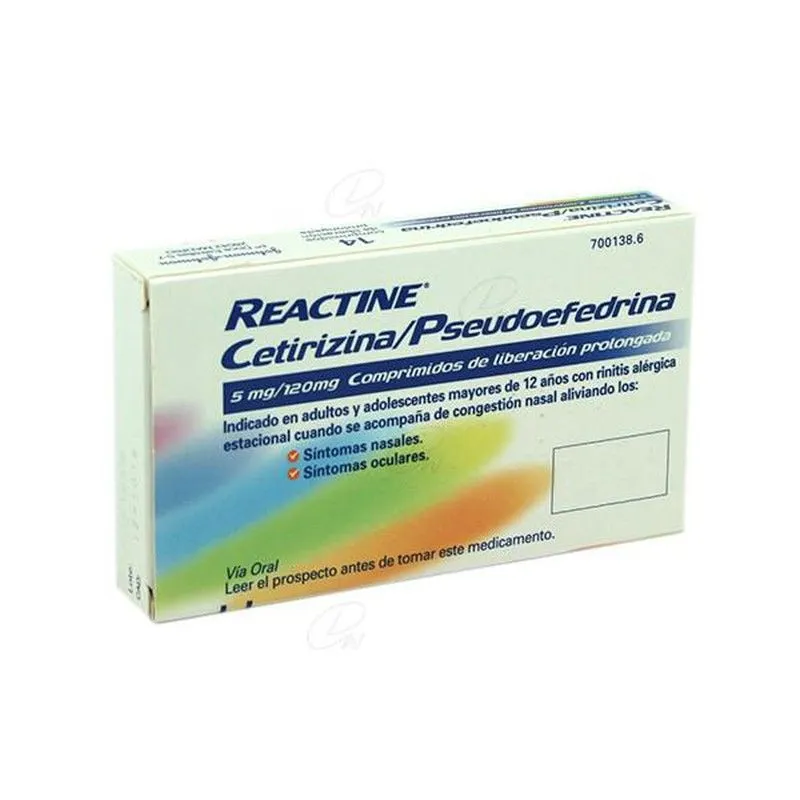
Table of Contents
- Package leaflet: Information for the user
- Introduction
- 1. What Reactine Cetirizine/Pseudoephedrine is and what it is used for
- 2. What you need to know before starting to take Reactine Cetirizine/Pseudoephedrine.
- 3. How to take Reactine Cetirizine/Pseudoephedrine
- 4. Possible adverse effects
- 5. Storage of Reactine Cetirizine/Pseudoephedrine
- 6. Contents of the pack and other information
Package leaflet: Information for the user
Introduction
Package leaflet: information for the user
Reactine Cetirizine/Pseudoephedrine 5 mg / 120 mg prolonged-release tablets
Cetirizine dihydrochloride / Pseudoephedrine hydrochloride
Read the entire leaflet carefully before you start taking this medicine because it contains important information for you.
Follow exactly the instructions for taking this medicine as described in this leaflet or as advised by your doctor or pharmacist.
- Keep this leaflet, as you may need to read it again.
- If you need advice or more information, consult your pharmacist.
- If you experience any adverse effects, consult your doctor or pharmacist, even if they are effects not listed in this leaflet.
- You must consult your doctor if you worsen or do not improve after 7 days of treatment.
Leaflet contents
- What Reactine Cetirizine/Pseudoephedrine is and what it is used for.
- What you need to know before taking Reactine Cetirizine/Pseudoephedrine.
- How to take Reactine Cetirizine/Pseudoephedrine.
- Possible side effects.
- How to store Reactine Cetirizine/Pseudoephedrine.
- Contents of the pack and other information.
1. What Reactine Cetirizine/Pseudoephedrine is and what it is used for
It is a medication that acts as an antihistamine and nasal decongestant.
Reactine Cetirizine/Pseudoephedrine is indicated for the relief of nasal and ocular symptoms of seasonal allergic rhinitis when accompanied by nasal congestion, in adults and adolescents over 12 years of age.
You should consult your doctor if your condition worsens or does not improve after 7 days of treatment.
2. What you need to know before starting to take Reactine Cetirizine/Pseudoephedrine.
Do not take REACTINE Cetirizine/Pseudoephedrine if:
- You are allergic (hypersensitive) to pseudoephedrine, cetirizine, antihistamines, other nasal decongestants, or any of the other components of this medicine (listed in section 6).
- You are a child under 12 years of age.
- You have or have had difficulty urinating and/or urinary retention.
- You have benign prostatic hyperplasia (enlarged prostate).
- You have kidney disease requiring dialysis.
- You suffer from severe hypertension or have a heart or blood vessel disease, or have had cerebral hemorrhage.
- You have very high blood pressure (severe hypertension) or uncontrolled hypertension despite medication.
- You have severe, acute (sudden) or chronic (long-term) kidney disease, or kidney failure.
- You have narrow-angle glaucoma.
- You have hyperthyroidism.
- You are taking or have taken within the last 2 weeks antidepressant medicines known as monoamine oxidase inhibitors (MAOIs).
- You are pregnant or breastfeeding.
Warnings and precautions
- You should consult your doctor before taking this medicine if you have:
- Diabetes; patients with diabetes should not take pseudoephedrine unless directed by a physician.
- Acute asthma attacks.
- High blood pressure (hypertension), heart disease, or blood vessel disease.
- Thyroid disease.
- High eye pressure (ocular hypertension).
- Epilepsy or risk of seizures.
- Severe liver disease with reduced function.
- Moderate or severe kidney disease with reduced function.
- If you are over 60 years old.
- Stomach ulcer, intestinal obstruction, or bladder obstruction.
- History of bronchospasm.
- Difficulty urinating due to an enlarged prostate.
If you are taking other medicines containing nasal decongestants, you should not take this medicine.
Cases of reversible posterior encephalopathy syndrome (RPES) and reversible cerebral vasoconstriction syndrome (RCVS) have been reported after using medicines containing pseudoephedrine. PRES and RCVS are rare conditions that may involve reduced blood flow to the brain. Stop using Reactine immediately and seek immediate medical help if you experience symptoms that could be signs of PRES or RCVS (see section 4 "Possible side effects" for symptoms).
If small pustules appear, mainly non-follicular, which may or may not be accompanied by fever and disseminated edematous erythema, mainly located in skin folds, trunk, and upper limbs, especially within the first 2 days of treatment, you may be experiencing acute generalized exanthematous pustulosis, which requires medical monitoring.
Sudden abdominal pain or rectal bleeding may occur with Reactine use due to inflammation of the colon (ischemic colitis). If these gastrointestinal symptoms occur, stop taking Reactine and contact your doctor or seek immediate medical attention. See section 4.
For controlled-release tablets using OROS® technology: Patients with intestinal obstruction or narrowing should consult a doctor before use. Rarely, this type of tablet may cause intestinal obstruction (blockage), usually in individuals with severe narrowing of the intestine (esophagus, stomach, intestine).
You should stop treatment and consult your doctor if, during treatment with this medicine, you notice or are diagnosed with high blood pressure (hypertension), rapid or strong heartbeat (tachycardia), palpitations, or irregular heart rhythm (arrhythmias), nausea, or headache.
With Reactine, blood flow to the optic nerve may be reduced. If you experience sudden vision loss, stop taking Reactine and contact your doctor or seek immediate medical attention. See section 4.
You should discontinue treatment at least 24 hours before undergoing surgery.
If you are scheduled for allergy testing, you must stop treatment 2 days before the test and inform your doctor.
Pseudoephedrine, the active ingredient in this medicine, may cause dependence when taken in large quantities and may therefore be harmful.
Avoid alcohol consumption while taking this medicine.
Concomitant use of cocaine with this medicine may increase cardiovascular effects and the risk of adverse reactions.
Small pellet-like particles may appear in the stool, representing undissolved remnants of the tablet. This is harmless and does not affect the medicine's efficacy.
If symptoms persist or worsen, or if new symptoms appear, patients should stop treatment and consult their doctor.
Interaction with diagnostic tests
If you are scheduled for any diagnostic tests (including blood and urine tests, skin tests using allergens, etc.), inform your doctor that you are taking this medicine, as it may alter test results.
Warning for athletes
It is not advisable to take Reactine Cetirizine/Pseudoephedrine (due to its pseudoephedrine content and prolonged-release formulation) for athletes, especially if there is a possibility of undergoing doping controls within the next 6 hours.
Use in children
Do not use this medicine in children under 12 years of age.
Taking Reactine Cetirizine/Pseudoephedrine with other medicines:
Inform your doctor or pharmacist if you are currently using, have recently used, or might need to use any other medicines.
In particular, inform your doctor if you are taking any of the following medicines, as dose adjustment or discontinuation may be necessary:
- Urinary acidifying agents (ammonium chloride).
- Urinary alkalinizing agents (sodium bicarbonate, citrates), as they may slow down the elimination of pseudoephedrine, increasing its effect and toxicity.
- Inhaled anesthetics, as they may increase the risk of heart problems.
- Antidepressants (tricyclics and monoamine oxidase inhibitors [MAOIs]), as they may cause increased blood pressure or hypertensive crisis: headache, high fever, and elevated blood pressure (see section "Do not take REACTINE Cetirizine/Pseudoephedrine").
- Certain antihypertensive medicines or diuretics (such as beta-blockers, ACE inhibitors, rauwolfia alkaloids like reserpine, methyldopa, guanethidine), as they may cause a decrease or sudden increase in blood pressure.
- Oral anticoagulants such as acenocoumarol, as their effect may be reduced.
- Dihydroergotamine (an ergot derivative used for headache treatment), as it may cause a severe increase in blood pressure.
- Central nervous system stimulants (amphetamines, xanthines), as they may cause nervousness, irritability, insomnia, or possibly seizures or irregular heart rhythm (arrhythmias).
- Digitalis glycosides (used for heart conditions), as they may cause cardiac rhythm disturbances.
- Thyroid hormones (used for thyroid disorders), as they may increase the effects of both the hormones and pseudoephedrine.
- Levodopa and selegiline (used for Parkinson’s disease), as they may cause severe high blood pressure, high fever, and headache.
- Linezolid (used as an antibacterial), as it may increase blood pressure.
- Nitrates (used for angina pectoris), as their effects may be reduced.
- Procarbazine (used to treat cancer), as it may cause severe high blood pressure, high fever, and headache.
- Ritonavir (an antiretroviral), as it increases blood levels of cetirizine and slows its elimination.
- Asthma medications containing theophylline.
- Antacids and kaolin.
Taking Reactine Cetirizine/Pseudoephedrine with food and drinks:
This medicine can be taken with or without food.
Alcohol consumption should be avoided during treatment with this medicine.
Pregnancy, breastfeeding, and fertility
If you are pregnant or breastfeeding, think you may be pregnant, or are planning to become pregnant, consult your doctor or pharmacist before using this medicine.
This medicine is contraindicated during pregnancy and breastfeeding.
Driving and using machines
Treatment with this medicine at the recommended doses is not expected to impair reaction ability or cause drowsiness, dizziness, or vertigo. However, if such effects occur, do not drive or operate dangerous machinery.
Reactine Cetirizine/Pseudoephedrine contains lactose
This medicine contains lactose. If your doctor has diagnosed you with an intolerance to certain sugars, consult him before taking this medicine.
3. How to take Reactine Cetirizine/Pseudoephedrine
Follow exactly the administration instructions for Reactine Cetirizine/Pseudoephedrine provided in this leaflet or those indicated by your doctor or pharmacist. If in doubt, consult your doctor or pharmacist.
Recommended dose:
-
Adults and adolescents aged 12 years and older: 1 tablet twice daily, morning and evening. The maximum daily dose is 2 tablets.
-
Patients over 60 years of age: Patients over 60 should not take this medicine without consulting their doctor.
-
Patients with kidney or liver disease: Patients with kidney or liver impairment should not take this medicine without consulting their doctor.
Method of administration
This medicine is taken orally.
The tablet should be swallowed whole and must not be split, chewed, or dissolved. It should be taken with liquid, preferably water. It may be taken with or without food.
If taken at night, it should be taken several hours before going to bed to minimize the possibility of insomnia.
If symptoms worsen or persist after 7 days of treatment, consult a doctor.
Use in children
This medicine is contraindicated in children under 12 years of age.
If you take more Reactine Cetirizine/Pseudoephedrine than you should
If you have taken more Reactine Cetirizine/Pseudoephedrine than you should, consult your doctor or pharmacist immediately.
Symptoms of overdose with Reactine Cetirizine/Pseudoephedrine include: confusion, diarrhoea, nausea, vomiting, dizziness, fatigue, headache, malaise, pupil dilation (mydriasis), skin irritation (pruritus), sedation, somnolence, stupor, tachycardia, bradycardia, psychosis, rapid breathing, excitation, nervousness, irritability, restlessness, agitation, anxiety, insomnia, tremors, seizures, muscle damage, palpitations, increased blood pressure, changes in heart rhythm (arrhythmias), heart attack, intestinal infarction, cerebral haemorrhage, difficulty urinating, sedation, breathing disturbances during sleep, unconsciousness, cardiovascular collapse, hallucinations, and epileptic seizures. In children, hyperactivity and sleeplessness may occur.
In case of overdose or accidental ingestion, contact your doctor, pharmacist, or the Toxicology Information Service immediately (telephone: 91.5620420), indicating the medicine and the amount ingested.
If you forget to take Reactine Cetirizine/Pseudoephedrine:
If you forget to take Reactine Cetirizine/Pseudoephedrine and symptoms persist, do not take a double dose to make up for the missed dose.
If necessary, take the next dose as indicated in section 3. How to take Reactine Cetirizine/Pseudoephedrine.
If you have any further questions about the use of this medicine, consult your doctor or pharmacist.
4. Possible adverse effects
Like all medicines, REACTINE Cetirizine/Pseudoephedrine may cause adverse effects, although not everyone gets them.
Frequency not known: cannot be estimated from the available data: serious conditions affecting the blood vessels of the brain known as reversible posterior encephalopathy syndrome (RPES) and reversible cerebral vasoconstriction syndrome (RCVS).
Stop using Reactine immediately and seek urgent medical attention if you experience symptoms that could be signs of reversible posterior encephalopathy syndrome (RPES) or reversible cerebral vasoconstriction syndrome (RCVS). These include:
- sudden, severe headache
- malaise
- vomiting
- confusion
- seizures
- changes in vision
Rare adverse effects (may affect up to 1 in 10,000 people): Anaphylactic shock.
Very rare adverse effects (may affect up to 1 in 10,000 people): Allergy, anxiety, aggression, euphoria, hallucinations, visual hallucinations, agitation, stroke, dysgeusia (disturbance of taste), dyskinesia (abnormal and involuntary movements), dystonia (disorders such as rigidity or tremors), memory impairment, headache, tingling or numbness in the limbs, restlessness, loss of consciousness, tremor, eye pain and swelling, photophobia (light sensitivity), blurred vision, arrhythmia, palpitations, tachycardia, myocardial infarction, abdominal discomfort, diarrhea, vomiting, ischemic colitis (inflammation of the colon due to insufficient blood supply), abnormal liver function (elevated transaminases, alkaline phosphatase, γ-GT, and bilirubin), generalized exanthematous pustulosis (severe skin reactions characterized by fever and numerous small superficial pustules appearing in extensive red areas), fixed drug eruption (skin and/or mucosal lesions following drug use), arthralgia, angioedema (swelling under the skin), pruritus (itching), urticaria, cough, breathing difficulty, urinary retention, difficulty or pain during urination, involuntary urination, itching after discontinuation of treatment, erectile dysfunction, reversible posterior encephalopathy syndrome, reversible cerebral vasoconstriction syndrome, hepatitis.
Adverse effects of unknown frequency: visual accommodation disorder, pupillary dilation, ocular deterioration.
During the marketing period of cetirizine and pseudoephedrine, the following adverse effects have been reported, with frequency estimated from clinical trials or epidemiological data:
Unknown frequency: aggression, euphoria, hallucinations, visual hallucinations, agitation, stroke, dysgeusia (disturbance of taste), dyskinesia (abnormal and involuntary movements), dystonia (disorders such as rigidity or tremors), memory impairment, tingling and numbness in the limbs, tremor, restlessness, loss of consciousness, eye pain, visual accommodation disorder, pupillary dilation, ocular deterioration or swelling, photophobia, blurred vision, arrhythmia, myocardial infarction, abdominal discomfort, vomiting, ischemic colitis, abnormal liver function, generalized exanthematous pustulosis (severe skin reactions characterized by fever and numerous small superficial pustules appearing in extensive red areas), angioedema (swelling under the skin), rash, pruritus (itching), urticaria, fixed drug eruption (skin and/or mucosal lesions following drug use), arthralgia, urinary retention, difficulty or pain during urination, involuntary urination, abnormal sensations, itching after discontinuation of treatment, erectile dysfunction, reversible posterior encephalopathy syndrome, reversible cerebral vasoconstriction syndrome, hepatitis.
Rare (may affect up to 1 in 10,000 people): Anaphylactic shock.
Uncommon (may affect up to 1 in 1,000 people): Allergy, anxiety, palpitations, tachycardia, breathing difficulty, cough, diarrhea, pruritus (itching), urticaria, malaise, increased blood pressure.
Very common (may affect up to 1 in 10 people): Headache.
If seizures or hallucinations occur, stop taking this medicine immediately.
If you experience any adverse effects, consult your doctor or pharmacist, even if they are adverse effects not listed in this leaflet.
Reporting of adverse effects
If you experience any type of adverse effect, talk to your doctor, pharmacist, or nurse, even if it is a possible adverse effect not listed in this leaflet. You can also report them directly via the Spanish Pharmacovigilance System for Human Medicines. Website: www.notificaram.es
5. Storage of Reactine Cetirizine/Pseudoephedrine
Keep this medicine out of the sight and reach of children.
This medicine does not require any special storage conditions.
Do not use Reactine Cetirizine/Pseudoephedrine after the expiry date stated on the packaging after “EXP”. The expiry date is the last day of the month indicated.
Medicines must not be disposed of via wastewater or household waste. Medicines and their empty containers should be taken to a Sigre collection point. If you are unsure, ask your pharmacist how to properly dispose of unused medicines and their containers. This will help protect the environment.
6. Contents of the pack and other information
Composition of Reactine Cetirizine/Pseudoephedrine:
The active substances are cetirizine and pseudoephedrine. Each tablet contains 5 mg of cetirizine (as dihydrochloride) and 120 mg of pseudoephedrine (as hydrochloride).
The other components (excipients) are: microcrystalline cellulose, lactose monohydrate, anhydrous colloidal silica, magnesium stearate, hypromellose (E-464), sodium croscarmellose, titanium dioxide (E-171) and polyethylene glycol 400.
Appearance of the product and contents of the pack:
Reactine Cetirizine/Pseudoephedrine is presented as white, round, biconvex prolonged-release tablets. Each pack contains 14 tablets.
Marketing Authorisation Holder and Manufacturer:
Marketing Authorisation Holder:
JNTL Consumer Health (Spain), S.L.
C/ Vía de los Poblados 1, Edificio E, planta 3
28033-Madrid
Spain
Manufacturer:
AESICA PHARMACEUTICALS, S.R.L.
Via Praglia, 15
I.10044 Pianezza, Italy
JNTL Consumer Health (France) S.A.S.
Domaine de Maigremont
27100 Val de Reuil
France
Date of the most recent review of this leaflet: June 2024
Detailed and up-to-date information on this medicinal product is available on the website of the Spanish Agency of Medicines and Medical Devices (AEMPS) http://www.aemps.gob.es