Rasagiline Kern Pharma 1 mg tablets EFG
Spain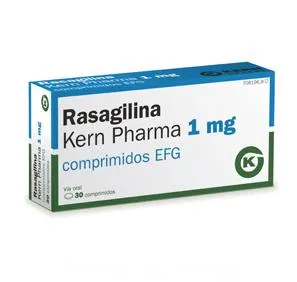
Table of Contents
- Package leaflet: Information for the user
- Introduction
- 1. What Rasagilina Kern Pharma is and what it is used for
- 2. What you need to know before starting to take Rasagilina Kern Pharma
- 3. How to take Rasagilina Kern Pharma
- 4. Possible adverse effects
- 5. Storage of Rasagiline Kern Pharma
- 6. Contents of the pack and other information
Package leaflet: Information for the user
Introduction
Package leaflet: Information for the user
Rasagilina Kern Pharma 1 mg tablets EFG
Read all of this leaflet carefully before you start taking this medicine, because it contains important information for you.
- Keep this leaflet, as you may need to read it again.
- If you have any questions, ask your doctor or pharmacist.
- This medicine has been prescribed for you only and must not be given to other people, even if they have the same symptoms, as it may harm them.
- If you experience any adverse effects, consult your doctor or pharmacist, even if the effects are not listed in this leaflet. See section 4.
Contents of the leaflet:
- What Rasagilina Kern Pharma is and what it is used for
- What you need to know before taking Rasagilina Kern Pharma
- How to take Rasagilina Kern Pharma
- Possible side effects
- How to store Rasagilina Kern Pharma
- Contents of the pack and other information
1. What Rasagilina Kern Pharma is and what it is used for
Rasagilina is indicated for the treatment of Parkinson's disease. It can be used with or without Levodopa (another medicine used to treat Parkinson's disease).
In Parkinson's disease, there is a loss of dopamine-producing cells in the brain.
Dopamine is a chemical substance in the brain involved in the control of movement. Rasagilina helps increase and maintain dopamine levels in the brain.
2. What you need to know before starting to take Rasagilina Kern Pharma
Do not take Rasagilina Kern Pharma
- If you are allergic (hypersensitive) to rasagiline or to any of the other ingredients of this medicine (listed in section 6).
- If you have severe liver problems.
Do not take the following medicines while taking rasagiline:
- Monoamine oxidase inhibitors (MAOIs) (e.g. for the treatment of depression or Parkinson's disease, or for other indications), including prescription-free medicines and natural products, e.g. St. John's wort.
- Pethidine (a strong painkiller).
You must wait at least 14 days after stopping treatment with rasagiline before starting treatment with MAOIs or pethidine.
Warnings and precautions
Talk to your doctor before starting to take this medicine. Inform your doctor if you have or have had any illness or symptoms, especially any of the following:
- Mild to moderate liver problems.
- Any suspicious skin changes.
Children and adolescents
Rasagiline is not recommended for patients under 18 years of age.
Use of other medicines
Inform your doctor or pharmacist if you are taking, have recently taken, or might stop or start taking any other medicines, including those obtained without a prescription, or if you smoke or intend to stop smoking.
Seek medical advice before taking any of the following medicines together with rasagiline:
- Certain antidepressants (selective serotonin reuptake inhibitors, serotonin-noradrenaline reuptake inhibitors, tricyclic or tetracyclic antidepressants).
- The antibiotic ciprofloxacin used for infections.
- The cough suppressant dextromethorphan.
- Sympathomimetics such as those found in eye drops, nasal and oral decongestants, and cold remedies containing ephedrine or pseudoephedrine.
The use of rasagiline together with antidepressants containing fluoxetine or fluvoxamine should be avoided. If you are starting treatment with rasagiline, you must wait at least 5 weeks after stopping treatment with fluoxetine.
If you are starting treatment with fluoxetine or fluvoxamine, you must wait at least 14 days after stopping treatment with rasagiline.
Inform your doctor if you or your family/caregiver notice that you are exhibiting unusual behaviors in which you cannot resist the impulse, urge, or craving to carry out certain harmful or detrimental activities. These are known as impulse control disorders. In patients taking rasagiline or other medicines used to treat Parkinson's disease, behaviors such as compulsions, obsessive thoughts, gambling, excessive spending, impulsive behavior, and abnormally increased sexual urges or increased thoughts or feelings related to sex have been observed. Your doctor may need to adjust or stop your dose.
Taking Rasagilina Kern Pharma with food and drinks
Rasagiline may be taken with or without food.
Pregnancy, breastfeeding, and fertility
If you are pregnant or breastfeeding, think you may be pregnant, or plan to become pregnant, consult your doctor before using this medicine. Your doctor will advise you whether you should continue treatment with rasagiline.
Driving and using machines
No studies on the effects on the ability to drive or use machines have been conducted. Seek medical advice before driving or operating machinery.
3. How to take Rasagilina Kern Pharma
Follow exactly the instructions for use of this medicine as given by your doctor. If in doubt, consult your doctor or pharmacist again.
The usual dose of rasagilina is 1 tablet of 1 mg taken orally once daily.
This medicine may be taken with or without food.
If you take more Rasagilina Kern Pharma than you should
In case of overdose or accidental ingestion, contact your doctor or pharmacist immediately or call the Toxicology Information Service, telephone: 91 562 04 20, stating the medicine and the amount ingested. Take the rasagilina packaging with you to show to the doctor or pharmacist.
If you forget to take Rasagilina Kern Pharma
Do not take a double dose to make up for missed doses. Take the next dose at the usual time.
If you stop taking Rasagilina Kern Pharma
Do not stop taking rasagilina without first consulting your doctor.
If you have any further questions about the use of this medicine, ask your doctor or pharmacist.
4. Possible adverse effects
Like all medicines, this medicine can cause adverse effects, although not everyone experiences them.
The following adverse effects have been reported in placebo-controlled clinical trials:
Very common adverse effects (may affect more than 1 in 10 people):
- Abnormal movements (dyskinesia).
- Headache.
Common adverse effects (may affect up to 1 in 100 people):
- Abdominal pain.
- Falls.
- Allergy.
- Fever.
- Flu-like syndrome (influenza).
- General malaise.
- Neck pain.
- Chest pain (angina pectoris).
- Low blood pressure upon standing, with symptoms such as dizziness/spinning sensation (orthostatic hypotension).
- Decreased appetite.
- Constipation.
- Dry mouth.
- Nausea and vomiting.
- Flatulence.
- Abnormal blood test results (leukopenia).
- Joint pain (arthralgia).
- Musculoskeletal pain.
- Joint inflammation (arthritis).
- Numbness and muscle weakness in the hand (carpal tunnel syndrome).
- Weight loss.
- Abnormal dreams.
- Difficulty with muscle coordination (balance disorder).
- Depression.
- Dizziness (vertigo).
- Prolonged muscle contractions (dystonia).
- Runny nose (rhinitis).
- Skin irritation (dermatitis).
- Rash.
- Redness of the eye (conjunctivitis).
- Urinary urgency.
Uncommon adverse effects (may affect up to 1 in 1,000 people):
- Stroke (cerebrovascular accident).
- Heart attack (myocardial infarction).
- Blistering rash (vesiculobullous rash).
Additionally, in placebo-controlled clinical trials, skin cancer was observed in approximately 1% of patients. However, scientific evidence indicates that Parkinson's disease itself, rather than any specific medication, is associated with an increased risk of skin cancer (not exclusively melanoma). You should speak with your doctor about any suspicious changes in your skin.
Parkinson's disease is associated with symptoms of hallucinations and confusion. In post-marketing experience, these symptoms have also been observed in patients with Parkinson's disease treated with rasagiline.
There have been cases of patients who, while taking one or more medications for the treatment of Parkinson's disease, were unable to resist the impulse, desire, or temptation to perform an action that could be harmful to themselves or others. These are known as impulse control disorders. The following disorders have been observed in patients taking rasagiline or other medicines used to treat Parkinson's disease:
- Obsessive thoughts or impulsive behavior.
- Strong urge to gamble excessively, despite serious personal or family consequences.
- Altered or increased sexual interest and behavior, causing concern to the patient or others, for example increased sex drive.
- Uncontrollable and excessive spending or shopping.
Inform your doctor if you experience any of these behaviors; they will explain how to manage or reduce the symptoms.
Reporting of adverse effects:
If you experience any type of adverse effect, consult your doctor or pharmacist, even if it is an effect not listed in this leaflet. You may also report them directly via the Spanish Pharmacovigilance System for Human Medicines: www.notificaRAM.es. By reporting adverse effects, you can help provide more information on the safety of this medicine.
5. Storage of Rasagiline Kern Pharma
Keep this medicine out of the sight and reach of children.
No special storage conditions are required.
Do not use this medicine after the expiry date stated on the packaging after EXP. The expiry date is the last day of the month indicated.
Medicines must not be disposed of via wastewater or household waste. Dispose of containers and unused medicines at a Pharmacy’s SIGRE Point. If in doubt, ask your pharmacist how to dispose of containers and medicines you no longer need. This will help protect the environment.
6. Contents of the pack and other information
Composition of Rasagilina Kern Pharma
- The active substance is rasagilina. Each tablet contains 1 mg of rasagilina (as tartrate).
- The other components are microcrystalline cellulose (E-460i), corn starch, pregelatinized corn starch, anhydrous colloidal silica, citric acid monohydrate (E-330), stearic acid (E-570), and talc (E-553b).
Appearance of the medicinal product and contents of the pack
This medicine is available as white or almost white, round, biconvex tablets.
The tablets are packed in blister packs containing 30 tablets.
Marketing Authorization Holder
Kern Pharma, S.L.
Venus, 72 - Pol. Ind. Colón II
08228 Terrassa - Barcelona
Spain
Manufacturer
Ferrer Internacional, S.A.
Joan Buscallà, 1-9
08173 Sant Cugat del Vallès - Barcelona
Spain
Date of the most recent revision of this leaflet: October 2015
Detailed and up-to-date information on this medicine is available on the website of the Spanish Agency for Medicines and Health Products (AEMPS) http://www.aemps.gob.es/