Rapiscan 400 mcg solution for injection
Spain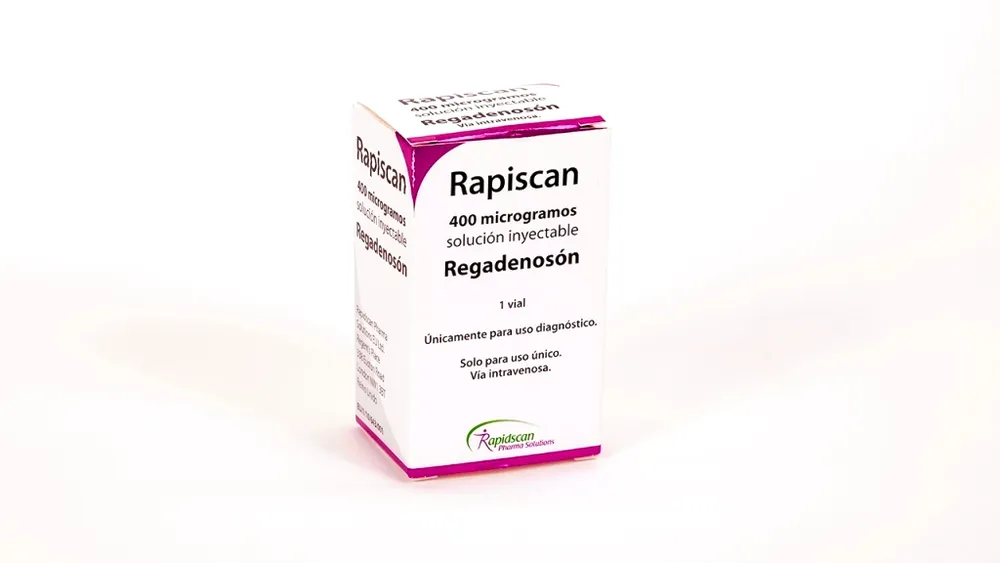
Table of Contents
Package leaflet: Information for the user
Introduction
Package leaflet: information for the user
Rapiscan 400 micrograms solution for injection
Regadenoson
Read all of this leaflet carefully before you are given this medicine, because it contains important information for you.
- Keep this leaflet, as you may need to read it again.
- If you have any questions, ask your doctor or pharmacist.
- If you experience any side effects, talk to your doctor or pharmacist, even if they are not listed in this leaflet. See section 4.
Contents of this leaflet:
- What Rapiscan is and what it is used for
- What you need to know before you are given Rapiscan
- How Rapiscan is administered
- Possible side effects
- How to store Rapiscan
- Contents of the pack and other information
1. What Rapiscan is and what it is used for
Rapiscan contains the active substance regadenoson. It belongs to a group of medicines called “coronary vasodilators”. It causes the coronary arteries to widen and increases the heart rate. This increases blood flow to the heart muscle.
This medicine is for diagnostic use only.
Rapiscan is used during a type of heart scan in adults known as a myocardial perfusion imaging study.
The imaging study uses a radioactive substance called “radiopharmaceutical” to create images. These images show whether blood flow is reaching the heart muscle. Exercise on a treadmill is usually used to stress the heart before the imaging study. During exercise, a small amount of radiopharmaceutical is injected into the body, often into a vein in the hand. Images of the heart are then obtained, allowing the doctor to check whether the heart muscle is receiving adequate blood flow during stress.
If you are unable to exercise sufficiently to achieve an adequate heart rate, Rapiscan will be injected to produce a heart rate increase that similarly enhances blood flow.
Rapiscan is also used during cardiac catheterization and visualization of the heart arteries (invasive coronary angiography) to dilate the coronary arteries and measure the pressure difference caused by a narrowing in one or more arteries. During cardiac catheterization, a long, thin tube called a catheter is inserted through the femoral or radial artery and advanced through the blood vessels to the heart. The physician performing the catheterization may also wish to measure the pressure difference (fractional flow reserve) due to a narrowing identified in one or more coronary arteries.
2. What you need to know before being administered Rapiscan
Do not use Rapiscan
- if you have a slow heart rate (high-grade heart block or sinus node disease) and do not have a pacemaker.
- if you suffer from chest pain that occurs unpredictably (unstable angina) and has not improved after treatment.
- if you have low blood pressure (hypotension).
- if you have heart failure.
- if you are allergic to regadenoson or to any of the other components of this medicine (listed in section 6).
Consult your doctor or nurse before using Rapiscan
Before administering Rapiscan, your doctor needs to know the following:
- if you have recently had any serious heart problems (for example, a myocardial infarction or abnormal heart rhythms).
- if you have a heart rhythm with very fast or irregular beats (atrial fibrillation or atrial flutter).
- if you have uncontrolled high blood pressure, especially if this has been accompanied by recent episodes of nosebleeds, headache, or blurred or double vision.
- if you have had episodes of mini-stroke (called transient ischemic attacks).
- if you have a heart rhythm disorder known as long QT syndrome.
- if you have experienced episodes of heart block (which may slow the heart) or very slow heart rate.
- if you have any heart or blood vessel condition, particularly one that worsens when your blood pressure drops. These conditions include low blood volume (caused, for example, by severe diarrhea, dehydration, or use of diuretic pills), inflammation around the heart (pericarditis), and certain forms of arterial or valvular heart disease (e.g., aortic or mitral stenosis).
- if you suffer from a condition that causes seizures, such as epilepsy, or if you have ever had seizures.
- if you have asthma or a lung disease.
If you have any of the above conditions, inform your doctor before receiving the injection.
Children and adolescents
Rapiscan must not be used in children or adolescents under 18 years of age.
Use of Rapiscan with other medicines
Inform your doctor if you are taking or have recently taken any other medicines, including those obtained without a prescription.
Special caution is required with the following medicines:
- Theophylline, a medicine used to treat asthma and other lung diseases, must not be used for at least 12 hours before receiving Rapiscan, as it may block the effect of Rapiscan.
- Dipyridamole, a medicine used to prevent blood clots, must not be used for at least two days before receiving Rapiscan, as it may alter the effect of Rapiscan.
Use of Rapiscan with food and drink
Do not eat food or drink beverages containing caffeine (e.g., tea, coffee, cocoa, cola, or chocolate) for at least 12 hours before administration of Rapiscan. This is because caffeine may interfere with the effect of Rapiscan.
Pregnancy and breastfeeding
Before receiving Rapiscan, inform your doctor:
- if you are pregnant, think you may be pregnant, or plan to become pregnant. There is insufficient information on the use of Rapiscan in pregnant women. Harmful effects have been observed in animal studies, but it is unknown whether there is a risk in humans. Your doctor will only administer Rapiscan if it is clearly necessary.
- if you are breastfeeding. It is unknown whether Rapiscan passes into breast milk, and you will only be administered the medicine if your doctor considers it necessary. You should avoid breastfeeding for at least 10 hours after administration of Rapiscan.
Consult your doctor before using any medicine.
Driving and using machines
Rapiscan may cause dizziness. It may cause other symptoms (such as headache or difficulty breathing) that could affect your ability to drive or operate machinery. These effects usually do not last longer than 30 minutes. Do not drive or operate machinery until these effects have subsided.
Rapiscan contains sodium
This medicine contains less than 1 mmol of sodium (23 mg) per dose. After Rapiscan has been administered, you will receive an injection of sodium chloride solution at a concentration of 9 mg/ml (0.9%), which contains 45 mg of sodium. This should be taken into account if you are on a low-sodium diet.
3. How Rapiscan is administered
Rapiscan is administered by a healthcare professional (a doctor, nurse, or medical technician) at a medical facility where heart and blood pressure monitoring can be performed. It is injected directly into a vein as a single dose of 400 micrograms in a 5 ml solution; the injection will take approximately 10 seconds to complete. The injected dose does not depend on your body weight.
You will also receive an injection of sodium chloride solution at a concentration of 9 mg/ml (0.9%) (5 ml) and an injection of a small amount of a radioactive substance (radiopharmaceutical).
When you are given Rapiscan, your heart rate will increase rapidly. Your heart rate and blood pressure will be monitored.
After the Rapiscan injection, you must remain sitting or lying down until your heart rate and blood pressure return to normal levels. Your doctor, nurse, or medical technician will inform you when it is safe to stand up.
A cardiac imaging study will be performed once sufficient time has elapsed for the radiopharmaceutical to reach the heart muscle.
During cardiac artery catheterization, your doctor may measure the pressure difference (also known as fractional flow reserve - FFR) caused by a narrowing in one or more of the heart's arteries.
If necessary, a second dose of 400 micrograms may be administered at least 10 minutes after the first dose to measure the pressure difference during the same catheterization procedure. Heart rate and blood pressure will be monitored throughout the procedure.
If you are given more Rapiscan than you should
Some individuals have experienced flushing, dizziness, and increased heart rate when given an overdose of Rapiscan. If your doctor considers that you are experiencing serious adverse effects or if the effects of Rapiscan are lasting too long, you may be given an injection of a medicine called aminophylline, which reduces these effects.
4. Possible adverse effects
Like all medicines, Rapiscan may cause adverse effects, although not everyone experiences them.
Adverse effects are usually mild. They typically begin shortly after receiving the Rapiscan injection and usually resolve within 30 minutes. They generally do not require any treatment.
Among the more serious adverse effects are:
- sudden cardiac arrest or heart damage, heart block (an electrical conduction disorder of the heart in which the signal cannot pass from the upper chambers to the lower chambers of the heart), rapid heartbeat
- low blood pressure, which may lead to fainting or mini-stroke (including facial weakness or inability to speak). Rarely, Rapiscan may cause a stroke (also known as cerebrovascular accident).
- an allergic reaction may occur immediately or later after the injection of Rapiscan, which may cause skin rash, hives, swelling under the skin near the eyes or throat, throat tightness, and difficulty breathing.
Inform your doctor immediately if you think you are experiencing serious adverse effects. Your doctor may then administer an injection of a medicine called aminophylline, which reduces these effects.
Very common adverse effects
(affects more than 1 in 10 people)
- headache, dizziness
- difficulty breathing
- chest pain
- changes in heart monitoring tests (electrocardiogram)
- flushing
- stomach discomfort
Common adverse effects
(affects between 1 and 10 in 100 people)
- heart pain (angina), abnormal heart rhythms, rapid heartbeat, sensation of skipped heartbeat, fluttering or pounding heartbeat too hard or too fast (palpitations)
- low blood pressure
- throat tightness, throat irritation, cough
- vomiting, nausea
- feeling unwell or weak
- excessive sweating
- back, arm, leg, neck, or jaw pain
- bone and muscle discomfort
- tingling, decreased sensitivity, taste changes
- mouth discomfort
Uncommon adverse effects
(affects between 1 and 10 in 1,000 people)
- sudden cardiac arrest or heart damage, heart block (an electrical conduction disorder of the heart in which the signal cannot pass from the upper chambers to the lower chambers of the heart), slow heartbeat
- seizures, fainting, mini-stroke (including facial weakness or inability to speak), reduced responsiveness (which may include a comatose state), tremor, drowsiness
- an allergic reaction that may cause skin rash, hives, swelling under the skin near the eyes or throat, throat tightness, difficulty breathing
- a whistling sound when breathing (wheezing)
- rapid breathing
- high blood pressure, paleness, cold extremities
- blurred vision, eye pain
- anxiety, difficulty sleeping
- ringing in the ears
- swelling, diarrhea, involuntary loss of faeces
- skin redness
- joint pain
- pain or discomfort around the injection site, body pain
Adverse effects with unknown frequency
(cannot be estimated from available data)
- difficulty breathing (bronchospasm)
- respiratory arrest
Reporting of adverse effects
If you experience any type of adverse effect, talk to your doctor or nurse, even if it is a possible adverse effect not listed in this leaflet. You may also report them directly through the national reporting system listed in Annex V. By reporting adverse effects, you can help provide more information on the safety of this medicine.
5. Storage of Rapiscan
Keep out of the sight and reach of children.
Do not use Rapiscan after the expiry date stated on the vial and on the outer packaging following EXP/CAD.
This medicine does not require any special storage conditions.
Rapiscan must not be used if the solution shows any change in colour or contains solid particles.
Medicines should not be disposed of via wastewater or household waste. Doing so helps protect the environment. Healthcare professionals are responsible for the storage and disposal of this medicine.
6. Pack contents and other information
Composition of Rapiscan
The active substance in Rapiscan is regadenoson. Each 5 ml vial of Rapiscan contains 400 micrograms of regadenoson.
The other components are: disodium edetate, disodium phosphate dihydrate, sodium dihydrogen phosphate monohydrate, propylene glycol, water for injections.
Presentation of the product and contents of the pack
Rapiscan injection solution is a clear, colourless solution free from visible particles. Rapiscan is supplied in a pack containing a single-use 5 ml glass vial with a rubber stopper and aluminium cap.
Marketing Authorisation Holder
GE Healthcare AS
Nycoveien 1
NO-0485 Oslo
Norway
Manufacturer
AndersonBrecon (UK) Limited
Wye Valley Business Park
Hay-on-Wye, Hereford
HR3 5PG
United Kingdom
Millmount Healthcare Limited
Block 7, City North Business Campus
Stamullen, Co Meath, K32 YD60
Ireland
Date of the most recent approval of this package leaflet MM/YYYY
Other sources of information
Detailed information on this medicine is available on the European Medicines Agency website: http://www.ema.europa.eu.
This package leaflet is available on the European Medicines Agency website in all languages of the European Union/European Economic Area.
This information is intended for healthcare professionals only:
Rapiscan must be administered as a rapid 10-second intravenous injection into a peripheral vein using a 22-gauge or larger catheter or needle.
Immediately after injection of Rapiscan, 5 ml of 9 mg/ml (0.9%) sodium chloride injection solution should be administered.
The radiopharmaceutical for myocardial perfusion imaging should be administered 10–20 seconds after the 9 mg/ml (0.9%) sodium chloride injection solution. The radiopharmaceutical may be injected directly into the same catheter used for Rapiscan administration.
For FFR measurement, Rapiscan must be administered as a rapid 10-second intravenous injection into a peripheral vein using a 22-gauge or larger catheter or needle. Immediately after injection of Rapiscan, 10 ml of 9 mg/ml (0.9%) sodium chloride injection solution should be administered. Standard catheterisation and FFR measurement techniques should be followed, and FFR should be measured as the lowest Pd/Pa value achieved during steady-state maximal hyperaemia.
If considered necessary, a second dose of 400 micrograms may be administered at least 10 minutes after the first dose to measure FFR during the same catheterisation procedure.
In the absence of compatibility studies, this medicinal product must not be mixed with other medicinal products.
Prior to administration, this medicinal product should be inspected visually for the presence of particulate matter or colour changes.
Any unused medicine and waste materials that have come into contact with the medicine should be disposed of in accordance with local regulations.
For more information, please refer to the Summary of Product Characteristics or the full SmPC.