Qutenza 179 mg cutaneous patch
Spain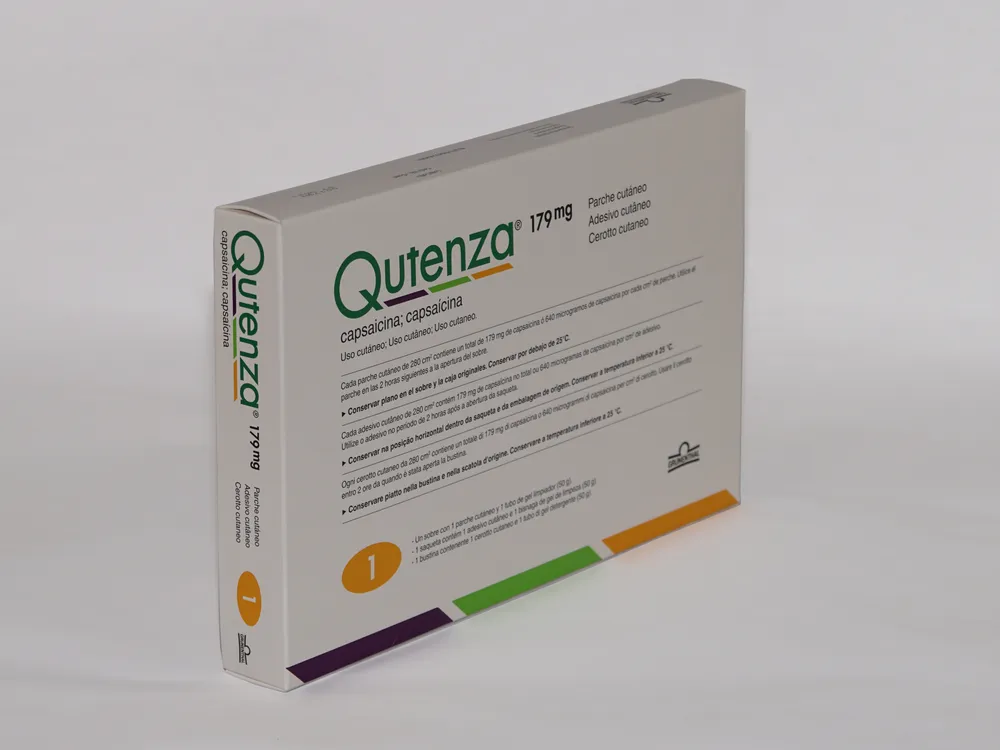
Table of Contents
Package leaflet: Information for the user
Introduction
Package leaflet: information for the user
Qutenza 179mg cutaneous patch
capsaicin
Read all of this leaflet carefully before you start using this medicine, because it contains important information for you.
- Keep this leaflet. You may need to read it again.
- If you have any questions, ask your doctor.
- This medicine has been prescribed for you only, and you should not give it to other people, even if they have the same symptoms as you, because it may harm them.
- If you experience any adverse effects, consult your doctor, even if they are adverse effects not listed in this leaflet. See section 4.
Contents of the leaflet:
- What Qutenza is and what it is used for
- What you need to know before using Qutenza
- How to use Qutenza
- Possible side effects
- How to store Qutenza
- Contents of the pack and other information
1. What Qutenza is and what it is used for
Qutenza is a patch containing capsaicin and belongs to a group of medicines called anaesthetics.
Qutenza is indicated for the treatment of peripheral neuropathic pain in adults, alone or in combination with other pain medications.
Qutenza is used to relieve pain in people who have neuropathic pain due to nerve damage in the skin. Skin nerves may be damaged as a result of various conditions, such as shingles, HIV infection, diabetes, certain medicines, and other disorders. When the patch is applied to the affected area, capsaicin penetrates the skin. It helps calm damaged nerves by causing them to retract. Over time, these nerves slowly heal and regrow. You may notice pain relief between week 1 and 3 after treatment.
You may feel better after the first treatment, or you may need several Qutenza treatments before noticing any improvement.
Pain sensations may be described as heat, burning, throbbing, shooting, stabbing, sharp, paresthetic, dull, or tingling pain. Peripheral neuropathic pain may also be associated with mood changes, sleep disturbances, fatigue (tiredness), and may impact physical and social activities, as well as overall quality of life.
2. What you need to know before using Qutenza
Do not use Qutenza
- if you are allergic to capsaicin (also found in chili peppers) or to any of the other ingredients of this medicine (listed in section 6).
Warnings and precautions
Talk to your doctor before starting to use Qutenza.
Do not use Qutenza on any part of the head or face.
Do not use Qutenza on damaged skin or open wounds.
Do not touch Qutenza or other materials that have been in contact with treated areas, as this may cause burning and stinging. Avoid touching your eyes, mouth, or other sensitive areas, as this may cause irritation and pain. If this happens, rinse or flush with cold water. Inhaling or breathing near Qutenza patches may cause coughing, throat irritation, or sneezing.
It is common for the skin to sting, become red, or burn during treatment with Qutenza and for a short period afterward. Due to pain, your blood pressure may increase, so your doctor will monitor your blood pressure several times during treatment. If you experience significant pain, your doctor may apply local cooling or give you a pain-relieving medication. If you experience severe pain, consult your doctor to have the patch removed.
Mild, temporary changes in the ability to sense whether an object is hot or sharp have generally been observed after using capsaicin.
If you have unstable or poorly controlled hypertension or a history of heart problems, your doctor will assess, before treating you with Qutenza, the risk of cardiovascular adverse effects or blood pressure changes due to the potential stress caused by the procedure.
Children and adolescents
Qutenza is not recommended for use in patients under 18 years of age.
Other medicines and Qutenza
Tell your doctor if you are taking, have recently taken, or might need to take any other medicines. Qutenza acts locally on the skin, and it is not expected to affect other medicines.
Pregnancy and breastfeeding
Qutenza should be used with caution if you are pregnant. Breastfeeding must be discontinued before starting treatment with Qutenza. If you are pregnant or breastfeeding, think you may be pregnant, or plan to become pregnant, consult your doctor before using this medicine.
Driving and using machines
No studies have been conducted on the effects of Qutenza on the ability to drive or operate machinery. Only very small amounts of the active ingredient are detected in the blood after using Qutenza, and only for a short time. Therefore, it is unlikely that Qutenza will have direct effects on your ability to concentrate or to drive or operate machinery.
The Qutenza cleaning gel contains butyl hydroxyanisole
The Qutenza cleaning gel may cause local skin reactions (such as contact dermatitis) or irritation of the eyes and mucous membranes because it contains butyl hydroxyanisole.
3. How to use Qutenza
Only your doctor or healthcare professional under their supervision may apply Qutenza.
No more than 4 patches may be used at the same time.
Qutenza is applied to the skin.
Your doctor or healthcare professional will mark the most affected areas of your skin with a pen or marker.
Before applying the Qutenza patches to your skin, the treatment area(s) must be washed with water and soap and thoroughly dried. Hair will be trimmed from the areas to be treated.
Before placing the Qutenza patch on your skin, your doctor or healthcare professional may apply an anesthetic gel or cream, or give you an oral pain medication to reduce possible burning. The gel or cream must be removed prior to Qutenza application, and the skin must be completely washed and dried.
Your doctor or healthcare professional may wear gloves, and sometimes a mask and protective goggles, when handling Qutenza patches. Do not breathe or inhale near the Qutenza patches, as this may cause coughing or sneezing.
Qutenza may be cut into smaller pieces to fit the treatment area. Your doctor or healthcare professional will remove the patches after 30 minutes if you are being treated for neurological pain in the feet, or after 60 minutes if the treatment is applied to other parts of the body.
It may take between 1 and 3 weeks before you notice pain relief with Qutenza. You may feel better after the first treatment, or you may need several Qutenza treatments before noticing any improvement.
If necessary, Qutenza treatment may be repeated at intervals of 90 days. If you experience insufficient pain relief or if pain returns earlier, consult your doctor. Your doctor may recommend starting treatment earlier (but with a minimum interval of 60 days).
You may receive painkillers to manage pain associated with Qutenza treatment.
It is common for the skin to burn, become red, or sting during Qutenza treatment.
If treatment is applied to the feet, you may wear disposable socks over the Qutenza patches.
Your doctor or healthcare professional may place a dressing over the Qutenza patch to secure it firmly against the skin.
Do not attempt to remove the patch yourself. Your doctor or healthcare professional will remove it.
At the end of Qutenza treatment, your doctor or healthcare professional will clean the treated area with the cleansing gel contained in a tube provided in the kit. The cleansing gel should remain on the skin for one minute and then be removed to eliminate any residual medication remaining on the skin after treatment. After removing the cleansing gel, the area will be gently washed with water and soap.
Do not touch the patch with your hands.
Do not touch your eyes, mouth, or other sensitive areas. If you accidentally touch the Qutenza patch or the treated skin before application of the cleansing gel, you may experience burning or stinging. Contact your doctor immediately.
Do not take the Qutenza patches out of the clinic.
Do not use Qutenza patches at home.
If you use Qutenza for longer than you should
An overdose is unlikely. However, if Qutenza is applied for longer than recommended, you may experience severe reactions at the application site such as pain, redness, and itching.
If you have any further questions about the use of this product, ask your doctor or pharmacist.
4. Possible adverse effects
Like all medicines, this medicine can cause adverse effects, although not everyone experiences them.
If you experience any of the following effects, consult your doctor immediately:
-
If you feel your heart beating very fast, very slowly, or irregularly.
-
Uncommon: may affect up to 1 in 100 people
-
Intense redness in the area where the patch is applied, blistering or oozing of the skin, skin becoming very painful to the touch, swollen, wet, or shiny. In a small number of cases, these may be signs of a burn requiring urgent medical attention.
-
Frequency not known: frequency cannot be estimated from the available data
Consult your doctor if any of the following adverse effects occur or worsen:
Very common: may affect more than 1 in 10 people
- Redness or pain at the site of patch application lasting for more than one day.
Common: may affect up to 1 in 10 people
- Itching, lumps, blisters, swelling, dryness at the site of patch application.
- Burning sensation, hypertension, cough, nausea, itching, pain in the limbs, muscle spasms, swelling of the limbs.
Uncommon: may affect up to 1 in 100 people
- Hives, tingling, inflammation, increased or decreased skin sensitivity, skin reaction, irritation, bruising at the site of patch application.
- Reduced sense of taste, decreased sensitivity in the limbs, eye irritation, throat irritation, herpes zoster.
Frequency not known: frequency cannot be estimated from the available data
- Accidental exposure (including eye pain, eye irritation, throat irritation, and cough).
If you experience any type of adverse effect, consult your doctor, even if it is a possible adverse effect not listed in this leaflet. You may also report them directly through the national reporting system included in Appendix V. By reporting adverse effects, you can help provide more information on the safety of this medicine.
5. Storage of Qutenza
Keep this medicine out of the sight and reach of children.
Do not use this medicine after the expiry date stated on the packaging after EXP. The expiry date refers to the last day of the month indicated.
Qutenza cutaneous patch: Store flat in the original sachet and carton. Store below 25°C.
Cleaning gel: Store below 25°C.
After opening the sachet, Qutenza must be applied within two hours.
Disposal of used and unused Qutenza patches.
If you touch these components, you may experience a stinging sensation in your fingers. Your doctor or healthcare professional will place them in a polyethylene bag and dispose of them safely. Used Qutenza patches and treatment-related materials must be appropriately discarded.
6. Contents of the pack and other information
Composition of Qutenza
The active substance is capsaicin. Each 280 cm² patch contains a total of 179 mg of capsaicin or 640 micrograms of capsaicin per cm² of patch (8% w/w).
The other components of the Qutenza transdermal patch are:
Matrix:
silicone adhesives
diethylene glycol monoethyl ether
silicone oil
ethylcellulose N50 (E462)
Reinforcement layer:
polyethylene terephthalate (PET) film, with silicone-coated inner side
printing ink containing pigment White 6
Removable protective liner (protective liner)
polyester film, with fluoropolymer coating
Qutenza is supplied with a tube of cleansing gel which does not contain any active substance.
The cleansing gel contains:
macrogol 300
carbomer
purified water
sodium hydroxide (E524)
disodium edetate
butyl hydroxyanisole (E320)
What Qutenza looks like and contents of the pack
Qutenza is a transdermal patch applied to the skin.
Each patch measures 14 cm x 20 cm (280 cm²) and consists of an adhesive side containing the active substance and an external reinforcement layer. The adhesive side is covered by a transparent, unprinted, diagonally cut protective liner which is removed prior to application. The outer surface of the reinforcement layer is printed with "capsaicin 8%".
Each Qutenza carton contains 1 or 2 pouches and 1 tube of cleansing gel (50 g). Only certain pack sizes may be marketed.
Marketing Authorisation Holder and Manufacturer
Grünenthal GmbH
Zieglerstraße 6
52078 Aachen
Germany
Date of the most recent revision of this leaflet:
Other sources of information
Detailed information on this medicinal product is available on the website of the European Medicines Agency: http://www.ema.europa.eu, and on the website of the Spanish Agency of Medicines and Medical Devices (AEMPS): http://www.aemps.gob.es/.