Qinlock 50 mg tablets
Spain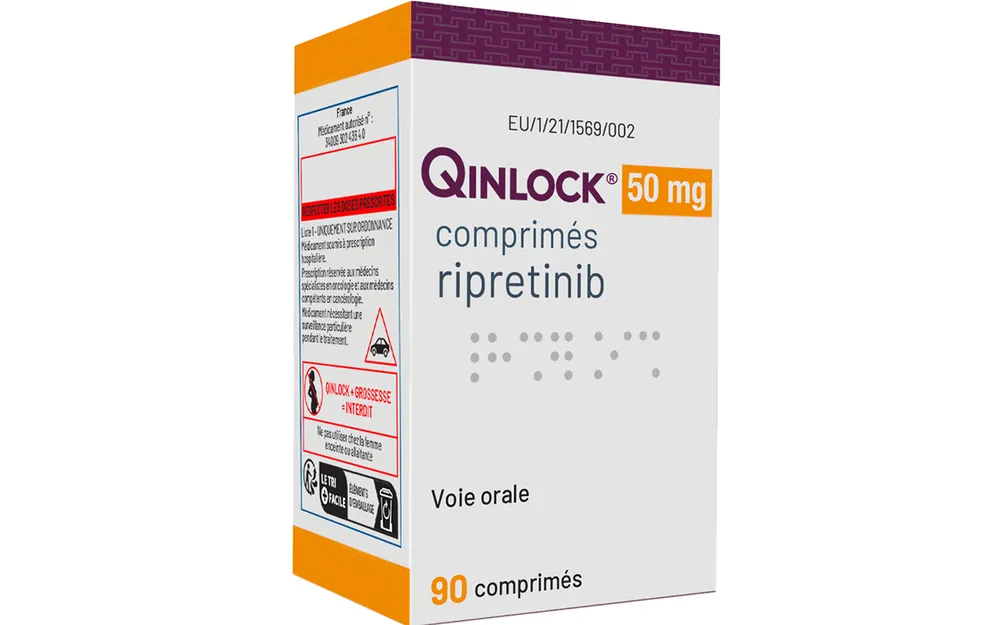
Table of Contents
Package leaflet: Information for the user
Introduction
Package leaflet: information for the user
QINLOCK 50 mg tablets
ripretinib
This medicine is subject to additional monitoring, which will allow quicker identification of new safety information. You can help by reporting any adverse reactions you may experience. The end of section 4 includes information on how to report these adverse reactions.
Read the entire leaflet carefully before you start taking this medicine, as it contains important information for you.
- Keep this leaflet, as you may need to read it again.
- If you have any questions, ask your doctor or pharmacist.
- This medicine has been prescribed for you only and must not be given to other people, even if they have the same symptoms as you, because it could harm them.
- If you experience any adverse reactions, consult your doctor or pharmacist, even if these adverse reactions are not listed in this leaflet. See section 4.
Contents of the leaflet
- What QINLOCK is and what it is used for
- What you need to know before taking QINLOCK
- How to take QINLOCK
- Possible adverse effects
- How to store QINLOCK
- Contents of the pack and other information
1. What QINLOCK is and what it is used for
QINLOCK is an anticancer medicine that contains the active substance ripretinib, a protein kinase inhibitor. Protein kinase inhibitors are used to treat cancer by blocking the activity of certain proteins involved in the growth and spread of cancer cells.
QINLOCK is used to treat adults with gastrointestinal stromal tumour (GIST), a rare cancer of the digestive system including the stomach and intestine, which:
- has spread to other parts of the body or cannot be removed by surgery;
- has been previously treated with at least three anticancer medicines, including imatinib.
If you have any questions about how QINLOCK works or why this medicine has been prescribed for you, please consult your doctor.
2. What you need to know before taking QINLOCK
Do not take QINLOCK if you are allergic to ripretinib or to any of the other ingredients of this medicine (listed in section 6).
Warnings and precautions
Before taking QINLOCK, consult your doctor or pharmacist if you have or have had:
-
High blood pressure. Your doctor will monitor your blood pressure before and during treatment with QINLOCK and may prescribe medication to treat hypertension if necessary.
-
Heart problems. Your doctor may perform additional tests to assess your heart function before and during treatment with QINLOCK.
-
Liver or kidney problems.
While taking QINLOCK, consult your doctor or pharmacist in the following cases:
-
If you notice redness, pain, swelling, or blisters on the palms of your hands or the soles of your feet. This is a skin condition known as hand-foot skin reaction (palmar-plantar erythrodysesthesia syndrome, PPES). Your doctor may continue treatment, adjust the dose, or interrupt treatment until your condition improves (see section 4).
-
If you observe unexpected changes in your skin, such as a new wart, an open sore, a red bump that bleeds or does not heal, or a change in the size or color of a mole. QINLOCK may increase the risk of certain types of skin cancer (see section 4). Your doctor will examine your skin when starting treatment with QINLOCK and routinely during treatment. It is important that your skin is regularly checked.
-
If you have surgical wounds from recent surgery that are not healing as expected. QINLOCK may affect wound healing. Your doctor may decide to temporarily interrupt QINLOCK treatment a few days before surgery and delay restarting until the wound has healed after surgery. Your doctor will determine when to resume QINLOCK treatment. It is important that you inform your doctor if you have any planned surgical procedures in the future.
-
If you feel tired, short of breath, notice prominent neck veins, or have swelling in the abdomen, ankles, or calves while taking QINLOCK; these may be symptoms of heart failure (see section 4).
-
If your skin or eyes become more sensitive to sunlight or other forms of light. Avoid direct sunlight, sunlamps, and other sources of ultraviolet radiation while taking this medicine. Wear protective clothing and apply sunscreen with a high protection factor when exposed to strong sunlight.
Important information for men and women regarding contraception
QINLOCK may harm the unborn baby. Do not become pregnant while taking QINLOCK. Use an effective method of contraception during treatment and for at least 1 week after the last dose of QINLOCK if you are a woman of childbearing potential or a man with a female partner of childbearing potential. If you use hormonal contraceptives, add a barrier method (such as condoms). See section on "Contraception, pregnancy, breastfeeding and fertility."
Children and adolescents
Do not administer this medicine to children and adolescents under 18 years of age, as its use has not been studied in this age group.
Other medicines and QINLOCK
Inform your doctor or pharmacist if you are taking, have recently taken, or might need to take any other medicines.
QINLOCK may affect how some medicines work. In addition, some medicines may affect how QINLOCK works.
In particular, inform your doctor if you are taking any of the following medicines:
- Medicines used to treat fungal infections (such as ketoconazole, itraconazole, posaconazole, or voriconazole)
- Medicines used to treat bacterial infections (such as erythromycin, clarithromycin, or rifampicin)
- Medicines used to treat HIV (such as ritonavir, efavirenz, etravirine, bictegravir, cabotegravir, dolutegravir, raltegravir)
- Medicines used for epilepsy or seizures (such as phenytoin, carbamazepine, phenobarbital, lamotrigine)
- Medicines used to treat irregular heartbeats (such as digoxin)
- Medicines used to prevent stroke or harmful blood clots (such as dabigatran etexilate)
- Medicines used to lower high cholesterol (such as rosuvastatin)
- Medicines used to lower blood glucose or treat diabetes (such as repaglinide or metformin)
- Medicines used to treat rheumatoid arthritis and severe intestinal inflammation (such as sulfasalazine)
- Medicines used to treat cancer (such as paclitaxel or irinotecan)
- Medicines used to prevent organ rejection (such as cyclosporine and tacrolimus)
- Medicines used to treat low platelet counts in the blood (such as eltrombopag)
- Medicines used to treat muscle spasms (such as tizanidine)
- Medicines used to relieve anxiety before procedures (such as midazolam)
- Herbal preparations used to treat depression and anxiety containing St. John's wort (Hypericum perforatum)
QINLOCK with food and drink
Grapefruit juice may alter the amount of QINLOCK in your body. It is not recommended to drink grapefruit juice or eat grapefruit during treatment with this medicine.
Contraception, pregnancy, breastfeeding and fertility
Contraception
Both women of childbearing potential and men should use effective contraceptive methods during treatment and for at least 1 week after stopping treatment. If using a hormonal contraceptive method, a barrier method (such as condoms) should be added.
Pregnancy
If you are pregnant, think you may be pregnant, or plan to become pregnant, you should not take this medicine unless your doctor has decided that treatment with QINLOCK is clearly necessary. Consult your doctor or pharmacist before starting this medicine.
Do not become pregnant while receiving treatment with QINLOCK.
If you are a male patient with a partner who is pregnant or could become pregnant, you must use a barrier method (such as condoms) during sexual intercourse during treatment and for at least 1 week after stopping treatment. This medicine may harm the unborn baby.
If you are a man and your female partner becomes pregnant during treatment with QINLOCK, inform your doctor immediately.
Women of childbearing potential should have pregnancy tests performed before starting and during treatment with QINLOCK.
Breastfeeding
Do not breastfeed during treatment with QINLOCK or for at least 1 week after stopping treatment, as this medicine may cause serious adverse effects in your child. Inform your doctor if you are breastfeeding or plan to breastfeed.
Fertility
QINLOCK may affect fertility in men and women. Consult your doctor before starting QINLOCK.
Driving and using machines
QINLOCK does not directly affect your ability to drive or operate machinery. However, if you feel unwell or very tired while receiving QINLOCK treatment, you should not drive or use machines until you feel well enough to do so safely.
QINLOCK contains lactose
If your doctor has informed you that you have an intolerance to certain sugars, consult with them before taking this medicine.
3. How to take QINLOCK
QINLOCK will be prescribed by a doctor experienced in the use of cancer treatments.
Follow exactly the instructions given by your doctor for taking this medicine. If in doubt, consult your doctor or pharmacist again.
The recommended daily dose is three 50 mg tablets (150 mg) once daily. Take the tablets at the same time each day, with or without food. Swallow the tablets whole with a glass of water; do not chew, split, or crush them. Do not take any tablet that is broken, cracked, or otherwise damaged, as the effects of taking a non-intact tablet are unknown.
If you need to take other medicines at the same time as QINLOCK, your doctor may change your dose to three 50 mg tablets (150 mg) twice daily.
Generally, you will continue taking QINLOCK for as long as you benefit from it and do not experience unacceptable side effects (see section 4); however, your doctor may reduce the dose or decide to interrupt or permanently discontinue treatment if necessary.
If you have kidney or severe liver problems
While being treated with QINLOCK, your doctor will monitor your kidney or liver function more closely.
If you take more QINLOCK than you should
If you have accidentally taken an excessive number of tablets, seek urgent medical advice.
If you forget to take QINLOCK
What you should do if you forget to take this medicine depends on when you remember the missed dose. If:
- less than 8 hours have passed (less than 4 hours for doses of 150 mg twice daily) since the scheduled time, take the missed dose as soon as you remember. Then take the next dose at the usual time.
- more than 8 hours have passed (more than 4 hours for doses of 150 mg twice daily) since the scheduled time, skip the missed dose. Then take the next dose at the usual time.
Do not take a double dose to make up for missed doses.
If you vomit after taking QINLOCK
If you vomit after taking this medicine, do not take an additional dose; continue as usual. Take your next dose of tablets the following day at the usual time and inform your doctor if you have vomited.
If you have any further questions about the use of this medicine, ask your doctor.
4. Possible adverse effects
Like all medicines, this medicine can cause adverse effects, although not everyone will experience them.
Serious adverse effects
Seek urgent medical advice if you experience any of the following serious adverse effects (see section 2):
- Skin problems (known as PPE)
Palmar-plantar erythrodysesthesia syndrome (PPE) is a very common adverse effect when taking this medicine. If you develop:
- redness, pain, swelling, or blisters on the palms of your hands or the soles of your feet,
your doctor may continue treatment, adjust the dose, or interrupt treatment until your condition improves.
- Hypertension
Hypertension is a very common adverse effect when taking this medicine. If you develop:
- headache, dizziness, or a feeling of dizziness, which may be symptoms of hypertension,
your doctor may adjust your dose or interrupt treatment until your condition improves.
- Heart problems (heart failure)
Heart failure is a common adverse effect when taking this medicine. If:
- you feel very tired, are short of breath, and have swollen feet or ankles, these may be symptoms of heart problems.
Consult your doctor or pharmacist if you have:
- Skin cancer
Treatment with QINLOCK may cause certain types of skin cancer, such as "cutaneous squamous cell carcinoma" and "melanoma". Inform your doctor if you notice unexpected changes in your skin during treatment, such as a new wart, an open sore, or a reddish bump that bleeds or does not heal, or a change in the size or color of a mole. Your doctor will examine your skin when you start treatment with QINLOCK and routinely during treatment (see section 2).
Very common adverse effects (may affect more than 1 in 10 people):
- nausea
- constipation
- diarrhea
- vomiting
- joint pain
- headache
- dyspnea
- blood tests showing increased levels of bilirubin, a substance produced by the liver
- blood tests showing increased levels of lipase, an enzyme involved in digestion
- blood tests showing decreased levels of phosphate
- fatigue
- hair loss
- muscle pain or tenderness
- weight loss
- muscle spasms
- dry skin
- back pain
- cough
- swelling of the hands and calves
- pain in hands or feet
- itching
- non-cancerous skin lesions
Common adverse effects (may affect up to 1 in 10 people):
- mouth sores
- stomach (abdominal) pain
- peripheral nerve damage (numbness and tingling in hands and feet, burning, stabbing, or shooting pain in affected areas, loss of balance and coordination, and muscle weakness, especially in the feet)
- skin reactions such as skin peeling and inflammation, rash characterized by a flat, red area of skin covered with small bumps or acne-like eruptions
- abnormal results in liver function tests (possible liver injury indicated by blood tests)
- depression
- underactive thyroid gland
- weakness
- chest pain
- rapid heart rate
Reporting of adverse effects
If you experience any type of adverse effect, consult your doctor or pharmacist, even if it is an effect not listed in this leaflet. You may also report them directly through the national reporting system included in Appendix V. By reporting adverse effects, you can help provide more information on the safety of this medicine.
5. Storage of QINLOCK
Keep this medicine out of sight and reach of children.
Do not use this medicine after the expiry date stated on the carton and on the label of the vial, after EXP. The expiry date refers to the last day of the month indicated.
This medicine does not require any special storage temperature.
Store in the original packaging and keep the vial tightly closed to protect it from light and moisture.
Do not use this medicine if you notice that the packaging is damaged or shows signs of tampering.
Medicines must not be disposed of via wastewater or household waste. Ask your pharmacist how to dispose of medicines and packaging that you no longer need. This will help protect the environment.
6. Package contents and other information
Composition of QINLOCK
- The active substance is ripretinib. Each tablet contains 50 mg of ripretinib.
- The other components are crospovidone (E1202), hypromellose acetate succinate, lactose monohydrate, magnesium stearate (E470b), microcrystalline cellulose (E460), and colloidal hydrated silica (E551) (see section 2, "QINLOCK contains lactose").
Appearance of the product and contents of the container
QINLOCK tablets are white to off-white, oval-shaped, and marked with the inscription "DC1" on one side.
Each child-resistant bottle contains 30 or 90 tablets and a desiccant. The bottles are sealed with an aluminum/polyethylene (PE) safety seal. The desicc combustible is a moisture-absorbing material contained in a small container to protect the tablets from moisture. Always keep the desiccant inside the bottle and do not ingest it.
Only certain pack sizes may be marketed.
Marketing Authorization Holder
Deciphera Pharmaceuticals (Netherlands) B.V.
Atrium Building, 4th Floor
Strawinskylaan 3051
1077ZX, Amsterdam
The Netherlands
Manufacturer responsible for manufacturing
Deciphera Pharmaceuticals (Netherlands) B.V.
Atrium Building, 4th Floor
Strawinskylaan 3051
1077ZX, Amsterdam
The Netherlands
For further information about this medicinal product, please contact the Marketing Authorization Holder:
Belgium/Belgium/Belgium Deciphera Pharmaceuticals (Netherlands) B.V. Tel/Tel: +31 8006333435 | Lithuania Genesis Pharma (Cyprus) Ltd Tel: +357 22765715 |
| Luxembourg/Luxembourg Deciphera Pharmaceuticals (Netherlands) B.V. Tel/Tel: +31 8006333435 |
Czech Republic Genesis Biopharma Czech Republic S.R.O. Tel: +357 22765715 | Hungary Genesis Biopharma Hungary kft Tel.: +357 22765715 |
Denmark Deciphera Pharmaceuticals (Netherlands) B.V. Tlf.: +31 8006333435 | Malta Genesis Pharma (Cyprus) Ltd Tel: +357 22765715 |
Germany Deciphera Pharmaceuticals (Netherlands) B.V. Tel: +31 8006333435 | Netherlands Deciphera Pharmaceuticals (Netherlands) B.V. Tel: +31 8006333435 |
Estonia Genesis Pharma (Cyprus) Ltd Tel: +357 22765715 | Norway Deciphera Pharmaceuticals (Netherlands) B.V. Tlf: +31 8006333435 |
Greece GENESIS PHARMA S.A. Tel: +30 210 87 71 500 | Austria Deciphera Pharmaceuticals (Netherlands) B.V. Tel: +31 8006333435 |
Spain Deciphera Pharmaceuticals (Netherlands) B.V. Tel: +31 8006333435 | Poland Genesis Biopharma Poland sp. z o.o. Tel.: +357 22765715 |
France Deciphera Pharmaceuticals (Netherlands) B.V. Tel: +31 8006333435 | Portugal Deciphera Pharmaceuticals (Netherlands) B.V. Tel: +31 8006333435 |
Croatia Genesis Pharma Adriatic d.o.o Tel: +385 1 5530 011 Ireland Deciphera Pharmaceuticals (Netherlands) B.V. Tel: +31 8006333435 | Romania Genesis Biopharma Romania SRL Tel: +40 21 403 4074 Slovenia Genesis Biopharma SL d.o.o. Tel: +386 1 292 70 90 |
Iceland Deciphera Pharmaceuticals (Netherlands) B.V. Tel: +31 8006333435 | Slovakia Genesis Biopharma Slovakia S.R.O. Tel: +357 22765715 |
Italy Deciphera Pharmaceuticals (Netherlands) B.V. Tel: +31 8006333435 | Finland/Finland Deciphera Pharmaceuticals (Netherlands) B.V. Tel/Puh: +31 8006333435 |
Cyprus Genesis Pharma (Cyprus) Ltd Tel: +357 22765715 | Sweden Deciphera Pharmaceuticals (Netherlands) B.V. Tel: +31 8006333435 |
Latvia Genesis Pharma (Cyprus) Ltd Tel: +357 22765715 |

Date of the most recent review of this leaflet:
Detailed information on this medicine is available on the website of the European Medicines Agency: http://www.ema.europa.eu https://www.ema.europa.eu.