Qalsody 100 mg solution for injection
Spain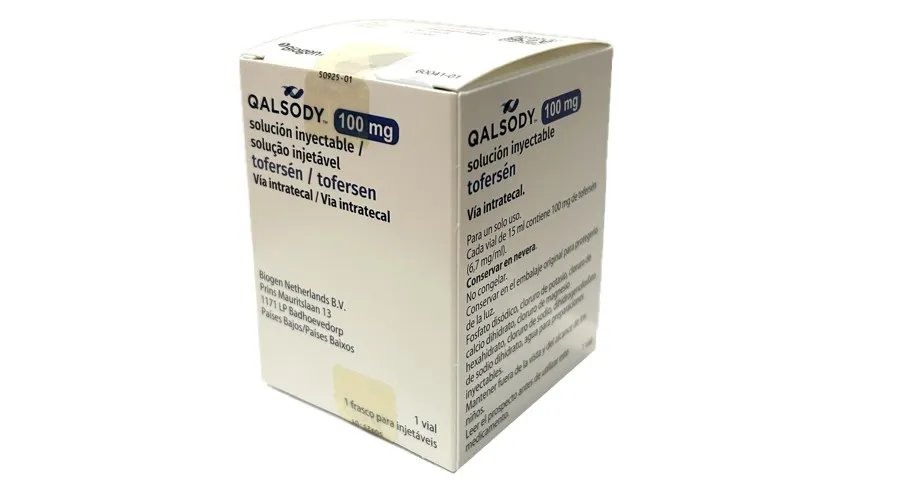
Table of Contents
Package leaflet: Information for the user
Introduction
Package leaflet: information for the patient
Qalsody 100 mg solution for injection
tofersen
This medicinal product is subject to additional monitoring, which will allow for faster identification of new safety information. You can help by reporting any adverse reactions you may experience. Section 4 at the end of this leaflet includes information on how to report these adverse reactions.
Read all of this leaflet carefully before this medicine is administered to you, because it contains important information for you.
- Keep this leaflet, as you may need to read it again.
- If you have any questions, ask your doctor, pharmacist, or nurse.
- If you experience any adverse reactions, consult your doctor, pharmacist, or nurse, even if they are adverse reactions not listed in this leaflet. See section 4.
Contents of this leaflet
- What Qalsody is and what it is used for
- What you need to know before Qalsody is administered to you
- How Qalsody is administered
- Possible side effects
- How to store Qalsody
- Contents of the pack and other information
1. What Qalsody is and what it is used for
Qalsody contains the active substance tofersen, which belongs to a group of medicines known as antisense oligonucleotides.
This medicine is used in adults to treat a type of amyotrophic lateral sclerosis (ALS) caused by mutations (changes) in a gene called SOD1.
ALS caused by mutations in the SOD1 gene is a rare type of motor neuron disease that affects nerve cells in the brain and spinal cord. Mutations in the SOD1 gene lead to an accumulation of a toxic form of the SOD1 protein. This causes the destruction of motor neurons (nerve cells responsible for sending signals to muscles), resulting in muscle weakness and atrophy, including in muscles used for breathing and swallowing.
Qalsody reduces the accumulation of the SOD1 protein. This helps prevent the destruction of motor neurons and may slow the loss of muscle strength.
2. What you need to know before you are given Qalsody
Qalsody must not be administered
- if you are allergic to tofersen or to any of the other ingredients of this medicine (listed in section 6).
Consult your doctor or nurse before starting treatment if any of the following apply to you.
Warnings and precautions
There is a risk of adverse effects following administration of Qalsody via lumbar puncture procedure (see section 3). These may include headache, back pain, and infection.
A small number of patients have been reported to develop inflammation of the spinal cord (myelitis) or irritation or injury of the nerve roots (radiculitis) after receiving Qalsody. You should be aware of the symptoms of these conditions while being treated with this medicine. See Serious adverse reactions in section 4 of this leaflet.
A small number of cases of swelling of the optic nerve of the eye (papilledema) or increased pressure around the brain (increased intracranial pressure) have been reported in patients treated with Qalsody. See Serious adverse reactions in section 4 of this leaflet.
Tests before treatment
You may be required to undergo a urine test (to check your kidneys) and a blood test (to ensure your blood clots properly) before starting treatment. This is because other medicines in the same class as Qalsody may affect the kidneys and blood cells involved in clotting. These tests may not be necessary every time Qalsody is administered.
Children and adolescents
This medicine must not be given to children and adolescents under 18 years of age. The use of this medicine has not been studied in patients under 18 years of age.
Other medicines and Qalsody
Inform your doctor if you are taking, have recently taken, or might need to take any other medicines.
Pregnancy and breastfeeding
If you are pregnant or breastfeeding, think you may be pregnant, or plan to become pregnant, consult your doctor before receiving this medicine.
Pregnancy
Use of Qalsody during pregnancy is not recommended, nor is it recommended for women of childbearing potential who are not using contraceptive methods.
Breastfeeding
Your doctor will help you decide whether to continue breastfeeding or start treatment with Qalsody. Your doctor will consider the potential benefits of treatment for you against the benefits of breastfeeding for your baby.
Driving and use of machines
This medicine may affect your ability to drive or operate machinery. Do not drive or operate machinery if you experience any change in vision while taking Qalsody.
Qalsody contains sodium
This medicine contains 52 mg of sodium (a main component of cooking/table salt) in each 15 ml. This corresponds to 3% of the maximum daily recommended sodium intake for an adult.
Qalsody contains potassium
This medicine contains less than 1 mmol (39 mg) of potassium per 15 ml dose, which is essentially “potassium-free”.
3. How Qalsody is administered
The recommended dose is 100 mg of tofersen. The first three doses are administered at 14-day intervals: on day 1, day 15, and day 29 of treatment. After that, Qalsody will be administered every 28 days.
This medicine is given by intrathecal injection (into the fluid surrounding the spinal cord) in the lower back via a lumbar puncture. A needle is inserted into the space surrounding the spinal cord. This procedure will be performed by a physician experienced in lumbar punctures.
Duration of Qalsody treatment
Your doctor will advise you on how long you should receive Qalsody. Do not stop treatment with Qalsody without consulting your doctor.
If you miss an injection of Qalsody
If you miss a dose of Qalsody, speak with your doctor so it can be administered as soon as possible.
If you have any further questions about the use of this medicine, ask your doctor, pharmacist, or nurse.
4. Possible side effects
Like all medicines, this medicine can cause side effects, although not everyone will experience them.
Side effects related to lumbar puncture may occur during or after administration of Qalsody. These side effects may include headache, back pain, and infection.
Serious side effects
The most serious side effects observed in patients treated with Qalsody are inflammation of the spinal cord (myelitis) or irritation and injury of the nerve roots (radiculitis). Common symptoms may include:
- weakness
- numbness
- abnormal sensations (tingling)
- pain.
Swelling of the nerve connecting the eyes to the brain (papilledema) and increased pressure around the brain (increased intracranial pressure) have also been reported. Papilledema may result from increased intracranial pressure. Common symptoms may include:
- blurred vision
- double vision
- vision loss
- headache.
Cases of inflammation of the tissue covering the brain and spinal cord (aseptic or chemical meningitis) have been reported. This is not due to infection. Common symptoms may include:
- headache
- fever
- neck stiffness
- nausea
- vomiting.
Contact your doctor immediately if you experience any of the symptoms listed above.
Other side effects
Very common (may affect more than 1 in 10 people )
- pain (back pain, pain in arms and legs)
- feeling tired
- muscle and joint pain
- fever
- increased protein levels or white blood cell count in the fluid surrounding the brain and spinal cord.
Common (may affect up to 1 in 10 people )
- muscle stiffness
- nerve pain, including burning, stabbing pain, tingling sensations.
Tell your doctor if you notice any of these symptoms or any other new symptoms that concern you.
Reporting of side effects
If you experience any type of side effect, consult your doctor, pharmacist, or nurse, even if they are possible side effects not listed in this leaflet. You can also report them directly via the Spanish Pharmacovigilance System for Human Medicines: www.notificaRAM.es.
By reporting side effects, you can help provide more information on the safety of this medicine.
5. Storage of Qalsody
Keep this medicine out of the sight and reach of children.
Do not use this medicine after the expiry date stated on the carton after EXP. The expiry date refers to the last day of the month indicated.
Do not use this medicine if you notice particles in the solution or if the liquid in the vial is not clear and colourless.
Store in a refrigerator (between 2 °C and 8 °C). Do not freeze.
Keep the vial in the outer packaging to protect it from light.
The vial of Qalsody may be stored in its original carton for up to 14 days at room temperature (store below 30 °C).
Unopened vials of Qalsody may be removed from and returned to the refrigerator as necessary. Unopened vials may be outside their original carton for up to 6 hours per day at room temperature for a maximum of 6 days.
6. Contents of the container and other information
Composition of Qalsody
-
The active substance is tofersen.
-
Each 15 ml vial contains 100 mg of tofersen.
-
Each ml contains 6.7 mg of tofersen.
-
The other components are disodium phosphate, potassium chloride, calcium chloride dihydrate, magnesium chloride hexahydrate, sodium chloride, sodium dihydrogen phosphate dihydrate, water for injections.
Appearance of the product and contents of the container
Qalsody is a clear, colorless to slightly yellowish injectable solution.
Each Qalsody carton contains one vial.
Marketing Authorization Holder and Manufacturer
Biogen Netherlands B.V.
Prins Mauritslaan 13
1171 LP Badhoevedorp
The Netherlands
Further information on this medicinal product is available from the local representative of the Marketing Authorization Holder:
Belgium/Belgium/Belgium Biogen Belgium NV/SA Tel/Tel: +32 2 2191218 | Lithuania Biogen Lithuania UAB Tel: +370 5 259 6176 |
| Luxembourg/Luxembourg Biogen Belgium NV/SA Tél/Tel: +32 2 2191218 |
Czech Republic Biogen (Czech Republic) s.r.o. Tel: +420 255 706 200 | Hungary Biogen Hungary Kft. Tel.: +36 1 899 9883 |
Denmark Biogen (Denmark) A/S Tlf: +45 77 41 57 57 | Malta Pharma. MT Ltd. Tel: +356 21337008 |
Germany Biogen GmbH Tel: +49 (0) 89 99 6170 | Netherlands Biogen Netherlands B.V. Tel: +31 20 542 2000 |
Estonia Biogen Estonia OÜ Tel: +372 618 9551 | Norway Biogen Norway AS Tlf: +47 23 40 01 00 |
Greece Genesis Pharma SA Tel: +30 210 8771500 | Austria Biogen Austria GmbH Tel: +43 1 484 46 13 |
Spain Biogen Spain, S.L. Tel: +34 91 310 7110 | Poland Biogen Poland Sp. z o.o. Tel.: +48 22 351 51 00 |
France Biogen France SAS Tél: +33 (0)1 41 37 95 95 | Portugal Biogen Portugal Sociedade Farmacêutica, Unipessoal, Lda. Tel: +351 21 318 8450 |
Croatia Biogen Pharma d.o.o. Tel: +385 (0) 1 775 73 22 | Romania Ewopharma România SRL Tel: +40 (0)21 260 13 44 |
Ireland Biogen Idec (Ireland) Ltd. Tel: +353 (0)1 463 7799 | Slovenia Biogen Pharma d.o.o. Tel: +386 1 511 02 90 |
Iceland Icepharma hf Tel: +354 540 8000 | Slovakia Biogen Slovakia s.r.o. Tel: +421 2 323 340 08 |
Italy Biogen Italia s.r.l. Tel: +39 02 5849901 | Finland Biogen Finland Oy Puh/Tel: +358 207 401 200 |
Cyprus Genesis Pharma Cyprus Ltd Tel: +357 22765715 | Sweden Biogen Sweden AB Tel: +46 8 594 113 60 |
Latvia Biogen Latvia SIA Tel: +371 68 688 158 |
This medicinal product has been authorised under "exceptional circumstances". This type of approval means that, due to the rarity of the disease, it has not been possible to obtain complete information on this medicinal product. The European Medicines Agency will review any new information about this medicinal product that becomes available on an annual basis, and this package leaflet will be updated as necessary.
Date of the most recent review of this package leaflet: 05/2024
Other sources of information
Detailed information on this medicinal product is available on the website of the European Medicines Agency: https://www.ema.europa.eu/.