Pyzchiva 90 mg solution for injection in pre-filled pen
Spain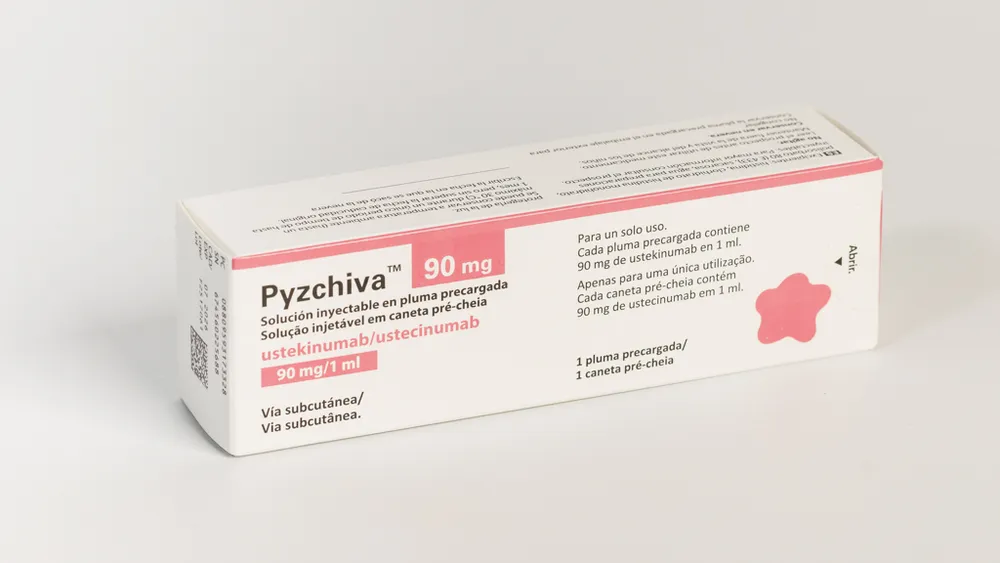
Table of Contents
Package leaflet: Information for the user
Introduction
Package leaflet: information for the patient
Pyzchiva 90mg solution for injection in pre-filled pen
ustekinumab
This medicinal product is subject to additional monitoring, which will allow rapid identification of new safety information. You can help by reporting any side effects you may experience. Information on how to report side effects is included at the end of section 4.
Read the entire leaflet carefully before you start using this medicine, because it contains important information for you.
This leaflet has been written for the person using the medicine.
- Keep this leaflet, as you may need to read it again.
- If you have any questions, ask your doctor or pharmacist.
- This medicine has been prescribed for you only and must not be given to other people, even if they have the same symptoms as you, because it may harm them.
- If you experience any side effects, talk to your doctor or pharmacist, even if they are side effects not listed in this leaflet. See section 4.
Leaflet contents
- What Pyzchiva is and what it is used for
- What you need to know before using Pyzchiva
- How to use Pyzchiva
- Possible side effects
- How to store Pyzchiva
- Contents of the pack and other information
1. What Pyzchiva is and what it is used for
What Pyzchiva is
Pyzchiva administered with the pre-filled pen contains the active substance “ustekinumab”, a monoclonal antibody. Monoclonal antibodies are proteins that specifically recognize and bind to certain proteins in the body.
Pyzchiva belongs to a group of medicines called “immunosuppressants”. These medicines work by weakening part of the immune system.
What Pyzchiva is used for
Pyzchiva administered with the pre-filled pen is used to treat the following inflammatory diseases:
- Plaque psoriasis – in adults
- Psoriatic arthritis – in adults
- Moderate to severe Crohn’s disease – in adults
Plaque psoriasis
Plaque psoriasis is a skin disease that causes inflammation affecting the skin and nails. Pyzchiva reduces inflammation and other signs of the disease.
Pyzchiva administered with the pre-filled pen is used in adults with moderate to severe plaque psoriasis who cannot use ciclosporin, methotrexate, or phototherapy, or when these treatments are not effective.
Psoriatic arthritis
Psoriatic arthritis is an inflammatory joint disease, which is usually accompanied by psoriasis. If you have active psoriatic arthritis, you will first be given other medicines. If you do not respond well to these medicines, you may be treated with Pyzchiva to:
- Reduce the signs and symptoms of your disease.
- Improve your physical function.
- Reduce joint damage.
Crohn’s disease
Crohn’s disease is an inflammatory bowel disease. If you have Crohn’s disease, you will first be given other medicines. If you do not respond adequately or cannot tolerate these medicines, you may be given Pyzchiva to reduce the signs and symptoms of your disease.
2. What you need to know before using Pyzchiva
Do not use Pyzchiva
- If you are allergic to ustekinumab or to any of the other components of this medicine (listed in section 6).
- If you have an active infection that your doctor considers significant.
If you are unsure whether any of the above apply to you, speak with your doctor or pharmacist before using Pyzchiva.
Warnings and precautions
Talk to your doctor or pharmacist before starting to use Pyzchiva. Your doctor will assess your condition before each treatment. Make sure to inform your doctor about any illness you may have before each treatment. Your doctor will also ask you whether you have recently been in contact with someone who might have tuberculosis. Your doctor will examine you and perform a test to detect tuberculosis before you start using Pyzchiva. If your doctor believes you are at risk of tuberculosis, they may prescribe medication to treat it.
Watch for serious adverse effects
Pyzchiva may cause serious adverse effects, including allergic reactions and infections. You should pay attention to certain signs of illness while using Pyzchiva. See the complete list of these adverse effects in the section “Serious adverse effects” in section 4.
Before using Pyzchiva, tell your doctor:
- If you have ever had an allergic reaction to ustekinumab. Consult your doctor if you are unsure.
- If you have ever had any type of cancer – because immunosuppressants like ustekinumab weaken part of the immune system. This may increase the risk of developing cancer.
- If you have been treated for psoriasis with other biologics (a medicine produced from a biological source and usually administered by injection) – the risk of developing cancer may be higher.
- If you have or have recently had an infection.
- If you have any new skin lesions or changes in existing lesions within the psoriasis area or on intact skin.
- If you are taking any other treatments for psoriasis and/or psoriatic arthritis – such as other immunosuppressants or phototherapy (when your body is treated with a type of ultraviolet (UV) light). These treatments may also weaken part of the immune system. The use of these treatments together with ustekinumab has not been studied. However, it may increase the likelihood of developing illnesses related to a weakened immune system.
- If you are receiving or have ever received allergy shots (immunotherapy) – it is unknown whether ustekinumab may affect these treatments.
- If you are 65 years of age or older – you are more likely to develop infections.
If you are unsure whether you have any of these conditions, speak with your doctor or pharmacist before using Pyzchiva.
Some patients have experienced lupus-like reactions during treatment with ustekinumab, including cutaneous lupus or lupus-like syndrome. Contact your doctor immediately if you develop a red, raised, scaly rash, sometimes with a darker border, in areas of skin exposed to sunlight, or if it is accompanied by joint pain.
Heart attacks and strokes
Heart attacks and strokes have been observed in a study of patients with psoriasis treated with ustekinumab. Your doctor will periodically check your risk factors for heart disease and stroke to ensure they are properly managed. Seek immediate medical attention if you experience chest pain, weakness or numbness on one side of the body, facial paralysis, or speech or vision disturbances.
Children and adolescents
The use of ustekinumab in a pre-filled pen is not recommended in children and adolescents under 18 years of age with psoriasis or Crohn’s disease, as it has not been studied in this age group. For children aged 6 years and older and adolescents with psoriasis, a pre-filled syringe or vial should be used instead. For children with Crohn’s disease weighing at least 40 kg, an intravenous solution, vial, or pre-filled syringe should be used instead.
The use of ustekinumab is not recommended in children and adolescents under 18 years of age with psoriatic arthritis or in children with Crohn’s disease weighing less than 40 kg, as it has not been studied in this age group.
Use of Pyzchiva with other medicines, vaccines
Inform your doctor or pharmacist:
- If you are currently using, have recently used, or might use any other medicines.
- If you have recently been vaccinated or are due to receive a vaccine. Certain types of vaccines (live vaccines) should not be administered while using Pyzchiva.
- If you received Pyzchiva during pregnancy, inform your infant’s doctor about your treatment with Pyzchiva before the infant receives any vaccine, including live vaccines such as the BCG vaccine (used to prevent tuberculosis). Live vaccines are not recommended for your infant during the first twelve months after birth if you received Pyzchiva during pregnancy, unless your infant’s doctor advises otherwise.
Pregnancy and breastfeeding
- If you are pregnant, think you might be pregnant, or plan to become pregnant, consult your doctor before using this medicine.
- No increased risk of congenital abnormalities has been observed in babies exposed to ustekinumab in utero. However, experience with ustekinumab in pregnant women is limited. Therefore, it is preferable to avoid using ustekinumab during pregnancy.
- If you are a woman of childbearing potential, you are advised to avoid becoming pregnant and to use adequate contraception while using ustekinumab and for at least 15 weeks after the last dose of ustekinumab.
- Pyzchiva can cross the placenta to the fetus. If you received Pyzchiva during pregnancy, your infant may have an increased risk of developing infections.
- It is important to inform your infant’s doctors and other healthcare professionals if you received Pyzchiva during your pregnancy before the infant receives any vaccine. Live vaccines, such as the BCG vaccine (used to prevent tuberculosis), are not recommended for your infant during the first twelve months after birth if you received Pyzchiva during pregnancy, unless your infant’s doctor advises otherwise.
- Ustekinumab may be excreted in breast milk in very small amounts. Inform your doctor if you are breastfeeding or plan to breastfeed. You and your doctor will decide whether to breastfeed or use ustekinumab. Do not do both at the same time.
Driving and using machines
The influence of ustekinumab on the ability to drive and use machines is none or negligible.
Pyzchiva contains polysorbate 80 (E433)
This medicine contains 0.02 mg of polysorbate 80 (E433) per pre-filled pen (1 ml), equivalent to 0.02 mg/0.5 ml. Polysorbates may cause allergic reactions. Inform your doctor if you have any known allergies.
3. How to use Pyzchiva
Pyzchiva must be used under the guidance and supervision of a doctor experienced in treating the conditions for which Pyzchiva is indicated.
Always follow exactly the administration instructions for this medicine given by your doctor. If in doubt, ask your doctor. Ask your doctor when your injections should be given and about follow-up appointments.
How much Pyzchiva is administered
Your doctor will decide the amount of Pyzchiva you need to use and the duration of treatment.
Adults aged 18 years and older
Psoriasis or psoriatic arthritis
- The recommended starting dose is 45 mg of Pyzchiva. Patients weighing more than 100 kilograms (kg) may start with a dose of 90 mg instead of 45 mg.
- After the initial dose, you will receive the next dose 4 weeks later, and then every 12 weeks. Subsequent doses are usually the same as the starting dose.
Crohn’s disease
- During treatment, your doctor will administer the first dose of approximately 6 mg/kg of Pyzchiva as an intravenous infusion (a drip into a vein in your arm). After the initial dose, you will receive the next dose of 90 mg of Pyzchiva 8 weeks later, and then every 12 weeks, as an injection under the skin (“subcutaneously”).
- In some patients, after the first subcutaneous injection, 90 mg of Pyzchiva will be administered every 8 weeks. Your doctor will decide when you should receive the next dose.
How Pyzchiva is administered
-
Pyzchiva is administered by subcutaneous injection (“under the skin”). At the beginning of your treatment, medical or nursing staff may administer Pyzchiva to you.
-
However, you and your doctor may decide that you can self-inject Pyzchiva. In that case, you will be trained on how to inject Pyzchiva yourself.
-
For instructions on how to inject Pyzchiva, see “Administration instructions” at the end of this leaflet.
Consult your doctor if you have any questions about self-injecting.
If you use more Pyzchiva than you should
If you have used or been administered too much Pyzchiva, speak immediately with your doctor or pharmacist. Always carry the medicine carton with you, even if it is empty.
If you forget to use Pyzchiva
If you miss a dose, speak with your doctor or pharmacist. Do not take a double dose to make up for missed doses.
If you stop using Pyzchiva
Stopping ustekinumab is not dangerous. However, if you stop, your symptoms may return.
If you have any further questions about using this medicine, ask your doctor or pharmacist.
4. Possible adverse effects
Like all medicines, this medicine can cause adverse effects, although not everyone will experience them.
Serious adverse effects
Some patients may experience serious adverse effects that may require urgent treatment.
Allergic reactions – these may require urgent treatment. Contact your doctor or seek immediate medical help if you notice any of the following signs.
-
Severe allergic reactions ("anaphylaxis") are rare in the population using ustekinumab (may affect up to 1 in 1,000 people). Signs include:
-
difficulty breathing and swallowing,
-
low blood pressure, which may cause dizziness or mild headaches,
-
swelling of the face, lips, mouth, or throat.
-
Common signs of an allergic reaction include rash and hives (may affect up to 1 in 100 people).
In rare cases, allergic reactions affecting the lungs and lung inflammation have been reported in patients treated with ustekinumab. Inform your doctor immediately if you develop symptoms such as cough, difficulty breathing, or fever.
If you have a severe allergic reaction, your doctor may decide that you should not use Pyzchiva again.
Infections – these may require urgent treatment. Contact your doctor immediately if you notice any of these signs.
- Nasal or throat infections and the common cold are common (may affect up to 1 in 10 people).
- Chest infections are uncommon (may affect up to 1 in 100 people).
- Inflammation of the tissues beneath the skin ("cellulitis") is uncommon (may affect up to 1 in 100 people).
- Herpes (a type of painful blistering rash) is uncommon (may affect up to 1 in 100 people).
Ustekinumab may affect your ability to fight infections. Some of these infections may become serious and may be caused by viruses, fungi, bacteria (including tuberculosis) or parasites. They include infections that occur mainly in people with weakened immune systems (opportunistic infections). Opportunistic infections of the brain (encephalitis, meningitis), lungs, and eyes have been reported in patients receiving ustekinumab.
You should monitor for signs of infection while using ustekinumab. These include:
-
fever, flu-like symptoms, night sweats, weight loss,
-
feeling tired or having difficulty breathing; persistent cough,
-
skin feeling hot, red, and painful, or a painful blistering skin rash,
-
burning sensation when urinating,
-
diarrhea,
-
visual deterioration or loss of vision,
-
headache, neck stiffness, light sensitivity, nausea, or confusion.
Contact your doctor immediately if you notice any of these signs of infection, as they may indicate infections such as chest infections, skin infections, herpes, or opportunistic infections that could lead to serious complications. You should also inform your doctor if you have any infection that does not go away or keeps recurring. Your doctor may decide that you should not use ustekinumab until the infection resolves. Also contact your doctor if you have an open wound or ulcer that could become infected.
Skin peeling – increased redness and peeling of the skin over a large area of the body may be symptoms of erythrodermic psoriasis or exfoliative dermatitis, which are serious skin disorders. If you notice any of these symptoms, you must inform your doctor immediately.
Other adverse effects
Common adverse effects (may affect up to 1 in 10 people):
- Diarrhea
- Nausea
- Vomiting
- Feeling tired
- Dizziness
- Headache
- Itching ("pruritus")
- Back, muscle, or joint pain
- Sore throat
- Redness and pain at the injection site
- Sinusitis
Uncommon adverse effects (may affect up to 1 in 100 people):
- Dental infections
- Vaginal yeast infections
- Depression
- Nasal congestion or stuffiness
- Bleeding, bruising, hardening, swelling, and itching at the injection site
- Feeling weak
- Drooping eyelid and sinking of the muscles on one side of the face ("facial paralysis" or "Bell's palsy"), which is usually temporary
- A change in psoriasis with redness and new small yellow or white blisters on the skin, sometimes accompanied by fever (pustular psoriasis)
- Skin peeling (skin exfoliation)
- Acne
Rare adverse effects (may affect up to 1 in 1,000 people):
- Redness and peeling of the skin over a large area of the body, which may cause itching or pain (exfoliative dermatitis). Similar symptoms may develop as a natural change in psoriasis symptoms (erythrodermic psoriasis)
- Inflammation of small blood vessels, which may cause a skin rash with small red or purple raised spots, fever, or joint pain (vasculitis)
Very rare adverse effects (may affect up to 1 in 10,000 people)
- Blisters on the skin, which may be red, itchy, and painful (bullous pemphigoid).
- Cutaneous lupus or lupus-like syndrome (a red, raised, scaly rash in sun-exposed areas of skin, possibly accompanied by joint pain).
Reporting of adverse effects
If you experience any adverse effect, talk to your doctor or pharmacist, even if it is a possible adverse effect not listed in this leaflet. You can also report them directly through the national reporting system included in Appendix V. By reporting adverse effects, you can help provide more information on the safety of this medicine.
5. Storage of Pyzchiva
- Keep this medicine out of the sight and reach of children.
- Store in a refrigerator (2 °C to 8 °C). Do not freeze.
- Keep the pre-filled pen in the outer packaging to protect it from light.
- If necessary, individual pre-filled pens of Pyzchiva may also be stored at room temperature up to 30 °C for a maximum period of up to 35 days, keeping them in their original carton to protect from light. Write the date when the pre-filled pen is first removed from the refrigerator in the designated space on the outer packaging. At any time before the end of this period, the product may be returned to the refrigerator once and stored there until the original expiration date. Discard the pen if not used within the maximum 35-day period at room temperature or before the original expiration date, whichever occurs first.
- Do not shake the pre-filled pens of Pyzchiva. Prolonged vigorous shaking may damage the medicine.
Do not use this medicine:
- After the expiry date stated on the label and packaging following “CAD/EXP”. The expiry date refers to the last day of the month indicated.
- If the liquid changes colour, becomes cloudy, or contains foreign particles floating in it (see section 6, “What Pyzchiva looks like and contents of the pack”).
- If you know or suspect it has been exposed to extreme temperatures (such as accidental overheating or freezing).
- If the product has been vigorously shaken.
Pyzchiva is for single use only. Any unused product remaining in the pre-filled pen must be discarded. Medicines should not be disposed of via wastewater or household waste. Ask your pharmacist how to dispose of medicines and packaging that you no longer need. This will help protect the environment.
6. Contents of the pack and other information
Composition of Pyzchiva
- The active substance is ustekinumab. Each pre-filled syringe contains 90 mg of ustekinumab in 1 ml.
- The other components are histidine, histidine hydrochloride monohydrate, polysorbate 80, sucrose, water for injections.
Appearance of Pyzchiva and contents of the pack
Pyzchiva is a transparent, colourless to pale yellow injectable solution. The solution may contain a few translucent or white protein particles. It is supplied in a pack containing 1 pre-filled single-dose glass pen of 1 ml. Each pre-filled pen contains 90 mg of ustekinumab in 1 ml of injectable solution.
Marketing Authorization Holder and Manufacturer
Samsung Bioepis NL. B.V.
Olof Palmestraat 10
2616 LR Delft
The Netherlands
For further information about this medicinal product, please contact the local representative of the Marketing Authorization Holder:
Belgium/Belgium/Belgium Sandoz nv/sa Tel/Tel: +32 2 722 97 97 | Lithuania Sandoz Pharmaceuticals d.d. branch Tel: +370 5 2636 037 |
| Luxembourg/Luxembourg Sandoz nv/sa Tel/Tel.: +32 2 722 97 97 |
Czech Republic Sandoz s.r.o. Tel: +420 225 775 111 | Hungary Sandoz Hungária Kft. Tel.: +36 1 430 2890 |
Denmark/Norway/Iceland/Sweden Sandoz A/S Tlf: +45 63 95 10 00 | Malta Sandoz Pharmaceuticals d.d. Tel: +35699644126 |
Germany Hexal AG Tel: +49 8024 908 0 | Netherlands Sandoz B.V. Tel: +31 36 52 41 600 |
Estonia Sandoz d.d. Estonian branch Tel: +372 665 2400 | Austria Sandoz GmbH Tel: +43 5338 2000 |
Greece SANDOZ HELLAS MONOPROSOPI E.E. Tel: +30 216 600 5000 | Poland Sandoz Polska Sp. z o.o. Tel.: +48 22 209 70 00 |
Spain Sandoz Farmacéutica, S.A. Tel: +34 900 456 856 | Portugal Sandoz Farmacêutica Lda. Tel: +351 21 000 86 00 |
France Sandoz SAS Tél: +33 1 49 64 48 00 | Romania Sandoz Pharmaceuticals SRL Tel: +40 21 407 51 60 |
Croatia Sandoz d.o.o. Tel: +385 1 23 53 111 | Slovenia Sandoz farmacevtska družba d.d. Tel: +386 1 580 29 02 |
Ireland Rowex Ltd. Tel: +353 27 50077 | Slovakia Sandoz d.d. - organizational unit Tel: +421 2 48 200 600 |
Italy Sandoz S.p.A. Tel: +39 02 81280696 | Finland/Finland Sandoz A/S Puh/Tel: +358 10 6133 400 |
Cyprus SANDOZ HELLAS MONOPROSOPI E.E. Tel: +30 216 600 5000 Latvia Sandoz d.d. Latvia branch Tel: +371 67 892 006 |
Traceability:
In order to improve the traceability of biological medicinal products, the name and batch number of the administered medicine should be clearly recorded.
Date of the most recent review of this leaflet: MM/YYYY
Other sources of information
Detailed information on this medicine is available on the website of the European Medicines Agency: http://www.ema.europa.eu
INSTRUCTIONS FOR USE
Pyzchiva
(ustekinumab)
Injection for subcutaneous use
Prefilled pen
Instructions for injecting Pyzchiva using a prefilled pen.
Read these instructions for use before starting to use Pyzchiva. Your healthcare professional must show you how to properly prepare and administer your Pyzchiva injection.
If you cannot administer the injection yourself:
- ask your healthcare professional for help, or
- ask someone who has been trained by a healthcare professional to give you the injections.
Do not attempt to inject Pyzchiva yourself until your healthcare professional has shown you how to do so.
Need help?
Consult your doctor for any questions you may have. For further assistance or to share your experience, refer to the contact information of your local representative provided in the package leaflet.
Important information you should know before injecting Pyzchiva
- For subcutaneous injection only (inject directly under the skin)
- Do not remove the needle cap before you are ready to inject.
- Do not shake the prefilled pen at any time. Shaking the prefilled pen may damage the Pyzchiva medicine.
Storage of the Pyzchiva prefilled pen:
- Store Pyzchiva in the refrigerator (between 2°C and 8°C).
- Store Pyzchiva in its original carton to protect it from light or physical damage.
- If necessary, individual Pyzchiva prefilled pens may also be stored at room temperature up to 30°C for a maximum of 35 days, kept in their original carton to protect them from light. Write the date when the prefilled pen is first removed from the refrigerator in the designated space on the outer packaging. At any time before this period ends, the product may be returned to the refrigerator once and stored there until the original expiration date. Dispose of the pen if it is not used after the maximum 35-day period at room temperature or before the original expiration date, whichever comes first. Do not store Pyzchiva under extreme heat or cold conditions.
- Do not freeze.
Preparing the injection with the Pyzchiva prefilled pen
Step 1. Before starting, check the carton to ensure you have the correct dose. A dose of 45 mg or 90 mg will be administered, as prescribed by your doctor.
- If your dose is 45 mg, you will receive one 45 mg prefilled pen.
- If your dose is 90 mg, you will receive either one 90 mg prefilled pen or two 45 mg prefilled pens. If you receive two 45 mg prefilled pens for a 90 mg dose, two injections must be administered, one after the other.
Step 2. Gather supplies
-
Step 2.1: Choose a clean, flat, well-lit work surface.
-
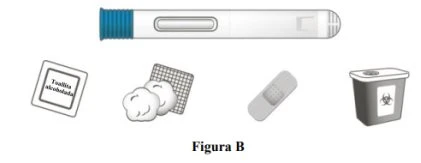
Step 2.2: Gather the supplies needed to prepare and administer your injection (Figure B).
You will need the following supplies:- Included in the carton:
- Pyzchiva prefilled pen
- Not included in the carton:
- Alcohol wipe
- Cotton balls or gauze pads
- Adhesive bandage
- Sharps disposal container (see "How to dispose of the used Pyzchiva prefilled pen").
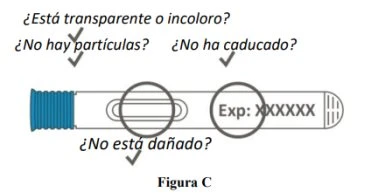
Step 3. Inspect the prefilled pen (Figure C)
-
Step 3.1: Check the expiration date on the prefilled pen or carton.
-
Step 3.2: Check for particles or color changes in the medicine through the viewing window. The medicine should appear clear and colorless to slightly yellow, with possible presence of some white particles.
-
Step 3.3: Ensure the pen is not damaged.
-
Do not use Pyzchiva if:
- the expiration date has passed, or if the prefilled pen has been stored at room temperature up to 30°C for more than 35 days, or if the prefilled pen has been stored above 30°C;
- it is frozen, discolored, cloudy, or contains large particles;
- it is damaged;
- it has been dropped and is cracked or broken.
-
It is normal to see one or more bubbles in the viewing window.
 Step 4. Allow the medicine to reach room temperature
- For a more comfortable injection, allow the Pyzchiva prefilled pen to warm to room temperature for about 30 minutes before injecting, after removing it from the refrigerator.
- Do not warm the prefilled pen in any other way (for example, do not use a microwave or warm water).
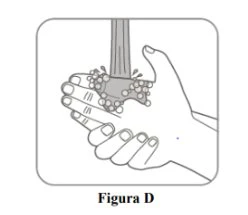
Step 5. Wash your hands
- Wash your hands thoroughly with warm water and soap (Figure D).
Step 6. Choose the injection site
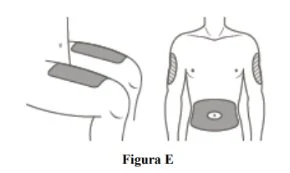
- Choose an injection site on the thigh or lower abdominal area (lower abdomen), at least 5 centimeters away from the navel. If a caregiver is administering the injection, it may also be given on the outer area of the upper arm (Figure E).
- Use a different injection site for each injection.
- Do not inject into an area of skin that is tender, bruised, red, hard, or shows signs of psoriasis.
Step 7. Clean the skin at the injection site
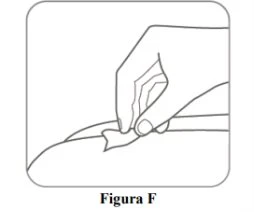
- Clean the skin with a new alcohol wipe at the site where you will administer the injection (Figure F).
- Do not touch this area again before administering the injection. Allow the skin to dry before injecting.
- Do not fan or blow on the cleaned area.
Injecting with the Pyzchiva prefilled pen
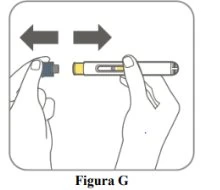
Step 8. Remove the needle cap when you are ready to inject Pyzchiva (Figure G).
- Discard the needle cap.
- It is normal for a few drops of liquid to appear at the needle.
- Do not twist or bend the needle cap when removing it, as this may damage the needle.
- Do not use a prefilled pen that has been dropped after removing the needle cap. Contact your healthcare professional for instructions.
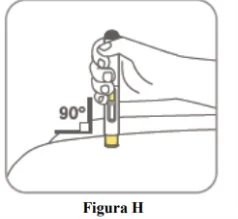
Step 9. Place the prefilled pen directly onto the skin at a 90-degree angle (Figure H).
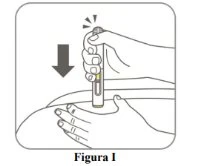
Step 10. Press the prefilled pen firmly against the skin to start the injection (Figure I).
- You may hear a first click when the injection begins.
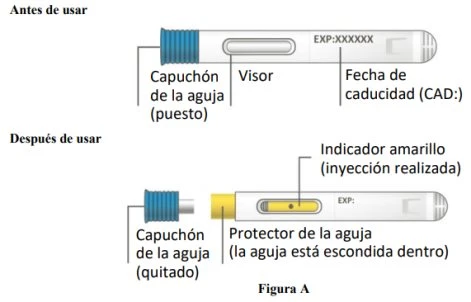
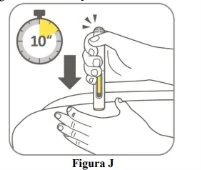
Step 11. Continue pressing against the skin until the yellow indicator stops moving (Figure J).
The injection may take up to 10 seconds.
- You may hear a second click. This indicates that the injection is complete.
- Do not stop applying pressure at the injection site until the injection is finished.
- Do not move the prefilled pen during the injection.
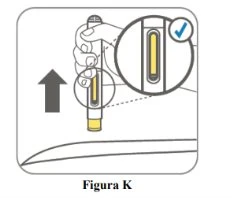
Step 12. Check that the viewing window has turned yellow to confirm the full dose has been administered, then remove the empty pen from the skin (Figure K).
- The needle safety shield will fully cover the needle.
- As shown in Figure K, a small grey band may still be visible in the viewing window.
- After removing the needle from the skin, slight bleeding or a few drops at the injection site may occur. This is normal. If needed, you may press the injection site with a cotton ball or gauze pad. Do not rub the skin at the injection site. If necessary, you may cover the injection site with a small adhesive bandage.
If your dose is 90 mg, you will receive either one 90 mg prefilled pen or two 45 mg prefilled pens. If you receive two 45 mg prefilled pens for a 90 mg dose, a second injection must be administered immediately after the first. Repeat steps 1–12 for the second injection using a new pen. Choose a different injection site for the second injection.
How to dispose of the used Pyzchiva prefilled pen
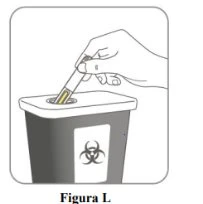
Step 13. Immediately after use, place the used pen into a sharps disposal container (Figure L).
- Do not throw (dispose of) loose pens into the trash.
- Do not recycle used sharps disposal containers.
Keep Pyzchiva and all medicines out of the reach of children.