Pylera 140 mg/125 mg/125 mg capsules
Spain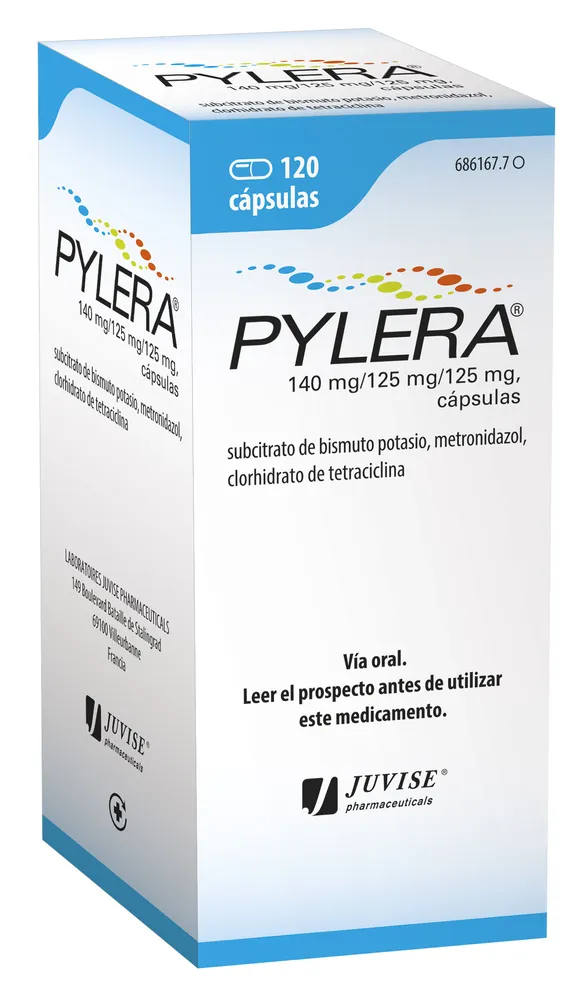
Table of Contents
- Package leaflet: Information for the user
- Introduction
- 1. What Pylera is and what it is used for
- 2. What you need to know before taking Pylera
- 3. How to take Pylera
- 4. Possible adverse effects
- **Stop taking Pylera and contact your doctor or go to a hospital immediately if you experience or notice any of the following:**
- 5. Storage of Pylera
- 6. Contents of the pack and other information
Package leaflet: Information for the user
Introduction
Package leaflet: information for the user
Pylera 140 mg/125 mg/125 mg capsules
bismuth subcitrate potassium
metronidazole
tetracycline hydrochloride
Read all of this leaflet carefully before you start taking this medicine because it contains important information for you.
- Keep this leaflet as you may need to read it again.
- If you have any questions, ask your doctor or pharmacist.
- This medicine has been prescribed for you only, and you should not give it to others, even if they have the same symptoms as you, because it may harm them.
- If you experience any adverse effects, consult your doctor or pharmacist, even if they are adverse effects not listed in this leaflet. See section 4.
Contents of the leaflet
- What Pylera is and what it is used for
- What you need to know before taking Pylera
- How to take Pylera
- Possible adverse effects
- How to store Pylera
- Contents of the pack and other information
1. What Pylera is and what it is used for
Pylera contains 3 different active substances: bismuth subcitrate potassium, metronidazole, and tetracycline hydrochloride. Tetracycline and metronidazole belong to a group of medicines called antibiotics. Bismuth subcitrate potassium helps the antibiotics to treat the infection.
Pylera contains a combination of medicines used to treat adult patients infected with Helicobacter pylori (H. pylori) who have or have had a peptic ulcer. H. pylori is a bacterium found in the stomach.
Antibiotics are used to treat bacterial infections and are not effective against viral infections such as flu or the common cold.
It is important that you follow your doctor's instructions regarding dose, dosing interval, and duration of treatment.
Do not store or reuse this medicine. If you have any antibiotic left over after completing the treatment, return it to the pharmacy for proper disposal. Do not dispose of medicines via wastewater or household waste.
Pylera must be taken together with a medicine called omeprazole. Omeprazol is a medicine that works by reducing the amount of acid produced by your stomach. When taken together with omeprazole, both medicines work in combination to treat the infection and reduce inflammation of the stomach lining.
2. What you need to know before taking Pylera
Do not take Pylera
- if you are pregnant or breastfeeding
- if you are under 12 years of age
- if you have kidney problems
- if you have liver problems
- if you are allergic (hypersensitive) to potassium bismuth subcitrate, metronidazole, or other nitroimidazole derivatives, tetracycline, or to any of the other ingredients of Pylera (listed in Section 6)
- if you have Cockayne syndrome (see Warnings and precautions).
Warnings and precautions
Consult your doctor or pharmacist before taking Pylera.
Cases of severe irreversible hepatic toxicity/acute liver failure, including rapidly fatal outcomes shortly after initiation of systemic metronidazole, have been reported in patients with Cockayne syndrome.
Inform your doctor immediately and stop taking metronidazole if you experience:
- stomach pain, loss of appetite, nausea, vomiting, fever, malaise, fatigue, jaundice, dark urine, clay-colored stools, or itching.
Metronidazole, one of the components of this medicine, may increase the risk of changes in the electrocardiogram (ECG), specifically QT interval prolongation, which delays electrical conduction and may lead to cardiac rhythm abnormalities (arrhythmias), when used concomitantly with other drugs that may cause similar ECG changes. Consult your doctor before starting Pylera, especially if you have previously experienced arrhythmias or such ECG changes (see section “Other medicines and Pylera”).
Take special care with Pylera
- if you are scheduled for X-rays, as Pylera may interfere with X-ray results
- if you need blood tests, as Pylera may affect test results
- if your doctor has told you that you have an intolerance to certain sugars
Avoid sunlight and UVA tanning booths during treatment with Pylera, as it may increase sensitivity to sunlight. Contact your doctor if you develop sunburn.
Children and adolescents
Pylera capsules must not be given to children under 12 years of age. Use in patients aged 12 to 18 years is not recommended.
Taking Pylera with other medicines
Inform your doctor or pharmacist if you are taking, have recently taken, or might need to take any other medicines, including those obtained without a prescription.
In particular, inform your doctor if you are currently using or have recently used any of the following medicines:
- lithium, used to treat certain mental illnesses
- medicines used to thin the blood or prevent blood clotting (e.g., warfarin)
- phenytoin and phenobarbital for epilepsy
- methoxyflurane (an anaesthetic)
- other antibiotics, especially penicillin
- supplements containing iron, zinc, or sodium bicarbonate
- the combination of Pylera with other bismuth-containing drugs used long-term may affect the nervous system
- busulfan and fluorouracil used in chemotherapy
- cyclosporine, used to suppress the immune response after organ transplantation
- disulfiram, used to treat alcohol dependence
- ranitidine, used for indigestion and heartburn
- retinoids for skin disorders
- atovaquone, used to treat a lung infection
- medicines that cause changes in the electrocardiogram (QT interval prolongation), and for which blood concentrations may increase when co-administered with metronidazole. Examples of such substances include:
- amiodarone (used to treat heart rhythm abnormalities);
- ondansetron (used to treat nausea and vomiting);
- methadone (used as an opioid dependence treatment);
- domperidone (used to treat nausea and vomiting)
Do not take antacids containing aluminium, calcium, or magnesium at the same time as Pylera.
Taking Pylera with food, drinks, and alcohol
Take Pylera with a full glass of water (250 ml) after meals and at bedtime (preferably after a light snack).
Do not consume any dairy products (such as milk or yoghurt) or drinks with added calcium at the same time as Pylera capsules or during the entire course of treatment with Pylera, as they may interfere with the effectiveness of Pylera.
Do not consume alcohol during treatment with Pylera or for at least 24 hours after completing treatment. Drinking alcohol during treatment with Pylera may cause unpleasant adverse effects such as nausea, vomiting, stomach pain (cramps), flushing, and headache.
Pregnancy and breastfeeding
Do not take Pylera if you are pregnant, could become pregnant during treatment, or suspect you may be pregnant. Speak to your doctor if you become pregnant while taking Pylera.
You must not breastfeed during treatment with Pylera, as small amounts of the components of Pylera may pass into breast milk.
Driving and use of machines
Do not drive or operate tools or machinery if you feel dizzy, drowsy, have epileptic seizures (convulsions), or experience blurred or double vision.
Pylera contains lactose, potassium, and other excipients.
Pylera contains lactose, a type of sugar. If your doctor has diagnosed you with an intolerance to certain sugars, consult them before taking this medicine.
Patients with renal impairment or those on potassium-restricted diets should be aware that Pylera contains approximately 96 mg of potassium per dose (3 capsules containing 32 mg of potassium each).
3. How to take Pylera
Follow exactly the instructions given by your doctor for taking this medicine. Pylera must be taken together with a medicine called omeprazole. If in doubt, consult your doctor or pharmacist again.
Adults and elderly patients
Do not open the capsules; swallow them whole.
Take 3 Pylera capsules after breakfast, 3 capsules after lunch, 3 capsules after dinner, and 3 capsules at bedtime (preferably after a snack), i.e., a total of 12 capsules per day. Swallow the capsules whole while sitting upright, with a full glass of water (250 ml) to avoid any throat irritation. Do not lie down immediately after taking Pylera. It is important to complete the full course of treatment (10 days) and to take all 120 capsules.
Take one 20 mg capsule/tablet of omeprazole with the Pylera doses taken at breakfast and dinner (a total of 2 omeprazole capsules/tablets per day).
Daily dosing schedule for Pylera
Dosing Schedule | Number of Pylera Capsules | Number of Omeprazole Capsules/Tablets |
After breakfast | 3 | 1 |
After lunch | 3 | 0 |
After dinner | 3 | 1 |
At bedtime (preferably after a snack) | 3 | 0 |
If you take more Pylera than you should
If you take more Pylera capsules per day than recommended, you must inform your doctor or go to the nearest hospital emergency department. Take the bottle and any remaining capsules with you so that the doctor knows what you have taken.
In case of overdose or accidental ingestion, contact your doctor or pharmacist immediately, or call the Toxicology Information Service at telephone number 915 620 420, indicating the medication and the amount ingested.
If you forget to take Pylera
If you forget to take Pylera, take it as soon as you remember. However, if it is almost time for your next dose, skip the missed dose. Do not take a double dose to make up for forgotten doses. If you forget to take more than 4 consecutive doses of Pylera (1 day), contact your doctor.
If you stop taking Pylera
It is important that you complete the full course of treatment, even if you start to feel better after a few days. If you stop treatment with Pylera too early, the infection may not be completely cured and the symptoms may return or worsen. You may also develop resistance to tetracycline and/or metronidazole (antibiotics).
If you have any further questions about the use of this medicine, ask your doctor or pharmacist.
4. Possible adverse effects
Like all medicines, this medicine can cause adverse effects, although not everyone will experience them.
Stop taking Pylera and contact your doctor or go to a hospital immediately if you experience or notice any of the following:
- swelling of the face, lips, tongue, or throat which may cause difficulty swallowing or breathing.
- a rash with itchy red bumps (wheals) or hives.
These could be signs of an allergic reaction.
- Severe skin reactions (Stevens-Johnson syndrome, toxic epidermal necrolysis (Lyell's syndrome), drug reaction with eosinophilia and systemic symptoms (DRESS)) (See below for "Frequency not known" adverse reactions).
A very rare but serious adverse reaction is a brain disorder (encephalopathy). Symptoms may vary, but may include fever, neck stiffness, headache, or seeing or hearing things that are not real. You may also have difficulty using your arms and legs or speaking, or feel confused. Contact your doctor immediately if you notice any of these adverse reactions.
Other possible adverse effects
Very common (may affect more than 1 in 10 people):
- changes in stool consistency or color, including dark-colored stools (black stools)
- diarrhea
- nausea
- bad taste in the mouth or metallic taste
Common (may affect up to 1 in 10 people):
- abdominal pain
- constipation
- dry mouth
- vomiting
- flatulence / gas
- headache
- feeling weak
- feeling of lack of energy or tiredness
- general malaise
- vaginal infection – symptoms include itching and irritation of the genital area, burning sensation, or yellowish/white vaginal discharge
- blood tests may show increased levels of liver enzymes (transaminases)
- dark-colored urine
- loss or decrease in appetite
- dizziness / lightheadedness
- numbness sensation
- skin problems such as redness (rash)
Uncommon (may affect up to 1 in 100 people):
- allergic reaction to the medicine (symptoms include swelling of the face, lips, tongue, or throat which may cause difficulty swallowing or breathing, or a rash with itchy red bumps (wheals) or hives)
- feeling of bloating / bloated abdomen
- belching or gas
- mouth sores / oral ulcers
- changes in tongue color (dark tongue)
- swollen tongue
- chest pain, chest discomfort
- yeast infections (candidiasis), which may occur in the mouth (symptoms include white patches in the mouth) or in the genital area (symptoms include severe itching, burning sensation, swelling)
- numbness
- tingling / pins and needles
- tremors
- feeling anxious, depressed, or having difficulty sleeping
- memory disturbance
- skin problems such as itching or wheals (hives)
- blurred vision
- dizziness (spinning sensation)
Frequency not known (cannot be estimated from available data):
- Serious illness with blistering of the skin, mouth, eyes, and genitals (Stevens-Johnson syndrome)
- Serious illness with blistering of the skin (Lyell's syndrome, toxic epidermal necrolysis)
- Pseudoinfluenza-like symptoms, facial rash followed by widespread rash with high fever, increased liver enzyme levels seen in blood tests, increase in a type of white blood cell (eosinophilia), and enlarged lymph nodes (DRESS)
- Blistering of the skin and peeling (desquamation) of the skin
- Aseptic meningitis: a group of symptoms including fever, nausea, vomiting, headache, neck stiffness, and extreme sensitivity to bright light. This may be caused by inflammation of the membranes covering the brain and spinal cord (meningitis).
- Nerve damage that may cause numbness, tingling, pain, and a feeling of weakness in arms and legs (peripheral neuropathy).
- Inflammation of the large intestine (pseudomembranous colitis).
- A neurological disorder called cerebellar syndrome, which includes symptoms such as difficulty coordinating movements, speech, and/or gait, involuntary eye movements, and tremor. This may resolve upon discontinuation of treatment.
Reporting of adverse reactions
If you experience any adverse reaction, consult your doctor or pharmacist, even if it is a possible adverse reaction not listed in this leaflet. You may also report them directly via the Spanish Pharmacovigilance System for Human Medicinal Products: https://www.notificaRAM.es. By reporting adverse reactions, you can help provide more information on the safety of this medicine.
5. Storage of Pylera
Keep this medicine out of the sight and reach of children.
- Do not use this medicine after the expiry date stated on the carton and bottle after "EXP". The expiry date refers to the last day of the month indicated.
- This medicine does not require any special storage temperature. Store in the original packaging to protect it from light and moisture.
Medicines must not be disposed of via wastewater or household waste. Dispose of unused medicines and their containers at the SIGRE collection point at your pharmacy. Ask your pharmacist how to dispose of medicines and containers you no longer need. This will help protect the environment.
6. Contents of the pack and other information
Composition of Pylera
The active substances are potassium bismuth subcitrate, metronidazole, and tetracycline hydrochloride.
Each capsule contains 140 mg of potassium bismuth subcitrate (equivalent to 40 mg of bismuth oxide), 125 mg of metronidazole, and 125 mg of tetracycline hydrochloride.
The other components are: magnesium stearate (E572), lactose monohydrate, talc (E553b), titanium dioxide (E171), gelatin, and printing ink containing shellac, propylene glycol, and iron oxide red (E172).
This medicine contains lactose and potassium. See section 2.
Appearance of Pylera and contents of the pack
Pylera capsules are hard, elongated, white and opaque, with "BMT" printed on the cap in red ink. The capsules contain a white powder and one smaller white opaque capsule containing a yellow powder.
Pylera capsules are available in high-density polyethylene bottles containing 120 capsules.
The bottle contains a desiccant (silica gel packet) and a rayon coil to keep the medicine dry. Do not ingest the desiccant or the rayon coil.
Marketing Authorization Holder and Manufacturer
Marketing Authorization Holder
LABORATOIRES JUVISE PHARMACEUTICALS
149 Boulevard Bataille de Stalingrad
69100 Villeurbanne
France
Manufacturer
SKYEPHARMA PRODUCTION SAS
Zone Industrielle Chesnes Ouest,
55 rue du Montmurier
38070 Saint Quentin Fallavier
France
This medicine is authorized in the European Economic Area member states under the following names:
Belgium: Tryplera
Germany, Austria, Slovakia, Spain, France, Italy, Poland, Portugal, Czech Republic: Pylera
Date of the most recent review of this leaflet: 06/2025
Detailed and up-to-date information on this medicine is available on the website of the Spanish Agency for Medicines and Health Products (AEMPS) http://www.aemps.gob.es/