Provocholine 100 mg powder for solution for inhalation by nebulizer
Spain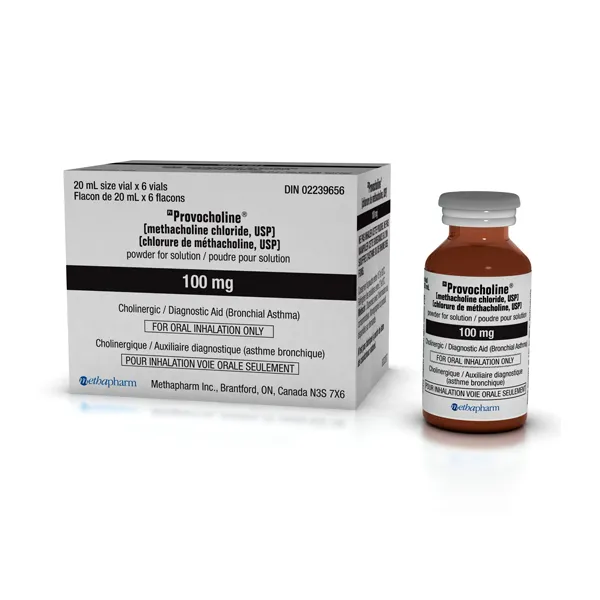
Table of Contents
- Package Leaflet: Information for the User
- Introduction
- 1. What PROVOCHOLINE 100 mg Powder for solution for inhalation by nebulizer is and what it is used for
- 2. What you need to know before using PROVOCHOLINE 100 mg Powder for solution for inhalation by nebulizer
- **Use of PROVOCHOLINE with food and beverages**
- **Driving and use of machines**
- 3. How to use PROVOCHOLINE 100 mg Powder for solution for inhalation by nebulizer
- **Adults and children aged 5 years and older**
- 4. Possible adverse effects
- 5. Storage of PROVOCHOLINE 100 mg Powder for solution for inhalation by nebulizer
- 6. Contents of the pack and other information
Package Leaflet: Information for the User
Introduction
Package leaflet: information for the user
PROVOCHOLINE 100 mg Powder for solution for inhalation for nebuliser
Methacholine chloride
Read the entire leaflet carefully before you start using this medicine, because it contains important information for you.
- Keep this leaflet. You may need to read it again.
- If you have any questions, ask your doctor or pharmacist.
- This medicine has been prescribed for you only. Do not pass it on to other people, even if they have the same symptoms, as it may harm them.
- If you experience any adverse effects, talk to your doctor or pharmacist, even if they are not listed in this leaflet. See section 4.
Leaflet Contents
- What PROVOCHOLINE 100 mg Powder for solution for inhalation for nebuliser is and what it is used for
- What you need to know before using PROVOCHOLINE 100 mg Powder for solution for inhalation for nebuliser
- How to use PROVOCHOLINE 100 mg Powder for solution for inhalation for nebuliser
- Possible side effects
- How to store PROVOCHOLINE 100 mg Powder for solution for inhalation for nebuliser
- Contents of the pack and other information
1. What PROVOCHOLINE 100 mg Powder for solution for inhalation by nebulizer is and what it is used for
This medicine is for diagnostic use only (performing a test to check whether a disease is present).
PROVOCHOLINE causes bronchoconstriction when administered as a solution via inhalation (inhalation).
PROVOCHOLINE is indicated for the diagnosis of asthma and, if positive, for determining its severity.
Individuals with asthma are much more sensitive to the bronchoconstriction caused by PROVOCHOLINE than healthy individuals. This difference in response is the pharmacological basis for diagnosing asthma with PROVOCHOLINE.
2. What you need to know before using PROVOCHOLINE 100 mg Powder for solution for inhalation by nebulizer
Do not use PROVOCHOLINE
-
If you are allergic to the active substance or to other parasympathomimetic agents (acetylcholine, carbachol, arecoline, pilocarpine…) or to any of the other components of this medicine (listed in section 6).
-
If you have asthma, wheezing (noisy breathing), or if your baseline (resting) lung function test results (FEV1) are equal to or less than 1–1.5 liters or 70% of the predicted value.
-
If you are taking beta-adrenergic blocking agents (medicines for blood pressure, circulation, or heart conditions); see “Other medicines and PROVOCHOLINE”.
-
If you have already undergone a test with PROVOCHOLINE, a second test with PROVOCHOLINE is contraindicated.
-
If you have uncontrolled hypertension (high blood pressure) or have had a myocardial infarction (heart attack) within the last 3 months.
-
If you have a disease called myasthenia gravis (muscle weakness and fatigue) and are being treated with cholinesterase inhibitor medicines.
Warnings and precautions
Consult your doctor or pharmacist before undergoing the provocation inhalation test with PROVOCHOLINE:
-
If you have ever had an epileptic seizure, or if you have any cardiovascular disease (heart or blood vessel disease), peptic ulcer, or urinary tract obstruction.
-
If you have recently had or currently have influenza, an upper respiratory tract infection, or chronic lung diseases (cystic fibrosis, sarcoidosis, tuberculosis, chronic obstructive pulmonary disease).
-
If you have allergic rhinitis (inflammation of the nasal mucosa with constant runny nose and nasal congestion) without asthma, if you are a smoker, or if you are exposed to airborne pollutants.
-
If you are being treated with medicines for asthma or allergies (see “Other medicines and PROVOCHOLINE”).
-
If you are a woman, you must inform your doctor whether you are pregnant, the date of your last menstrual period, or the date and result of your last pregnancy test. In women of childbearing age, pregnancy must be ruled out before performing the PROVOCHOLINE test.
-
Use is not recommended in children under 5 years of age due to lack of safety data.
-
Administration of PROVOCHOLINE may result in severe bronchoconstriction and reduced respiratory function. Patients with airway hyperreactivity may experience bronchoconstriction (bronchial narrowing that makes breathing difficult) at very low concentrations such as 0.025 mg/ml. If severe bronchoconstriction occurs, your doctor will administer an inhaled fast-acting bronchodilator (a beta-agonist) to counteract it.
-
The provocation inhalation test with PROVOCHOLINE must be performed only under the supervision of a specialist physician and in facilities equipped with appropriate equipment.
Other medicines and PROVOCHOLINE
Inform your doctor or pharmacist if you are using, have recently used, or might need to use any other medicines.
If you are taking beta-adrenergic blocking agents (medicines for blood pressure, circulation, or heart conditions), you should not undergo the provocation inhalation test with PROVOCHOLINE, as the response to methacholine hydrochloride may be exaggerated or prolonged, and you may not respond readily to treatment intended to restore normal breathing and relieve discomfort.
Treatment with asthma and allergy medicines (beta-agonists, anticholinergics, and theophylline) should be discontinued prior to the PROVOCHOLINE test.
The use of other asthma and allergy medicines such as corticosteroids, cromoglycate, and nedocromil may alter the response to PROVOCHOLINE; however, treatment with these medicines does not need to be interrupted.
The effects of other, more recently developed medicines have not been investigated.
Use of PROVOCHOLINE with food and beverages
Avoid consuming coffee, tea, cola drinks, and chocolate on the day the PROVOCHOLINE test is performed.
Pregnancy and breastfeeding
If you are pregnant or breastfeeding, think you may be pregnant, or plan to become pregnant, consult your doctor or pharmacist before using this medicine.
PROVOCHOLINE must not be used in pregnant women.
Breastfeeding will be interrupted if the PROVOCHOLINE test needs to be performed, as it is unknown whether it is excreted in breast milk.
Driving and use of machines
No effects on driving or use of machinery have been reported.
3. How to use PROVOCHOLINE 100 mg Powder for solution for inhalation by nebulizer
Follow exactly the instructions for administration of this medicine given by your doctor or pharmacist. If in doubt, consult your doctor or pharmacist again.
This medicine must be inhaled only using a special breathing device (nebulizer) under the direct supervision of a specialist physician. PROVOCHOLINE must not be used orally or by injection. It must be diluted before being inhaled. Your doctor will administer different concentrations of the diluted medicine by inhalation, as considered necessary, depending on the results obtained. Inform your doctor if you experience any difficulty breathing at any time during the test.
Adults and children aged 5 years and older
Before starting the PROVOCHOLINE challenge test, your doctor will perform tests to assess your baseline (resting) lung function. You may only undergo the inhalation provocation test with PROVOCHOLINE if your FEV1 (forced expiratory volume in the first second of forced exhalation) is at least 70% of the predicted value.
The test is considered positive if the reduction in FEV1 with PROVOCHOLINE reaches 20% compared to the value obtained in the lung function test performed without medication.
Standard inhalation procedure: The patient will receive a series of increasing concentrations (from lowest to highest) of PROVOCHOLINE. For each concentration, 5 inhalations will be administered via a nebulizer capable of delivering intermittent doses every 0.6 seconds using a dosimeter.
After the PROVOCHOLINE test, your doctor may administer a medication (bronchodilator) to accelerate the return of FEV1 to normal levels and relieve discomfort. Most patients return to normal lung function within 5 minutes after bronchodilator administration, or within 30–45 minutes without a bronchodilator.
Children under 5 years of age
Not recommended for use in children under 5 years of age due to lack of safety data.
If you use more PROVOCHOLINE than you should
PROVOCHOLINE is administered as a solution and only by inhalation. If administered orally or by injection, overdose of methacholine chloride may cause syncope (fainting), cardiac arrest, and loss of consciousness.
Severe toxic reactions should be treated with 0.5–1 mg of atropine sulfate administered intramuscularly or intravenously.
In case of overdose or accidental ingestion, consult your doctor or pharmacist immediately or call the Toxicology Information Service at telephone number 91 562 04 20.
4. Possible adverse effects
Like all medicines, this medicine may cause adverse effects, although not everyone experiences them.
Adverse reactions associated with inhalation provocation tests using PROVOCHOLINE include the following adverse effects: headache, throat irritation, dizziness, and itching.
Reporting of adverse effects
If you experience any type of adverse effect, consult your doctor or pharmacist, even if it is a possible adverse effect not listed in this leaflet. You can also report them directly through the Spanish Pharmacovigilance System for Human Medicines at http://www.notificaram.es. By reporting adverse effects, you can help provide more information on the safety of this medicine.
5. Storage of PROVOCHOLINE 100 mg Powder for solution for inhalation by nebulizer
Keep this medicine out of the sight and reach of children.
-
Unreconstituted vials (powder): No special storage conditions required.
-
Reconstituted vials (dilutions A, B, C, and D): Store in the refrigerator (between 2º and 8ºC) for up to 2 weeks. The stability of solutions A, B, C, and D is not affected by freezing.
-
Reconstituted vial E: Prepare on the same day of the provocation test.
Do not use this medicine after the expiry date stated on the packaging after EXP. The expiry date refers to the last day of the month indicated.
Medicines must not be disposed of via wastewater or household waste. Ask your pharmacist how to dispose of medicines and containers you no longer need. This helps protect the environment.
6. Contents of the pack and other information
Composition of PROVOCHOLINE
- The active substance is methacholine hydrochloride. Each 20 ml vial contains 100 mg of methacholine hydrochloride as powder.
- The excipient is nitrogen.
Appearance of the product and contents of the pack
PROVOCHOLINE is supplied in 20 ml amber-colored vials containing 100 mg of methacholine hydrochloride as powder, which is reconstituted with 0.9% sodium chloride injection containing 0.4% phenol (pH = 7.0). Each pack contains 6 vials.
Marketing Authorization Holder and Manufacturer
DIATER LABORATORIO DE DIAGNÓSTICO Y APLICACIONES TERAPÉUTICAS, S.A.
Avda. Gregorio Peces Barba 2,
28919 Leganés, Madrid
SPAIN
This information is intended solely for healthcare professionals:
Standard inhalation procedure: The patient will receive a series of concentrations (from lowest to highest) of PROVOCHOLINE. For each concentration, 5 inhalations will be administered via a nebulizer allowing intermittent release every 0.6 seconds using a dosimeter.
For each of the 5 inhalations in the concentration series, the patient will start from functional residual capacity (FRC) and inhale slowly and completely the dose released. FEV1 values will be determined 5 minutes after each administration. The procedure will end when FEV1 decreases by 20% or more from the baseline value obtained with sodium chloride solution (e.g., a positive response), or when a total cumulative dose of 188.88 units has been administered and FEV1 has decreased by 14% or less (e.g., a negative response). If a reduction in FEV1 of 15% to 19% is observed compared to baseline, the test may either be repeated at the same concentration or the next higher concentration may be administered, provided that the total cumulative dose does not exceed 188.88 units.
Prior to performing the inhalation provocation test, the physician must prepare the appropriate dilutions of PROVOCHOLINE. To do so, follow the instructions below:
Dilutions: (Note: Do not inhale the powder. Do not handle this product if you have asthma or allergy.) All dilutions must be prepared using 0.9% injectable sodium chloride solution containing 0.4% phenol (pH = 7.0), using empty, sterile Type I borosilicate glass vials. After adding the sodium chloride solution, shake each vial until a clear solution is obtained.
Dilution sequence – test for multiple patients (2–5 patients)
2 vials of PROVOCHOLINE are required.
Vials | Concentrations | |
A1 and A2 | Add 4 ml of 0.9% sodium chloride solution containing 0.4% phenol (pH = 7.0) to each of the 20 ml vials containing 100 mg of PROVOCHOLINE. Label the vials as A1 and A2. | 25 mg/ml |
B | Transfer 3 ml from vial A1 to another vial and add 4.5 ml of 0.9% sodium chloride solution containing 0.4% phenol (pH = 7.0). Label as vial B. | 10 mg/ml |
C | Transfer 1 ml from vial A2 to another vial and add 9 ml of 0.9% sodium chloride solution containing 0.4% phenol (pH = 7.0). Label as vial C. | 2.5 mg/ml |
D | Transfer 1 ml from vial C to another vial and add 9 ml of 0.9% sodium chloride solution containing 0.4% phenol (pH = 7.0). Label as vial D. | 0.25 mg/ml |
E | Transfer 1 ml from vial D to another vial and add 9 ml of 0.9% sodium chloride solution containing 0.4% phenol (pH = 7.0). Label as vial E. Prepare vial E on the day of the test. | 0.025 mg/ml |
Single patient dilution series - test
Vials | Concentrations | |
A | Add 4 ml of 0.9% sodium chloride solution containing 0.4% phenol (pH = 7.0) to each 20 ml vial containing 100 mg of PROVOCHOLINE. Label as vial A. | 25 mg/ml |
B | Transfer 1 ml from vial A to another vial and add 1.5 ml of 0.9% sodium chloride solution containing 0.4% phenol (pH = 7.0). Label as vial B. | 10 mg/ml |
C | Transfer 1 ml from vial A to another vial and add 9 ml of 0.9% sodium chloride solution containing 0.4% phenol (pH = 7.0). Label as vial C. | 2.5 mg/ml |
D | Transfer 1 ml from vial C to another vial and add 9 ml of 0.9% sodium chloride solution containing 0.4% phenol (pH = 7.0). Label as vial D. | 0.25 mg/ml |
E | Transfer 1 ml from vial D to another vial and add 9 ml of 0.9% sodium chloride solution containing 0.4% phenol (pH = 7.0). Label as vial E. Prepare vial E on the day of the test. | 0.025 mg/ml |
Use a sterile filter capable of retaining bacteria (0.22 μm) to transfer the solution from each vial (of at least 2 ml) to the nebulizer.
Date of the most recent review of this summary: June 2020
Detailed information on this medicine is available on the website of the Spanish Agency for Medicines and Health Products (AEMPS) (http://www.aemps.gob.es/)