Prothromplex Total 600 IU / 20 ml powder and solvent for solution for injection
Spain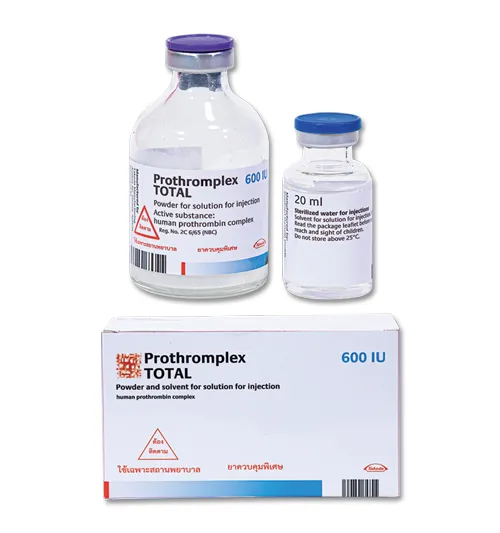
Table of Contents
- Package leaflet: Information for the user
- Introduction
- 1. What Prothromplex Total is and what it is used for
- 2. What you need to know before starting to use Prothromplex Total
- 3. How to use Prothromplex Total
- 4. Possible adverse effects
- 5. Storage of Prothromplex Total
- 6. Contents of the pack and other information
Package leaflet: Information for the user
Introduction
Package leaflet: information for the patient
Prothromplex Total 600 IU / 20 ml
Powder and solvent for solution for injection
human prothrombin complex
Read this entire leaflet carefully before you start using this medicine, because it contains important information for you.
- Keep this leaflet, as you may need to read it again.
- If you have any questions, consult your doctor.
- If you experience any adverse reactions, consult your doctor or pharmacist, even if they are not listed in this leaflet. See section 4.
Leaflet contents
- What Prothromplex Total is and what it is used for
- What you need to know before using Prothromplex Total
- How to use Prothromplex Total
- Possible adverse effects
- How to store Prothromplex Total
- Contents of the pack and other information
1. What Prothromplex Total is and what it is used for
Prothromplex Total is prepared from human plasma (the liquid part of the blood). It contains blood coagulation factors II, VII, IX, and X (prothrombin complex coagulation factors) and protein C.
These coagulation factors are vitamin K-dependent and, like vitamin K, play an important role in blood clotting. In case of deficiency of any of these factors, blood does not clot as quickly as usual, which increases the tendency to bleed.
Prothromplex Total is used for:
- the treatment of bleeding
- the prevention of bleeding immediately before or after surgery
- acquired deficiency and congenital deficiency of coagulation factors
Acquired deficiency:
You may develop a deficiency of vitamin K-dependent coagulation factors (acquired deficiency) caused, for example, by treatment with or overdose of medications that reduce the effect of vitamin K (known as vitamin K antagonists).
Congenital deficiency:
If you were born with a deficiency (congenital deficiency), this medicine can be administered immediately before or after surgery when the appropriate individual factor concentrate is not available.
2. What you need to know before starting to use Prothromplex Total
Do not use Prothromplex Total
- if you are allergic to coagulation factors or to any of the other components of this medicine (listed in section 6).
- if heparin has caused or you suspect has ever caused you a decrease in platelets, the blood cells responsible for blood clotting (heparin-induced thrombocytopenia).
Warnings and precautions
Traceability
Each time a dose of Prothromplex TOTAL is administered, it is recommended to record the product name and batch number to maintain traceability of the batches used.
Consult your doctor before starting to use Prothromplex Total
- because there is a rare possibility that you may develop a sudden severe allergic reaction (anaphylactic reaction) to Prothromplex Total, as such reactions have been reported.
Detailed information about the initial symptoms of this type of allergic reaction can be found in section 4, “Possible side effects”.
- if you have an acquired deficiency of vitamin K-dependent coagulation factors.
This acquired deficiency may be caused by treatment with medications that inhibit blood clotting through vitamin K antagonism. In this case, Prothromplex Total should only be used when rapid correction of prothrombin complex levels is required, such as in cases of severe bleeding or emergency surgery. In other cases, reducing the dose of the vitamin K antagonist or administering vitamin K is sufficient.
-
if you are receiving medications to inhibit blood clotting (vitamin K antagonists). You may have a tendency to form blood clots, which may increase with administration of human prothrombin complex concentrate.
-
if you have a congenital deficiency of specific vitamin K-dependent coagulation factors, a product containing the specific factor should be used if available.
-
if you are being treated with human prothrombin complex concentrate, especially if it has been administered repeatedly, as blood clots (thrombosis) may occur and enter the bloodstream (embolism).
-
if you belong to any of the following patient groups due to the risk of developing clots:
-
patients with coronary heart disease or who have had a myocardial infarction
-
patients with liver disease
-
pre- or post-operative patients
-
neonates
-
patients at risk of thromboembolic complications or disseminated intravascular coagulation (DIC)
In all these situations, your doctor will carefully evaluate the benefits of treatment with Prothromplex Total against the potential risks of these complications.
Viral safety
When medicines derived from human plasma or blood are administered, certain measures must be taken to prevent transmission of infections to patients.
Such measures include:
- careful selection of donors to exclude those at risk of carrying infectious diseases,
- testing for specific markers of infection in individual donations and plasma pools,
- inclusion of manufacturing steps designed to inactivate or remove viruses.
Despite these measures, when medicines derived from human blood or plasma are administered, the possibility of transmitting infectious agents cannot be completely ruled out. This also applies to emerging or unknown viruses and other types of infections.
These measures are considered effective against enveloped viruses such as human immunodeficiency virus (HIV), hepatitis B virus, hepatitis C virus, and against the non-enveloped hepatitis A virus. However, these measures may have limited effectiveness against other non-enveloped viruses such as parvovirus B19. Parvovirus B19 infection may be severe in pregnant women (fetal infection) and in individuals with weakened immune systems or certain types of anemia (e.g., sickle cell disease or hemolytic anemia).
Your doctor may recommend vaccination against hepatitis A and hepatitis B if you are receiving human prothrombin complex concentrates derived from human plasma on a regular or repeated basis.
It is strongly recommended that each time a dose of Prothromplex Total is administered, the name of the medicine and the batch number be recorded to maintain traceability of the batches used.
Children and adolescents
The safety and efficacy of Prothromplex Total in patients under 18 years of age have not been established in clinical trials.
Other medicines and Prothromplex Total
Inform your doctor or pharmacist if you are taking, have recently taken, or might need to take any other medicines.
Inform your doctor if you are receiving medications to inhibit blood clotting (vitamin K antagonists). You may have a tendency to form blood clots, which may increase with administration of human prothrombin complex concentrate.
Interference with biological tests
When performing coagulation tests that are sensitive to heparin in patients receiving high doses of prothrombin complex, the heparin contained in the administered product should be taken into account.
Pregnancy, breastfeeding, and fertility
If you are pregnant or breastfeeding, think you may be pregnant, or are planning to become pregnant, consult your doctor or pharmacist before using this medicine. Prothromplex Total may be used during pregnancy and breastfeeding only when clinically indicated.
There is no information available regarding the effects of Prothromplex Total on fertility.
Driving and using machines
No studies on the ability to drive and use machines have been conducted.
Prothromplex Total contains sodium and heparin
This medicine contains 81.7 mg of sodium (the main component of table/cooking salt) per vial. This corresponds to 4.1% of the maximum daily recommended sodium intake for an adult.
Heparin may cause allergic reactions and a reduction in blood cell counts that may affect the blood coagulation system. Patients with a history of heparin-induced allergic reactions should avoid using medicines containing heparin.
3. How to use Prothromplex Total
The initiation, administration, and monitoring of treatment must be carried out under the strict supervision of a physician experienced in the treatment of coagulation disorders.
The dose and duration of treatment with Prothromplex Total will depend on several factors such as body weight, severity of your condition, location and intensity of bleeding, or the need to prevent bleeding during surgical procedures.
Your doctor will calculate the dose according to your specific needs and will regularly monitor your coagulation and clinical condition (see section "This information is intended for healthcare professionals only").
Method of administration
Intravenous route.
The administration of Prothromplex Total must be supervised by a physician.
After reconstitution with the sterile water for injections supplied, Prothromplex Total is administered slowly into a vein (intravenous route). The rate of administration depends on your clinical condition and must not exceed 2 ml per minute (60 IU/min).
Use in children and adolescents
There are insufficient data to recommend the use of Prothromplex Total in patients under 18 years of age.
If you use more Prothromplex Total than you should
In case of overdose, the risk of thromboembolic complications or consumption coagulopathy increases.
When high doses of human prothrombin complex concentrates have been administered, myocardial infarction, increased consumption of platelets and coagulation factors, excessive clot formation in blood vessels (DIC, disseminated intravascular coagulation, consumption coagulopathy), venous thrombosis, and pulmonary embolism have been observed.
If you have any further questions about the use of this medicine, ask your doctor.
4. Possible adverse effects
Like all medicines, this medicine can cause adverse effects, although not everyone will experience them.
As with all treatments using plasma-derived products, there is a possibility that you may develop a sudden allergic reaction (anaphylactic reaction). In individual cases, this may range from a severe hypersensitivity reaction to shock.
Therefore, you should pay attention to possible early symptoms of an allergic reaction, such as:
- erythema (redness of the skin)
- skin rash
- appearance of hives on the skin (rash/urticaria)
- itching anywhere on the body
- swelling of the lips and tongue
- difficulty breathing/dyspnea
- chest tightness
- general malaise
- dizziness
- drop in blood pressure
If you notice one or more of the symptoms listed above, stop the infusion immediately. Call your doctor immediately. Severe symptoms require immediate emergency treatment.
When using prothrombin complex concentrates (including Prothromplex Total), patients may develop resistance (inhibitors) to one or more coagulation factors, resulting in inactivation of blood coagulation factors. The appearance of these inhibitors may manifest as an inadequate response to treatment.
During treatment with prothrombin complex concentrates, blood clots (thrombi) may form and enter the bloodstream (embolism). This may lead to complications such as myocardial infarction, increased consumption of platelets and coagulation factors with excessive clot formation in blood vessels (consumption coagulopathy), blockage of veins by a blood clot (venous thrombosis), and blockage of a pulmonary vessel by a blood clot (pulmonary infarction).
The following adverse effects may affect up to 1 in 10 people using Prothromplex Total:
- formation of blood clots throughout the body (disseminated intravascular coagulation), resistance (inhibitors) to one or more of the prothrombin complex factors (factors II, VII, IX, X)
- severe and sudden allergic reaction (anaphylactic shock), anaphylactic reaction, hypersensitivity, stroke, headache
- heart attack (acute myocardial infarction), rapid heartbeat (tachycardia)
- arterial thrombosis, venous thrombosis, drop in blood pressure (hypotension), redness of the skin (flushing)
- blockage of a pulmonary vessel by a blood clot (pulmonary embolism), difficulty breathing, shortness of breath (dyspnea), gasping
- vomiting, feeling of nausea (nausea)
- rash all over the body (urticaria), skin rash (erythematous rash), itching (pruritus)
- a certain kidney disorder with symptoms such as swelling of the eyelids, face, and lower legs, weight gain, and loss of protein through urine (nephrotic syndrome)
- fever (pyrexia).
The following adverse effects have been observed with other prothrombin complex concentrates:
- swelling of the face, tongue, and lips (angioedema), skin sensations such as burning, tingling, itching, or prickling of the skin (paresthesia)
- reaction at the injection site
- lethargy
- restlessness
Reporting of adverse effects
If you experience any type of adverse effect, consult your doctor, even if they are possible adverse effects not listed in this leaflet. You may also report them directly via the Spanish Pharmacovigilance System for Human Medicinal Products: www.notificaRAM.es.
By reporting adverse effects, you can help provide more information on the safety of this medicine.
5. Storage of Prothromplex Total
Store in a refrigerator (between 2°C and 8°C). Do not freeze.
Keep the medicine in the original packaging to protect it from light.
Keep this medicine out of the sight and reach of children.
Do not use this medicine after the expiry date stated on the container after EXP. The expiry date refers to the last day of the month indicated.
During its shelf life, the product may be stored at room temperature (maximum 25°C) for a period of up to 6 months. The start and end dates of storage at room temperature must be recorded on the medicine container.
After storage at room temperature, Prothromplex Total must not be returned to the refrigerator (2°C to 8°C) and must be discarded if not used within the 6-month period.
Use the solution immediately after reconstitution.
Medicines should not be disposed of via wastewater or household waste. Ask your pharmacist how to dispose of medicines and packaging you no longer need. This will help protect the environment.
6. Contents of the pack and other information
Composition of Prothromplex Total
Powder:
The active substance is human prothrombin complex, composed of human coagulation factors II, VII, IX, and X and protein C.
Per vial UI | After reconstitution with 20 ml of sterile water for injectable preparations UI/ml | |
human coagulation factor II | –450-850 | –22.5-42.5 |
human coagulation factor VII | 500 | 25 |
human coagulation factor IX | 600 | 30 |
human coagulation factor X | 600 | 30 |
A vial contains at least 400 IU of protein C co-purified with blood coagulation factors.
The other components are: sodium chloride, sodium citrate dihydrate, sodium heparin (0.2-0.5 IU/IU of factor IX), and antithrombin III 15-30 IU per vial (0.75-1.5 IU/ml).
Solvent: Sterile water for injectable preparations.
Appearance of the product and contents of the container
Powder and solvent for injectable solution.
Prothromplex Total is a white or slightly yellow powder, lyophilized or in the form of a compact dry substance.
After reconstitution, the solution has a pH between 6.5 and 7.5 and an osmolality of not less than 240 mosm/kg. The solution is clear or slightly opalescent.
The powder and solvent are contained in single-dose glass vials (hydrolytic glass type I and type II, respectively) sealed with butyl rubber stoppers.
Contents of the container
1 vial with Prothromplex Total 600 IU powder
1 vial with 20 ml sterile water for injectable preparations
Depending on the country-specific labelling, the packages may contain the following combinations of devices:
- 1 transfer needle, 1 air vent needle, 1 filter needle
- 1 disposable syringe, 1 triple set (air vent needle, butterfly needle, and disposable needle), 1 filter needle, 1 transfer needle
- 1 disposable syringe, 1 air vent needle, 1 butterfly needle, 1 disposable needle, 1 filter needle, 1 transfer needle
- 1 triple set (air vent needle, butterfly needle, and disposable needle), 1 filter needle, 1 transfer needle
- 1 transfer needle, 1 filter needle, 1 air vent needle, 1 butterfly needle, 1 disposable needle
- 1 transfer needle, 1 filter needle, 1 disposable syringe, 1 air vent needle, 1 twin set (butterfly needle, disposable needle)
Pack size 1 x 600 IU
Marketing Authorization Holder and Manufacturer
Marketing Authorization Holder:
Baxalta Innovations GmbH
Industriestrasse 67
1221 Vienna
Austria
Manufacturer:
Takeda Manufacturing Austria AG
Industriestrasse 67
A-1221 Vienna, Austria
Local representative:
Takeda Farmacéutica España S.A.
Calle Albacete, 5, 9th floor
Edificio Los Cubos
28027 Madrid
Spain
Tel: +34 91 790 42 22
This medicinal product is authorized in the Member States of the European Economic Area under the following names:
Austria: | Prothromplex TOTAL 600 IU Powder and solvent for solution for injection |
Belgium, Luxembourg: | Prothromplex 600 IU, powder and solvent for injectable solution |
Bulgaria: | Prothromplex Total NF 600 IU |
Czech Republic, Poland: | Prothromplex Total NF |
Denmark, Norway, Portugal: | Prothromplex |
Estonia, Greece: | Prothromplex TOTAL |
Germany: | Prothromplex NF 600 |
Hungary: | Prothromplex TOTAL 600 NE |
Ireland, Malta, United Kingdom: | Prothromplex TOTAL 600 IU |
Italy: | PROPLEX |
Lithuania: | Prothromplex 600 TV powder and solvent for injection solution |
Latvia: | Prothromplex TOTAL 600 SV powder and solvent for preparation of injection solution |
Netherlands: | Prothromplex 600 IU powder and solvent for solution for injection |
Romania: | Prothromplex TOTAL 600 IU powder and solvent for injectable solution |
Slovakia: | Prothromplex NF 600 IU |
Slovenia: | PROPLEX 600 i.e. powder and vehicle for solution for injection |
Spain: | Prothromplex Total 600 IU |
Date of the most recent review of this summary: 10/2024
Detailed and up-to-date information on this medicine is available on the website of the Spanish Agency of Medicines and Health Products (AEMPS) http://www.aemps.gob.es/
This information is intended exclusively for healthcare professionals:
Dosage
The following are general dosage guidelines only, except for the treatment of bleeding and perioperative bleeding prophylaxis during treatment with vitamin K antagonists.
Treatment must be initiated under the supervision of a physician experienced in the management of coagulation disorders. The dose and duration of replacement therapy depend on the severity of the disorder, the location and intensity of bleeding, and the patient's clinical condition.
The amount and frequency of administration must be individually calculated for each patient. Dosing intervals should be adjusted according to the different circulating half-lives of the various coagulation factors in the prothrombin complex.
Individual dosage requirements can only be determined through periodic measurement of plasma levels of the relevant coagulation factors or through global assessment of prothrombin complex levels (e.g., Quick test, INR, prothrombin time), along with continuous monitoring of the patient's clinical condition.
In the case of major surgical procedures, precise monitoring of replacement therapy is essential, using coagulation tests (specific factor assays and/or global tests to measure prothrombin complex levels).
Bleeding and perioperative bleeding prophylaxis during treatment with vitamin K antagonists:
In severe bleeding or prior to undergoing surgery with a high risk of bleeding, normal levels must be achieved (Quick test 100%, INR 1.0).
The following rule applies: 1 IU of factor IX/kg body weight increases the Quick test value by approximately 1%.
If administration of Prothromplex Total is based on INR values, the dose will depend on the pre-treatment INR value and the target INR to be achieved.
The doses described in the following table should be followed, according to the recommendations published by Makris et al 20011.
Prothromplex Total Dose Based on Initial INR Values | |
INR | Dose, IU/kg (IU refers to Factor IX) |
2.0–3.9 | 25 |
4.0–6.0 | 35 |
>6.0 | 50 |
The correction of vitamin K antagonist-induced impairment of hemostasis lasts for approximately 6–8 hours. However, the effects of vitamin K, when administered simultaneously, are usually achieved within 4–6 hours. Therefore, repeating treatment with human prothrombin complex concentrate is not necessary when vitamin K has been administered.
Since these recommendations are empirical and recovery and duration of effect may vary, monitoring of the INR during treatment is mandatory.
1Makris M, Watson HG: The Management of Coumarin-Induced Over-Anticoagulation Br. J. Haematol. 2011; 114:271-280
Treatment of bleeding and perioperative bleeding prophylaxis in congenital deficiency of any vitamin K-dependent coagulation factor, when a purified specific coagulation factor product is not available:
The calculation of the required dose for treatment is based on the empirical observation that approximately 1 IU of factor VII or factor IX per kg of body weight increases plasma factor IX activity by about 0.015 IU/mL; and 1 IU per kg of body weight of factor VII by about 0.024 IU/mL. One IU of factor II or X per kg of body weight increases plasma factor II or X activity by approximately 0.021 IU/mL2
2Ostermann H, Haertel S, Knaub S, Kalina U, Jung K, Pabinger I. Pharmacokinetics of Beriplex P/N prothrombin complex concentrate in healthy volunteers. Thromb Haemost. 2007;98(4):790-797
The dose of a specific factor administered is expressed in International Units (IU), which are related to the current WHO standard for each factor. The plasma activity of a specific coagulation factor is expressed either as a percentage (relative to normal plasma) or in International Units (relative to the international standard for the specific coagulation factor).
One International Unit (IU) of coagulation factor activity is equivalent to the amount contained in 1 mL of normal human plasma.
The required dose is determined using the following formula:
For example, the calculation of the required dose of factor X is based on the empirical observation that 1 International Unit (IU) of factor X per kg of body weight increases plasma factor X activity by approximately 0.017 IU/mL. The required dose is determined using the following formula:
Units required = body weight (kg) × desired increase in factor X (IU/mL) × 60
where 60 (mL/kg) is the reciprocal of the estimated recovery.
If individual recovery is known, this value should be used in the calculation.
Paediatric population
The safety and efficacy of Prothromplex Total in the paediatric population have not been established in Baxter's clinical trials.
Interaction with other medicinal products and other forms of interaction
When high doses of Prothromplex Total are administered, the heparin contained in the product must be taken into account when performing coagulation tests sensitive to heparin.
Incompatibilities
This medicinal product must not be mixed with other medicinal products except with the solvent supplied.
As with all coagulation factor medicines, the efficacy and tolerability of the product may be affected if mixed with other medicinal products. It is recommended to flush a common venous access line with isotonic saline solution before and after administration of Prothromplex Total.
Special precautions for disposal and other handling
Only the reconstitution equipment supplied should be used for reconstitution.
Prothromplex Total must be reconstituted immediately before administration. The solution should be used immediately after reconstitution (the solution does not contain preservatives).
The solution is transparent or slightly opalescent. The reconstituted product should be inspected visually before administration to ensure the absence of foreign particles or discoloration. Do not use solutions that are cloudy or contain deposits.
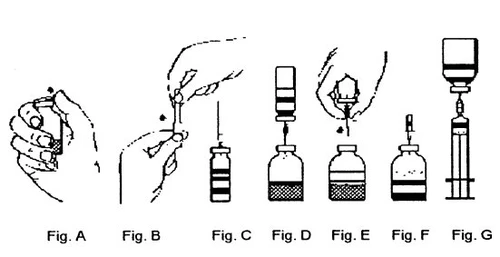
Reconstitution of the powder for solution for injection:
Use an aseptic technique!
- Warm the vial containing the solvent (sterile water for injection), without opening, to room temperature (max. 37°C).
- Remove the caps from the concentrate vial and the solvent vial (Fig. A) and disinfect the corresponding rubber stoppers.
- Remove the cap from one end of the transfer needle provided, by twisting and pulling, and insert the needle through the rubber stopper of the solvent vial (Fig. B and C).
- Remove the cap from the other end of the transfer needle, taking care not to touch the exposed end.
- Invert the solvent vial over the powder vial and insert the free end of the transfer needle through the rubber stopper of the powder vial (Fig. D). The solvent will be drawn into the powder vial by vacuum action.
- Disconnect the two vials by removing the transfer needle together with the solvent vial from the powder vial (Fig. E). Gently shake the concentrate vial to accelerate dissolution.
- Once the powder is completely dissolved, insert the included air-venting needle (Fig. F) to eliminate any foam. Remove the air-venting needle.
Injection/Infusion:
The reconstituted product must always be inspected visually before administration to ensure the absence of foreign particles or discoloration.
Use an aseptic technique!
- Remove the cap from the included filter needle by twisting and pulling, and attach the filter needle to a sterile disposable syringe. Draw the solution into the syringe (Fig. G).
- Detach the filter needle from the syringe and administer the solution slowly intravenously (maximum injection/infusion rate: 2 mL/min).
After administration, dispose of all opened needles together with the syringe and/or administration equipment in the product packaging to avoid risk to others.
Disposal of unused medicine and all materials that have come into contact with it must be carried out in accordance with local regulations.
Document each administration of Prothromplex Total in the patient's record using the adhesive label supplied.