ProQuad powder and solvent for injectable suspension in pre-filled syringe
Spain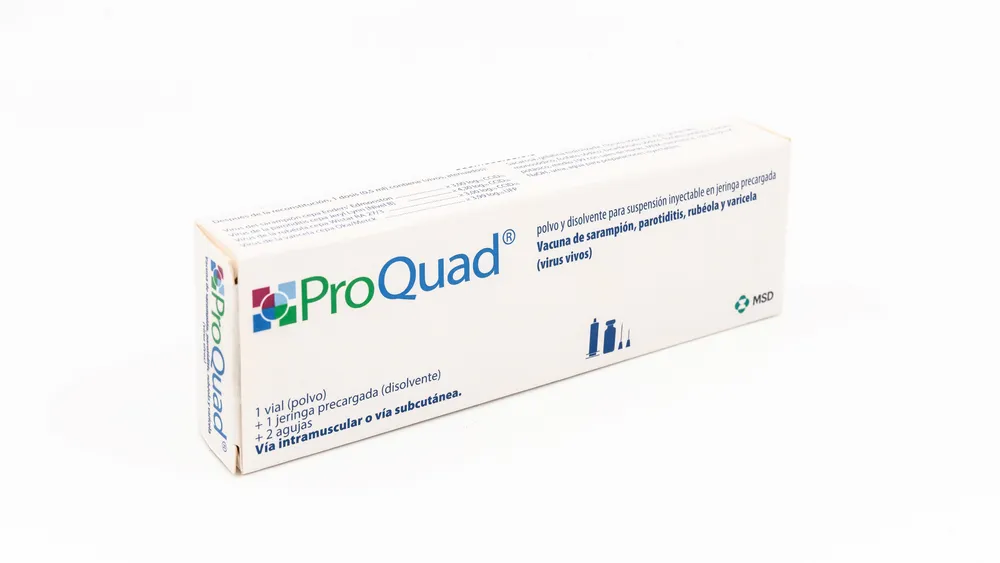
Table of Contents
Package leaflet: Information for the user
Introduction
Package leaflet: information for the user
ProQuad
Powder and solvent for injectable suspension in pre-filled syringe
Measles, mumps, rubella and varicella vaccine (live)
Read the entire leaflet carefully before you or your child are vaccinated, because it contains important information for you.
- Keep this leaflet, as you may need to read it again.
- If you have any questions, consult your doctor or pharmacist.
- This vaccine has been prescribed for you or your child only, and must not be given to other people.
- If you experience adverse reactions, consult your doctor or pharmacist, even if they are adverse reactions not listed in this leaflet. See section 4.
Leaflet contents
- What ProQuad is and what it is used for
- What you need to know before receiving ProQuad
- How to use ProQuad
- Possible adverse effects
- How to store ProQuad
- Contents of the pack and other information
1. What ProQuad is and what it is used for
ProQuad is a vaccine containing attenuated viruses of measles, mumps, rubella, and varicella. When the vaccine is administered to a person, the immune system (the body's natural defenses) will produce antibodies against the measles, mumps, rubella, and varicella viruses. These antibodies help protect against infections caused by these viruses.
ProQuad is given to help protect your child against measles, mumps, rubella, and varicella. The vaccine can be administered to individuals from 12 months of age.
ProQuad may also be administered to children from 9 months of age under special circumstances (to comply with national vaccination schedules, during outbreak situations, or travel to regions with high measles prevalence).
Although ProQuad contains live viruses, they are too weak to cause measles, mumps, rubella, or varicella in healthy individuals.
2. What you need to know before receiving ProQuad
Do not use ProQuad
- If the person to be vaccinated is allergic to any varicella, measles, mumps, or rubella vaccine, or to any of the other components of this vaccine (listed in section 6), including neomycin.
- If the person to be vaccinated has blood disorders or any type of cancer affecting the immune system.
- If the person to be vaccinated is receiving treatment or taking medication that may weaken the immune system (except low-dose corticosteroid therapy for asthma or replacement therapy).
- If the person to be vaccinated has a weakened immune system due to illness (including HIV/AIDS).
- If the person to be vaccinated has a family history of congenital or hereditary immunodeficiency, unless their immune competence has been demonstrated.
- If the person to be vaccinated has untreated active tuberculosis.
- If the person to be vaccinated has any illness with fever above 38.5°C; however, a lower fever is not in itself a reason to delay vaccination.
- If the person to be vaccinated is pregnant (also, pregnancy should be avoided for 1 month after vaccination; see Pregnancy and breastfeeding).
Warnings and precautions
If the person to be vaccinated experiences any of the following problems, consult your doctor or pharmacist before receiving ProQuad:
- An allergic reaction to egg or any egg-containing product.
- Personal or family history of allergies or seizures (fits).
- An adverse reaction after measles, mumps, and/or rubella-containing vaccines involving bruising or prolonged bleeding.
- Human Immunodeficiency Virus (HIV) infection without symptoms of HIV disease. However, vaccination may be less effective than in non-infected individuals (see Do not use ProQuad).
If you have a bleeding disorder or low platelet levels, the injection will be given subcutaneously.
In rare cases, it is possible to contract chickenpox, including severe chickenpox, from a person who has been vaccinated with ProQuad. This may occur in individuals who have not previously been vaccinated against chickenpox or have not had chickenpox, as well as in individuals in the following categories:
- Individuals with low resistance to disease.
- Pregnant women who have never had chickenpox or have not been vaccinated against chickenp0x.
- Newborns whose mothers have never had chickenpox or have not been vaccinated against chickenpox.
Whenever possible, individuals who have been vaccinated with ProQuad should avoid close contact, for up to 6 weeks after vaccination, with anyone in the above categories. Inform your doctor if someone falls into one of the above categories and is expected to have close contact with the vaccinated person.
As with other vaccines, ProQuad may not fully protect all vaccinated individuals. In addition, if the person to be vaccinated has already been exposed to measles, mumps, rubella, or varicella virus but has not yet developed the disease, ProQuad may not prevent the disease from occurring.
Other medicines and ProQuad
Inform your doctor or pharmacist if the vaccinated person is using or has recently used any other medicines (or other vaccines).
ProQuad can be administered at the same time as other pediatric vaccines such as Prevenar and/or hepatitis A vaccine, or with vaccines containing diphtheria, tetanus, acellular pertussis, Haemophilus influenzae type b, inactivated polio, or hepatitis B. A different injection site will be used for each vaccine.
The doctor may delay vaccination by at least 3 months after a blood or plasma transfusion or after administration of immunoglobulin (Ig) or varicella-zoster immunoglobulin (VZIG). After vaccination with ProQuad, Ig or VZIG should not be administered within 1 month, unless otherwise directed by your doctor.
If a tuberculin skin test is to be performed, it should be done either before vaccination at any time, simultaneously with ProQuad, or 4 to 6 weeks after vaccination.
Inform your doctor if the vaccinated person has recently received a vaccine or has one scheduled in the near future. Your doctor will determine when ProQuad should be administered.
The use of salicylates (e.g., acetylsalicylic acid, a substance found in many medicines used to relieve pain and reduce fever) should be avoided for 6 weeks following vaccination with ProQuad.
Pregnancy and breastfeeding
ProQuad must not be given to pregnant women. Women of childbearing age should take appropriate precautions to avoid pregnancy for 1 month after vaccination.
Inform your doctor if you are breastfeeding or will be breastfeeding. Your doctor will decide whether you should receive ProQuad.
If you are pregnant or breastfeeding, think you may be pregnant, or plan to become pregnant, consult your doctor or pharmacist before using this vaccine.
Driving and using machines
There is no information suggesting that ProQuad affects the ability to drive or operate machinery.
ProQuad contains sodium
This medicine contains less than 1 mmol of sodium (23 mg) per dose; that is, essentially “sodium-free”.
ProQuad contains potassium
This medicine contains potassium, less than 1 mmol (39 mg) per dose; that is, essentially “potassium-free”.
ProQuad contains sorbitol
This medicine contains 16 mg of sorbitol per dose. The additive effect of concomitantly administered medicines containing sorbitol (or fructose) and dietary intake of sorbitol (or fructose) should be taken into account.
3. How to use ProQuad
ProQuad must be injected into the muscle or under the skin, either into the outer side of the thigh or the upper arm.
The recommended injection sites for intramuscular injections are the thigh area in young children, whereas for older individuals, the upper arm is preferred.
If the person to be vaccinated has a coagulation disorder or low platelet levels, the vaccine should be administered subcutaneously, as bleeding may occur after intramuscular administration.
ProQuad must not be injected directly into any blood vessel.
ProQuad is administered by injection as follows:
- Children between 9 and 12 months of age:
ProQuad may be given starting at 9 months of age. To ensure optimal protection against varicella and measles, two doses of ProQuad should be administered with an interval of at least 3 months between doses.
- Individuals 12 months of age and older:
To ensure optimal protection against varicella, two doses of ProQuad should be administered with an interval of at least 1 month between doses.
The appropriate timing and number of injections will be determined by your doctor according to official recommendations.
Reconstitution instructions intended for physicians or healthcare professionals are included at the end of the leaflet.
If you forgot to use ProQuad
Your doctor will decide when to administer the missed dose.
4. Possible side effects
Like all vaccines and medicines, this vaccine may cause side effects, although not everybody gets them.
Allergic reactions (such as hives) may occur. Some of these reactions can be serious and may include difficulty breathing or swallowing. If the vaccinated person experiences an allergic reaction, contact their doctor immediately.
Other side effects have been reported following administration of ProQuad, some of which were serious. These included:
- Uncommon (may affect up to 1 in 100 people): febrile seizures.
- Rare (may affect up to 1 in 1,000 people): unsteadiness when walking.
The following side effects most frequently reported with the use of ProQuad were:
- Very common (may affect more than 1 in 10 people): injection site discomfort including pain/tenderness/discomfort, redness, fever (38.9 °C or higher);
- Common (may affect up to 1 in 10 people): injection site discomfort including swelling or painful lump; irritability; rash (including measles-like rash, chickenpox-like rash, and rash at the injection site); upper respiratory tract infection; vomiting and diarrhoea.
Other side effects have been reported with the administration of at least one of the following vaccines: ProQuad, previous formulations of monovalent and combined measles, mumps, and rubella vaccines manufactured by Merck Sharp & Dohme LLC, Rahway, NJ 07065, USA (hereinafter MSD), or Varicella Virus Live Vaccine (Oka/Merck). These adverse events include:
- Uncommon (may affect up to 1 in 100 people): cough
- Rare (may affect up to 1 in 1,000 people): skin infection; chickenpox.
- Not known (cannot be estimated from available data):
- Brain infection or inflammation (encephalitis) has been observed after vaccination with live attenuated measles, mumps, rubella, and varicella vaccines. In some cases, this disease has been fatal, especially in individuals with weakened immune systems (as noted in section 2, ProQuad must not be used in patients with weakened immune systems). Seek immediate medical attention if you or your child experience loss of or decreased level of consciousness, seizures, or loss of control of body movements, accompanied by fever and headache, as these could be signs of brain infection or inflammation. Inform your doctor or pharmacist that you or your child have been vaccinated with ProQuad.
- unusual bleeding or painful skin lesions; swelling of the testicles; skin tingling; herpes zoster (shingles); inflammation of the membranes covering the brain and spinal cord not caused by bacterial infection (aseptic meningitis); severe skin disorders; skin granuloma (collections of inflammatory cells); stroke; seizures without fever; joint pain and/or swelling (which may be transient or chronic); lung inflammation (pneumonia/pneumonitis).
Your doctor has access to a more comprehensive list of side effects for ProQuad and for the components of ProQuad (measles, mumps, and rubella vaccines manufactured by MSD and Varicella Virus Live Vaccine (Oka/Merck)).
Reporting of side effects
If you experience any type of side effect, talk to your doctor, pharmacist, or nurse, even if it is a possible side effect not listed in this leaflet. You can also report them directly through the national reporting system listed in Appendix V. By reporting side effects, you can help provide more information on the safety of this medicine.
5. Storage of ProQuad
Keep this vaccine out of the sight and reach of children.
Do not use this vaccine after the expiry date stated on the outer packaging following EXP. The expiry date refers to the last day of the month indicated.
Store and transport refrigerated (between 2 °C and 8 °C).
Do not freeze.
Keep the vial in the outer carton to protect it from light.
Medicines should not be disposed of via wastewater or household waste. Ask your pharmacist how to dispose of medicines and packaging you no longer need. This will help protect the environment.
6. Contents of the container and other information
Composition of ProQuad
After reconstitution, one dose (approximately 0.5 ml) contains:
The active substances are:
Measles virus1 Enders' Edmonston strain (live, attenuated) | not less than 3.00 log10 TCID50* |
Mumps virus1 Jeryl Lynn strain (Level B) (live, attenuated) | not less than 4.30 log10 TCID50* |
Rubella virus2 Wistar RA 27/3 strain (live, attenuated) | not less than 3.00 log10 TCID50* |
Varicella virus3 Oka/Merck strain (live, attenuated) | not less than 3.99 log10 PFU** |
- Dose infecting 50% of histocultures
** Plaque-forming units
(1) Produced in chick embryo cells.
(2) Produced in human diploid lung fibroblasts (WI-38).
(3) Produced in human diploid cells (MRC-5).
The other components are:
Powder
Sucrose, hydrolyzed gelatin, urea, sodium chloride, sorbitol (E-420), monosodium glutamate, sodium phosphate, sodium bicarbonate, potassium phosphate, potassium chloride, Medium 199 with Hanks' salts, MEM, neomycin, phenol red, hydrochloric acid (HCl), and sodium hydroxide (NaOH).
Solvent
Water for injections.
Appearance of the product and contents of the container
The vaccine is a powder for injectable suspension contained in a single-dose vial, which must be mixed with the solvent supplied with the powder vial.
The powder is a compact crystalline mass, white to pale yellow in color, and the solvent is a colorless, clear liquid.
ProQuad is available in pack sizes of 1, 10, and 20. Only some pack sizes may be marketed.
Marketing Authorization Holder and Manufacturer
Merck Sharp & Dohme B.V., Waarderweg 39, 2031 BN Haarlem, The Netherlands
Further information on this medicinal product is available upon request to the local representative of the Marketing Authorization Holder.
Belgium/Belgium/Belgium MSD Belgium Tel/Tel: +32(0)27766211 | Lithuania UAB Merck Sharp & DohmeTel. +370 5 2780 [email protected] |
| Luxembourg/Luxembourg MSD Belgium Tel/Tel: +32(0)27766211 |
Czech Republic Merck Sharp & Dohme s.r.o.Tel.: +420 277 050 [email protected] | Hungary MSD Pharma Hungary Kft.Tel.: + 36 1 888 5300 |
Denmark MSD Danmark ApS Tlf.: +45 4482 4000 | Malta Merck Sharp & Dohme Cyprus LimitedTel: 8007 4433 (+356 99917558) |
Germany MSD Sharp & Dohme GmbH Tel.: +49 (0) 89 20 300 4500 | Netherlands Merck Sharp & Dohme B.V. Tel: 0800 9999000 (+31 23 5153153) |
Estonia Merck Sharp & Dohme OÜ Tel: +372 614 4200 | Norway MSD (Norge) AS Tlf: +47 32 20 73 00 |
Greece MSD Α.Φ.Ε.Ε. Tel: +30 210 98 97 300 | Austria Merck Sharp & Dohme Ges.m.b.H. Tel: +43 (0) 1 26 044 |
Spain Merck Sharp & Dohme de España, S.A. Tel: +34 91 321 06 00 | Poland MSD Polska Sp. z o.o.Tel.: +48 22 549 51 00 |
France MSD FranceTél: + 33 (0)1 80 46 40 40 | Portugal Merck Sharp & Dohme, Lda Tel: +351 21 4465700 |
Croatia Merck Sharp & Dohme d.o.o.Tel: +385 1 66 11 333 | Romania Merck Sharp & Dohme Romania S.R.L Tel: + 4021 529 29 00 |
Ireland Merck Sharp & Dohme Ireland (Human Health) Limited Tel: +353 (0)1 2998700 | Slovenia Merck Sharp & Dohme, inovativna zdravila d.o.o.Tel: +386 1 520 4201 |
Iceland Vistor ehf. Tel: + 354 535 7000 | Slovakia Merck Sharp & Dohme, s. r. o.Tel: +421 2 58282010 |
Italy MSD Italia S.r.l. Tel: 800 23 99 89 (+39 06 361911) | Finland/Sweden MSD Finland Oy Tel/Tel: +358 (0)9 804 650 |
Cyprus Merck Sharp & Dohme Cyprus LimitedTel: 800 00 673 (+357 22866700) | Sweden Merck Sharp & Dohme (Sweden) AB Tel: +46 77 5700488 |
Latvia SIA Merck Sharp & Dohme LatvijaTel.: +371 67025300 |
Date of the most recent review of this leaflet: <{MM/YYYY}><{month YYYY}>.
Other sources of information
Detailed information on this medicinal product is available on the European Medicines Agency website: https://www.ema.europa.eu.
This information is intended for healthcare professionals only:
Before mixing with the solvent, the vaccine powder is a compact crystalline mass ranging in colour from white to pale yellow. The solvent is a colourless, clear liquid. When fully reconstituted, the vaccine is a pale yellowish to pale pink liquid.
For reconstitution of the vaccine, use only the solvent supplied, as it contains no preservatives or other antiviral substances that could inactivate the vaccine.
It is important to use a new sterile syringe and new sterile needle for each individual to prevent transmission of infectious agents from one person to another.
A separate needle should be used for reconstitution and a different needle for injection.
ProQuad must not be mixed in the same syringe with other vaccines.
Instructions for reconstitution
To attach the needle, firmly place it on the end of the syringe and secure by twisting.
Inject the entire contents of the solvent from the syringe into the vial containing the powder. Gently shake to ensure complete mixing.
The reconstituted vaccine should be inspected visually for foreign particles and/or any change in physical appearance before administration. If either is observed, discard the vaccine.
It is recommended that the vaccine be administered immediately after reconstitution to minimize loss of potency. Discard the reconstituted vaccine if not used within 30 minutes.
Do not freeze the reconstituted vaccine.
Withdraw the complete contents of the reconstituted vaccine from the vial into a syringe, change the needle, and inject the full dose subcutaneously or intramuscularly.
Any unused products or waste materials must be disposed of in accordance with local requirements.
See also Section 3 How to use ProQuad