Propofol Lipuro 10 mg/ml emulsion for injection and infusion
Spain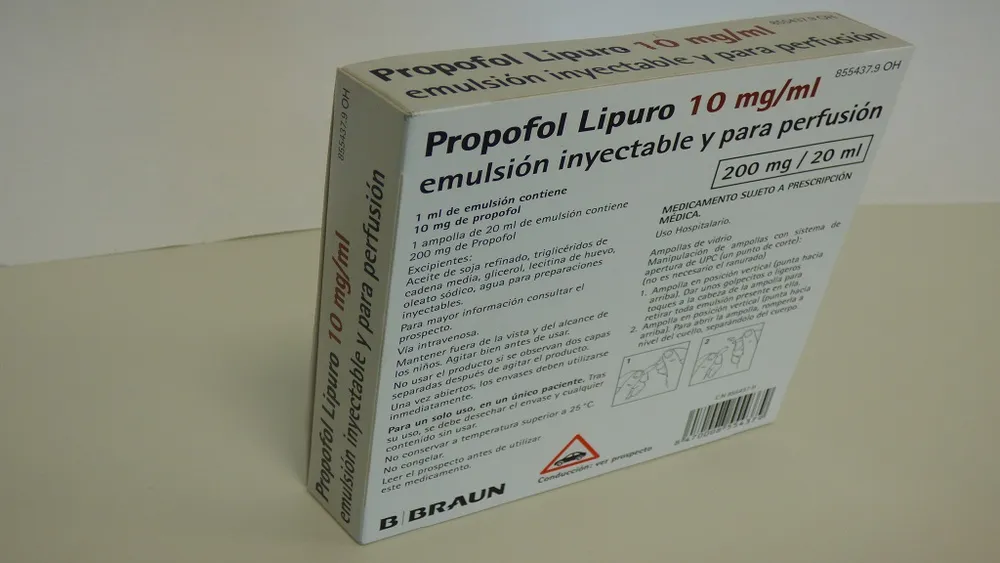
Table of Contents
Package leaflet: Information for the user
Introduction
Package leaflet: Information for the user
Propofol Lipuro 10mg/ml emulsion for injection and infusion
Propofol
Read the entire leaflet carefully before you start using this medicine, because it contains important information for you.
- Keep this leaflet, as you may need to read it again.
- If you have any questions, ask your doctor, pharmacist or nurse.
- If you experience any adverse effects, consult your doctor, pharmacist or nurse, even if they are adverse effects not listed in this leaflet. See section 4.
Leaflet contents
- What Propofol Lipuro is and what it is used for
- What you need to know before using Propofol Lipuro
- How to use Propofol Lipuro
- Possible side effects
- How to store Propofol Lipuro
- Contents of the pack and other information
1. What Propofol Lipuro is and what it is used for
Propofol Lipuro belongs to a group of medicines called general anaesthetics. General anaesthetics are used to produce unconsciousness (sleep) so that surgical operations or other procedures can be performed. They may also be used to sedate you (to make you drowsy, but not completely asleep).
Propofol Lipuro is used for:
- inducing and maintaining general anaesthesia in adults and children over 1 month of age,
- sedating patients over 16 years of age who are receiving mechanical ventilation in intensive care,
- sedating adults and children over 1 month of age during diagnostic and surgical procedures, either alone or in combination with local or regional anaesthesia.
2. What you need to know before using Propofol Lipuro
Do not use Propofol Lipuro:
- If you are allergic to propofol, soy, peanuts, or any of the other ingredients of this medicine (listed in section 6).
It must not be used in patients aged 16 years or younger for intensive care sedation.
Safety and efficacy have not been established in these age groups.
Warnings and precautions
Talk to your doctor or pharmacist before you start receiving Propofol Lipuro.
Special care is needed
- if you have severe head injuries,
- if you have a mitochondrial disease,
- if you suffer from a disorder in which your body does not properly process fats,
- if you have any other medical condition requiring particular caution when using fat emulsions,
- if your blood volume is too low (hypovolemia),
- if you have low levels of protein in the blood (hypoproteinemia),
- if you are very weak or suffer from heart, kidney, or liver problems,
- if you have high pressure in the skull,
- if you have any respiratory problems,
- if you suffer from epilepsy,
- if you are undergoing certain procedures where spontaneous movements are especially undesirable.
Inform your doctor if you have any of these diseases or conditions.
If you are simultaneously receiving other lipids by intravenous infusion, your doctor will pay special attention to your total daily fat intake.
Propofol will be administered by a specialist doctor experienced in anaesthesia or intensive care. You will be continuously monitored during anaesthesia and the recovery period.
If you experience signs of the so-called "propofol infusion syndrome" (see section 4, "Possible side effects", "Call a doctor immediately if any of the following effects occur"), your doctor will immediately stop the administration of propofol.
See also section "Driving and using machines" for precautions to take after using propofol.
Children and adolescents
The use of Propofol Lipuro is not recommended in newborns.
This medicine must not be used in patients aged 16 years or younger for sedation in intensive care (see section "Do not use Propofol Lipuro").
Other medicines and Propofol Lipuro
Inform your doctor or pharmacist if you are taking, have recently taken, or might need to take any other medicines.
Propofol has been successfully used in combination with various regional anaesthesia techniques, which numb only part of the body (epidural and spinal anaesthesia).
In addition, its safe use has been demonstrated in combination with:
- drugs given before surgery,
- other medicines such as muscle relaxants,
- inhaled anaesthetic agents,
- analgesics.
However, your doctor may administer lower doses of propofol if general anaesthesia or sedation is required as an adjunct to regional anaesthesia techniques.
Your doctor should be aware that administering propofol together with other medicines that have a central nervous system depressant effect may enhance the effects of propofol. Particular attention should be paid if you are concurrently receiving an antibiotic containing rifampicin — you may develop a severe drop in blood pressure.
Your doctor may reduce the dose if you are also receiving valproate (an anticonvulsant).
Use of Propofol Lipuro and alcohol
Your doctor will advise you on alcohol consumption before and after the use of Propofol Lipuro.
Pregnancy and breastfeeding
If you are pregnant or breastfeeding, think you may be pregnant, or are planning to become pregnant, consult your doctor or pharmacist before using this medicine.
Propofol Lipuro should not be used during pregnancy unless absolutely necessary. It crosses the placenta and may depress vital functions in the baby.
However, propofol may be used during induced abortion.
If you are breastfeeding, you must stop temporarily and discard breast milk for 24 hours after receiving Propofol Lipuro. Studies in lactating women have shown that propofol passes into breast milk in small amounts.
Driving and using machines
Do not drive or operate tools or machinery for some time after receiving an injection or infusion of Propofol Lipuro.
Your doctor will advise you:
- whether you should be accompanied when leaving,
- when you may resume driving and operating machinery,
- about the use of other sedative drugs (e.g., sedatives, strong analgesics, alcohol).
Propofol Lipuro contains sodium and soybean oil
This medicine contains less than 1 mmol of sodium (23 mg) per 100 ml; hence, it is essentially "sodium-free".
Propofol Lipuro contains soybean oil. Do not use this medicine if you are allergic to peanuts or soy.
3. How to use Propofol Lipuro
Propofol Lipuro will only be administered by individuals trained in the administration of anaesthesia or by specially qualified doctors in a hospital or a properly equipped day treatment unit.
Posology
Your dose will vary, depending on your age, body weight and physical condition. Your doctor will administer the appropriate dose to induce and maintain anaesthesia or to achieve the desired level of sedation, carefully observing your responses and vital signs (pulse, blood pressure, respiration, etc.).
Your doctor will observe the maximum administration time, if necessary.
Propofol Lipuro will only be administered for a maximum of seven days.
Method of administration
You will receive Propofol Lipuro by injection or infusion, that is, through a small needle or a small tube placed in one of your veins. If administered by infusion, it may be diluted beforehand.
Since Propofol Lipuro does not contain preservatives, an infusion from a vial of Propofol Lipuro must not last longer than 12 hours. An infusion from a diluted vial of Propofol Lipuro must not last longer than 6 hours.
Your circulation and respiration will be continuously monitored while you receive the injection or infusion.
If you have been given more Propofol Lipuro than you should have
It is unlikely that this will occur, as the doses you receive are very carefully controlled.
However, if you accidentally receive an overdose, this may lead to depression of cardiac and respiratory function. In such a case, your doctor will immediately initiate any necessary treatment.
If you have any further questions about the use of this product, ask your doctor or pharmacist.
4. Possible adverse effects
Like all medicines, Propofol Lipuro 10 mg/ml may produce adverse effects, although not everyone experiences them.
Call a doctor immediately if any of the following effects occur
Frequent (may affect between 1 and 10 out of every 100 patients/people):
- Decrease in blood pressure, which might occasionally require administration of fluids and reduction in the infusion rate of propofol.
- Very slow heartbeats, which could rarely be serious.
Rare (may affect between 1 and 10 out of every 10,000 patients/people):
- Seizures, as seen in epilepsy.
Very rare (may affect fewer than 1 in every 10,000 patients/people):
- Allergic reactions up to anaphylactic shock, such as swelling of the face, tongue or throat, wheezing, skin redness, and low blood pressure.
- Cases of postoperative unconsciousness have been reported. Therefore, you will be carefully monitored during the recovery period.
- Fluid in the lungs (pulmonary edema) after administration of propofol.
- Inflammation of the pancreas.
Not known (cannot be estimated from available data):
-
Isolated cases of adverse reactions have been reported, presenting as a combination of the following symptoms: breakdown of muscle tissue, accumulation of acid substances in the blood, abnormally high potassium levels in the blood, abnormally high levels of fats in the blood, abnormalities in the electrocardiogram (ECG Brugada type), enlarged liver, irregular heartbeats, kidney failure, and heart failure. This has been termed the "propofol infusion syndrome". Some of the reported cases have been fatal. These effects have only been observed in intensive care patients, mainly in patients with severe head injuries and in children with respiratory tract infections who received doses exceeding 4 mg of propofol per kg of body weight per hour. See also section 2 "Warnings and precautions".
-
Hepatitis (liver inflammation), acute liver failure (symptoms may include yellowing of the skin and eyes, itching, dark urine, stomach pain, and liver tenderness (indicated by pain below the front of the rib cage on the right side)), sometimes accompanied by loss of appetite.
Other side effects include:
Very frequent (may affect more than 1 in every 10 patients/people):
- Pain at the injection site, occurring during the first injection. Pain can be reduced by injecting propofol into large veins of the forearm. Simultaneous injection of lidocaine (a local anesthetic) with propofol also helps reduce injection site pain.
Frequent (may affect between 1 and 10 out of every 100 patients/people):
- Brief interruption of breathing.
- Headache during the recovery period.
- Nausea or vomiting during the recovery period.
Uncommon (may affect between 1 and 10 out of every 1,000 patients/people):
- Blood clots in veins or inflammation of veins at the injection site.
Very rare (may affect fewer than 1 in every 10,000 patients/people):
- Loss of sexual control during recovery.
- Abnormal urine color after prolonged administration of propofol.
- Cases of fever after surgery.
- Tissue damage after accidental injection of the medicine outside the vein.
Not known (cannot be estimated from available data):
- Involuntary movements.
- Abnormally elevated mood.
- Drug abuse and drug dependence.
- Heart failure.
- Cardiac arrest.
- Shallow breathing.
- Prolonged and painful penile erection.
- Pain and/or swelling at the injection site after accidental injection of the medicine outside the vein.
- Muscle tissue breakdown has been very rarely reported in cases where propofol was administered at doses higher than recommended for sedation in intensive care units.
Reporting of adverse effects
If you experience any adverse effects, consult your doctor, pharmacist, or nurse, even if they are possible adverse effects not listed in this leaflet. You may also report them directly via the Spanish Pharmacovigilance System for Human Medicines: www.notificaRAM.es.
By reporting adverse effects, you can help provide more information on the safety of this medicine.
5. Storage of Propofol Lipuro
Keep this medicine out of the sight and reach of children.
Do not use this medicine after the expiry date stated on the label and packaging. The expiry date refers to the last day of the month indicated.
Do not store above 25 °C. Do not freeze.
Propofol Lipuro must be used immediately after opening the ampoule or vial.
Dilutions of Propofol Lipuro should be used immediately after preparation.
Do not use Propofol Lipuro if two separate layers are observed after shaking the product, or if it does not have a milky white appearance.
6. Contents of the pack and other information
Composition of Propofol Lipuro
- The active substance is propofol.
Each millilitre of Propofol Lipuro 10 mg/ml contains 10 mg of propofol.
One 10 ml ampoule contains 100 mg of propofol.
One 20 ml ampoule or vial contains 200 mg of propofol.
One 50 ml vial contains 500 mg of propofol.
One 100 ml vial contains 1,000 mg of propofol.
- The other components (excipients) are:
Refined soybean oil,
Medium-chain triglycerides,
Egg phospholipids for injectable preparations,
Glycerol,
Sodium oleate,
Water for injectable preparations.
Appearance of Propofol Lipuro and contents of the pack
It is an injectable and perfusion emulsion.
It is a white, milky-appearing oil-in-water emulsion.
It is available in:
-
10 ml glass ampoules, available in packs of 10 ampoules,
-
20 ml glass ampoules, available in packs of 5 ampoules,
-
20 ml vials, available in packs of 10 vials,
-
50 ml or 100 ml glass vials, available in packs of 1 or 10 vials.
Only certain pack sizes may be marketed.
Marketing Authorisation Holder, Manufacturer and Local Representative
Marketing Authorisation Holder and Manufacturer
- Braun Melsungen AG
Carl-Braun-Straße 1
Postal address:
34212 Melsungen / 34209 Melsungen, Germany
Telephone: +49/5661/71-0
Fax: +49/5661/71-4567
Further information on this medicinal product is available from the local representative of the Marketing Authorisation Holder:
- Braun Medical, S.A.
Ctra. Terrasa, 121
08191 Rubí (Spain)
This medicinal product is authorised in the Member States of the European Economic Area and in the United Kingdom (Northern Ireland) under the following names:
Propofol Lipuro 1% (10 mg/ml): Czech Republic, Ireland, Malta, Poland, Portugal, Slovakia, United Kingdom (Northern Ireland)
Propofol B.Braun 1%: Italy
Propofol "B.Braun" 10 mg/ml: Denmark
Propofol Lipuro 10 mg/ml: Austria, Estonia, Finland, France, Germany, Hungary, Latvia, Lithuania, Luxembourg, Netherlands, Slovenia, Spain, Sweden, Norway
Propofol Lipuro 1%: Cyprus, Greece
Date of the latest revision of this product information: 07/2024
Detailed information on this medicinal product is available on the website of the Spanish Agency for Medicines and Health Products (AEMPS) (http://www.aemps.gob.es/)
This information is intended for healthcare professionals only:
The containers are for single use in a single patient only.
The containers must be shaken before use.
Before administration, the neck of the ampoule or the rubber stopper surface of the vial must be cleaned with medicinal alcohol (spray or cotton swab soaked in alcohol).
The infusion line and the container containing Propofol Lipuro must be discarded and replaced with new ones after a maximum of 12 hours.
Any unused emulsion must be discarded at the end of administration. Disposal of unused medicinal product and of all materials that have come into contact with it must be carried out in accordance with local regulations.
For complete information on this medicinal product, please consult the Summary of Product Characteristics.