Propalcof 15 mg/ml oral solution drops
Spain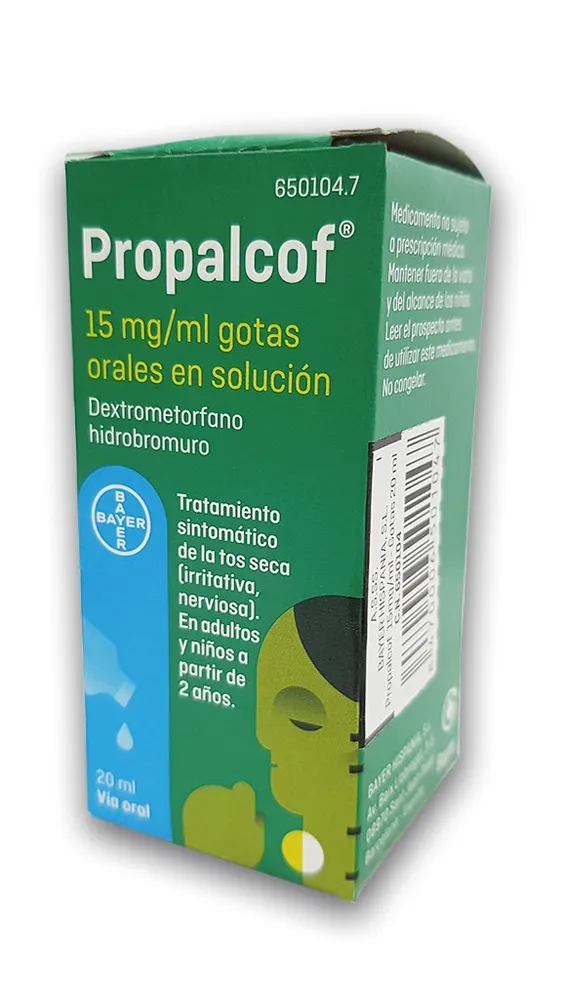
Table of Contents
Package leaflet: Information for the user
Introduction
PACKAGE LEAFLET: INFORMATION FOR THE USER
PROPALCOF 15 mg/ml oral solution drops
Dextromethorphan hydrobromide
Read the entire leaflet carefully before starting to take this medicine because it contains important information for you.
Follow exactly the instructions for taking this medicine as described in this leaflet or as indicated by your doctor, pharmacist, or nurse.
- Keep this leaflet as you may need to read it again.
- If you experience any adverse reactions, consult your doctor, pharmacist, or nurse, even if they are not listed in this leaflet. See section 4.
- You should consult your doctor if your condition worsens or does not improve after 7 days of treatment, or if cough is accompanied by high fever, skin rash, or persistent headache.
Leaflet contents:
-
What Propalcof is and what it is used for
-
What you need to know before taking Propalcof
-
How to take Propalcof
-
Possible side effects
-
How to store Propalcof
-
Contents of the pack and other information
1. What Propalcof is and what it is used for
Dextromethorphan, the active ingredient in this medicine, is an antitussive that suppresses the cough reflex.
It is indicated for the symptomatic treatment of dry cough (irritative cough, nervous cough) not accompanied by expectoration in adults and children aged 2 years and older.
You should consult a doctor if symptoms worsen or do not improve after 7 days of treatment.
2. What you need to know before taking Propalcof
Do not take Propalcof:
- If you are allergic (hypersensitive) to dextromethorphan hydrobromide or to any of the other ingredients of this medicine (listed in section 6).
- If you have severe lung disease.
- If you have asthmatic cough.
- If you have a cough accompanied by abundant secretions.
- If you are currently receiving or have received within the previous 2 weeks treatment with monoamine oxidase inhibitors (MAOIs) used to treat depression, Parkinson's disease, or other conditions, as well as other serotonin reuptake inhibitors used for depression such as fluoxetine and paroxetine; or also with bupropion, which is a medicine used to stop smoking, or with linezolid, which is an antibacterial medicine. (See section Use of Propalcof with other medicines).
- Children under 2 years of age must not take this medicine.
Warnings and precautions
Talk to your doctor, pharmacist, or nurse before taking Propalcof.
This medicine may cause dependence. Therefore, treatment should be short-term.
Particular caution is advised, and medical advice should be sought before using this medicine, especially in patients:
- With persistent or chronic cough, such as that due to smoking. Particularly in children, chronic cough may be an early sign of asthma.
- With liver or kidney disease.
- With atopic dermatitis (an inflammatory skin disease characterized by erythema, itching, exudation, crusting, and scaling, which begins in childhood in individuals with hereditary predisposition to allergy).
- Who are sedated, weakened, or bedridden.
- With CYP2D6 polymorphism (a genetic alteration affecting the activity of this liver enzyme).
- If you are taking other medicines such as antidepressants or antipsychotics, Propalcof may interact with these medicines and you may experience changes in your mental state (e.g., agitation, hallucinations, coma) and other effects such as body temperature above 38°C, increased heart rate, high blood pressure, exaggerated reflexes, muscle rigidity, lack of coordination, and/or gastrointestinal symptoms (e.g., nausea, vomiting, and diarrhea).
Cases of abuse of medicines containing dextromethorphan have been reported in adolescents; therefore, this possibility should be considered, as serious adverse effects may occur (see section "If you take more Romilar than you should"). This product may also be addictive, and its use at high doses or for prolonged periods may lead to tolerance and mental and physical dependence. In patients with a tendency to abuse or dependence, it should only be administered under strict medical supervision and for short periods.
Children and adolescents
Do not use in children under 2 years of age.
Use of Propalcof with other medicines
Inform your doctor or pharmacist if you are taking, have recently taken, or might need to take any other medicines.
Do not take this medicine during treatment with, or within 2 weeks after treatment with, the following medicines, as it may cause excitation, high blood pressure, and fever above 40°C (hyperpyrexia):
- Monoamine oxidase inhibitor antidepressants (MAOIs) (moclobemide, tranylcypromine, phenelzine, iproniazid, and isocarboxazid)
- Serotonin reuptake inhibitor antidepressants (fluoxetine, sibutramine, sertraline, or paroxetine)
- Bupropion (used to stop smoking)
- Linezolid (used as an antibacterial)
- Procarbazine (used to treat cancer)
- Selegiline (used to treat Parkinson's disease)
Before starting this medicine, consult your doctor if you are taking any of the following medicines, as it may be necessary to adjust the dose or interrupt treatment:
- Amiodarone and quinidine (used to treat heart arrhythmias)
- Anti-inflammatory medicines (celecoxib, parecoxib, or valdecoxib)
- Central nervous system depressants (some used to treat: mental disorders, allergies, Parkinson's disease, etc.)
- Expectorants and mucolytics (used to eliminate phlegm and mucus)
- CYP2D6 inhibitors such as haloperidol (used to treat mental disorders)
Taking Propalcof with food and drinks
Do not consume alcoholic beverages during treatment, as they may cause adverse reactions.
Do not take grapefruit or orange juice together with this medicine during treatment, as they may increase the adverse effects of this medicine.
Pregnancy, breastfeeding, and fertility
If you are pregnant or breastfeeding, think you may be pregnant, or are planning to become pregnant, consult your doctor or pharmacist before using this medicine.
Pregnant or breastfeeding women should not take this medicine without consulting a doctor.
Driving and using machines
During treatment with this medicine, mild drowsiness, dizziness, fatigue (tiredness), dystonia (involuntary muscle contractions), and visual hallucinations may occur, which should be taken into account when driving or operating dangerous machinery.
Propalcof contains propylene glycol (E-1520), macrogol glycerol ricinoleate, anhydrous ethanol, methylparaben (E-218), propylparaben (E-216), and sodium
This medicine contains 400 mg of propylene glycol per ml of solution. If you are pregnant or breastfeeding, do not take this medicine unless recommended by your doctor. Your doctor may carry out additional check-ups while you are taking this medicine. If you have hepatic or renal impairment, do not take this medicine unless recommended by your doctor. Your doctor may carry out additional check-ups while you are taking this medicine. If the child is under 5 years of age, consult your doctor or pharmacist, especially if other medicines containing propylene glycol or alcohol have been administered.
This medicine may cause stomach discomfort and diarrhea because it contains macrogol glycerol ricinoleate.
It may cause allergic reactions (possibly delayed) because it contains methylparaben (E-218) and propylparaben (E-216).
This medicine contains 0.74 mg of alcohol (ethanol) per ml. The amount of alcohol in 1 ml of this medicine is equivalent to less than 19 ml of beer or 8 ml of wine.
The small amount of alcohol in this medicine has no significant effect. This medicine contains less than 23 mg of sodium (1 mmol) per ml of solution; hence, it is essentially "sodium-free".
3. How to take Propalcof
Follow exactly the instructions for administering this medicine as described in this leaflet or as directed by your doctor, pharmacist, or nurse. If in doubt, ask your doctor, pharmacist, or nurse.
Recommended dose:
? Adults and adolescents aged 12 years and older: 1 ml (20 drops) (15 mg of dextromethorphan) every 4 hours, or 2 ml (40 drops) (30 mg) every 6–8 hours, depending on the intensity of the cough. Do not exceed a daily dose of 120 mg (8 ml or 160 drops).
? Children aged 6 to 12 years: 0.5 ml (10 drops) (7.5 mg) every 4 hours, or 1 ml (20 drops) (15 mg) every 6–8 hours, depending on the intensity of the cough. Do not exceed a daily dose of 60 mg (4 ml or 80 drops).
? Children aged 2 to 6 years: 0.25 ml (5 drops) (3.75 mg) every 4 hours, or 0.5 ml (10 drops) (7.5 mg) every 6–8 hours, depending on the intensity of the cough. Do not exceed a daily dose of 30 mg (2 ml or 40 drops).
Do not exceed 6 doses per day.
Paediatric population
Serious adverse effects may occur in children in case of overdose, including neurological disturbances. Caregivers must not exceed the recommended dose.
Method of administration:
For oral use.
The drops may be dissolved in a small amount of water, fruit juice (except grapefruit or orange juice, see Taking Propalcof with food and drink), milk, tea, etc.
Hold the bottle vertically with the opening facing downwards. If the solution does not drip immediately, shake or tap it gently with your hand, or invert it several times.
Concomitant intake of this medicine with other foods or drinks does not affect its efficacy.
If cough worsens or persists for more than 7 days, or if it is accompanied by high fever, skin rash, or persistent headache, consult your doctor.
Use in children and adolescents
Do not administer to children under 2 years of age.
If you take more Propalcof than you should
If you take more Propalcof than recommended, you may experience the following symptoms: nausea and vomiting, involuntary muscle contractions, agitation, confusion, drowsiness, disturbances of consciousness, rapid and involuntary eye movements, cardiac disorders (increased heart rate), coordination disorders, psychosis with visual hallucinations, and hyperexcitability.
Other symptoms in case of massive overdose may include: coma, severe breathing problems, and seizures.
Contact your doctor or hospital immediately if you experience any of the symptoms listed above.
Cases of abuse of medicines containing dextromethorphan have been reported in adolescents, which may lead to serious adverse effects such as tachycardia (rapid heartbeat), lethargy, hypertension or hypotension (high or low blood pressure), mydriasis (pupil dilation), agitation, dizziness, gastrointestinal discomfort, hallucinations, slurred speech, nystagmus (involuntary and uncontrolled eye movements), fever, tachypnea (rapid and shallow breathing), brain damage, ataxia (uncoordinated movements), seizures, respiratory depression, loss of consciousness, arrhythmias (irregular heartbeat), and death.
In case of poisoning, appropriate treatments for the symptoms should be administered, which may include intravenous naloxone injection and gastric lavage.
In case of overdose or accidental ingestion, consult your doctor or pharmacist immediately, go to a medical centre, or call the Toxicology Information Service at telephone: 91 562 04 20, indicating the medicine and the amount ingested.
If you forget to take Propalcof
Do not take a double dose to make up for missed doses. If you miss a dose, take it as soon as possible and continue with your usual dosing schedule, as indicated in section 3. How to take Propalcof.
If you have any further questions about the use of this medicine, ask your doctor, pharmacist, or nurse.
4. Possible adverse effects
Like all medicines, Propalcof may produce adverse effects, although not everyone will experience them.
During the period of use of dextromethorphan, the following adverse effects have been observed, although their frequency cannot be accurately determined:
- Nervous system disorders: drowsiness, dizziness, fatigue, involuntary muscle contractions, and more rarely mental confusion and headache.
- Gastrointestinal disorders: nausea, vomiting, gastrointestinal discomfort such as stomach pain, constipation.
- Ear and labyrinth disorders: vertigo.
- Immune system disorders: hypersensitivity and anaphylactic reaction including symptoms such as: skin rash, urticaria, edema, pruritus, and cardio-respiratory difficulty.
- Psychiatric disorders: visual hallucinations and confusion. These effects are much more pronounced in cases of overdose (See section If you take more Propalcof than you should).
- Skin and subcutaneous tissue disorders: skin rash, urticaria, pruritus, erythema, allergic dermatitis.
If you consider any of the adverse effects you experience to be severe, or if you notice any adverse effect not listed in this leaflet, inform your doctor or pharmacist.
Reporting of adverse effects
If you experience any type of adverse effect, consult your doctor, pharmacist, or nurse, even if it is a possible adverse effect not listed in this leaflet. You may also report them directly through the Spanish Pharmacovigilance System for Human Medicinal Products: https://notificaram.es. By reporting adverse effects, you can help provide more information on the safety of this medicine.
5. Storage of Propalcof
Keep this medicine out of the sight and reach of children.
Do not freeze.
Do not use this medicine after the expiry date stated on the carton and label, following EXP. The expiry date is the last day of the month indicated.
Medicines should not be disposed of via wastewater or household waste. Dispose of unused medicines and their containers at the SIGRE Point at your pharmacy. If in doubt, ask your pharmacist how to dispose of medicines and containers you no longer need. This will help protect the environment.
6. Contents of the pack and other information
Composition of Propalcof:
Each ml of solution (= 20 drops) contains:
-The active substance is: Dextromethorphan hydrobromide, 15 mg.
-The other components (excipients) are: propylene glycol, anhydrous ethanol, flavourings (coriander oil, sweet orange essential oil, lemon tetraflavour), macrogol glycerol ricinoleate (Cremophor EL), methylparahydroxybenzoate (E-218), propylparahydroxybenzoate (E-216), sodium saccharin, citric acid monohydrate, sodium hydroxide, purified water.
Appearance of the medicine and contents of the pack
This medicine is presented as an oral solution in drop form. It is supplied in packs containing a 20 ml glass bottle with a dropper. Each ml of solution corresponds to 20 drops.
Marketing Authorization Holder:
BAYER HISPANIA, S.L.
Av. Baix Llobregat, 3-5
08970 Sant Joan Despí (Barcelona), Spain
Manufacturer:
KVP Pharma + Veterinar – Produkte GmbH
Projensdorfer Str. 324 (Kiel) – D – 24106 – Germany
Date of the most recent review of this leaflet: October 2019
Detailed and up-to-date information on this medicine is available on the website of the Spanish Agency for Medicines and Health Products (AEMPS) http://www.aemps.es/