Primene 10% solution for infusion
Spain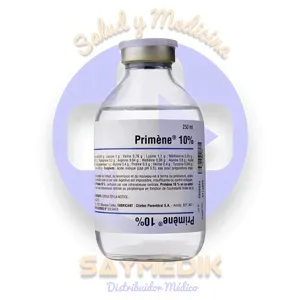
Table of Contents
- Package leaflet: Information for the user
- Introduction
- 1. What PRIMENE is and what it is used for
- 2. What you need to know before your child is given PRIMENE
- **Do not use PRIMENE in the following cases:**
- 3. How PRIMENE will be administered to your child
- **If your child is given more Primenedel than they should receive**
- 4. Possible adverse effects
- 5. Storage of PRIMENE
- 6. Contents of the pack and other information
Package leaflet: Information for the user
Introduction
Package leaflet: Information for the user
PRIMENE 10% solution for infusion
Read the entire leaflet carefully before starting to use this medicine, as it contains important information for you.
- Keep this leaflet, as you may need to read it again.
- If you have any questions, consult your doctor, pharmacist, or nurse.
- If your child experiences any adverse reactions, consult your child's doctor, pharmacist, or nurse, even if they are adverse reactions not listed in this leaflet. See section 4.
In this leaflet:
- What PRIMENE is and what it is used for
- What you need to know before PRIMENE is administered to your child
- How PRIMENE will be administered
- Possible adverse effects
- How to store PRIMENE
- Contents of the pack and other information
This medicine is called PRIMENE 10% solution for infusion, but will be referred to as PRIMENE throughout the rest of this leaflet.
1. What PRIMENE is and what it is used for
PRIMENE is a sterile solution containing:
- amino acids: these are the basic components the body uses to produce proteins.
PRIMENE is used in children, infants, and full-term or premature newborns to provide nourishment (nutrition) directly into the bloodstream when sufficient food cannot be taken by mouth. It is generally administered together with other nutritional solutions and similar compounds such as glucose, minerals, and vitamins.
2. What you need to know before your child is given PRIMENE
Do not use PRIMENE in the following cases:
- If your child is allergic to any of the ingredients in PRIMENE (listed in section 6).
- If your child has a problem metabolizing one or more amino acids.
Warnings and precautions
Talk to your child's doctor or nurse before PRIMENE is administered.
Allergic reactions
Infusion must be stopped immediately if any sign or symptom of an allergic reaction occurs (such as fever, sweating, chills, headache, skin rash, or difficulty breathing).
Formation of small particles in the blood vessels of the lungs:
Difficulty breathing could be a sign that small particles have formed, blocking blood vessels in the lungs (pulmonary vascular precipitates). If your child experiences any breathing difficulty, inform your doctor or nurse. They will decide on the appropriate action to take.
Infection and sepsis
Children may sometimes develop infections and sepsis (bacteria in the blood) when they have a tube connected to a vein (intravenous catheter). Certain medications and diseases can increase the risk of developing sepsis or infection. Your doctor will closely monitor your child for any signs of infection.
Changes in blood chemical levels
Your doctor will check and monitor your child's body fluids, levels of chemicals in the blood, and other blood parameters. Excess fluid in the tissues and swelling may also occur. Parenteral nutrition should be started slowly and under supervision.
Hypertonic solution (high concentration of dissolved amino acids)
PRIMENE is a solution containing a high concentration of dissolved amino acids. It is administered through a plastic tube connected either to a vein in the arm or to a large vein in the chest. If administered into a smaller vein in the arm, it may cause irritation of the vein. Speak with your doctor or nurse if your child experiences discomfort at or around the injection site.
Monitoring and adjustment:
Your doctor will monitor your child's condition at the beginning and during the infusion. Make sure the doctor is informed if your child has serious metabolic disorders affecting the way the body regulates sugars, fats, proteins, or salt.
If abnormal signs such as sweating, chills, bruising, or abnormal heart rate occur, the infusion must be stopped and your doctor or nurse informed.
To ensure ongoing efficacy and safety of treatment, your doctor will regularly monitor your child's blood while receiving this medicine, especially if your child currently has liver, kidney, adrenal, heart, or circulatory problems.
Children and adolescents
When used in newborns and children under 2 years of age, the solution (in bags and administration sets) must be protected from light exposure until administration is complete. Exposure of Primene 10% to ambient light, especially after mixing with trace elements or vitamins, may generate peroxides and other degradation products, which can be reduced by protecting the product from light.
Use of PRIMENE with other medicines:
Inform your doctor or pharmacist if your child is taking, has recently taken, or might need to take any other medicines.
No problems are known when PRIMENE is used with other medicines.
Pregnancy and breastfeeding
There are insufficient data on the use of PRIMENE in pregnant or breastfeeding women.
If you are pregnant or breastfeeding, think you might be pregnant, or plan to become pregnant, consult your doctor before using this medicine.
3. How PRIMENE will be administered to your child
Your child must always be given PRIMENE exactly as prescribed by their doctor. Please consult the doctor if you have any doubts.
This medicine is an infusion solution. It is administered through a plastic tube connected to a vein in your child's arm or to a large vein in the chest.
When used in newborns and children under 2 years of age, the solution (in bags and administration sets) must be protected from exposure to light until administration is complete (see section 2).
Dosage and duration of treatment
Your child's doctor will decide the dose required and how long the treatment will last. The dose depends on your child's nutritional needs and will be based on body weight, medical condition, protein requirements, and your child's ability to digest and absorb the components of Primene. Additional proteins or nutrition may also be given orally or via the intestine.
The usual dose is 15 to 35 ml of PRIMENE per kilogram of body weight. These are the recommended daily doses, but your doctor may prescribe a higher or lower dose as appropriate.
The solution is administered slowly at a rate not exceeding 0.05 ml per kilogram per minute.
You will not be given more than 35 milliliters per kilogram of body weight in one day.
If your child is given more Primenedel than they should receive
If the dose administered is too high or the infusion is too fast, your child may develop an increased circulating blood volume, the blood may become too acidic, or there may be an increase in nitrogen levels in the blood and urine. Symptoms may include nausea, vomiting, tremors, confusion, and rapid heart rate. In such cases, the infusion must be stopped immediately. Your child's doctor will decide whether further actions are necessary.
To prevent these reactions, your doctor will regularly monitor your child's condition and perform blood tests during treatment.
In case of overdose or accidental ingestion, contact the Toxicology Information Service at telephone number 915 620 420.
4. Possible adverse effects
Like all medicines, this medicine can cause adverse effects, although not everyone will experience them.
If you notice any change in how your child feels during or after treatment, inform your doctor or nurse immediately.
The tests your doctor will perform on your child during treatment are intended to minimize the risk of adverse effects.
If symptoms of an allergic reaction occur, the infusion must be stopped and the doctor contacted immediately. This may be serious and symptoms may include: abnormally high or low blood pressure, development of a bluish or purplish skin discoloration, facial or eyelid swelling, abnormally rapid heart rate, difficulty breathing, vomiting, nausea, skin rashes, elevated body temperature, excessive sweating, chills, or tremors.
The following adverse effects have been reported with similar products:
- Elevated levels of ammonia and nitrogen-containing compounds in the blood.
- Anaphylactic reactions. A severe allergic reaction that starts rapidly and, if untreated, may be fatal.
- Impaired liver function with abnormal liver function blood tests.
- Inflammation of the gallbladder with presence of gallstones in the gallbladder.
- Increased blood acidity.
- Formation of small particles that block blood vessels in the lungs.
- Inflammation of the veins at the infusion site, venous irritation, pain, heat, swelling, and induration.
- In case of leakage of the infusion solution, severe local reactions may occur in the tissues surrounding the infusion site: skin tissue necrosis, blistering, swelling, scarring, and skin discoloration.
Reporting of adverse effects:
If your child experiences any type of adverse effect, consult your doctor or nurse, even if it is a possible adverse effect not listed in this leaflet. You may also report them directly through the Spanish Pharmacovigilance System for Human Medicines: https://www.notificaram.es. By reporting adverse effects, you can help provide more information on the safety of this medicine.
5. Storage of PRIMENE
Keep this medicine out of the sight and reach of children.
When used in newborns and children under 2 years of age, the solution (in bags and administration sets) must be protected from exposure to light until administration is complete (see section 2).
Do not store above 25°C.
Do not use PRIMENE after the expiry date stated on the container and outer packaging (MM/YYYY). The expiry date refers to the last day of the month indicated.
6. Contents of the pack and other information
Composition of PRIMENE
-
The active substances are: L-Isoleucine 6.70 g, L-Leucine 10.00 g, L-Valine 7.60 g, L-Lysine 11.00 g, L-Methionine 2.40 g, L-Phenylalanine 4.20 g, L-Threonine 3.70 g, L-Tryptophan 2.00 g, L-Arginine 8.40 g, L-Histidine 3.80 g, L-Alanine 8.00 g, L-Aspartic acid 6.00 g, L-Cysteine 1.89 g, L-Glutamic acid 10.00 g, Glycine 4.00 g, L-Proline 3.00 g, L-Serine 4.00 g, L-Tyrosine 0.45 g, L-Ornithine hydrochloride 3.18 g, Taurine 0.60 g.
-
The other components are Water for injections and L-Malic acid.
Appearance of the product and contents of the pack
PRIMENE is an infusion solution supplied in 250 ml glass bottles.
Only certain pack sizes may be marketed.
Marketing Authorization Holder
Baxter S.L.
Pouet de Camilo, 2.
46394 Ribarroja del Turia (Valencia)
Spain
Manufacturer responsible for manufacturing
Bieffe Medital S.p.A.
Via Nuova Provinciale, 23034 Grosotto (So)
Italy
Date of the most recent revision of this leaflet: October 2019
Detailed and up-to-date information on this medicinal product is available on the website of the Spanish Agency of Medicines and Health Products (AEMPS) http://www.aemps.gob.es
This information is intended for healthcare professionals only.
Method of administration:
When used in newborns and children under 2 years of age, the solution (in bags and administration sets) must be protected from exposure to light until administration is complete.
Special warnings and precautions for use:
Exposure to light of intravenous parenteral nutrition solutions, especially after mixing with trace elements or vitamins, may have adverse effects on clinical outcomes in newborns due to the formation of peroxides and other degradation products. When used in newborns and children under 2 years of age, Primene 10% must be protected from ambient light until administration is complete.
Special precautions for disposal and other handling:
When used in newborns and children under 2 years of age, the product must be protected from exposure to light until administration is complete. Exposure of Primene 10% to ambient light, particularly after mixing with trace elements or vitamins, generates peroxides and other degradation products, which can be minimized by protecting the product from light exposure.