Pranzo 62.5 / 1.25 / 0.5 mg/ml oral solution
Spain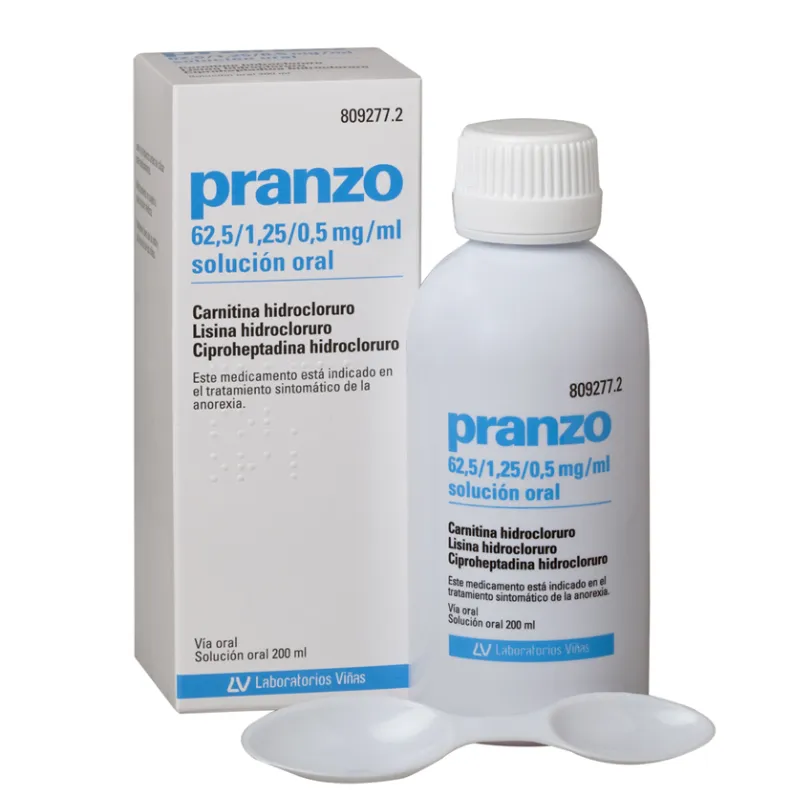
Table of Contents
- Package leaflet: Information for the user
- Introduction
- 1. What Pranzo is and what it is used for
- 2. What you need to know before taking Pranzo
- **Use in children:**
- 3. How to take Pranzo
- **If you take more Pranzo than you should**
- 4. Possible adverse effects
- 5. Storage of Pranzo
- 6. Contents of the pack and other information
Package leaflet: Information for the user
Introduction
Package leaflet: information for the user
Pranzo 62.5/1.25/0.5 mg/ml
oral solution
Carnitine hydrochloride
Lysine hydrochloride
Cyproheptadine hydrochloride
Read the entire leaflet carefully before you start taking this medicine, because it contains important information for you.
Follow exactly the instructions for administration of this medicine provided in this leaflet or those given by your doctor or pharmacist.
- Keep this leaflet, as you may need to read it again.
- If you need advice or more information, consult your pharmacist.
- If you experience any adverse effects, consult your doctor or pharmacist, even if they are effects not listed in this leaflet. See section 4.
You should consult a doctor if your condition worsens or does not improve after 30 days.
Contents of the leaflet
-
What Pranzo is and what it is used for
-
What you need to know before taking Pranzo
-
How to take Pranzo
-
Possible side effects
-
How to store Pranzo
-
Contents of the pack and other information
1. What Pranzo is and what it is used for
Pranzo is an appetite stimulant medicine and is indicated for the symptomatic treatment of anorexia.
2. What you need to know before taking Pranzo
Do not take Pranzo
- If you are allergic to the active substances or to any of the other components of this medicine (listed in section 6).
- During an asthma attack.
- If you have porphyria (a hereditary disorder of blood hemoglobin).
- If you are pregnant or breastfeeding.
- In children under 2 years of age.
Warnings and precautions
Consult your doctor or pharmacist before taking Pranzo.
- If you have a history of bronchial asthma, hyperthyroidism, cardiovascular diseases, hypertension, or increased intraocular pressure.
The pleasant taste of Pranzo may lead children to ingest excessive amounts of the medicine; therefore, keep it out of their reach.
Use in children:
Do not administer to children under 2 years of age.
Other medicines and Pranzo
Inform your doctor or pharmacist if you are taking, have recently taken, or might need to take any other medicine.
It is not advisable to take this medicine concomitantly with barbiturates, benzodiazepines and other CNS depressants, selective serotonin reuptake inhibitor antidepressants such as fluoxetine, alkalinizing agents, sympathomimetics, oral anticoagulants, estrogens, progesterone, phenytoin, griseofulvin, and MAO inhibitors.
Taking Pranzo with food, drinks, and alcohol
It is not advisable to take this medicine with alcoholic beverages.
Pranzo should be taken before meals.
Pregnancy, lactation, and fertility
If you are pregnant or breastfeeding, think you may be pregnant, or plan to become pregnant, consult your doctor or pharmacist before using this medicine.
Avoid administration of this medicine during pregnancy and breastfeeding.
Driving and use of machines:
Driving vehicles or operating dangerous or precision machinery is not recommended (this medicine may reduce driving ability and reflexes).
Pranzo contains sucrose, ethanol, propyl parahydroxybenzoate, sodium salt (E-217), amaranth (E-123), and sodium.
This medicine contains sucrose. If your doctor has informed you of an intolerance to certain sugars, consult him before taking this medicine.
Patients with diabetes mellitus should be aware that this medicine contains 0.6 g of sucrose per 2 ml dose, or 1.2 g of sucrose per 4 ml dose.
It may cause dental caries.
This medicine contains 97.8 mg of ethanol (alcohol) per 2 ml dose, or 195.7 mg of ethanol (alcohol) per 4 ml dose, equivalent to 4.89%. The amount of 2 ml of this medicine is equivalent to less than 2.5 ml of beer or 1 ml of wine. The amount of 4 ml of this medicine is equivalent to 5 ml of beer or 2 ml of wine.
The amount of alcohol contained in this medicine is unlikely to have any noticeable effect in adults or adolescents. It could have some effects in young children, such as drowsiness.
The amount of alcohol contained in this medicine may alter the effect of other medicines. Consult your doctor or pharmacist if you are taking other medicines.
If you are pregnant or breastfeeding, consult your doctor or pharmacist before taking this medicine.
If you have alcohol addiction, consult your doctor or pharmacist before taking this medicine.
It may cause allergic reactions (possibly delayed) because it contains propyl parahydroxybenzoate, sodium salt (E-217).
This medicine may cause allergic reactions because it contains amaranth (E-123). It may provoke asthma, especially in patients allergic to acetylsalicylic acid.
This medicine contains less than 23 mg of sodium (1 mmol) per ml; thus, it is essentially “sodium-free”.
3. How to take Pranzo
Follow exactly the instructions for use provided in this leaflet or those indicated by your doctor or pharmacist. If in doubt, consult your doctor or pharmacist.
This medicine should be taken using the double measuring spoon of 2 ml and 4 ml.
Take this medicine before meals.
Use in adults:
The recommended daily dose is 1 large spoonful (4 ml) per 10 kg of body weight.
The total dose should be divided into 3 or 4 doses per day. Do not exceed 5 spoonfuls of 4 ml per day (20 ml).
Use in children:
The recommended daily dose is 1 small spoonful (2 ml) per 4 kg of body weight.
As a general guide, the following dosing schedule is recommended:
Approximate body weight in kg | Dosage ml per day | 2 ml teaspoons | Divided into 3 or 4 daily doses |
8 to 12 kg | 4 to 6 ml | 2 to 3 | |
13 to 16 kg | 6 to 8 ml | 3 to 4 | |
17 to 20 kg | 8 to 10 ml | 4 to 5 | |
21 to 24 kg | 10 to 12 ml | 5 to 6 | |
25 to 28 kg | 12 to 14 ml | 6 to 7 | |
29 to 32 kg | 14 to 16 ml | 7 to 8 | |
33 to 36 kg | 16 to 18 ml | 8 to 9 | |
37 to 40 kg | 18 to 20 ml | 9 to 10 |
If symptoms worsen or persist after 30 days, you should consult a doctor.
If you take more Pranzo than you should
Poisoning, caused only by doses far exceeding the therapeutic ones, may cause drowsiness and, sometimes, paradoxically, seizures. Treatment must be administered by a healthcare professional, including gastric lavage, sedatives if necessary, and respiratory stimulants.
In case of overdose or accidental ingestion, immediately consult your doctor or pharmacist, or call the Toxicology Information Service at telephone number 91 562 04 20, indicating the medication and the amount ingested.
If you forget to take Pranzo
Do not take a double dose to make up for missed doses. Take it as soon as you remember, and take the following doses at the recommended intervals (3–4 doses per day).
If you have any further questions about the use of this medicine, ask your doctor or pharmacist.
4. Possible adverse effects
Like all medicines, this medicine may cause adverse effects, although not everyone will experience them.
The adverse effects listed below are classified according to frequency and by organ systems. Frequency categories are defined as follows: very common (affects more than 1 in 10 people); common (affects up to 1 in 100 people); uncommon (affects up to 1 in 1,000 people); rare (affects between 1 and 10 in 10,000 people); very rare (affects less than 1 in 10,000 people); frequency not known (cannot be estimated from available data).
Common: may affect up to 1 in 10 people:
Somnolence and drowsiness. In children, these effects may be desirable, as they reduce emotional tension, often associated with anorexia.
Uncommon: may affect up to 1 in 100 people:
Dry mouth, dizziness, nervousness, weakness, dryness of mucous membranes, headache, nausea, and mild skin allergic reactions such as rash and edema.
Rare: may affect up to 1 in 1,000 people:
CNS stimulation (such as agitation, confusion, visual hallucinations).
In patients with renal insufficiency, administration of carnitine may cause myasthenia.
Reporting of adverse effects
If you experience any type of adverse effect, consult your doctor or pharmacist, even if it is a possible adverse effect not listed in this leaflet. You may also report them directly via the Spanish Pharmacovigilance System for Human Medicines website: www.notificaRAM.es. By reporting adverse effects, you can help provide more information on the safety of this medicine.
5. Storage of Pranzo
Keep this medicine out of the sight and reach of children.
No special storage conditions are required.
Do not use this medicine after the expiry date stated on the packaging after EXP. The expiry date is the last day of the month indicated.
Do not use this medicine if you notice any visible signs of deterioration or if the bottle is open.
Medicines must not be disposed of via wastewater or household waste. Dispose of unused medicines and their containers at the SIGRE collection point at your pharmacy. If you are unsure, ask your pharmacist how to properly dispose of medicines and containers you no longer need. This will help protect the environment.
6. Contents of the pack and other information
Composition of Pranzo
- The active substances are carnitine hydrochloride, lysine hydrochloride and cyproheptadine hydrochloride. Each ml of oral solution contains 62.50 mg of carnitine hydrochloride, 1.25 mg of lysine hydrochloride and 0.50 mg of cyproheptadine hydrochloride.
- The other components (excipients) are: sucrose, 96 percent ethanol, sodium saccharin, raspberry flavour 5304-A, disodium edetate, potassium sorbate (E-202), propyl parahydroxybenzoate, sodium salt (E-217), amaranth (E-123) and purified water.
Appearance of the product and contents of the pack
Pranzo is a pink-coloured oral solution.
It is supplied in white opaque plastic bottles with a screw cap and tamper-evident seal, together with a double-ended dosing spoon (2 ml and 4 ml).
The pack contains 200 ml of oral solution.
Marketing Authorisation Holder and Manufacturer
Marketing Authorisation Holder
Laboratorios Viñas, S.A.
Provenza, 386
08025 - Barcelona
Spain
Manufacturer
Laboratorios Viñas, S.A.
Torrent d’en Vidalet, 29
08012 - Barcelona
Spain
Date of the most recent revision of this leaflet: May 2010
Detailed information on this medicine is available on the website of the Spanish Agency of Medicines and Medical Devices (AEMPS) http://www.aemps.gob.es/