Potassium Grifols 0.04 mEq/ml in glucose 5% solution for infusion
Spain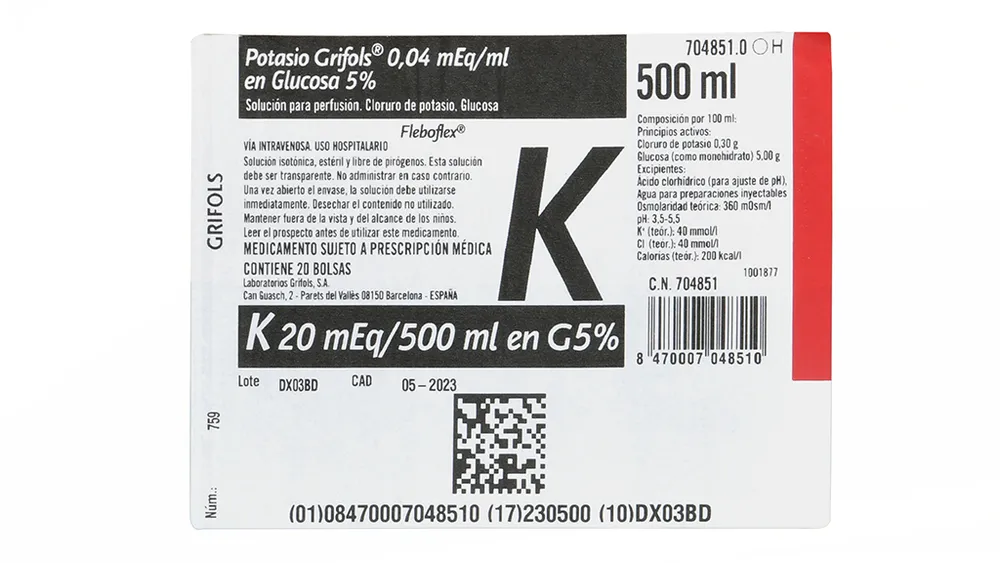
Table of Contents
- Package leaflet: Information for the user
- Introduction
- 1. What Potassium Grifols 0.04 mEq/ml in 5% Glucose is and what it is used for
- 2. What you need to know before using Potassium Grifols 0.04 mEq/ml in 5% Glucose
- 3. How to use Potassium Grifels 0.04 mEq/ml in 5% Glucose
- 4. Possible adverse effects
- 5. Storage of Potassium Grifols 0.04 mEq/ml in 5% Glucose
- 6. Contents of the pack and other information
Package leaflet: Information for the user
Introduction
Package leaflet: information for the user
Potassium Grifols 0.04 mEq/ml in Glucose 5% Solution for infusion
Potassium chloride, Glucose
Read the entire leaflet carefully before you start using this medicine, because it contains important information for you.
- Keep this leaflet, as you may need to read it again.
- If you have any questions, consult your doctor or nurse.
- If you experience any side effects, consult your doctor or nurse, even if they are side effects not listed in this leaflet. See section 4.
Leaflet contents
- What Potassium Grifols 0.04 mEq/ml in Glucose 5% is and what it is used for
- What you need to know before using Potassium Grifols 0.04 mEq/ml in Glucose 5%
- How to use Potassium Grifols 0.04 mEq/ml in Glucose 5%
- Possible side effects
- How to store Potassium Grifols 0.04 mEq/ml in Glucose 5%
- Contents of the pack and other information
1. What Potassium Grifols 0.04 mEq/ml in 5% Glucose is and what it is used for
Potassium Grifols 0.04 mEq/ml in 5% Glucose is an intravenous solution for restoring electrolyte balance, containing electrolytes associated with carbohydrates.
Potassium Grifols 0.04 mEq/ml in 5% Glucose is indicated in the following situations:
- Hypokalemia (low blood potassium levels).
- Potassium depletion due to vomiting, diarrhea, gastrointestinal suction, or fistulas.
- Nutritional deficiencies lacking potassium.
- Prolonged treatment with potassium-depleting diuretics and corticosteroids.
- Primary or secondary hyperaldosteronism (increased production and secretion of the hormone aldosterone).
- Tubular disorders with potassium loss.
- Cardiac arrhythmias due to digitalis intoxication.
- Hypochloremic alkalosis (increased blood pH due to low blood chloride ion concentration).
- Familial hypokalemic periodic paralysis (a hereditary disorder causing occasional episodes of muscle weakness, during which blood potassium levels are low).
2. What you need to know before using Potassium Grifols 0.04 mEq/ml in 5% Glucose
Do not use Potassium Grifols 0.04 mEq/ml in 5% Glucose
- if you are allergic to potassium chloride, glucose, or any of the other ingredients of this medicine (listed in section 6)
- if you have hyperkalemia (high levels of potassium in the blood) or hyperchloremia (high levels of chloride in the blood)
- if you have acute renal failure (impaired kidney function) or suppression or reduced urine output
- if you have adrenal insufficiency (impaired function of the adrenal glands): Addison's disease or hypoaldosteronism (reduced secretion of the hormone aldosterone)
- if you have extensive burns (initial phase)
- if you are experiencing hemolytic crises (destruction of red blood cells)
- if you have metabolic or respiratory acidosis
- if you are being treated with potassium-sparing diuretics or aldosterone-inhibiting agents
- if you have familial hyperkalemic periodic paralysis (a hereditary disorder causing occasional episodes of muscle weakness, possibly with elevated blood potassium levels)
- if you are a digitalized patient with severe cardiac block, as potassium salts are not recommended in this case
Warnings and precautions
Consult your doctor or nurse before starting to use Potassium Grifols 0.04 mEq/ml in 5% Glucose.
-
Due to its glucose content, this medicine should be administered with caution in diabetic patients, with blood glucose levels closely monitored. Each 100 ml of this medicine contains 5 g of glucose.
-
Frequent monitoring of diuresis (urine production), electrolyte balance, and blood glucose levels is recommended during treatment. Special monitoring of serum potassium levels (potassemia) and electrocardiogram is required during potassium-containing solution administration.
-
This medicine may become physiologically hypotonic in the body due to the rapid metabolism of glucose (see section 3).
-
Depending on the volume and rate of infusion, your initial clinical condition, and your ability to metabolize glucose, intravenous administration of this type of solution may cause electrolyte disturbances such as hyponatremia (low sodium levels in blood).
Hyponatremia:
If you are a patient with non-osmotic release of vasopressin (antidiuretic hormone) (e.g., in critical conditions, pain, postoperative stress, infections, burns, and central nervous system disorders), if you have heart, liver, or kidney disease, or if you are exposed to vasopressin agonists (see next subsection), you are at special risk of developing acute hyponatremia following administration of hypotonic solutions.
Acute hyponatremia may cause acute hyponatremic encephalopathy (cerebral edema), characterized by headache, nausea, seizures, lethargy, and vomiting. Patients with cerebral edema are at special risk of suffering severe, irreversible, and potentially fatal brain damage.
Children, women of reproductive age, and patients with reduced cerebral compliance (e.g., in cases of meningitis, intracranial hemorrhage, and cerebral contusion) are at special risk of severe and potentially fatal cerebral edema caused by acute hyponatremia.
Other medicines and Potassium Grifols 0.04 mEq/ml in 5% Glucose
Inform your doctor if you are taking, have recently taken, or might need to take any other medicines.
- Do not administer with medicines that reduce kidney functional capacity.
- Concomitant administration of potassium salts with captopril may cause hyperkalemia.
- Administration together with salt substitutes or potassium-sparing diuretics (spironolactone, triamterene, amiloride) may lead to hyperkalemia, which can be severe, especially in patients with renal impairment.
- Intravenous administration of physiologically hypotonic solutions together with medicines that enhance the effect of antidiuretic hormone (such as chlorpropamide, clofibrate, carbamazepine, vincristine, selective serotonin reuptake inhibitors, 3,4-methylenedioxy-N-methamphetamine, ifosfamide, antipsychotics, narcotics, NSAIDs (non-steroidal anti-inflammatory drugs), cyclophosphamide, desmopressin, oxytocin, vasopressin, terlipressin), which reduce water excretion in urine, increases the risk of hospital-acquired hyponatremia (see previous subsection and sections 3 and 4).
- Diuretics in general and antiepileptic drugs such as oxcarbazepine increase the risk of hyponatremia.
Pregnancy and breastfeeding
If you are pregnant or breastfeeding, think you may be pregnant, or plan to become pregnant, consult your doctor before using this medicine.
The safety of its use during pregnancy and breastfeeding has not been established. Therefore, it should only be used when clearly necessary and when the beneficial effects outweigh the potential risks to the fetus or infant.
This medicine should be administered with special caution in pregnant women during labor, especially if administered in combination with oxytocin, due to the risk of hyponatremia (see previous subsections and section 4).
Driving and using machines
Since this medicine is administered only to hospitalized patients, studies on such effects have not been conducted.
3. How to use Potassium Grifels 0.04 mEq/ml in 5% Glucose
The dosage will be determined by medical judgment depending on the degree of hypokalemia and the patient's clinical condition. Generally, 500–1000 ml per day at a rate of 20–30 drops/min by intravenous route is recommended. The maximum daily dose is 2000 ml at an infusion rate of 60–80 drops/min.
You may need to have your fluid balance, serum glucose, serum sodium, and other electrolytes monitored before and during administration, especially if you have non-osmotic release of vasopressin (syndrome of inappropriate antidiuretic hormone secretion, SIADH), or if you are simultaneously receiving medications that are vasopressin agonists, due to the risk of hyponatremia. Monitoring of serum sodium is particularly important when physiologically hypotonic solutions are administered. This medicine may become hypotonic after administration due to the rapid metabolism of glucose in the body (see sections 2 and 4).
If you receive more Potassium Grifels 0.04 mEq/ml in 5% Glucose than you should
In case of overdose or too rapid administration, hyperkalemia may occur.
If hyperkalemia develops, administration should be discontinued and symptomatic treatment initiated, aimed primarily at antagonizing the effects of potassium and stimulating its elimination.
For this purpose, intravenous infusion of sodium bicarbonate 1.4%, calcium chloride or calcium gluconate (10 or 20 ml of a 10% solution), or glucose (100 ml of a 50% solution or 1000 ml of a 10% solution) together with 30 units of crystalline insulin is appropriate.
In severe cases with renal failure, hemodialysis or peritoneal dialysis should be performed to remove body potassium and correct hyperkalemia.
If electrocardiographic abnormalities due to excess potassium occur, potassium may be removed by administering an ion-exchange resin (sodium polystyrene sulfonate) orally or by enema.
In case of overdose or accidental ingestion, contact the Toxicology Information Service. Telephone: 915 620 420.
If you have any further questions about the use of this medicine, ask your doctor or nurse.
4. Possible adverse effects
Like all medicines, this medicine may cause adverse effects, although not everyone will experience them.
Adverse effects may occur if an excessive dose of potassium chloride is administered. If there are elevated levels of potassium in the blood (hyperkalemia), the following adverse effects may occur:
- Mental depression
- Confusion
- Paresthesia (abnormal sensation of general senses or sensitivity)
- Muscle weakness and flaccid paralysis (loss of muscle strength and tone) of the extremities and respiratory muscles
- Bradycardia (slowing of the heart rate)
- Hypotension (decrease in blood pressure)
- Electrocardiographic abnormalities
- Cardiac arrest
- Death
Hyperkalemia also produces a series of hormonal effects, as it stimulates the secretion of aldosterone, insulin, and glucagon, and inhibits renin production.
In patients with non-osmotic release of vasopressin, in patients with heart, liver, or kidney disease, and in patients treated with vasopressin agonists, the risk of developing acute hyponatremia after administration of hypotonic solutions is increased. Hospital-acquired hyponatremia may cause irreversible brain damage and death due to the development of cerebral edema (see sections 2 and 3).
Reporting of adverse effects
If you experience any type of adverse effect, consult your doctor or nurse, even if it is a possible adverse effect not listed in this leaflet. You may also report them directly via the Spanish Pharmacovigilance System for Human Medicinal Products: www.notificaRAM.es. By reporting adverse effects, you can help provide more information on the safety of this medicine.
5. Storage of Potassium Grifols 0.04 mEq/ml in 5% Glucose
No special storage conditions are required.
After opening the container, the solution must be used immediately.
Keep this medicine out of the sight and reach of children.
Do not use this medicine after the expiry date stated on the container. The expiry date refers to the last day of the month indicated.
Do not use this medicine if the solution is not clear or if it contains precipitates.
6. Contents of the pack and other information
Composition of Potassium Grifols 0,04 mEq/ml in Glucose 5%
-
The active substances are potassium chloride and glucose. Each 100 ml of solution contains 0.30 g of potassium chloride and 5.00 g of glucose (as monohydrate).
-
The other components (excipients) are hydrochloric acid (for pH adjustment) and water for injections.
Appearance of the product and contents of the pack
Potassium Grifuls 0,04 mEq/ml in Glucose 5% is an incolor or slightly yellowish, transparent infusion solution supplied in flexible polypropylene bags (Fleboflex) of 500 ml and 1000 ml.
Marketing Authorization Holder
LABORATORIOS GRIFOLS, S.A.
Can Guasch, 2
08150 Parets del Vallès, Barcelona (SPAIN)
Manufacturer
LABORATORIOS GRIFOLS, S.A.
Polígono Industrial Los Llanos. C/ Marte, 4
30565 Las Torres de Cotillas, Murcia (SPAIN)
Date of the most recent revision of this leaflet: June 2018
Other sources of information
Detailed information on this medicinal product is available on the website of the Spanish Agency of Medicines and Health Products (AEMPS) (http://www.aemps.gob.es/)
This information is intended for healthcare professionals only:
Potassium Grifols 0,04 mEq/ml in Glucose 5% is administered by infusion. The medicine is supplied ready for administration.
The solution must be clear and free from particles or precipitates. Do not administer if this is not the case.
Once the container is opened, the solution must be used immediately. Discard any unused content.
Do not remove the Fleboflex bag from its protective overwrap until immediately before use.
Check for small leaks by firmly squeezing the bag. If leaks are detected, discard the product.
Fleboflex bags are designed for administration without air entry. If an infusion set with air entry must be used, ensure that it remains closed at all times.
To connect the infusion set, remove the protective tab from the infusion port, exposing the access membrane of the bag.
If adding medications to the solution, disinfect the injection site on the bag. Prepare a syringe with the medication using a 20–22 G needle.
Use aseptic technique when administering the solution and when adding medications to the solution, if necessary.
As with other parenteral solutions, compatibility tables should be consulted before adding medications.
In general, 500–1000 ml per day at a rate of 20–30 drops/min intravenously is recommended, although dosage should be adjusted according to medical judgment. The maximum daily dose is 2000 ml at a rate of 60–80 drops/min.