Potassium B. Braun 0.04 mEq/ml prediluted in glucose 5% solution for infusion
Spain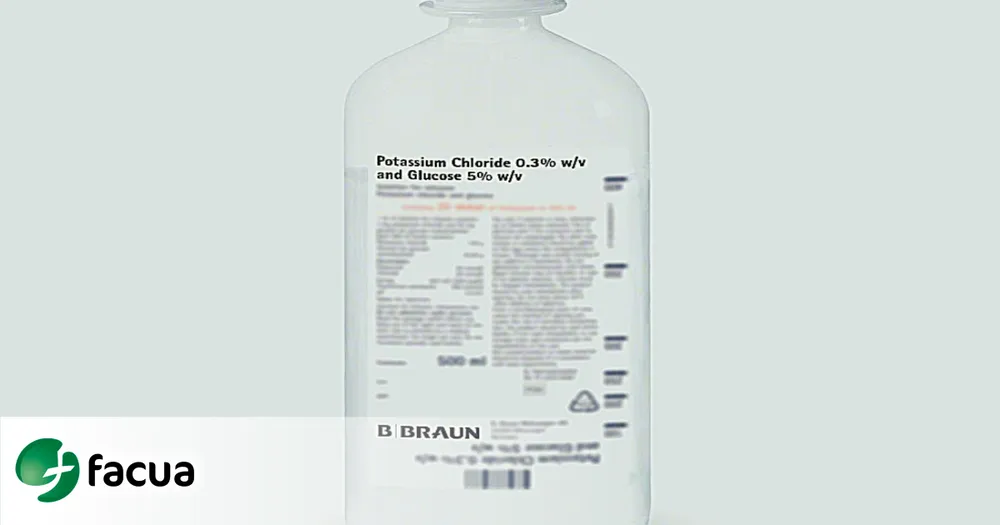
Table of Contents
- Package leaflet: Information for the user
- Introduction
- 1. What Potassium B. Braun 0.04 mEq/ml Prediluted in 5% Glucose Solution for Infusion Is and What It Is Used For
- 2. What you need to know before using Potassium B. Braun 0.04 mEq/ml Prediluted in Glucose 5% solution for infusion
- 3. How to use Potassium B. Braun 0.04 mEq/ml Premixed in 5% Glucose Solution for Infusion
- 4. Possible adverse effects
- 5. Storage of Potassium B. Braun 0.04 mEq/mL Premixed in 5% Glucose
- 6. Contents of the pack and other information
Package leaflet: Information for the user
Introduction
Package leaflet: information for the user
Potassium B. Braun 0.04 mEq/ml Pre-diluted in Glucose 5% solution for infusion
Potassium chloride and Glucose
Read all of this leaflet carefully before you start using this medicine, because it contains important information for you.
- Keep this leaflet as you may need to read it again.
- If you have any questions, ask your doctor or pharmacist.
- This medicine has been prescribed for you, and you should not give it to other people, even if they have the same symptoms as you, because it could harm them.
- If you experience any adverse reactions, consult your doctor or pharmacist, even if they are adverse reactions not listed in this leaflet. See section 4.
Contents of this leaflet:
- What Potassium B. Braun 0.04 mEq/ml Pre-diluted in Glucose 5% is and what it is used for
- What you need to know before using Potassium B. Braun 0.04 mEq/ml Pre-diluted in Glucose 5%
- How to use Potassium B. Braun 0.04 mEq/ml Pre-diluted in Glucose 5%
- Possible side effects
- How to store Potassium B. Braun 0.04 mEq/ml Pre-diluted in Glucose 5%
- Contents of the pack and other information
1. What Potassium B. Braun 0.04 mEq/ml Prediluted in 5% Glucose Solution for Infusion Is and What It Is Used For
This medicine contains a solution of potassium chloride and glucose. It is administered through a narrow catheter into a vein (intravenous infusion).
This medicine is used to maintain or restore your potassium levels and to meet your basic energy requirements.
2. What you need to know before using Potassium B. Braun 0.04 mEq/ml Prediluted in Glucose 5% solution for infusion
Do not use Potassium B. Braun 0.04 mEq/ml Prediluted in Glucose 5% solution for infusion
-
if you have abnormally high levels of potassium or chloride in your blood (severe hyperkalemia or hyperchloremia),
-
if you have severe kidney disease,
-
if you have sustained head injuries (during the first 24 hours),
-
if you have excess water in your body (hyperhydration),
-
if you have high blood glucose levels (hyperglycemia) requiring more than 6 units of insulin per hour to control.
Warnings and precautions
Talk to your doctor before starting treatment with Potassium B. Braun 0.04 mEq/ml Prediluted in Glucose 5%.
Your doctor will exercise special caution when administering this medicine if you have:
- Kidney problems:
You will receive this medicine as a slow intravenous infusion after your doctor has confirmed that your kidneys are functioning properly. If you have kidney problems, your potassium levels, blood parameters, and electrocardiogram (ECG) will be monitored during treatment. Your doctor will ensure that the infusion is stopped if your condition worsens.
- Heart disease:
If you suffer from heart disease, this medicine will be administered with caution.
- Swelling of the lower limbs (edematous states) or fluid in the lungs (pulmonary edema):
If you have any of these conditions, large volumes of this medicine will be administered only with caution.
- High levels of electrolytes in the blood:
When this medicine is administered, patients who are seriously ill, in pain, postoperative stress, infections, burns, nervous system, heart, liver, or kidney diseases, and patients taking medications that act like vasopressin (a hormone regulating body fluid balance), are at special risk of developing abnormally low sodium levels in the blood (acute hyponatremia), which may lead to potentially fatal brain swelling (hypotonic encephalopathy, cerebral edema).
Women of childbearing age and patients with severe brain disorders, such as infection of the membranes surrounding the brain (meningitis) or brain injury (intracranial hemorrhage, cerebral contusion), are at particular risk of developing severe and potentially fatal cerebral edema caused by abnormally low blood sodium levels.
To prevent excessively low sodium levels in the blood (hyponatremia), appropriate amounts of sodium may be administered additionally.
- Certain types of diabetes:
This medicine will be administered with caution
- if you have diabetes,
- in other conditions where your body does not process sugars normally (e.g., if you are taking other medications; see section “Use of Potassium B. Braun 0.04 mEq/ml Prediluted in Glucose 5% with other medicines”).
Your glucose levels will be monitored.
- Blood transfusion:
This medicine must not be administered simultaneously, before, or after blood transfusion through the same intravenous line.
- After suffering a stroke:
You should normally not receive this medicine if you have suffered or recently suffered a stroke, unless your doctor considers it essential for your recovery.
- Excess potassium in the blood:
If you have a condition causing high potassium levels in your blood, such as Addison’s disease (a specific adrenal gland disorder) or sickle cell anemia (a hereditary red blood cell disorder),
your electrocardiogram, fluid balance, blood electrolytes, and glucose levels will be regularly monitored during treatment.
An adequate supply of vitamins (particularly vitamin B1) will be ensured.
Elderly patients, who are more prone to cardiac and renal problems, will be continuously monitored during treatment, and the dose will be carefully adjusted.
Children
Children are at special risk of developing severe and potentially fatal cerebral edema caused by abnormally low blood sodium levels (hyponatremia).
This medicine will be administered to children with special caution. Your doctor will strictly monitor electrolyte levels and fluid balance.
Use of Potassium B. Braun 0.04 mEq/ml Prediluted in Glucose 5% solution for infusion with other medicines
Inform your doctor if you are taking, or have recently taken, any other medicines.
If you are taking digoxin or similar medicines to support heart function, inform your doctor, as their effects may change. The amount of Potassium B. Braun 0.04 mEq/ml Prediluted in Glucose 5% may be adjusted, especially towards the end of treatment.
Tell your doctor if you are taking medicines containing potassium or that may cause high potassium levels, such as:
- Potassium-sparing agents, e.g., spironolactone or triamterene (medicines that increase urine flow),
- ACE inhibitors (medicines for high blood pressure or heart failure),
- AT1 receptor antagonists (medicines for high blood pressure),
- Non-steroidal anti-inflammatory drugs (for acute or chronic pain and inflammation),
- Cyclosporine, tacrolimus (medicines used after organ transplantation),
- Suxamethonium (a medicine used during anesthesia).
Your doctor will exercise special caution if you are receiving/taking medicines that retain potassium, as they may cause cardiac problems (cardiac arrhythmia). If you are taking certain medicines called corticosteroids, adrenocorticotropic hormone, or loop diuretics, the amount of potassium lost through the kidneys may increase.
Your doctor will administer this solution only with caution if you are taking any of the following medicines that act like vasopressin or enhance vasopressin’s effect, increasing the risk of low blood sodium levels (hyponatremia):
- Carbamazepine and oxcarbazepine, used to treat epilepsy,
- Clofibrate, used to treat high blood fat levels,
- Vincristine and ifosfamide, used as cancer treatments,
- Cyclophosphamide, used to treat cancer and autoimmune diseases,
- Selective serotonin reuptake inhibitors (SSRIs), used to treat depression,
- Antipsychotics, used to treat mental disorders,
- Opioid analgesics, used to relieve severe pain,
- Non-steroidal anti-inflammatory drugs (NSAIDs), used to relieve mild to moderate pain and treat inflammation,
- Chlorpropamide, used to treat diabetes mellitus (high blood sugar levels after meals),
- Desmopressin, used to treat diabetes insipidus (extreme thirst and continuous production of large volumes of dilute urine),
- Oxytocin, used during childbirth,
- Vasopressin and terlipressin, used to treat bleeding esophageal varices (dilated veins in the digestive tract due to liver problems),
- 3,4-methylenedioxy-N-methamphetamine (MDMA, "ecstasy"), an illegal drug,
- Diuretics (medicines that increase urine output).
Pregnancy and breastfeeding
If you are pregnant or breastfeeding, think you may be pregnant, or are planning to become pregnant, consult your doctor or pharmacist before using this medicine.
This medicine may be used during pregnancy and breastfeeding if your doctor considers it necessary.
Driving and using machines
Potassium B. Braun 0.04 mEq/ml Prediluted in Glucose 5% has no effect on the ability to drive or operate machinery.
3. How to use Potassium B. Braun 0.04 mEq/ml Premixed in 5% Glucose Solution for Infusion
Follow exactly the administration instructions given by your doctor. If in doubt, consult your doctor again.
Your doctor may monitor your fluid balance, glucose, and electrolyte levels (including sodium) in the blood before and during treatment, especially in patients with increased vasopressin production (a hormone that regulates the body's fluid levels) and in patients taking medications that act like vasopressin, because of the risk of abnormally low sodium levels in the blood (hyponatremia). See also sections "Warnings and precautions", "Use with other medicines and Potassium B. Braun 0.02 mEq/ml Premixed in 5% Glucose", and "Possible side effects".
Dosage
Your doctor will determine the amount of medication to be administered, based on your age, weight, and condition, particularly if your heart or kidneys are not functioning properly. While receiving this medication, your blood glucose and electrolyte (salts) levels, fluid balance, and electrocardiogram will be routinely monitored. Your doctor will ensure that your urine output is adequate.
The recommended maximum dose for an adult is 40 ml per kg of body weight per day. In cases where more potassium is required, your doctor will consider the use of other doses.
This medicine will be administered for as long as you require salts and fluids via infusion.
Elderly patients
In principle, the same dose as in adults may be used. However, the dose may be adjusted to avoid heart and kidney problems.
Use in children and adolescents
In children and adolescents, your doctor will determine the dose individually; therefore, your child may receive a lower dose.
Method of administration
This medicine will be administered through an intravenous drip (intravenous infusion).
If you receive more Potassium B. Braun 0.04 mEq/ml Premixed in 5% Glucose Solution for Infusion than you should
This is unlikely to happen, as your doctor will determine your daily dose.
Signs of overdose
If you receive too much medication or have kidney problems, levels of salts, sugar, and water and acid-base balances may be affected. You may also experience tissue fluid accumulation and potassium intoxication.
Blood potassium levels may increase excessively. Signs of this condition may include:
- Low blood pressure (hypotension)
- Irregular heartbeat or cessation of heartbeat
- Abnormal electrocardiogram up to cardiac arrest
- General weakness and lethargy
- Muscle weakness, inability to move
- Numbness, weakness, and heaviness in the legs
- Confusion
If you have any further questions about the use of this medicine, ask your doctor or pharmacist.
4. Possible adverse effects
Like all medicines, this medicine can cause adverse effects, although not everyone will experience them.
When this medicine is used according to the instructions, it is very unlikely that side effects will occur.
Inform your doctor if you notice pain, tenderness or swelling due to blood clots at the injection site.
Not known (frequency cannot be estimated from the available data)
? Abnormally low levels of sodium in the blood acquired in hospital (hyponatremia).
Brain swelling (cerebral edema) due to abnormally low levels of sodium in the blood (hyponatremic encephalopathy). This may cause irreversible brain damage and death. Symptoms include: headache, nausea, vomiting, seizures, tiredness and lack of energy.
Reporting of adverse effects
If you experience any type of adverse effect, consult your doctor, even if they are adverse effects not listed in this leaflet. You may also report them directly through the Spanish Pharmacovigilance System for Human Medicinal Products: www.notificaRAM.es.
By reporting adverse effects, you can help provide more information on the safety of this medicine.
5. Storage of Potassium B. Braun 0.04 mEq/mL Premixed in 5% Glucose
Before opening: Do not store above 25°C.
Keep this medicine out of the sight and reach of children.
Do not use this medicine after the expiry date which is stated on the label and outer packaging following EXP. The expiry date refers to the last day of the month indicated.
Do not use this medicine if the solution is cloudy or discolored, if you see particles in the solution, or if the container or closure is damaged.
This container is for single use only. After use, discard the container and any remaining contents.
6. Contents of the pack and other information
Composition of Potassium B.Braun 0.04 mEq/ml Prediluted in Glucose 5%
- The active substances are potassium chloride and glucose.
1 ml of infusion solution contains 3 mg of potassium chloride and 50 mg of glucose (55 mg as glucose monohydrate).
1 L of infusion solution contains 40 mmol of potassium and 40 mmol of chloride.
The other component is water for injections.
Approximate caloric value: 835 kJ/L – 200 kcal/L
Theoretical osmolarity (approx.): 358 mOsm/L
Approximate pH: 3.5 – 6.5
Appearance of the product and contents of the container
Potassium B.Braun 0.04 mEq/ml Prediluted in Glucose 5% solution for infusion is a sterile, clear, aqueous solution, colorless to slightly straw-colored, containing potassium chloride and glucose in water.
It is supplied in plastic bottles (polyethylene) containing 500 ml or 1,000 ml each, available in packs of 10 x 500 ml and 10 x 1,000 ml.
Marketing Authorization Holder and Manufacturer
Marketing Authorization Holder
- Braun Melsungen AG
Carl-Braun Strasse 1
34212 Melsungen
Germany
Manufacturer
-
Braun Melsungen AG
Carl-Braun-Strasse 1
34212 Melsungen
Germany
Tel: +49-5661-71-0
Fax: +49-5661-4567 -
Braun Medical S.A.
Carretera de Terrassa 121
08191 Rubí, Barcelona
Spain
Tel: +34-93-5866200
Fax: +34-93-5881096
This medicinal product is authorized in the Member States of the EEA under the following names:
Czech Republic: Kaliumchlorid/glucose 0,3% + 5% B. Braun
Estonia: Kalii chloridum/Glucosum B. Braun 3 mg/ml + 50 mg/ml, infuusioneste, liuos / infusionsvätska, lösning / infusioonilahus
Spain: Potasio B.Braun 0,04 mEq/ml Prediluido en Glucosa 5% solución para perfusión
Finland: Kalii chloridum/Glucosum B. Braun (3 mg/ml) + 50 mg/ml infuusioneste, liuos / infusionsvätska, lösning / infusioonilahus
Ireland: Potassium Chloride 0.3% w/v and Glucose 5% w/v solution for infusion
The Netherlands: Kaliumchloride 0,3%- Glucose 5%, oplossing voor intraveneuze infusie
Poland: Potassium Chloride 0,3% + Glucose 5% B. Braun
Portugal: Cloreto de Potássio 0.3% + Glucose 5% B.Braun
Slovakia: Kaliumchlorid/glucose 0,3%+ 5% B. Braun
United Kingdom: Potassium Chloride 0.3% w/v and Glucose 5% w/v solution for infusion
Date of most recent review of this summary: May 2025
Detailed information on this medicinal product is available on the website of the Spanish Agency of Medicines and Health Products (AEMPS) (http://www.aemps.gob.es/)
This information is intended for healthcare professionals only:
Dosage
Adults:
The following recommendations are general guidelines for potassium administration.
Potassium
The amount required to correct moderate potassium deficiency and for maintenance can be calculated using the following formula:
mmol K+ required = (body weight [kg] × 0.2)* × 2 × (target serum K+** – actual serum K+ [mmol/L])
*This term represents the extracellular fluid volume
**Target serum K+ should be 4.5 mmol/L
The recommended maximum dose of potassium is 2 to 3 mmol per kg of body weight every 24 hours.
Maximum infusion rate
Up to 5 ml/kg body weight per hour, corresponding to 0.25 g glucose/kg body weight per hour.
Paediatric population:
The potassium replacement rate should generally not exceed 0.5 mmol/kg body weight per hour.
Maximum daily dose
The recommended maximum daily dose of potassium is 3 mmol/kg body weight over 24 hours. Under no circumstances should the maximum daily fluid intake dose be exceeded.
Method of administration
As a general rule, infusion pumps should be used for potassium infusion to ensure proper therapy management.
Special warnings and precautions for use
Solutions with low electrolyte content, particularly sodium, must also be administered with caution in patients with hyponatremia.
Care must be taken to avoid a marked decrease in plasma sodium levels, as this may be associated with the risk of osmotic central nervous system injury.
Monitoring of fluid balance, serum glucose, and other electrolytes may be necessary before and during administration, especially in patients with non-osmotic vasopressin release (syndrome of inappropriate antidiuretic hormone secretion, SIADH) and in patients receiving concomitant treatment with vasopressin agonist drugs, due to the risk of hyponatremia.
Serum sodium monitoring is particularly important for physiologically hypotonic fluids. The infusion solution of Potassium B.Braun 0.02 mEq/ml Prediluted in Glucose 5% may become hypotonic after administration due to glucose and its metabolism in the body (see Summary of Product Characteristics, sections 4.4, 4.5 and 4.8).
Paediatric population
Infusion of hypotonic fluids together with non-osmotic antidiuretic hormone release (due to pain, anxiety, post-operative state, nausea and vomiting, fever, sepsis, reduced circulating volume, respiratory disorders, CNS infections, and metabolic and endocrine disorders) may trigger hyponatremia.
Management of overdose
Immediate discontinuation of the infusion, electrocardiographic monitoring, and if necessary, increasing urine flow and thus excretion of fluids and electrolytes. Administration of sodium bicarbonate and insulin. If insulin is administered to enhance cellular uptake of potassium, glucose should be co-administered to prevent hypoglycemia. In patients with persistent ECG abnormalities, calcium gluconate may be administered, for example, to counteract the cardiotoxic effects of potassium. Hemodialysis or peritoneal dialysis may be required in patients with renal failure.
Incompatibilities
This medicinal product must not be mixed with other medicinal products unless compatibility has been previously demonstrated.
Shelf-life after first opening of the container
From a microbiological standpoint, the product should be used immediately. If not used immediately, storage conditions and duration prior to use are the responsibility of the user and normally should not exceed 24 hours at 2 to 8 °C, unless dilution has occurred under strictly controlled and validated aseptic conditions.
For complete information on this medicinal product, refer to the Summary of Product Characteristics.