Potassium acetate B. Braun 1 mEq/ml concentrate for infusion solution
Spain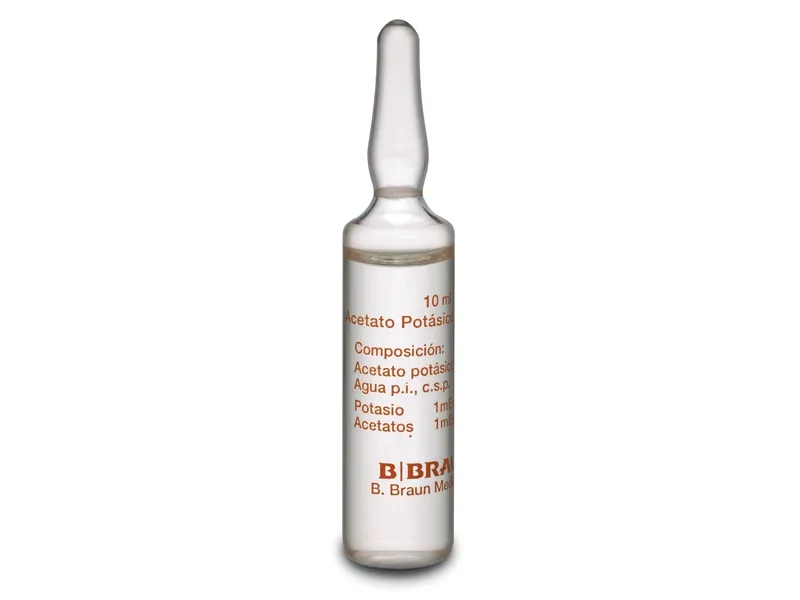
Table of Contents
- Patient Information Leaflet
- Introduction
- **Read the entire leaflet carefully before starting to use this medicine, as it contains important information for you.**
- 1. What Acetato de Potasio B. Braun 1 mEq/ml is and what it is used for
- 2. What you need to know before starting to use Potassium Acetate B. Braun 1 mEq/ml
- 3. How to use Potassium Acetate B. Braun 1 mEq/ml
- 4. Possible adverse effects
- 5. Storage of Potassium Acetate B. Braun 1 mEq/ml
- 6. Contents of the container and additional information
Patient Information Leaflet
Introduction
Patient Information Leaflet
Potassium Acetate B. Braun 1 mEq/mL
concentrate for solution for infusion
Read the entire leaflet carefully before starting to use this medicine, as it contains important information for you.
- Keep this leaflet, as you may need to read it again.
- If you have any questions, consult your doctor, pharmacist, or nurse.
- This medicine has been prescribed for you only and must not be given to other people, even if they have the same symptoms as you, because it could harm them.
- If you experience any adverse effects, consult your doctor, pharmacist, or nurse, even if the effects are not listed in this leaflet.
Leaflet contents:
- What Acetato de Potasio B. Braun 1 mEq/ml is and what it is used for
- What you need to know before using Acetato de Potasio B. Braun 1 mEq/ml
- How to use Acetato de Potasio B. Braun 1 mEq/ml
- Possible adverse effects
- How to store Acetato de Potasio B. Braun 1 mEq/ml
- Package contents and additional information
1. What Acetato de Potasio B. Braun 1 mEq/ml is and what it is used for
This product belongs to the group of medicines known as “Additives for intravenous solutions: Electrolyte solutions”.
Acetato de Potasio B. Braun 1 mEq/ml is used for:
- the treatment of potassium deficiency due to any cause
- correcting the potassium content of other solutions that are administered directly into the bloodstream.
2. What you need to know before starting to use Potassium Acetate B. Braun 1 mEq/ml
Do not use Potassium Acetate B. Braun 1 mEq/ml:
If you are allergic (hypersensitive) to any of the components of Potassium Acetate B. Braun.
If you have:
- excess acid in tissues and blood (metabolic acidosis),
- untreated Addison's disease,
- kidney disorders or adrenal cortex disorders (glands located above the kidneys),
- heart block and are being treated with digitalis medications (heart stimulants),
- medical conditions related to trauma: severe burns, traumatic injuries, external infections, major surgery within the previous 24 hours before administration, or hemodialysis (a technique used to remove waste products from the blood such as potassium or urea),
- reduced or absent urine production (oliguria or anuria).
Warnings and precautions
Consult your doctor, pharmacist, or nurse before starting to use Potassium Acetate B. Braun.
Potassium supplements should be administered with caution in elderly patients or in those with impaired kidney function.
Your doctor will assess whether it is advisable to administer appropriate amounts of sodium chloride.
Use of Potassium Acetate B. Braun with other medicines:
Inform your doctor or pharmacist if you are taking, have recently taken, or might need to take any other medicines.
Inform your doctor if you are taking:
- Corticosteroids, mineralocorticoids, or corticotropin (ACTH),
- Laxative medicines. Chronic or excessive use of these promotes excessive potassium loss,
- Concomitant administration of medications containing potassium or salt substitutes,
- Angiotensin-converting enzyme inhibitors (ACE inhibitors) such as captopril or enalapril, or angiotensin II receptor antagonists (candesartan, telmisartan, eprosartan, irbesartan, losartan, valsartan),
- Quinidine and digoxin (medicines used to treat heart disorders).
If in doubt, consult your doctor or pharmacist.
Pregnancy and breastfeeding:
Consult your doctor or pharmacist before using any medicine.
The safety of this medicine during pregnancy and breastfeeding has not been established; therefore, your doctor must evaluate the benefit/ risk of therapy before administration.
3. How to use Potassium Acetate B. Braun 1 mEq/ml
This medicine is administered directly into a vein, will always be used in a hospital setting, and will be administered by healthcare professionals.
Potassium Acetate B. Braun must not be injected alone; it must be used diluted with other solutions prior to administration.
Your doctor will determine the duration of your treatment with Potassium Acetate B. Braun and will decide the most appropriate dose for you.
If you use more Potassium Acetate B. Braun 1 mEq/ml than you should
If you have used more Potassium Acetate B. Braun 1 mEq/ml than you should have, consult your doctor or pharmacist immediately.
It is unlikely that this will occur, as your doctor will determine the dose you require. However, if you were to receive more medicine than required, you might experience: slower heartbeat (bradycardia), confusion, fatigue, diarrhea, difficulty swallowing (dysphagia), changes in the electrocardiogram, excess potassium in the blood (hyperkalemia), breathing difficulties, uncontrolled contraction of heart muscle fibers (ventricular fibrillation), paralysis of voluntary muscles, cardiac arrest, and death.
If any of these effects occur, treatment must be stopped immediately, and all potassium-containing elements in the diet and potassium-sparing diuretic medications should be removed.
In case of overdose or accidental ingestion, contact the Toxicology Information Service (telephone: 91.562 04 20) or consult your doctor or pharmacist. Keep this leaflet with you.
4. Possible adverse effects
Like all medicines, Potassium Acetate B. Braun may produce adverse effects, although not everyone experiences them.
The possible adverse reactions are those due to high levels of potassium. The signs and symptoms are those described in the previous section, and may include hypotension and even cardiac arrest.
At the site of administration:
- pain at the injection site,
- cell death (necrosis) in case of blood leakage,
- inflammation of the veins in case of concentrations that are too high (phlebitis).
Reporting of adverse effects
If you experience any type of adverse effect, consult your doctor or pharmacist, even if it is a possible adverse effect not listed in this leaflet. You may also report them directly via the Spanish Pharmacovigilance System for Human Medicines: www.notificaRAM.es. By reporting adverse effects, you can help provide more information on the safety of this medicine.
5. Storage of Potassium Acetate B. Braun 1 mEq/ml
Keep out of the sight and reach of children.
No special storage conditions are required.
Do not use Potassium Acetate B. Braun after the expiry date indicated on the container. The expiry date is the last day of the month indicated.
Medicines should not be disposed of via wastewater or household waste. Ask your pharmacist how to dispose of medicines and containers you no longer need. This will help protect the environment.
6. Contents of the container and additional information
Composition of Potassium Acetate B. Braun 1 mEq/ml
The active ingredient is: | Per 10 ml |
Potassium acetate | 0.98 g |
Theoretical osmolarity | 2,000 mOsm/l |
Per 10 ml | |
Acetate- | 10 mEq |
Potassium | 10 mEq |
The other components are: water for injections.
Appearance of the product and contents of the container
Potassium Acetate B. Braun 1 mEq/ml is available in the following pack sizes: (not all sizes may be marketed).
Format: | 10 vials of 10 ml |
100 vials of 10 ml |
Marketing Authorization Holder and Manufacturing Responsible Party
Marketing Authorization Holder:
B|BRAUN
- Braun Medical, S.A.
Ctra. de Terrassa, 121
08191-Rubí (Barcelona)
Spain
Manufacturing Responsible Party:
- Braun Medical, S.A.
Ronda de los Olivares, Parcela 11
Polígono Industrial Los Olivares
23009-Jaén (Jaén)
Spain
This summary of product characteristics was approved in February 2015.
Detailed information on this medicine is available on the website of the Spanish Agency of Medicines and Health Products: http://www.aemps.gob.es/
This information is intended exclusively for physicians or healthcare professionals:
Instructions for correct administration:
Administer exclusively diluted in an appropriate solution and by intravenous route.
Drug addition should be performed by trained personnel, never in a hanging position, and compatibility tables should be consulted before combining or co-administering with other medications.
Since hypokalaemia may be associated with hypochloremic alkalosis, administration of appropriate amounts of sodium chloride together with potassium may be advisable.
Administration must be performed slowly and under cardiac activity monitoring.
Patient monitoring is especially important, as it indicates the appropriate infusion rate following the initial infusion.
Normal doses in adults and adolescents:
The dose and infusion rate must be determined according to individual patient needs, up to a daily maximum equivalent of 400 mEq of potassium (normally, no more than 3 mEq per kg of body weight). In most cases, the recommended maximum concentration is 40 mEq of potassium per liter.
Potassium administration must not exceed 20 mmol per hour.
Pediatric doses:
Safety and efficacy have not been fully established in pediatric patients. However, intravenous administration is recommended after dilution in an appropriate solution, using a maximum concentration of 3 mmol of potassium/kg of body weight or 40 mmol/m² of body surface area.
The solution should be inspected visually before use. The solution must be clear, free from precipitates, and the container must be intact. Do not administer if these conditions are not met.
Use an aseptic procedure when administering the solution and adding medications, if necessary.