Plasbumin 20% solution for infusion
Spain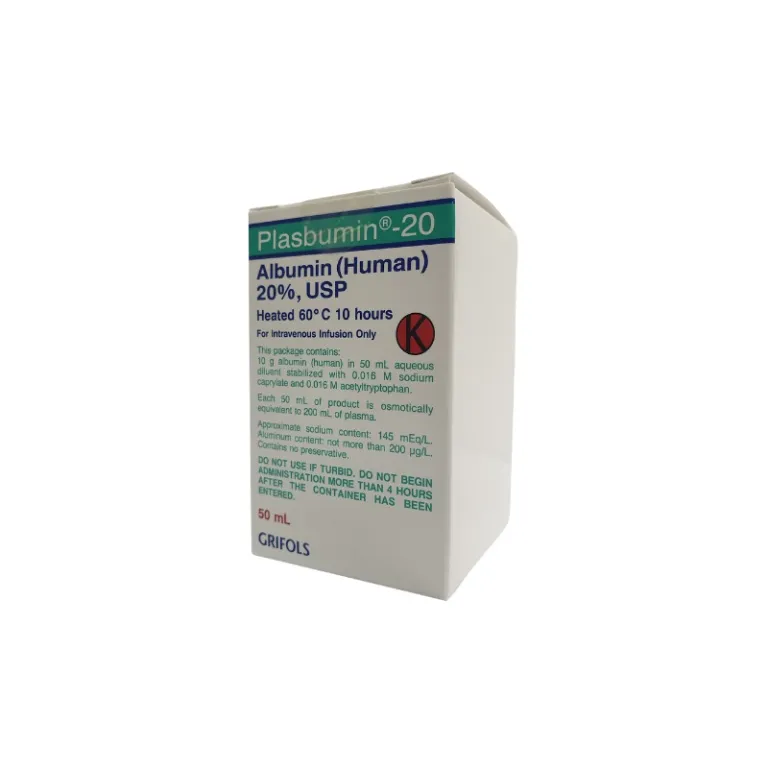
Table of Contents
- Package leaflet: Information for the user
- Introduction
- 1. What Plasbumin 20 is and what it is used for
- 2. What you need to know before using Plasbumin 20
- - Decompensated heart failure
- - Hypertension
- - Esophageal varices
- - Pulmonary edema
- - Hemorrhagic diathesis
- - Severe anemia
- - Renal and post-renal anuria
- **Pregnancy, breastfeeding and fertility**
- **Driving and Use of Machinery**
- 3. How to use Plasbumin 20
- **If you forget to use Plasbumin 20**
- 4. Possible adverse effects
- 5. Storage of Plasbumin 20
- 6. Contents of the container and other information
- - The active substance is human albumin.
- For more information about the components, see also “Important information about some of the components of Plasbumin 20” at the end of section 2.
- **Appearance of the product and contents of the pack**
- **Plasbumin 20** is presented as a solution for intravenous infusion. The solution is clear, slightly viscous, pale yellow to amber or green in color.
Package leaflet: Information for the user
Introduction
Package leaflet: information for the user
Plasbumin 20% solution for infusion
Human albumin 20%
Read the entire leaflet carefully before you start using this medicine, as it contains important information for you.
|
Package leaflet contents
- What Plasbumin 20 is and what it is used for
- What you need to know before using Plasbumin 20
- How to use Plasbumin 20
- Possible side effects
- How to store Plasbumin 20
- Contents of the pack and other information
1. What Plasbumin 20 is and what it is used for
This medicinal product belongs to the group of medicines known as plasma substitutes.
It is presented as a solution for intravenous infusion. Each Plasbumin 20 container consists of 1 vial containing human albumin.
The administration of Plasbumin 20 is indicated for the restoration and maintenance of circulating volume when a volume deficit has been demonstrated and the use of a colloid is considered appropriate. The choice of albumin over an artificial colloid will depend on the patient's clinical condition and should be based on official recommendations.
2. What you need to know before using Plasbumin 20
Do not use Plasbumin 20:
If you are allergic (hypersensitive) to albumin or to any of the other components of this medicine (listed in section 6).
Warnings and precautions
Consult your doctor, pharmacist, or nurse before starting to use Plasbumin 20.
Inform your doctor if:
- You experience an allergic or anaphylactic reaction, as the infusion must be immediately discontinued. In case of hypersensitivity to human plasma proteins, administration should be carried out slowly, with special precautionary measures and under medical supervision.
- You have:
- Decompensated heart failure
- Hypertension
- Esophageal varices
- Pulmonary edema
- Hemorrhagic diathesis
- Severe anemia
- Renal and post-renal anuria
This medicine should be administered with caution as hypervolemia (abnormally increased plasma volume) or hemodilution may occur.
When medicinal products derived from human plasma or blood are administered, certain measures should be taken to prevent the transmission of infections to patients. These measures include:
- careful selection of donors, to exclude those at risk of carrying infectious diseases,
- testing for specific markers of infection in individual donations and in plasma pools,
- inclusion of steps in the manufacturing process to inactivate/eliminate viruses.
Nevertheless, when administering medicinal products derived from human blood or plasma, the possibility of transmitting infectious agents cannot be completely excluded. This also applies to emerging viruses or those of unknown origin, as well as other types of infections.
No cases of viral infections have been reported with albumin manufactured according to the specifications and processes defined in the European Pharmacopoeia.
It is highly recommended that each time a healthcare professional administers a dose of Plasbumin 20, they record the name of the medicine and the batch number administered, in order to maintain a traceable record of batches used.
Use of Plasbumin 20 with other medicines
Inform your doctor or pharmacist if you are taking, have recently taken, or might need to take any other medicines.
In general, this medicine should not be mixed with other medicinal products, including whole blood and red blood cell concentrates.
Pregnancy, breastfeeding and fertility
If you are pregnant or breastfeeding, think you may be pregnant, or are planning to become pregnant, consult your doctor or pharmacist before using this medicine.
Your doctor will weigh the potential risk to the fetus and will inform you whether treatment with this medicine is appropriate.
Driving and Use of Machinery
There are no indications that Plasbumin 20 may affect the ability to drive vehicles or operate machinery.
Important information about some of the components of Plasbumin 20
Patients on sodium-restricted diets should be aware that this medicinal product contains 166.8 mg (7.3 mmol) of sodium per 50 ml vial and 333.5 mg (14.5 mmol) of sodium per 100 ml vial.
Patients with renal insufficiency or those on potassium-restricted diets should be aware that this medicinal product contains a maximum of 10 mmol of potassium per litre of perfusion solution.
3. How to use Plasbumin 20
Follow exactly the administration instructions for this medicine given by your doctor or pharmacist. If in doubt, consult your doctor or pharmacist again.
Plasbumin 20 is a hospital-use medicine, so it will be administered to you in a hospital by qualified healthcare personnel.
The concentration and dose of albumin, as well as the rate of administration, will be adjusted according to your needs.
Your doctor will determine how often and at what intervals Plasbumin 20 should be administered.
Your doctor will indicate the duration of your treatment with Plasbumin 20.
If you use more Plasbumin 20 than you should
Contact your doctor or pharmacist immediately.
In case of overdose or accidental administration, contact the Toxicology Information Service. Telephone: 91 562 04 20.
If you forget to use Plasbumin 20
Do not take a double dose to make up for missed doses.
If you have any further questions about the use of this medicine, ask your doctor, pharmacist, or nurse.
4. Possible adverse effects
Like all medicines, this medicine may produce adverse effects, although not everyone experiences them.
- Rare adverse effects (occur in 1 to 10 out of every 10,000 patients receiving treatment): mild reactions such as redness, skin rashes, fever, and nausea may occur.
- Very rare adverse effects (occur in fewer than 1 in every 10,000 treated patients): anaphylactic shock may occur.
For information on viral safety, see section 2.
Reporting of adverse effects
If you experience any type of adverse effect, consult your doctor, pharmacist, or nurse, even if it is a possible adverse effect not listed in this leaflet. You may also report them directly through the Spanish Pharmacovigilance System for Human Medicinal Products: www.notificaRAM.es. By reporting adverse effects, you can help provide more information on the safety of this medicine.
5. Storage of Plasbumin 20
Keep this medicine out of the sight and reach of children.
Store in its original packaging and protect from light. Do not store above 30°C.
Do not freeze.
Do not use this medicine after the expiry date stated on the container after EXP:.
The expiry date refers to the last day of the indicated month.
Once the container has been opened, the contents should be used immediately.
Do not use this medicine if you notice that the solution is cloudy or contains sediments.
6. Contents of the container and other information
Composition of Plasbumin 20
- The active substance is human albumin.
Each vial contains a 20% protein solution, of which at least 95% is human albumin.
- The other components are: sodium caprylate, N-acetyl-DL-tryptophan, ions (sodium, potassium), and water for injections.
For more information about the components, see also “Important information about some of the components of Plasbumin 20” at the end of section 2.
Appearance of the product and contents of the pack
Plasbumin 20 is presented as a solution for intravenous infusion. The solution is clear, slightly viscous, pale yellow to amber or green in color.
Plasbumin 20 is available in vials containing 50 ml and 100 ml of product.
Pack size: 1 vial
Marketing Authorization Holder and Manufacturing Responsible Party
Marketing Authorization Holder
Grifols Deutschland GmbH
Colmarer Straße 22
D-60528 Frankfurt
Germany
Responsible Manufacturer
Instituto Grifols, S.A.
Can Guasc, 2 - Parets del Vallès
08150 Barcelona
Spain
Local Representative
Instituto Grifols, S.A.
Can Guasc, 2 - Parets del Vallès
08150 Barcelona
Spain
Date of the most recent review of this summary of product characteristics: December 2016
Detailed and up-to-date information on this medicinal product is available on the website of the Spanish Agency of Medicines and Health Products (AEMPS) http://www.aemps.es/
__________________________________________________________________________________
This information is intended solely for physicians or healthcare professionals:
-
Plasbumin 20 must be administered intravenously by infusing the contents of the container directly or diluted with an isotonic solution (e.g., 5% glucose solution or physiological saline). Mixing with electrolyte solutions must be performed under aseptic conditions.
-
Plasbumin 20 must not be diluted with water for injection, as this may cause hemolysis in the recipient.
-
Solutions should be clear or slightly opalescent. Turbid solutions or those containing sediments must not be used, as these may indicate protein instability or contamination. Once the container has been opened, its contents should be used immediately.
-
Infusion must be carried out intravenously using a single-use, sterile, and pyrogen-free infusion set. Before inserting the infusion set into the stopper, the stopper must be disinfected with an appropriate antiseptic. Once the infusion set is attached to the vial, the contents should be infused immediately.
-
The infusion rate should be adjusted according to the individual patient's clinical condition and indication. During plasmapheresis, the infusion rate should match the plasma exchange rate. If the dose and infusion rate are not adjusted to the patient's circulatory status, hypervolemia may occur. If clinical signs of cardiovascular overload appear (e.g., headache, dyspnea, jugular venous distension), increased blood pressure, elevated venous pressure, or pulmonary edema, the infusion must be stopped immediately.
-
When large volumes are administered, the product should be warmed to body temperature before use.
-
When administering concentrated albumin, adequate hydration of the patient must be ensured. Patients must be adequately monitored to prevent circulatory overload and hyperhydration.
-
When administering albumin, the patient's electrolyte balance must be monitored, and appropriate measures taken, if necessary, to restore or maintain it.
-
Adequate replacement of other blood components (coagulation factors, electrolytes, platelets, and erythrocytes) must be ensured.
Any unused solutions must be properly discarded.