Pirfenidone Cipla 801 mg film-coated tablets EFG
Spain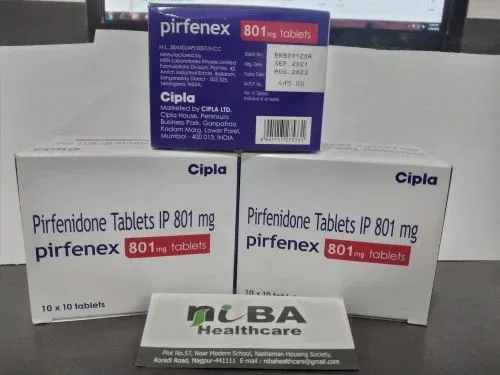
Table of Contents
- Package leaflet: Information for the user
- Introduction
- 1. What Pirfenidone Cipla is and what it is used for
- 2. What you need to know before taking Pirfenidona Cipla
- 3. How to take Pirfenidone Cipla
- 4. Possible adverse effects
- 5. Storage of Pirfenidone Cipla
- 6. Contents of the pack and other information
Package leaflet: Information for the user
Introduction
Package leaflet: information for the user
Pirfenidone Cipla 267 mg film-coated tablets EFG
Pirfenidone Cipla 801 mg film-coated tablets EFG
Read all of this leaflet carefully before you start taking this medicine because it contains important information for you.
- Keep this leaflet. You may need to read it again.
- If you have any questions, ask your doctor or pharmacist.
- This medicine has been prescribed for you only and must not be given to other people, even if they have the same symptoms as you. It may harm them.
- If you experience any adverse effects, consult your doctor or pharmacist, even if they are adverse effects not listed in this leaflet. See section 4.
Contents of the leaflet
- What Pirfenidone Cipla is and what it is used for
- What you need to know before taking Pirfenidone Cipla
- How to take Pirfenidone Cipla
- Possible side effects
- How to store Pirfenidone Cipla
- Contents of the pack and other information
1. What Pirfenidone Cipla is and what it is used for
Pirfenidone Cipla contains the active substance pirfenidone and is used for the treatment of Idiopathic Pulmonary Fibrosis (IPF) in adults.
IPF is a disease in which lung tissues become inflamed and progressively scarred over time, making it difficult to breathe deeply. Under these circumstances, the lungs have difficulty functioning properly. This medicine helps reduce scarring and inflammation in the lungs, helping you breathe better.
2. What you need to know before taking Pirfenidona Cipla
Do not take Pirfenidona Cipla
- If you are allergic to pirfenidone or to any of the other ingredients of this medicine (listed in section 6).
- If you have previously had angioedema with pirfenidone, including symptoms such as swelling of the face, lips and/or tongue, which may be associated with difficulty breathing or wheezing.
- If you are taking a medicine called fluvoxamine (used to treat depression and obsessive-compulsive disorder [OCD]).
- If you have severe or end-stage liver disease.
- If you have severe or end-stage kidney disease requiring dialysis.
If any of the above apply to you, do not take this medicine. If you have any doubts, consult your doctor or pharmacist.
Warnings and precautions
Talk to your doctor or pharmacist before starting to take this medicine.
- You may become more sensitive to sunlight (photosensitivity reaction) while taking pirfenidone. Avoid sunlight (including UV lamps) while taking pirfenidona. Use sunscreen daily and cover your arms, legs, and head to reduce sun exposure (see section 4: Possible side effects).
- You should not take other medicines, such as tetracycline antibiotics (e.g., doxycycline), that may increase your sensitivity to sunlight.
- You must inform your doctor if you have kidney problems.
- You must inform your doctor if you have mild to moderate liver problems.
- You must refrain from smoking before and during treatment with pirfenidona. Tobacco may reduce the effect of pirfenidona.
- Pirfenidona may cause dizziness and fatigue. Be cautious if you need to perform activities requiring attention and coordination.
- Pirfenidona may cause weight loss. Your doctor will monitor your weight while you are taking this medicine.
- Cases of Stevens-Johnson syndrome, toxic epidermal necrolysis, and drug reaction with eosinophilia and systemic symptoms (DRESS) have been reported in association with pirfenidone treatment. Stop taking pirfenidona and seek immediate medical attention if you notice any symptoms related to these serious skin reactions described in section 4.
Pirfenidona can cause serious liver problems. Some cases have been fatal. You will need to have a blood test before starting pirfenidona, once a month for the first 6 months, and then every 3 months thereafter while taking this medicine, to check that your liver is functioning properly. It is important that you have these blood tests performed regularly throughout the entire time you are taking pirfenidona.
Children and adolescents
Do not give pirfenidone to children and adolescents under 18 years of age.
Other medicines and Pirfenidona Cipla
Inform your doctor or pharmacist if you are taking, have recently taken, or might need to take any other medicines.
This is especially important if you are taking the following medicines, as they may alter the effect of pirfenidona.
The following medicines may increase the side effects of pirfenidona:
- enoxacin (a type of antibiotic).
- ciprofloxacin (a type of antibiotic).
- amiodarone (used to treat certain types of heart disease).
- propafenone (used to treat certain types of heart disease).
- fluvoxamine (used to treat depression and obsessive-compulsive disorder [OCD]).
The following medicines may reduce the effectiveness of pirfenidona:
- omeprazole (used to treat conditions such as indigestion and gastroesophageal reflux disease).
- rifampicin (a type of antibiotic).
Taking Pirfenidona Cipla with food and drinks
Do not drink grapefruit juice while taking this medicine. Grapefruit juice may cause pirfenidona to not work properly.
Pregnancy and breastfeeding
As a precautionary measure, it is preferable to avoid using pirfenidona if you are pregnant, planning to become pregnant, or think you might be pregnant, as the potential risks to the fetus are unknown.
If you are breastfeeding or plan to breastfeed, talk to your doctor or pharmacist before taking this medicine. Since it is not known whether pirfenidona is excreted in breast milk, your doctor will explain the risks and benefits of taking this medicine during breastfeeding if you decide to do so.
Driving and using machines
Do not drive or operate machinery if you feel dizzy or tired after taking pirfenidona.
Pirfenidona Cipla contains sodium
This medicine contains less than 1 mmol of sodium (23 mg) per tablet; therefore, it is essentially “sodium-free”.
3. How to take Pirfenidone Cipla
Treatment with pirfenidone should be initiated and supervised by specialist physicians experienced in the diagnosis and treatment of IPF.
Follow exactly the dosing instructions for this medicine as given by your doctor or pharmacist. If you are unsure, consult your doctor or pharmacist again.
You will normally be given this medicine with a gradually increasing dose as follows:
- For the first 7 days, take a dose of 267 mg (1 yellow tablet), 3 times a day with food (total of 801 mg/day).
- From days 8 to 14, take a dose of 534 mg (2 yellow tablets), 3 times a day with food (total of 1,602 mg/day). A dose of 534 mg is obtained by taking 2 yellow tablets (267 mg each).
- From day 15 onwards (maintenance phase), take a dose of 801 mg (3 yellow tablets or 1 pink tablet), 3 times a day with food (total of 2,403 mg/day).
The recommended daily maintenance dose of pirfenidone is 801 mg (3 yellow tablets or 1 pink tablet) three times a day with meals, for a total daily dose of 2,403 mg.
Swallow the tablets whole with water, during or after a meal to reduce the risk of side effects such as nausea (feeling unwell) and dizziness. If symptoms persist, contact your doctor.
Dose reduction due to side effects
Your doctor may decide to reduce your dose if you experience side effects such as stomach problems, skin reactions to sunlight or UVA lamps, or significant changes in liver enzymes.
If you take more Pirfenidone Cipla than you should
Go immediately to your doctor, pharmacist, or the nearest hospital emergency department if you take more tablets than you should, and bring your medication with you.
In case of overdose or accidental ingestion, contact your doctor or pharmacist immediately or call the Toxicology Information Service at telephone number 91 562 04 20, indicating the medicine and the amount ingested.
If you forget to take Pirfenidone Cipla
If you forget to take a dose, take it as soon as you remember. Do not take a double dose to make up for missed doses. Each dose should be separated by at least 3 hours. Do not take more tablets in one day than your prescribed daily dose.
If you stop taking Pirfenidone Cipla
In certain situations, your doctor may advise you to stop taking pirfenidone. If for any reason you stop taking pirfenidone for more than 14 consecutive days, your doctor will restart your treatment at a dose of 267 mg three times a day and gradually increase it to 801 mg three times a day.
If you have any further questions about the use of this medicine, ask your doctor or pharmacist.
4. Possible adverse effects
Like all medicines, this medicine can cause adverse effects, although not everyone will experience them.
Stop taking pirfenidone and seek immediate medical attention if you experience any of the following symptoms or signs:
- Swelling of the face, lips and/or tongue, itching, hives, difficulty breathing or wheezing, or a feeling of fainting, which are signs of angioedema, a serious allergic reaction or anaphylaxis.
- Yellowing of the eyes or skin, dark urine, possibly accompanied by itching of the skin, pain in the upper right area of the abdomen, loss of appetite, bleeding or bruising more easily than normal, or feeling tired. These could be signs of abnormal liver function and may indicate liver damage, which is an uncommon adverse effect of pirfenidone.
- Reddish, non-elevated spots, or circular rashes on the trunk, often with central blisters, skin peeling, or ulcers in the mouth, throat, nose, genitals, and eyes. These severe skin rashes may be preceded by fever and flu-like symptoms (Stevens-Johnson syndrome or toxic epidermal necrolysis).
- Widespread skin rash, high body temperature, and enlarged lymph nodes (DRESS syndrome or drug hypersensitivity syndrome).
Other possible adverse effects are
If you experience any type of adverse effect, consult your doctor.
Very common adverse effects (may affect more than 1 in 10 people):
- Throat or respiratory tract infections reaching the lungs and/or sinusitis.
- Feeling unwell (nausea).
- Stomach problems such as acid reflux, vomiting, and constipation.
- Diarrhea.
- Indigestion or stomach heaviness.
- Weight loss.
- Decreased appetite.
- Difficulty sleeping.
- Fatigue.
- Dizziness.
- Headache.
- Difficulty breathing.
- Cough.
- Joint pain.
Common adverse effects (may affect up to 1 in 10 people):
- Bladder infections.
- Drowsiness.
- Taste disturbance.
- Hot flushes.
- Stomach problems such as feeling of fullness, abdominal pain and discomfort, heartburn, and flatulence.
- Blood tests may show increased liver enzymes.
- Skin reactions after exposure to sunlight or use of UVA lamps.
- Skin problems such as itching, irritation, or redness, dryness, rash.
- Muscle pain.
- Weakness or lack of energy.
- Chest pain.
- Sunburn.
Uncommon adverse effects (may affect up to 1 in 100 people):
- Low levels of sodium in the blood. This may cause headache, dizziness, confusion, weakness, muscle cramps, or nausea and vomiting.
- Blood test results may show decreased white blood cells.
Reporting of adverse effects
If you experience any type of adverse effect, talk to your doctor or pharmacist, even if it is a possible adverse effect not listed in this leaflet. You can also report them directly via the Spanish Pharmacovigilance System for Human Medicines: www.notificaram.es. By reporting adverse effects, you can help provide more information on the safety of this medicine.
5. Storage of Pirfenidone Cipla
Keep this medicine out of the sight and reach of children.
Do not use this medicine after the expiry date stated on the blister or carton, following “EXP”. The expiry date refers to the last day of the month indicated.
This medicine does not require any special storage conditions.
Medicines must not be disposed of via wastewater or household waste. Dispose of unused medicines and their containers at the SIGRE Point at your pharmacy. Ask your pharmacist how to dispose of medicines and containers you no longer need. This will help protect the environment.
6. Contents of the pack and other information
Composition of Pirfenidone Cipla
-
The active substance is pirfenidone.
-
267 mg tablets: Each film-coated tablet contains 267 mg of pirfenidone.
-
801 mg tablets: Each film-coated tablet contains 801 mg of pirfenidone.
-
The other components are:
-
Tablet core: anhydrous colloidal silica (E551), hypromellose (E464), mannitol (E421), sodium carboxymethyl starch (Type A), and sodium stearyl fumarate.
-
Coating material: macrogol (E1521), poly(vinyl alcohol) (E1203), talc (E553b), titanium dioxide (E171).
267 mg film-coated tablets also contain yellow iron oxide (E172).
801 mg film-coated tablets also contain red iron oxide (E172).
Appearance of the product and contents of the pack
267 mg tablets
Pirfenidone Cipla 267 mg film-coated tablets EFG are light yellow to yellow, biconvex, bevel-edged, oval-shaped, film-coated tablets, smooth on both sides. The tablet size is approximately 14 mm × 7 mm.
Pack for initiation of treatment over 2 weeks: the multipack contains 63 film-coated tablets (1 pack of 21 and 1 pack of 42).
84 film-coated tablets.
Maintenance pack: the multipack contains 252 film-coated tablets (3 packs of 84).
801 mg tablets
Pirfenidone Cipla 801 mg film-coated tablets EFG are light pink to pink, biconvex, capsule-shaped, film-coated tablets, smooth on both sides. The tablet size is approximately 20 mm × 9 mm.
84 film-coated tablets.
Maintenance pack: the multipack contains 252 film-coated tablets (3 packs of 84).
Each blister strip is marked with the following symbols and abbreviations as a reminder to take a dose three times a day:
 (sunrise; morning dose),
  (sun; afternoon dose), and
  (moon; evening dose).
Mon., Tue., Wed., Thu., Fri., Sat., Sun.
Only certain pack sizes may be commercially available.
Marketing Authorization Holder and Manufacturer
Cipla Europe NV
De Keyserlei 60C, Bus-1301,
2018 Antwerp, Belgium
Local representative
Cipla Europe NV, Spanish branch
C/Guzmán el Bueno 133, Edificio Britannia
28003 Madrid, Spain
This medicinal product is authorized in the Member States of the European Economic Area under the following names:
Sweden: Pirfenidon Cipla
Belgium: Pirfenidon Cipla
Germany: Pirfenidon Cipla
Spain: Pirfenidona Cipla 267 mg film-coated tablets EFG
Pirfenidona Cipla 801 mg film-coated tablets EFG
Norway: Pirfenidon Cipla
France: Pirfenidone Cipla
Italy: Pirfenidone Cipla
Poland: Pirfenidon Cipla
Ireland: Pirfenidone Cipla
Finland: Pirfenidon Cipla
Date of the most recent review of this leaflet: March 2024
Detailed information on this medicinal product is available on the website of the Spanish Agency of Medicines and Health Products (AEMPS) (http://www.aemps.gob.es/).