Pifeltro 100 mg film-coated tablets
Spain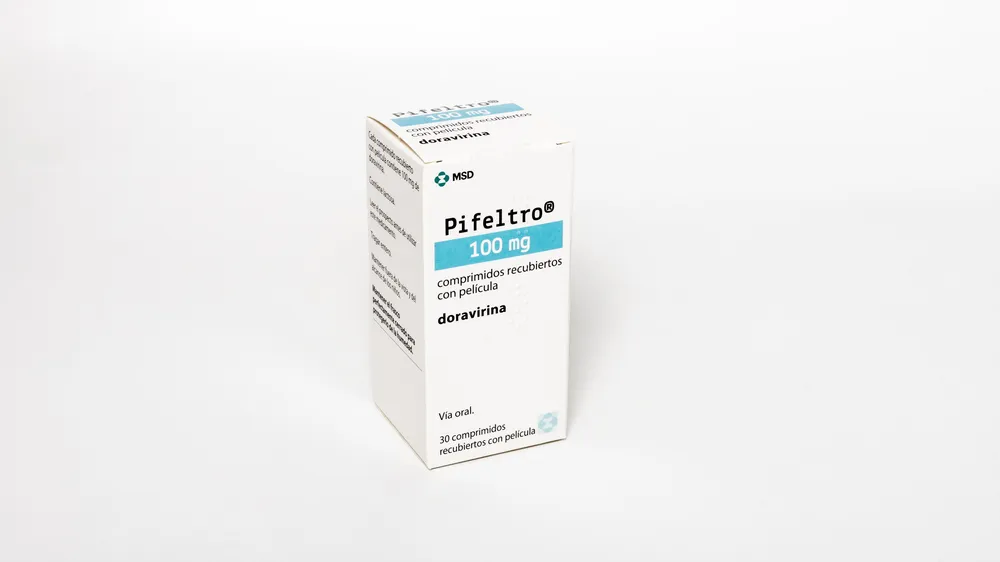
Table of Contents
Package leaflet: Information for the user
Introduction
Package leaflet: information for the user
Pifeltro 100 mg film-coated tablets
doravirine
Read the entire leaflet carefully before you start taking this medicine because it contains important information for you.
- Keep this leaflet as you may need to read it again.
- If you have any questions, ask your doctor, pharmacist or nurse.
- This medicine has been prescribed for you only and must not be given to other people, even if they have the same symptoms as you. It may harm them.
- If you experience any side effects, talk to your doctor, pharmacist or nurse, even if they are side effects not listed in this leaflet. See section 4.
Leaflet contents
- What Pifeltro is and what it is used for
- What you need to know before taking Pifeltro
- How to take Pifeltro
- Possible side effects
- How to store Pifeltro
- Contents of the pack and other information
1. What Pifeltro is and what it is used for
What Pifeltro is
Pifeltro is used to treat HIV ("human immunodeficiency virus") infection. It belongs to a group of medicines called "antiretrovirals".
Pifeltro contains the active substance doravirine, a non-nucleoside reverse transcriptase inhibitor (NNRTI).
What Pifeltro is used for
Pifeltro is used to treat HIV infection in adults and adolescents aged 12 years and older with a body weight of at least 35 kg. HIV is the virus that causes AIDS ("Acquired Immunodeficiency Syndrome"). You should not take Pifeltro if your doctor has told you that the virus causing your infection is resistant to doravirine.
Pifeltro must be used in combination with other HIV medicines.
How Pifeltro works
When used together with other medicines, Pifeltro works by preventing HIV from producing more virus in your body by:
- reducing the amount of HIV in the blood (known as "viral load")
- increasing the number of white blood cells called "CD4+ T cells". This may strengthen your immune system and reduce the risk of early death or of developing infections due to a weakened immune system.
2. What you need to know before taking Pifeltro
Do not take Pifeltro
-
if you are allergic to doravirine or to any of the other ingredients of this medicine (listed in section 6).
-
if you are taking any of the following medicines:
-
carbamazepine, oxcarbazepine, phenobarbital, phenytoin (medicines used to treat seizures)
-
rifampicin, rifapentine (medicines used to treat tuberculosis)
-
St. John’s wort (Hypericum perforatum, a herbal remedy used for depression and anxiety) or products containing it
-
mitotane (a medicine used to treat cancer)
-
enzalutamide (a medicine used to treat prostate cancer)
-
lumacaftor (a medicine used to treat cystic fibrosis)
Do not take Pifeltro if you are in any of the situations listed above. If you are unsure, consult your doctor, pharmacist, or nurse before taking Pifeltro. Also refer to the section "Other medicines and Pifeltro".
Warnings and precautions
Talk to your doctor, pharmacist, or nurse before starting to take Pifeltro.
Severe skin reactions
Severe skin reactions, including Stevens-Johnson syndrome/toxic epidermal necrolysis, have been reported with Pifeltro treatment. Stop taking Pifeltro and seek immediate medical attention if you experience any of the symptoms related to these severe skin reactions described in section 4.
Immune reconstitution syndrome
This syndrome may occur when you start treatment with any HIV medicine, including this one. Your immune system may strengthen and begin to fight infections that were previously hidden in your body. Inform your doctor immediately if you develop any new symptoms after starting HIV medication.
Autoimmune disorders (a condition in which the immune system attacks healthy body tissue) may also occur after you have started taking medicines for your HIV infection. These disorders may appear many months after starting treatment. If you notice any signs of infection or other symptoms such as muscle weakness, weakness starting in the hands and feet and moving upward toward the trunk, palpitations, tremors, or hyperactivity, inform your doctor immediately so that appropriate treatment can be given.
Children and adolescents
Do not give this medicine to children under 12 years of age or weighing less than 35 kg. The use of Pifeltro has not yet been studied in children under 12 years of age or weighing less than 35 kg.
Other medicines and Pifeltro
Inform your doctor, pharmacist, or nurse if you are taking, have recently taken, or might need to take any other medicines. This is because other medicines may affect how Pifeltro works, and Pifeltro may in turn affect how those other medicines work.
There are some medicines that you must not take with Pifeltro. See the list in the section "Do not take Pifeltro".
Talk to your doctor before taking the following medicines with Pifeltro, as your doctor may need to adjust the dose of your medicines:
- bosentan (a medicine used to treat lung diseases)
- dabrafenib (a medicine used to treat skin cancer)
- lesinurad (a medicine used to treat gout)
- modafinil (a medicine used to treat excessive sleepiness)
- nafcillin (a medicine used to treat certain bacterial infections)
- rifabutin (a medicine used to treat certain bacterial infections, such as tuberculosis)
- telotristat ethyl (a medicine used to treat diarrhoea in people with carcinoid syndrome)
- thioridazine (a medicine used to treat psychiatric conditions such as schizophrenia)
If your doctor decides you should take these medicines with Pifeltro, you must take one tablet of doravirine twice daily (approximately 12 hours apart).
Your doctor may monitor your blood levels or check for adverse effects if you take the following medicines with Pifeltro:
- sirolimus (a medicine used to control your body's immune response after transplantation)
- tacrolimus (a medicine used to control your body's immune response after transplantation)
Pregnancy and breastfeeding
If you are pregnant or breastfeeding, think you may be pregnant, or plan to become pregnant, consult your doctor about the risks and benefits of taking Pifeltro. It is preferable to avoid using this medicine during pregnancy. This is because it has not been studied in pregnancy, and it is unknown whether it could harm your baby while you are pregnant.
Breastfeeding is not recommended for women living with HIV because HIV infection can be transmitted to the baby through breast milk.
If you are breastfeeding or considering breastfeeding, you should consult your doctor as soon as possible.
Driving and using machines
Be cautious when driving, cycling, or operating machinery if you feel tired, dizzy, or sleepy after taking this medicine.
Pifeltro tablets contain lactose
If your doctor has diagnosed you with lactose intolerance, consult with them before taking this medicine.
3. How to take Pifeltro
Follow exactly the instructions for taking this medicine as given by your doctor, pharmacist, or nurse. If in doubt, consult your doctor, pharmacist, or nurse again. This medicine must be used in combination with other anti-HIV medicines.
How much to take
The recommended dose is one tablet once daily. If you are taking certain medicines, your doctor may need to adjust the amount of doravirine you take. See section "Other medicines and Pifeltro" for a list of these medicines.
How to take this medicine
- Swallow the tablet whole (do not crush or chew it).
- This medicine can be taken with or without food.
If you take more Pifeltro than you should
Do not take a higher dose than recommended. If you accidentally take more than you should, contact your doctor.
If you forget to take Pifeltro
- It is important not to miss or skip any doses of this medicine.
- If you forget to take a dose, take it as soon as you remember. However, if there are less than 12 hours until the time for your next dose, skip the missed dose and take the next dose at your usual time. After that, continue your treatment as usual.
- Do not take a double dose to make up for a missed dose.
- If you are unsure what to do, consult your doctor or pharmacist.
If you stop taking Pifeltro
Do not run out of this medicine. Reorder your prescription or speak with your doctor before your supply runs out.
If you have any further questions about the use of this medicine, ask your doctor, pharmacist, or nurse.
4. Possible adverse effects
Like all medicines, this medicine can cause adverse effects, although not everyone will experience them. Do not stop taking this medicine without first consulting your doctor.
Stop taking Pifeltro and seek immediate medical attention if you notice any of the following symptoms: red, non-elevated spots, target-like or circular rashes on the trunk, often with blisters in the center, skin peeling, ulcers in the mouth, throat, nose, genitals, and eyes. These severe skin reactions may begin with fever and flu-like symptoms (Stevens-Johnson syndrome/toxic epidermal necrolysis). The frequency of these reactions cannot be estimated from the available data.
Other possible adverse effects
Common: may affect up to 1 in 10 people:
- abnormal dreams, difficulty sleeping (insomnia)
- headache, dizziness, drowsiness
- nausea, diarrhea, stomach pain, vomiting, gas (flatulence)
- rash
- feeling of tiredness
Blood tests may also show:
- increased levels of liver enzymes (ALT)
Uncommon: may affect up to 1 in 100 people:
- nightmares, depression, anxiety, irritability, confusion, suicidal thoughts
- difficulty concentrating, memory problems, tingling in hands and feet, muscle stiffness, poor quality of sleep
- high blood pressure
- constipation, stomach discomfort, bloating or swelling of the stomach (abdominal distension), indigestion, soft stools, stomach spasms
- itching
- muscle pain, joint pain
- feeling of weakness, general feeling of discomfort
Blood tests may also show:
- decreased phosphate levels
- increased levels of liver enzymes (AST)
- increased levels of lipase
- increased levels of amylase
- decreased hemoglobin levels
Rare: may affect up to 1 in 1,000 people:
- aggression, hallucinations, difficulty adapting to changes, mood changes, sleepwalking
- difficulty breathing, enlarged tonsils
- sensation of incomplete bowel evacuation
- skin inflammation due to allergy, redness of the cheeks, nose, chin or forehead, lumps or pimples on the face
- kidney damage, kidney problems, kidney stones
- chest pain, feeling cold, pain, thirst
Blood tests may also show:
- decreased magnesium levels
- increased levels of creatine phosphokinase
Frequency not known: frequency cannot be estimated from the available data:
- abdominal pain caused by liver inflammation
Reporting of adverse effects
If you experience any type of adverse effect, consult your doctor, pharmacist, or nurse, even if it is a possible adverse effect not listed in this leaflet. You may also report them directly through the national reporting system listed in Appendix V. By reporting adverse effects, you can help provide more information on the safety of this medicine.
5. Storage of Pifeltro
- Keep this medicine out of the sight and reach of children.
- Do not use this medicine after the expiry date stated on the bottle after EXP. This medicine should be used within 35 days after first opening the bottle.
- The bottle contains a desiccant that protects the tablets from moisture. Keep the desiccant inside the bottle and do not discard it until you have finished taking the medicine.
- Keep the bottle tightly closed to protect it from moisture.
- This medicine does not require any special storage temperature.
- Medicines should not be disposed of via wastewater or household waste. Ask your pharmacist how to dispose of medicines and packaging you no longer need. This will help protect the environment.
6. Contents of the container and other information
Composition of Pifeltro
- The active substance is doravirine 100 mg.
- The other components are croscarmellose sodium E468; succinate acetate of hypromellose; lactose monohydrate; magnesium stearate E470b; microcrystalline cellulose E460 and colloidal anhydrous silica E551. The tablets are film-coated, and the coating contains the following components: carnauba wax E903; hypromellose E464; lactose monohydrate; titanium dioxide E171 and triacetin E1518.
Appearance of the product and contents of the pack
Pifeltro is presented as white, oval, film-coated tablets, embossed with the corporate logo and 700 on one side and plain on the other side.
The following pack sizes are available:
- 1 bottle containing 30 film-coated tablets
- 90 film-coated tablets (3 bottles of 30 film-coated tablets each)
Only some pack sizes may be marketed.
Marketing Authorization Holder and Manufacturer
Merck Sharp & Dohme B.V., Waarderweg 39, 2031 BN Haarlem, The Netherlands
For further information on this medicinal product, please contact the local representative of the Marketing Authorization Holder:
Belgium/Belgium/Belgium MSD Belgium Tel/Tel: +32(0)27766211 | Lithuania UAB Merck Sharp & Dohme Tel. +370 5 2780 247 |
| Luxembourg/Luxembourg MSD Belgium Tel/Tel: +32(0)27766211 |
Czech Republic Merck Sharp & Dohme s.r.o. Tel.: +420 277 050 000 | Hungary MSD Pharma Hungary Kft. Tel.: +36 1 888 5300 |
Denmark MSD Danmark ApS Tlf.: +45 4482 4000 | Malta Merck Sharp & Dohme Cyprus Limited Tel: 8007 4433 (+356 99917558) |
Germany MSD Sharp & Dohme GmbH Tel.: +49 (0) 89 20 300 4500 | Netherlands Merck Sharp & Dohme B.V. Tel: 0800 9999000 (+31 23 5153153) |
Estonia Merck Sharp & Dohme OÜ Tel: +372 614 4200 | Norway MSD (Norge) AS Tlf: +47 32 20 73 00 |
Greece MSD Α.Φ.Ε.Ε. Tel: +30 210 98 97 300 | Austria Merck Sharp & Dohme Ges.m.b.H. Tel: +43 (0) 1 26 044 |
Spain Merck Sharp & Dohme de España, S.A. Tel: +34 91 321 06 00 | Poland MSD Polska Sp. z o.o. Tel.: +48 22 549 51 00 |
France MSD France Tel: +33 (0)1 80 46 40 40 | Portugal Merck Sharp & Dohme, Lda Tel.: +351 21 4465700 |
Croatia Merck Sharp & Dohme d.o.o. Tel: +385 1 6611 333 | Romania Merck Sharp & Dohme Romania S.R.L. Tel.: +40 21 529 29 00 |
Ireland Merck Sharp & Dohme Ireland (Human Health) Limited Tel: +353 (0)1 2998700 | Slovenia Merck Sharp & Dohme, inovativna zdravila d.o.o. Tel: +386 1 520 4201 |
Iceland Vistor ehf. Tel: +354 535 7000 | Slovakia Merck Sharp & Dohme, s. r. o. Tel.: +421 2 58282010 |
Italy MSD Italia S.r.l. Tel: 800 23 99 89 (+39 06 361911) | Finland MSD Finland Oy Tel: +358 (0)9 804 650 |
Cyprus Merck Sharp & Dohme Cyprus Limited Tel: 800 00 673 (+357 22866700) | Sweden Merck Sharp & Dohme (Sweden) AB Tel: +46 77 5700488 |
Latvia SIA Merck Sharp & Dohme Latvija Tel.: +371 67025300 |
Date of the most recent review of this leaflet: {MM/YYYY}.
Other sources of information
Detailed information on this medicine is available on the website of the European Medicines Agency: https://www.ema.europa.eu.