Pheburane 483 mg/g granules
Spain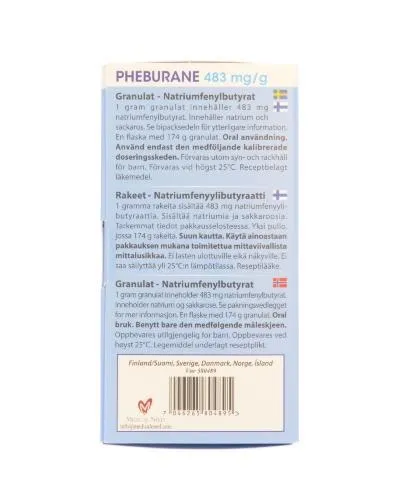
Table of Contents
Patient Information Leaflet
Introduction
Patient Information Leaflet
PHEBURANE 483mg tablets
Sodium phenylbutyrate
Read all of this leaflet carefully before you start taking this medicine, as it contains important information for you.
- Keep this leaflet, as you may need to read it again.
- If you have any questions, ask your doctor or pharmacist.
- This medicine has been prescribed for you only; do not give it to others, even if they have the same symptoms as you, because it may harm them.
- If you experience any side effects, talk to your doctor or pharmacist, even if they are side effects not listed in this leaflet. See section 4.
Contents of this leaflet:
- What PHEBURANE is and what it is used for
- What you need to know before taking PHEBURANE
- How to take PHEBURANE
- Possible side effects
- How to store PHEBURANE
- Contents of the pack and other information
1. What PHEBURANE is and what it is used for
PHEBURANE contains the active substance sodium phenylbutyrate, which is used to treat patients of all ages with urea cycle disorders. These rare disorders are caused by a deficiency of certain liver enzymes required to eliminate residual nitrogen in the form of ammonia.
Nitrogen is a component of proteins, which are an essential part of the food we eat. As the body breaks down proteins after eating, residual nitrogen in the form of ammonia accumulates because the body cannot eliminate it. Ammonia is especially toxic to the brain and, in severe cases, may lead to loss of consciousness and coma.
PHEBURANE helps the body eliminate residual nitrogen and reduces the amount of ammonia in the body.
However, PHEBURANE must be used in conjunction with a low-protein diet specifically designed for your case by your doctor or dietitian. You must carefully follow this diet.
2. What you need to know before taking PHEBURANE
Do not take PHEBURANE:
- if you are allergic to sodium phenylbutyrate or to any of the other ingredients of this medicine (listed in section 6).
- if you are pregnant.
- if you are breastfeeding.
Warnings and precautions
Talk to your doctor or pharmacist before taking PHEBURANE if you:
- have heart failure (a type of heart disease in which the heart cannot pump enough blood for the body) or reduced kidney function.
- have reduced function of the kidneys or liver, as PHEBURANE is eliminated from the body through these organs.
PHEBURANE does not completely prevent the buildup of ammonia in the blood, a condition that is often a medical emergency. If this occurs, you may experience symptoms such as nausea, vomiting, and confusion, and you must seek urgent medical attention.
If you undergo laboratory tests, it is important to inform your doctor that you are taking PHEBURANE, as sodium phenylbutyrate may interfere with the results of certain tests (such as blood electrolytes or proteins, or liver function tests).
If you have any doubts, consult your doctor or pharmacist.
Other medicines and PHEBURANE
Inform your doctor or pharmacist if you are taking, have recently taken, or might need to take any other medicines.
It is especially important that you inform your doctor if you are taking medicines containing:
- valproate (an antiepileptic medicine),
- haloperidol (used to treat certain psychotic disorders),
- corticosteroids (medicines used to reduce inflammation in parts of the body),
- probenecid (for the treatment of hyperuricemia, high blood levels of uric acid, associated with gout).
These medicines may alter the effect of PHEBURANE, and you may require more frequent blood tests. If you are unsure whether your medicines contain these active ingredients, consult your doctor or pharmacist.
Pregnancy and breastfeeding
Do not take PHEBURANE if you are pregnant, as this medicine may harm the fetus.
If you could become pregnant, you must use an effective method of contraception during treatment with PHEBURANE. Consult your doctor for further details.
Do not use PHEBURANE if you are breastfeeding, as this medicine may pass into breast milk and may harm your baby.
Driving and using machines
It is unlikely that PHEBURANE will affect your ability to drive or operate machinery.
PHEBURANE contains sodium and sucrose.
This medicine contains 124 mg (5.4 mmol) of sodium per 1 g of sodium phenylbutyrate. Talk to your doctor or pharmacist if you need 3 or more grams daily for a prolonged period, especially if you have been advised to follow a low-salt (sodium) diet.
This medicine contains 768 mg of sucrose per 1 g of sodium phenylbutyrate. This should be taken into account if you have diabetes mellitus. If your doctor has told you that you have an intolerance to certain sugars, consult your doctor before taking this medicine.
3. How to take PHEBURANE
Follow exactly the instructions for administering this medicine as given by your doctor. If in doubt, consult your doctor or pharmacist again.
Dosage
The daily dose of PHEBURANE will be based on your body weight or body surface area, and will be adjusted according to your tolerance to protein and diet. Regular blood tests should be performed to adjust the correct daily dose. Your doctor will tell you how much you should take.
Method of administration
PHEBURANE must be taken orally. Because it dissolves slowly, PHEBURANE must not be administered via gastrostomy (a tube going into the stomach through the abdomen) or via nasogastric tube (a tube going into the stomach through the nose).
PHEBURANE must be taken while following a special low-protein diet.
You should take PHEBURANE with each meal. In young children, this may be 4 to 6 times a day.
The doses of PHEBURANE prescribed by your doctor are expressed in grams of sodium phenylbutyrate. This medicine includes a calibrated dosing spoon that dispenses up to 3 g of sodium phenylbutyrate at a time. Use this dosing spoon only to measure the dose of PHEBURANE. The dosing spoon must not be used for any other medication.
To measure the dose:
-
The markings on the spoon indicate the amount of PHEBURANE in grams of sodium phenylbutyrate. Take the correct amount as prescribed by your doctor.
-
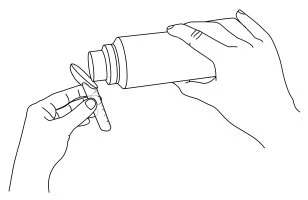
Pour the granules directly into the spoon as shown in the picture (in the outer carton and in this leaflet).
-
Tap the spoon lightly once to achieve a level surface of granules, and continue filling if necessary.
The granules can be swallowed directly with a drink (water, fruit juice, protein-free infant formulas), or can be mixed with one spoonful of solid food (mashed potatoes or apple sauce). If mixed with food, it is important to take it immediately. This will help preserve the taste-masking effect.
You must take this medicine and follow a lifelong diet.
If you take more PHEBURANE than you should
Patients who have taken very high doses of sodium phenylbutyrate have experienced:
- drowsiness, fatigue, dizziness, and less frequently, confusion;
- headache;
- taste disturbances (dysgeusia);
- decreased hearing capacity;
- disorientation;
- memory problems;
- worsening of existing neurological conditions.
If you experience any of these symptoms, you must contact your doctor or the nearest hospital emergency department immediately to receive symptomatic treatment.
If you forget to take PHEBURANE
You should take the missed dose as soon as possible with the next meal. Make sure that at least 3 hours pass between two doses. Do not take a double dose to make up for forgotten doses.
If you have any further questions about the use of this medicine, ask your doctor or pharmacist.
4. Possible adverse effects
Like all medicines, this medicine can cause adverse effects, although not everyone experiences them.
If persistent vomiting occurs, you should contact your doctor immediately.
Very common adverse effects (may affect more than 1 in 10 people): irregular menstruation and cessation of menstruation in women of childbearing age.
The absence of menstruation in sexually active women may not be caused by the use of PHEBURANE. If this occurs, consult your doctor, as it could be due to pregnancy (see "Pregnancy and breastfeeding" in the previous section) or menopause.
Common adverse effects (may affect more than 1 in 100 people): changes in blood cell counts (red blood cells, white blood cells, and platelets), changes in blood bicarbonate levels, decreased appetite, depression, irritability, headache, fainting, fluid retention (swelling), changes in taste (taste disturbances), abdominal pain, vomiting, nausea, constipation, unpleasant body odour, rash, abnormal kidney function, weight gain, abnormal laboratory test results.
Uncommon adverse effects (may affect more than 1 in 1,000 people): low red blood cell count (anaemia) due to bone marrow failure, bruising, changes in heart rhythm, rectal bleeding, inflammation of the stomach, gastroduodenal ulcer, inflammation of the pancreas.
Reporting of adverse effects
If you experience any adverse effects, consult your doctor or pharmacist, even if they are adverse effects not listed in this leaflet. You can also report them directly through the national reporting system listed in Appendix V. By reporting adverse effects, you can help provide more information on the safety of this medicine.
5. Storage of PHEBURANE
Keep this medicine out of the sight and reach of children.
Do not use PHEBURANE after the expiry date stated on the carton and on the label of the bottle following «EXP». The expiry date refers to the last day of the month indicated.
After first opening, PHEBURANE can be used within 45 days.
Medicines should not be disposed of via wastewater or household waste. Ask your pharmacist how to dispose of medicines and containers you no longer need. This will help protect the environment.
6. Contents of the pack and other information
Composition of PHEBURANE
The active substance is sodium phenylbutyrate.
Each gram of granules contains 483 mg of sodium phenylbutyrate.
The other components are: sugar spheres (sucrose and corn starch, see section 2 "PHEBURANE contains sucrose"), hypromellose, ethylcellulose N7, macrogol 1500, povidone K25.
Appearance of the product and contents of the pack
PHEBURANE granules are white to off-white.
The granules are packed in a plastic bottle with a child-resistant closure and a desiccant. Each bottle contains 174 g of granules. Each carton contains one bottle.
A calibrated measuring spoon is included.
Marketing Authorization Holder and Manufacturer
Eurocept International BV
Trapgans 5
1244 RL Ankeveen
The Netherlands
For further information on this medicinal product, please contact the local representative of the Marketing Authorization Holder:
Belgium/Belgium/Belgium Lucane Pharma Tel/Tel: + 33 153 868 750 | Lithuania FrostPharma AB Tel: +46 775 86 80 02 |
Greece Lucane Pharma Tel: + 33 153 868 750 | Luxembourg/Luxembourg Lucane Pharma Tél/Tel: + 33 153 868 750 |
Czech Republic Lucane Pharma Tél/Tel: + 33 153 868 750 | Hungary Lucane Pharma Tel: + 33 153 868 750 |
Denmark FrostPharma AB Tlf: +45 808 20 101 | Malta Lucane Pharma Tel: + 33 153 868 750 |
Germany Lucane Pharma Tel: + 33 153 868 750 | Netherlands Eurocept International BV Tel: +31 35 528 39 57 |
Estonia FrostPharma AB Tel: +46 775 86 80 02 | Norway FrostPharma AB Tlf: +47 815 03 175 |
Greece Lucane Pharma Tel: + 33 153 868 750 | Austria Lucane Pharma Tel: + 33 153 868 750 |
Spain Lucane Pharma Tel: + 33 153 868 750 | Poland Lucane Pharma Tel: + 33 153 868 750 |
France Lucane Pharma Tél: + 33 153 868 750 | Portugal Lucane Pharma Tel: + 33 153 868 750 |
Croatia Lucane Pharma Tel: + 33 153 868 750 | Romania Lucane Pharma Tel: + 33 153 868 750 |
Ireland Lucane Pharma Tel: + 33 153 868 750 | Slovenia Lucane Pharma Tel: + 33 153 868 750 |
Iceland Lucane Pharma Sími: + 33 153 868 750 | Slovakia Lucane Pharma Tel: + 33 153 868 750 |
Italy Lucane Pharma Tel: + 33 153 868 750 | Finland/Suomi FrostPharma AB Puh/Tel: +35 875 32 51 209 |
Cyprus Lucane Pharma Tel: + 33 153 868 750 | Sweden FrostPharma AB Tel: +46 775 86 80 02 |
Latvia FrostPharma AB Tel: +46 775 86 80 02 | United Kingdom Lucane Pharma Tel: + 33 153 868 750 |
Date of the most recent review of this summary:
Detailed information on this medicine is available on the website of the European Medicines Agency: http://www.ema.europa.eu/.
There are also links to other websites on rare diseases and orphan medicinal products.