Peitel 2.5 mg/g cutaneous solution
Spain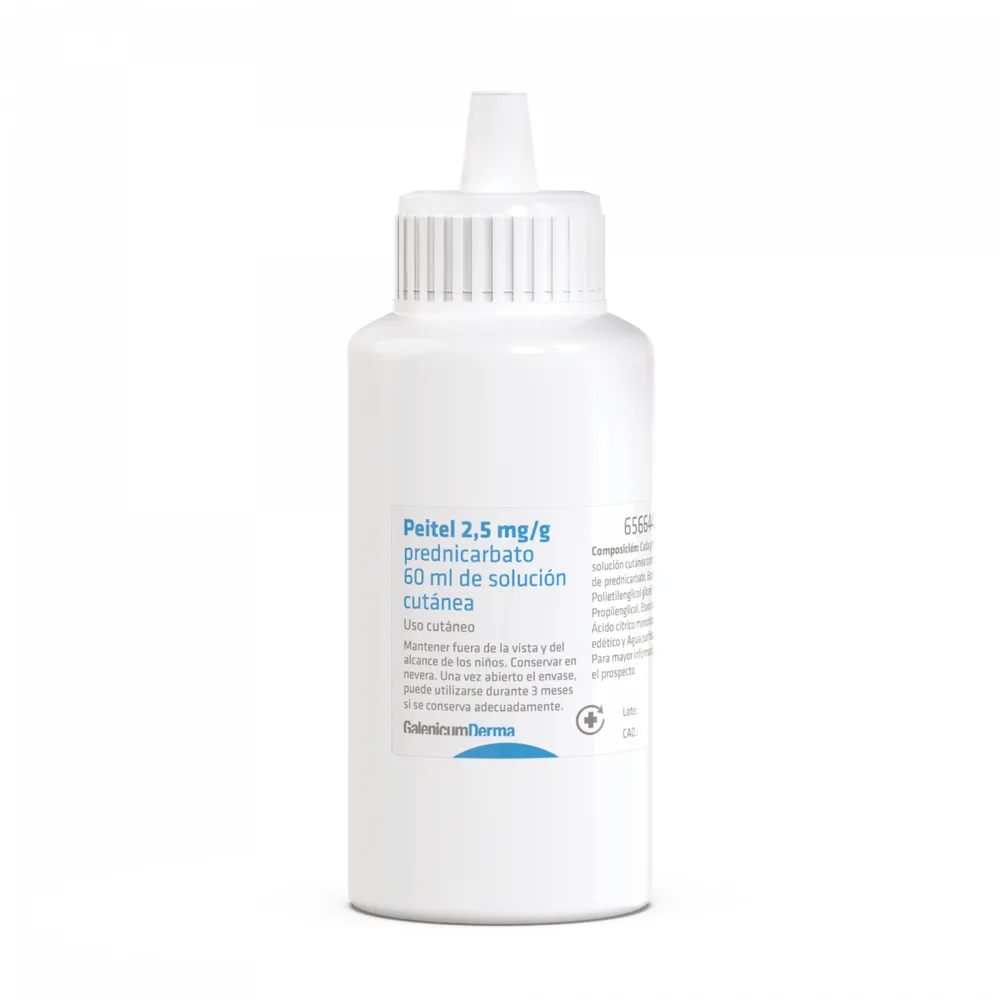
Table of Contents
Patient Information Leaflet
Introduction
Patient Information Leaflet
Peitel 2.5 mg/g cutaneous solution
prednicarbate
Read the entire leaflet carefully before you start using this medicine, as it contains important information for you.
- Keep this leaflet, as you may need to read it again.
- If you have any questions, ask your doctor or pharmacist.
- This medicine has been prescribed for you only, and you should not give it to others, even if they have the same symptoms as you, because it may harm them.
- If you experience any adverse effects, consult your doctor or pharmacist, even if they are effects not listed in this leaflet. See section 4.
Leaflet Contents
- What Peitel is and what it is used for
- What you need to know before using Peitel
- How to use Peitel
- Possible side effects
- How to store Peitel
- Contents of the pack and other information
1. What Peitel is and what it is used for
Peitel contains the active substance prednicarbate and belongs to a group of medicines called topical corticosteroids. This medicine is applied to the skin to reduce inflammation, allergic reactions, redness, and exudation in inflamed skin.
Peitel is indicated for the symptomatic treatment of dermatoses in hairy areas of the body (e.g., scalp, beard, armpits, and pubic region) that respond to treatment with topical corticosteroids, such as psoriasis, atopic eczema, and seborrheic eczema.
2. What you need to know before using Peitel
Do not use Peitel:
- If you are allergic to prednicarbate or to any of the other ingredients of this medicine (listed in section 6)
- In the eyes, or on deep open wounds
- On areas of skin showing a vaccine reaction, i.e., redness or inflammation after vaccination
- If you have tuberculosis, syphilis, or viral infections (for example, chickenpox or herpes)
- In rosacea, vulgar acne, or skin conditions with thinning of the skin (atrophy)
- In inflammation around the mouth (perioral dermatitis).
Warnings and precautions
Consult your doctor or pharmacist before starting to use Peitel.
- Peitel should not be applied over large areas of the body or for prolonged periods, as this significantly increases the risk of side effects. This medicine should be used at the lowest possible dose and only for the minimum time necessary to treat the skin condition.
- Avoid contact of Peitel with eyes, open wounds, or mucous membranes.
- If bacterial or fungal skin infections develop, consult your doctor, who will establish an appropriate additional treatment.
- If you apply the medicine to skin areas with folds (e.g., armpits or groin), you must be very cautious, as this may increase the absorption of the active ingredient.
- This medicine should not be used under occlusive dressings, such as non-breathable bandages, dressings, or diapers.
- The use of topical corticosteroids over extensive areas or at high doses for prolonged periods significantly increases the risk of adverse effects.
- If you are being treated for psoriasis, strict medical supervision is recommended.
- Sudden discontinuation of treatment should be avoided. When stopping long-term treatment with a potent corticosteroid, a rebound effect may occur, manifesting as dermatitis with intense redness, itching, and burning.
- Non-professional use of topical corticosteroids may mask symptoms and hinder correct diagnosis and treatment.
- Avoid contact between Peitel and latex condoms, as it may cause leakage or breakage.
- Contact your doctor if you experience blurred vision or other visual disturbances.
Children
The use of this medicine is not recommended in children under 2 years of age due to the lack of clinical data in this population.
In children, topical corticosteroids should be used with caution and limited to the lowest effective dose.
Use of Peitel with other medicines
Inform your doctor or pharmacist if you are using, have recently used, or might need to use any other medicines.
No interactions with Peitel are known; however, other preparations should not be applied to the treated area.
Pregnancy, breastfeeding and fertility
Pregnancy
If you are pregnant or breastfeeding, think you may be pregnant, or plan to become pregnant, consult your doctor or pharmacist before using this medicine.
There are insufficient data on the use of Peitel in pregnant women.
In general, during the first trimester of pregnancy, medicines containing corticosteroids should not be applied to the skin.
Breastfeeding
The safety of Peitel during breastfeeding has not been established, and therefore its use is not recommended. Women who are breastfeeding should not apply the medicine to the breasts.
Driving and using machines
The effect of Peitel on the ability to drive and use machines is none or negligible.
Peitel contains Propylene glycol.
This medicine contains 150 mg of propylene glycol in each gram of cutaneous solution. Propylene glycol may cause skin irritation.
3. How to use Peitel
Follow exactly the administration instructions for this medicine as given by your doctor or pharmacist. If in doubt, consult your doctor or pharmacist again.
The recommended dose is:
Adults and children over 2 years of age
Peitel in bottle with dosing device: Apply one or two drops of the topical solution using the dosing device, evenly distributed over the area of skin to be treated, rubbing gently. Apply once or twice daily.
Or
Peitel in bottle with applicator: Apply a thin layer of the topical solution using the applicator to the area of skin to be treated, rubbing gently.
Treatment may be reduced to once daily when a clear improvement is observed.
As a general rule, treatment duration should not exceed 4 weeks.
Method of administration:
This medicine is for topical use only (for application to the skin).
Hands should be washed after each application, unless the hands are the area being treated.
Instructions for use of
Peitel in bottle with dosing device:
To use Peitel in a bottle with dosing device, the patient should unscrew the cap, turn the bottle upside down, and gently squeeze the bottle walls to facilitate the release of drops of the topical solution through the dosing device orifice.
Peitel in bottle with applicator:
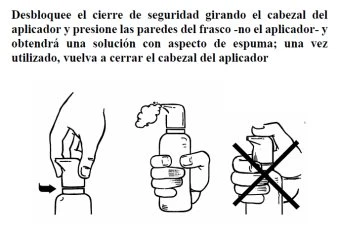
To use Peitel with applicator, the patient should remove the screw cap and attach the applicator provided in the package, which acts as a closure (see Figure 1).
Figure: 1
Use in children
The use of Peitel is not recommended in children under 2 years of age due to limited safety data.
In children, topical corticosteroids should be used with caution and limited to the lowest dose compatible with effective treatment.
If you use more Peitel than you should
If the recommended doses are significantly exceeded, adverse effects typical of systemic corticosteroids cannot be ruled out.
In case of overdose or accidental ingestion, consult your doctor or pharmacist, go to a medical center, or call the Toxicology Information Service. Tel.: 91 562 04 20, indicating the medicine and the amount ingested.
If you forget to use Peitel
Do not apply a double dose to make up for missed doses.
Apply the dose as soon as you remember, or wait until the next scheduled dose if it is almost time for it.
If you have any further questions about the use of this medicine, ask your doctor or pharmacist.
4. Possible adverse effects
Like all medicines, this medicine can cause adverse effects, although not everyone will experience them.
The adverse effects of topical prednicarbate are generally local, mild, and transient. As with other topical corticosteroids, prolonged use of large amounts or treatment of extensive areas may lead to systemic corticosteroid effects due to absorption. If this occurs, topical treatment should be discontinued.
The possible adverse effects that may occur with the use of this medicine are listed below according to their frequency:
Frequent adverse effects (may affect up to 1 in 10 people)
Skin and subcutaneous tissue disorders:
- mild to moderate burning sensation at the application site,
- tingling sensation (paresthesia),
- itching (pruritus),
- bacterial infections,
- furunculosis,
- local thinning of the skin (local cutaneous atrophy).
Uncommon adverse effects (may affect up to 1 in 100 people)
Skin disorders:
- skin striae,
- irritation,
- excessive hair growth on the skin (hypertrichosis),
- loss of skin color (hypopigmentation),
- skin condition around the mouth (perioral dermatitis),
- skin maceration,
- allergic contact dermatitis,
- papular rosacea-like skin condition (facial skin),
- acneiform reactions,
- capillary fragility (bruising),
- red or white bumps on various parts of the body (miliaria),
- dry skin,
- inflammation of hair follicles (folliculitis),
- erythema.
Infections:
- secondary infection.
Very rare adverse effects (may affect up to 1 in 10,000 people)
Vascular disorders:
- dilation of blood vessels in the skin or spider veins (telangiectasia).
Adverse effects with unknown frequency (cannot be estimated from available data)
Eye disorders:
- blurred vision.
Other adverse effects in children
Children and adolescents may show greater susceptibility than adult patients to suppression of the hypothalamic-pituitary-adrenal axis and corticosteroid-induced Cushing's syndrome due to the higher ratio of skin surface area to body weight. Chronic therapy with corticosteroids may interfere with growth and development in children.
Intracranial hypertension has been reported in children treated with topical corticosteroids. Manifestations of intracranial hypertension include bulging of the fontanelles, headaches, and bilateral papilledema.
Reporting of adverse effects
If you experience any type of adverse effect, consult your doctor or pharmacist, even if it is a possible adverse effect not listed in this leaflet. You may also report them directly via the Spanish Pharmacovigilance System for Human Medicines: www.notificaram.es. By reporting adverse effects, you can help provide more information on the safety of this medicine.
5. Storage of Peitel
Keep this medicine out of sight and reach of children.
Do not use this medicine after the expiry date stated on the packaging, after EXP. The expiry date refers to the last day of the month indicated.
After opening the container, the medicine may be used for 3 months if stored under the same specified conditions.
Store in a refrigerator (between 2°C and 8°C).
Medicines must not be disposed of via wastewater or household waste. Dispose of unused medicines and their packaging at the SIGRE collection point at your pharmacy. If you have any doubts, ask your pharmacist how to properly dispose of unused medicines and their packaging. This will help protect the environment.
6. Contents of the package and other information
Composition of Peitel:
- The active substance is prednicarbate.
Each gram of cutaneous solution contains 2.5 mg of prednicarbate.
- The other components (excipients) are: polyglyceryl oleate cocoate, propylene glycol, 96% ethanol, citric acid monohydrate, edetic acid and purified water.
Appearance of the product and contents of the container
Peitel 2.5 mg/g cutaneous solution is a clear, colourless solution.
It is supplied in a polyethylene bottle with dispenser or applicator, containing 60 ml of cutaneous solution.
Other presentations:
Peitel 2.5 mg/g ointment and Peitel 2.5 mg/g cream.
Marketing Authorization Holder:
Galenicum Derma, S.L.U.
Ctra N-1, Km 36
28750 San Agustin del Guadalix (Madrid)
Spain
Manufacturer:
Ferrer Internacional, S.A.
Joan Buscallá, 1-9
08173 - Sant Cugat del Vallés (Barcelona)
Spain
Date of the most recent review of this summary: October 2024
Detailed information on this medicine is available on the website of the Spanish Agency for Medicines and Health Products (AEMPS) (http://www.aemps.gob.es/).