Paricalcitol Aurovitas Spain 1 microgram soft capsules EFG
Spain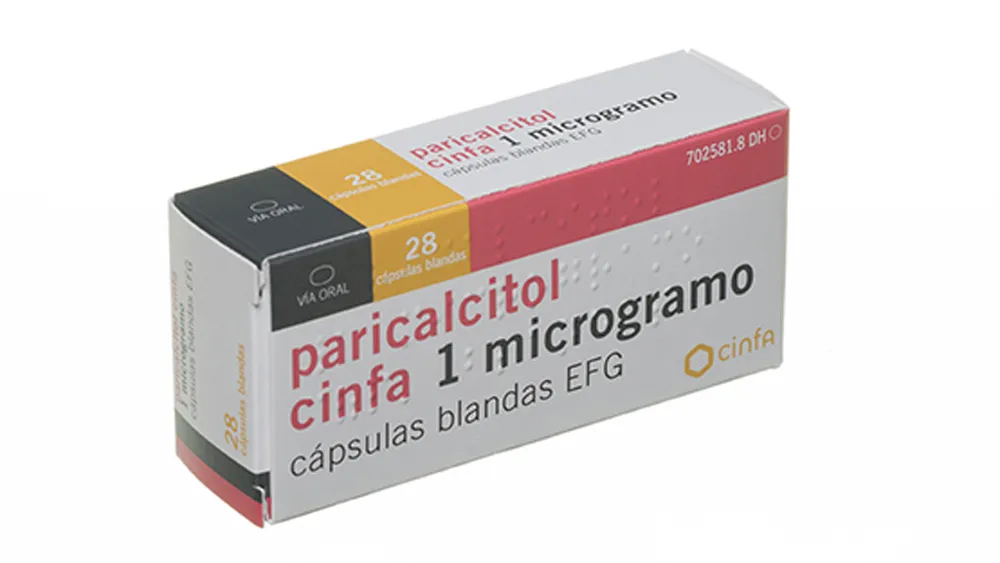
Instructions for Use
Table of Contents
- Introduction
- 1. What Paricalcitol Aurovitas Spain is and what it is used for
- 2. What you need to know before starting Paricalcitol Aurovitas Spain
- 3. How to take Paricalcitol Aurovitas Spain
- 4. Possible adverse effects
- 5. Storage of Paricalcitol Aurovitas Spain
- 6. Contents of the pack and other information
Package leaflet: Information for the user
Introduction
Package leaflet: information for the user
Paricalcitol Aurovitas Spain 1 microgram soft capsules EFG
Paricalcitol
Read the entire leaflet carefully before you start taking this medicine, as it contains important information for you.
-
Keep this leaflet, as you may need to read it again.
-
If you have any questions, consult your doctor or pharmacist.
-
This medicine has been prescribed for you only, and you should not give it to other people, even if they have the same symptoms as you, because it may harm them.
- If you experience any adverse effects, consult your doctor or pharmacist, even if these are adverse effects not listed in this leaflet. See section 4.
Leaflet contents
-
What Paricalcitol Aurovitas Spain is and what it is used for
-
What you need to know before taking Paricalcitol Aurovitas Spain
-
How to take Paricalcitol Aurovitas Spain
-
Possible side effects
- Storage of Paricalcitol Aurovitas Spain
-
Contents of the pack and other information
1. What Paricalcitol Aurovitas Spain is and what it is used for
Paricalcitol Aurovitas Spain contains the active substance paricalcitol, which is a synthetic form of active vitamin D.
Active vitamin D is necessary for the normal functioning of many tissues in the body, including the parathyroid gland and bones. In people with normal kidney function, this active form of vitamin D is naturally produced by the kidneys. However, in cases of kidney failure, the production of active vitamin D is markedly reduced. Therefore, Paricalcitol Aurovitas Spain provides a source of active vitamin D when the body cannot produce enough on its own, helping to prevent the consequences of low levels of active vitamin D—specifically, high levels of parathyroid hormone, which can lead to bone problems. Paricalcitol Aurovitas Spain is used in adult patients with stages 3, 4, and 5 chronic kidney disease and in children aged 10 to 16 years with stages 3 and 4 chronic kidney disease.
2. What you need to know before starting Paricalcitol Aurovitas Spain
Do not take Paricalcitol Aurovitas Spain
- if you are allergic to paricalcitol or to any of the other ingredients of this medicine (listed in section 6).
- if you have very high levels of calcium or vitamin D in your blood.
Your doctor will advise you if any of these conditions apply to you.
Warnings and precautions
Talk to your doctor or pharmacist before starting to take Paricalcitol Aurovitas Spain.
- Before starting treatment, it is important that you limit the amount of phosphorus in your diet.
- Phosphate-binding agents may be needed to control phosphorus levels. If you are taking phosphate-binding agents containing calcium, your doctor may adjust your dose.
- Your doctor will perform blood tests to monitor your treatment.
- In some patients with stage 3 and 4 chronic kidney disease, an increase in creatinine levels has been observed. However, this increase does not reflect a decline in kidney function.
Other medicines and Paricalcitol Aurovitas Spain
Tell your doctor or pharmacist if you are taking, have recently taken, or might need to take any other medicines.
Some medicines may affect the action of this medicine or may increase the likelihood of side effects.
It is particularly important to inform your doctor if you are taking:
- medicines to treat fungal infections such as candidiasis or oral thrush (e.g. ketoconazole)
- medicines for heart conditions or high blood pressure (e.g. digoxin and diuretics or medicines that remove fluid)
- medicines that bind to phosphorus (e.g. medicines to reduce calcium levels in the blood)
- medicines containing calcium or vitamin D, including supplements and multivitamins available without a prescription
- medicines containing magnesium or aluminium, for example, some medicines for indigestion (antacids)
- colestyramine (medicines used to lower cholesterol levels (e.g. colestyramine)).
Taking Paricalcitol Aurovitas Spain with food and drink
Paricalcitol Aurovitas Spain may be taken with or without food.
Pregnancy, breast-feeding and fertility
If you are pregnant or breast-feeding, think you might be pregnant or are planning to become pregnant, consult your doctor or pharmacist before using this medicine.
There are insufficient data on the use of paricalcitol in pregnant women. The risk in humans is unknown; therefore, it should not be used during pregnancy unless clearly necessary.
It is unknown whether paricalcitol passes into breast milk. If you are taking Paricalcitol Aurovitas Spain, inform your doctor before breastfeeding your baby.
Driving and using machines
Paricalcitol Aurovitas Spain is not expected to affect your ability to drive or operate machinery.
Paricalcitol Aurovitas Spain contains ethanol
This medicine contains 1,420 mg of alcohol (ethanol) in each soft capsule, equivalent to 1,420 mg/capsule. The amount in one capsule of this medicine is equal to less than 0.035 ml of beer or 0.014 ml of wine. The small amount of alcohol contained in this medicine will not have noticeable effects.
3. How to take Paricalcitol Aurovitas Spain
Follow exactly the instructions for using this medicine given by your doctor or pharmacist. If you are unsure, consult your doctor or pharmacist again.
Chronic kidney disease, stages 3 and 4
In adult patients, the usual starting dose is one capsule daily, or one capsule on alternate days up to a maximum of three times per week. Your doctor will use the results of certain laboratory tests to determine the correct dose for you.
Once treatment with Paricalcitol Aurovitas Spain has been started, a dose adjustment will likely be needed depending on your response to treatment.
Your doctor will help you determine the correct dose of Paricalcitol Aurovitas Spain.
Chronic kidney disease, stage 5
In adult patients, the usual initial dose is one capsule on alternate days, up to a maximum of three times per week. Your doctor will use the results of certain laboratory tests to determine the correct dose for you. Once treatment with Paricalcitol Aurovitas Spain has been started, a dose adjustment will likely be needed depending on your response to treatment. Your doctor will help you determine the correct dose of Paricalcitol Aurovitas Spain.
Liver disease
If you have mild to moderate liver disease, you will not need to adjust the dose. However, there is no experience in patients with severe liver disease.
Kidney transplant
The usual dose is one capsule daily, or one capsule on alternate days up to a maximum of three times per week. Your doctor will use the results of certain laboratory tests to determine the correct dose for you. Once treatment with Paricalcitol Aurovitas Spain has been started, a dose adjustment will likely be needed depending on your response to treatment. Your doctor will help you determine the correct dose of Paricalcitol Aurovitas Spain.
Use in children and adolescents
In children aged 10 to 16 years with chronic kidney disease stages 3 or 4, the usual initial dose is one capsule on alternate days, up to three times per week. Your doctor will use the results of laboratory tests to determine the correct dose. Once treatment with Paricalcitol Aurovitas Spain has been started, the dose may need to be adjusted depending on your response to treatment. Your doctor will help you determine the correct dose of Paricalcitol Aurovitas Spain.
The efficacy of Paricalcitol Aurovitas Spain has not been established in children with stage 5 chronic kidney disease.
There is no information on the use of Paricalcitol Aurovitas Spain capsules in children under 10 years of age.
Elderly patients
Experience with paricalcitol in patients aged 65 years or older is limited. In general, no overall differences in effectiveness or safety have been observed between patients over 65 years and younger patients.
If you take more Paricalcitol Aurovitas Spain than you should
An overdose of Paricalcitol Aurovitas Spain may cause abnormally high levels of calcium in the blood, which can be harmful. Symptoms that may occur after taking an excessive dose of Paricalcitol Aurovitas Spain include: feeling weak and/or drowsy, headache, nausea (feeling sick) or vomiting (being sick), dry mouth, constipation, muscle or bone pain, and metallic taste.
Symptoms that may occur over the long term after excessive intake of Paricalcitol Aurovitas Spain may include: loss of appetite, feeling weak, weight loss, dry eyes, runny nose, skin itching, feeling hot and fever, loss of sexual appetite, severe abdominal pain (due to inflammation of the pancreas), and kidney stones. Your blood pressure may be affected and irregular heartbeats (palpitations) may occur. Blood and urine tests may show high cholesterol, urea, nitrogen, and elevated liver enzyme levels.
Rarely, Paricalcitol Aurovitas Spain may cause mental changes such as confusion, drowsiness, insomnia, or nervousness.
If you take too much Paricalcitol Aurovitas Spain or experience any of the symptoms described above, consult your doctor immediately. In case of overdose or accidental ingestion, contact your doctor or pharmacist immediately or call the Toxicology Information Service at 91.562.04.20, indicating the medicine and the amount ingested.
If you forget to take Paricalcitol Aurovitas Spain
If you forget to take a dose, take it as soon as you remember. However, if it is almost time for your next dose, do not take the missed capsule and continue your treatment as directed by your doctor.
Do not take a double dose to make up for a missed dose.
If you stop taking Paricalcitol Aurovitas Spain
Unless your doctor tells you to stop treatment, it is important to continue taking Paricalcitol Aurovitas Spain as directed by your doctor.
If you have any further questions about the use of this medicine, ask your doctor or pharmacist.
4. Possible adverse effects
Like all medicines, this medicine may cause adverse effects, although not everyone gets them.
Important: Tell your doctor immediately if you notice any of the following adverse effects:
- Allergic reactions (such as shortness of breath, wheezing, rash, itching, or swelling of the face and lips).
Inform your doctor or nurse if you experience any of the following adverse effects:
Frequent (may affect up to 1 in 10 people):
- increased blood levels of a substance called calcium; in addition to increased calcium time, increased levels of another substance called phosphate may occur (in patients with significant chronic kidney disease)
- blood phosphate levels may also increase.
Uncommon (may affect up to 1 in 100 people):
- pneumonia (lung infection)
- decrease in parathyroid hormone levels
- loss of appetite
- decrease in calcium levels
- dizziness
- unusual taste in the mouth
- headache
- irregular heartbeat
- stomach discomfort or pain
- constipation
- diarrhea
- dry mouth
- heartburn (reflux or indigestion)
- nausea
- vomiting
- acne
- skin itching
- rash
- hives
- muscle cramps
- muscle pain
- breast tenderness on palpation
- weakness
- feeling of tiredness, malaise
- swelling in the legs
- pain
- increased creatinine levels
- changes in liver function tests.
If you experience an allergic reaction, please contact your doctor immediately.
Reporting of adverse effects
If you experience any type of adverse effect, consult your doctor or pharmacist, even if it is a possible adverse effect not listed in this leaflet. You may also report them directly through the Spanish Pharmacovigilance System for Human Medicinal Products: www.notificaRAM.es.
By reporting adverse effects, you can help provide more information on the safety of this medicine.
5. Storage of Paricalcitol Aurovitas Spain
Keep this medicine out of sight and reach of children.
This medicine does not require any special storage conditions.
Do not use this medicine after the expiry date stated on the packaging after EXP. The expiry date refers to the last day of the month indicated.
Medicines should not be disposed of via wastewater or household waste. Dispose of unused medicines and their containers at the SIGRE Point at your pharmacy. If you are unsure, ask your pharmacist how to dispose of medicines and containers you no longer need. This will help protect the environment.
6. Contents of the pack and other information
Composition of Paricalcitol Aurovitas Spain
- The active substance is paricalcitol. Each soft capsule contains 1 microgram of paricalcitol.
- The other components (excipients) are: medium-chain triglycerides, ethanol, butylhydroxytoluene.
The capsule shell contains: gelatin, anhydrous glycerol, titanium dioxide (E171), and black iron oxide (E172).
Appearance of the product and contents of the pack
Paricalcitol Aurovitas Spain 1 microgram is grey, oval-shaped soft capsules.
It is available in cardboard packaging containing 7, 28 or 30 capsules.
Only some pack sizes may be marketed.
Marketing Authorization Holder and Manufacturer
Marketing Authorization Holder:
Aurovitas Spain, S.A.U.
Avda. de Burgos, 16-D
28036 Madrid
Spain
Manufacturer:
G.A.P. SA
46, Agissilaou str.
Agios Dimitrios
Attiki,
Greece
or
Rafarm S.A.
Thesi Poussi Hantzi, AgiouLouka, Paiania,
19002 Attiki
Greece
or
Viminco A/S
Lodshusvej 11, Skælskør
DK-4230,
Denmark
Date of the most recent revision of this package leaflet: March 2024
Detailed and up-to-date information on this medicinal product is available on the website of the Spanish Agency of Medicines and Medical Devices (AEMPS) http://www.aemps.gob.es/.
Similar Medications
-
Paricalcitol Cinfa 1 microgram capsule EFG
Form: capsules, soft gelatin
Active substance Dosage PARICALCITOL 0,001 mg Manufacturer: Laboratorios Cinfa S.A.
-
Paricalcitol Normon 1 microgram soft capsules EFG
Form: capsules, soft gelatin
Active substance Dosage PARICALCITOL 1 µg Manufacturer: Laboratorios Normon S.A.
-
Paricalcitol Stada 1 microgram capsule soft EFG
Form: capsules, soft gelatin
Active substance Dosage PARICALCITOL 0,001 mg Manufacturer: Laboratorio Stada S.L.
-
Paricalcitol Teva 1 microgram soft capsules EFG
Form: capsules, soft gelatin
Active substance Dosage PARICALCITOL 0,001 mg Manufacturer: Teva Pharma S.L.U.
-
Pleopar 1 microgram soft capsules EFG
Form: capsules, soft gelatin
Active substance Dosage PARICALCITOL 0.001 mg Manufacturer: Industria Quimica Y Farmaceutica Vir S.A.
-
Zemplar 1 microgram soft capsules
Form: capsules, soft gelatin
Active substance Dosage PARICALCITOL 1 µg Manufacturer: Abbvie Spain, S.L.U.
This page has been machine-translated and may contain inaccuracies. The original data is available in the manufacturing country's language.
Last data check: May 18, 2026 · Data source: CIMA — AEMPS