Paracetamol Teva 650 mg tablets EFG
Spain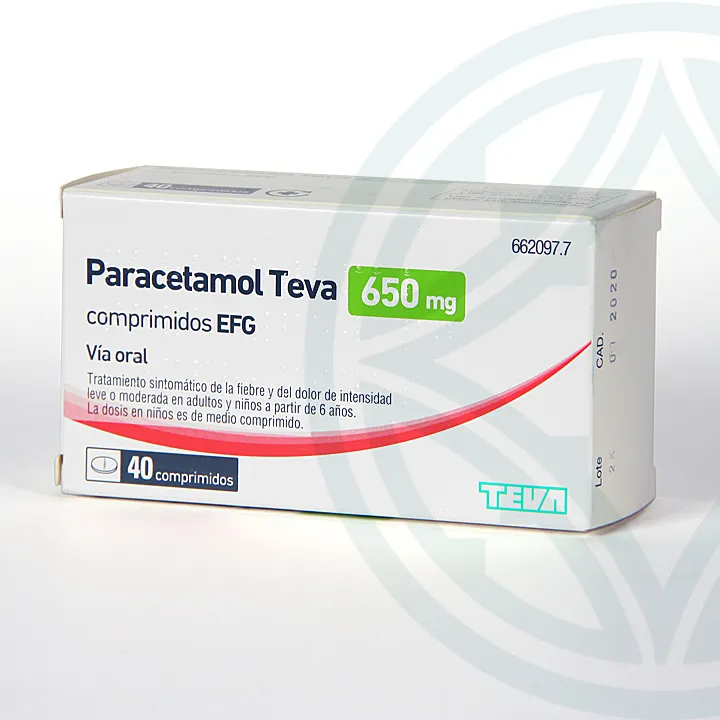
Table of Contents
Package leaflet: Information for the user
Introduction
Package leaflet: information for the user
Paracetamol Teva 650 mg tablets EFG
Read the entire leaflet carefully before you start taking this medicine, because it contains important information for you.
-
Keep this leaflet, as you may need to read it again.
- If you have any questions, consult your doctor or pharmacist.
-
This medicine has been prescribed for you only, and you should not give it to other people, even if they have the same symptoms as you, because it may harm them.
- If you experience any adverse effects, consult your doctor or pharmacist, even if they are adverse effects not listed in this leaflet. See section 4.
.
Contents of the leaflet:
- What Paracetamol Teva is and what it is used for
- What you need to know before taking Paracetamol Teva
- How to take Paracetamol Teva
- Possible side effects
- How to store Paracetamol Teva
- Contents of the pack and other information
1. What Paracetamol Teva is and what it is used for
Paracetamol Teva belongs to a group of medicines called analgesics and antipyretics.
This medicine is used for the symptomatic treatment of mild to moderate pain and for fever.
2. What you need to know before taking Paracetamol Teva
Do not take Paracetamol Teva
- If you are allergic to paracetamol or to any of the other ingredients of this medicine (listed in section 6).
Warnings and precautions
Talk to your doctor or pharmacist before taking Paracetamol Teva
- Do not take more than the recommended dose.
- Concomitant use of this medicine with other medicines containing paracetamol, such as cold and flu remedies, should be avoided, as high doses may cause liver damage. Do not use more than one medicine containing paracetamol without consulting your doctor.
- If you are an asthmatic patient sensitive to acetylsalicylic acid, you should consult your doctor before taking this medicine.
- If you have kidney, liver, heart or lung disease, or suffer from anaemia (reduced haemoglobin levels in the blood, due to a reduced number of red blood cells or not), you should consult your doctor before taking this medicine.
- In chronic alcoholics, care should be taken not to exceed 2 g/day of paracetamol.
During treatment with paracetamol, inform your doctor immediately if:
- You have serious illnesses such as severe renal failure or sepsis (when bacteria and their toxins circulate in the blood, causing organ damage), or if you suffer from malnutrition, chronic alcoholism, or are also taking flucloxacillin (an antibiotic). A serious condition called metabolic acidosis (an imbalance in blood and body fluids) has been reported in patients under these conditions when paracetamol is used at regular doses for prolonged periods or when paracetamol is taken together with flucloxacillin. Symptoms of metabolic acidosis may include: severe breathing difficulties with deep and rapid breathing, drowsiness, malaise (nausea), and vomiting.
Interference with laboratory tests:
If you are due to have any laboratory tests (including blood and urine tests), inform your doctor that you are taking this medicine, as it may alter the results of such tests.
Paracetamol may alter the analytical values of uric acid and glucose.
Other medicines and Paracetamol Teva:
Inform your doctor or pharmacist if you are using, have recently used, or might need to use any other medicines.
Paracetamol may interact with the following medicines:
- Oral anticoagulants (used to treat thromboembolic disorders)
- Antiepileptics (used to treat epileptic seizures)
- Diuretics (used to increase urine elimination)
- Flucloxacillin (antibiotics), due to a serious risk of blood and fluid disorder (called metabolic acidosis) requiring urgent treatment (see section 2)
- Isoniazid (used to treat tuberculosis)
- Lamotrigine (used to treat epilepsy)
- Probenecid (used to treat gout)
- Propranolol (used to treat hypertension, cardiac arrhythmias)
- Rifampicin (used to treat tuberculosis)
- Colestipol (used to lower blood cholesterol levels)
Do not use with other analgesics (medicines that reduce pain) without consulting your doctor. As a general rule for any medicine, it is advisable to systematically inform your doctor or pharmacist if you are taking any other treatment. Paracetamol may occasionally be used as the analgesic of choice in patients receiving oral anticoagulants.
Taking Paracetamol Teva with food, drinks and alcohol:
The use of paracetamol in patients who habitually consume alcohol (three or more alcoholic drinks per day, such as beer, wine, spirits, etc.) may cause liver damage.
Pregnancy, breastfeeding and fertility
If you are pregnant or breastfeeding, think you may be pregnant, or are planning to become pregnant, consult your doctor before using this medicine.
Paracetamol may be used during pregnancy if necessary. Use the lowest possible dose that relieves pain or fever, and use it for the shortest possible duration. Contact your doctor or midwife if pain or fever does not improve, or if you need to take the medicine more frequently.
Pregnancy
If you are pregnant or think you might be, consult your doctor before taking this medicine. Taking medicines during pregnancy may be harmful to the embryo or fetus and should be monitored by your doctor.
Epidemiological studies in pregnant women have not shown adverse effects from the use of paracetamol at recommended doses, but patients should follow their doctor's advice regarding its use.
Breastfeeding
Consult your doctor or pharmacist before using any medicine.
Small amounts of paracetamol may pass into breast milk; therefore, it is recommended that you consult your doctor or pharmacist before taking this medicine.
Driving and using machines
The effect of this medicine on the ability to drive and use machines is none or negligible.
3. How to take Paracetamol Teva
Follow exactly the instructions for use of this medicine provided by your doctor or pharmacist.
If in doubt, please consult your doctor or pharmacist again.
This medicine is for oral use. According to your preference, the tablets may be taken whole or split in half with water, milk, or fruit juice.
The score line allows the tablet to be divided into two equal doses.
The recommended dose is:
Adults and adolescents over 15 years of age
1 tablet every 4–6 hours as needed, up to a maximum of 6 tablets in 24 hours.
Children and adolescents
It is necessary to follow dosage recommendations based on body weight. The age range corresponding to each weight category is provided for informational purposes only.
The recommended daily dose of paracetamol is approximately 60 mg/kg/day, divided into 4 or 6 doses per day, i.e., 15 mg/kg every 6 hours or 10 mg/kg every 4 hours.
- Between 21 and 25 kg (6 to 10 years of age): half a tablet per dose, every 6 hours, up to a maximum of 2 tablets per day.
- Between 26 and 40 kg (8 to 13 years of age): half a tablet per dose, every 4 hours, up to a maximum of 3 tablets per day.
- Between 41 and 50 kg (12 to 15 years of age): 1 tablet per dose, every 6 hours, up to a maximum of 4 tablets per day.
Patients with liver disease:
Before taking this medicine, you must consult your doctor. You should take only the amount prescribed by your doctor, with a minimum interval of 8 hours between doses. You must not take more than 3 tablets of 650 mg of paracetamol in 24 hours.
Patients with kidney disease:
Before taking this medicine, you must consult your doctor.
Maximum dose per administration: 500 milligrams of paracetamol.
Due to the dosage strength (650 mg of paracetamol), this formulation is not recommended for this patient group.
Elderly patients:
Your doctor will determine the most appropriate treatment for you.
If you feel that the effect of this medicine is too strong or too weak, inform your doctor or pharmacist.
When doses lower than 650 mg of paracetamol per administration are required, other formulations of paracetamol better suited to the required dosage should be used.
If you take more Paracetamol Teva than you should:
If you have taken more paracetamol than recommended, or accidentally ingested the entire contents of the package, contact your doctor or pharmacist immediately or call the Toxicology Information Service at telephone number 915 620 420, indicating the name of the medicine and the amount ingested.
If you have taken an overdose, you must go immediately to a medical center even if no symptoms are present, as symptoms often do not appear until three days after the overdose, even in cases of severe poisoning.
Symptoms of overdose may include: nausea, dizziness, vomiting, anorexia, loss of appetite, yellowing of the skin and eyes (jaundice), and abdominal pain.
Liver and kidney damage may subsequently develop. Severe overdoses can lead to death.
Treatment of overdose is most effective when started within 4 hours of taking the medicine.
Patients undergoing treatment with barbiturates or those suffering from chronic alcoholism may be more susceptible to paracetamol overdose.
If you forget to take Paracetamol Teva
Do not take a double dose to make up for missed doses. Simply take the missed dose as soon as you remember, and then take the following doses at the recommended intervals (at least 4 hours apart).
4. Possible adverse effects
Like all medicines, this medicine can cause adverse effects, although not everyone experiences them.
The adverse effects observed are described below according to their frequency of occurrence:
Rare adverse effects (may affect up to 1 in 1,000 people), very rare adverse effects (may affect up to 1 in 10,000 people), not known (cannot be estimated from available data)
The following adverse effects have been observed:
General disorders and administration site conditions
Rare: Malaise
Immune system disorders
Not known: Allergic reactions (hypersensitivity) ranging from a simple skin rash (redness or inflammation of the skin) or urticaria (hives) to anaphylactic shock (a severe type of allergic reaction).
Hepatobiliary disorders
Rare: Increased levels of liver transaminases (liver enzymes).
Very rare: Hepatotoxicity (liver toxicity) and jaundice (yellowing of the skin and mucous membranes).
Not known: Liver damage
Metabolism and nutrition disorders
Very rare: Hypoglycemia (reduced blood glucose levels).
Not known: A serious condition that may cause blood to become more acidic (called metabolic acidosis) in severely ill patients using paracetamol (see section 2).
Blood and lymphatic system disorders
Very rare: Leukopenia, neutropenia (decrease in white blood cells), hemolytic anemia (decrease in red blood cells).
Not known: Thrombocytopenia (reduction in platelets in blood), agranulocytosis
Vascular disorders
Rare: Hypotension (decrease in blood pressure).
Renal and urinary disorders
Very rare: Sterile pyuria (cloudy urine), adverse renal effects.
Skin and subcutaneous tissue disorders
Not known: Exanthema
Serious skin reactions have been reported in very rare cases (medicines that induce Stevens-Johnson syndrome (SJS), toxic epidermal necrolysis (TEN), and acute generalized exanthematous pustulosis (AGEP)).
Reporting of adverse effects:
If you experience any type of adverse effect, consult your doctor or pharmacist, even if it is a possible adverse effect not listed in this leaflet. You may also report them directly via the Spanish Pharmacovigilance System for Human Medicines: https://www.notificaram.es. By reporting adverse effects, you can help provide more information on the safety of this medicine.
5. Storage of Paracetamol Teva
Keep this medicine out of the sight and reach of children.
Do not use this medicine after the expiry date stated on the carton after EXP. The expiry date refers to the last day of the month indicated.
This medicine does not require any special storage conditions.
Medicines must not be disposed of via wastewater or household waste. Dispose of empty containers and unused medicines at a SIGRE point in your pharmacy. If you are in doubt, please ask your pharmacist how to dispose of medicines and containers you no longer need. This will help protect the environment.
6. Contents of the pack and other information
Composition of Paracetamol Teva
The active substance is paracetamol. Each tablet contains 650 mg of paracetamol.
The other components are: pregelatinized corn starch, stearic acid,
povidone, crospovidone, microcrystalline cellulose and vegetable magnesium stearate.
Appearance of the product and contents of the pack
The tablets are oblong, scored and white in colour. They are packaged in blisters and available in pack sizes of 20 and 40 tablets.
Only some pack sizes may be marketed.
Marketing Authorization Holder and Manufacturer:
Marketing Authorization Holder
Teva Pharma, S.L.U.
C/ Anabel Segura 11, Edificio Albatros B,
1st floor, Alcobendas,
28108 Madrid (Spain)
Manufacturer:
Toll Manufacturing Services S.L
C/ Aragoneses, 2. 28108 Alcobendas (Madrid)
Spain
Or
Pharmex Advanced Laboratories, S.L
Pol. Ind. Los Mochos. Polígono 8 - Parcela 20. Crta. A-431, Km 19 (Almodovar del Río) -
14720 – Spain
Or
SAG MANUFACTURING S.L.U.
Carretera Nacional I, Km. 36
28750 San Agustin de Guadalix,
Spain
Date of the most recent revision of this leaflet: January 2025