Palexia 20 mg/ml oral solution
Spain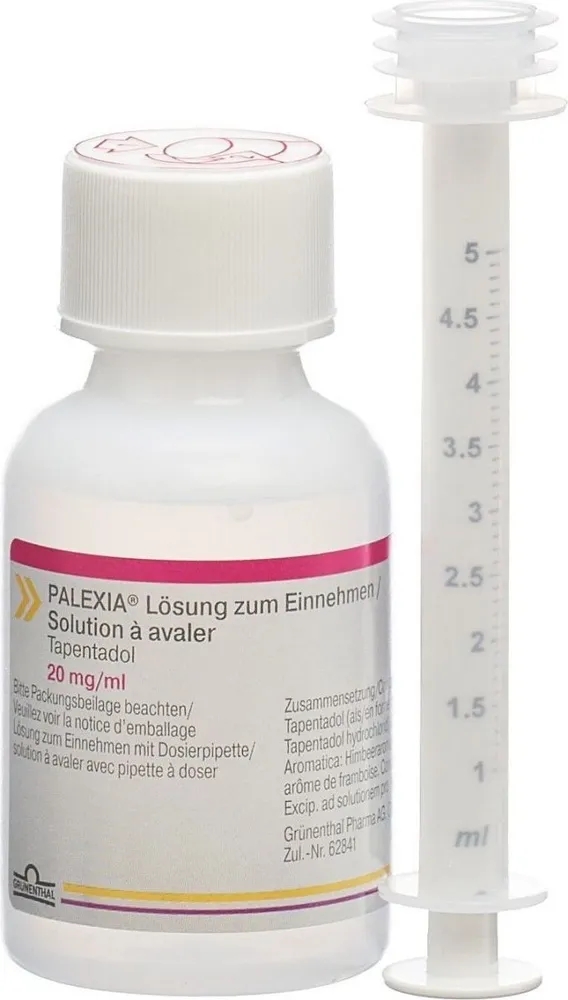
Table of Contents
Package leaflet: Information for the user
Introduction
Package leaflet: information for the user
Palexia 20 mg/ml oral solution
Tapentadol
Read the entire leaflet carefully before you start taking this medicine because it contains important information for you.
-
Keep this leaflet. You may need to read it again.
-
If you have any questions, ask your doctor or pharmacist.
-
This medicine has been prescribed for you only. Do not give it to other people, even if they have the same symptoms as you, because it could harm them.
-
If you experience any adverse effects, consult your doctor or pharmacist, even if they are adverse effects not listed in this leaflet. See section 4.
Leaflet contents
- What Palexia is and what it is used for
- What you need to know before taking Palexia
- How to take Palexia
- Possible side effects
- How to store Palexia
- Contents of the pack and other information
1. What Palexia is and what it is used for
Tapentadol—the active substance in Palexia—is a pain medication belonging to the class of strong opioids. This medicine is used for the treatment of moderate to severe acute pain that can only be adequately managed with an opioid, in children and adolescents aged 2 years and older with a body weight greater than 16 kg, as well as in adults.
2. What you need to know before starting to take Palexia
Do not take Palexia:
- if you are allergic to tapentadol or to any of the other components of this medicine (listed in section 6),
- if you have asthma or if your breathing is slow or shallow to dangerous levels [respiratory depression; hypercapnia (higher than normal levels of carbon dioxide in the blood)],
- if you have a condition in which the intestine does not function properly (intestinal paralysis),
- if you have consumed alcohol, sleeping pills, other analgesics, or other psychotropic medicines (medicines that affect mood and emotions) in high doses (see section "Taking Palexia with other medicines").
Warnings and precautions
Consult your doctor or pharmacist before starting to take Palexia:
- if your breathing is slow or shallow,
- if you have increased intracranial pressure or impaired consciousness up to and including coma,
- if you have had a head injury or brain tumors,
- if you have liver or kidney disease (see section “How to take Palexia”),
- if you have a disease of the pancreas (such as pancreatitis) or of the biliary tract,
- if you are taking medicines called mixed opioid agonist/antagonists (e.g.: pentazocine, nalbuphine) or partial agonists of µ-opioid receptors (e.g.: buprenorphine),
- if you are prone to epilepsy or seizures, or if you are taking other medicines known to increase the risk of seizures, as the risk of such seizures may be increased.
Tolerance, dependence and addiction
This medicine contains tapentadol, which is an opioid. It may cause dependence and/or addiction. |
This medicine contains tapentadol, which is an opioid medicine. Repeated use of opioids may reduce the effectiveness of the medicine (you may become accustomed to it, which is known as tolerance). Repeated use of Palexia may also lead to dependence, abuse, and addiction, which may result in a potentially fatal overdose. The risk of adverse effects may increase with higher doses and longer duration of use.
Dependence or addiction may make you feel that you no longer have control over how much medicine you need to take or how often you need to take it. The risk of becoming dependent or addicted varies from person to person. You may have a higher risk of becoming dependent or addicted to Palexia if:
- you or a family member have a history of alcohol, prescription medicine, or illicit substance abuse or dependence ("addiction"),
- you are a smoker,
- you have ever had problems with your mood (depression, anxiety, or a personality disorder) or have received treatment from a psychiatrist for other mental illnesses.
If you notice any of the following signs while taking Palexia, it could be a sign that you have become dependent or addicted:
- you need to take the medicine for longer than recommended by your doctor,
- you need to take higher doses than recommended,
- you may feel that you need to keep taking the medicine even when it is not helping relieve pain,
- you are using the medicine for reasons other than prescribed, for example, "to calm down" or "to help you sleep",
- you have made repeated unsuccessful attempts to stop or control the use of the medicine,
- you do not feel well when you stop taking the medicine and feel better when you take it again ("withdrawal symptoms").
If you notice any of these signs, speak with your doctor to address the most appropriate treatment strategy for your case, including when it is appropriate to stop taking it and how to do so safely (see section 3 "If you stop taking Palexia").
Children and adolescents
Children and adolescents with obesity should be closely monitored, and the maximum recommended dose must not be exceeded.
Do not administer this medicine to children under 2 years of age or with a body weight below 16 kg.
Sleep-related breathing disorders
Palexia may cause sleep-related breathing disorders such as sleep apnea (pauses in breathing during sleep) and sleep-related hypoxemia (low levels of oxygen in the blood). Symptoms may include pauses in breathing during sleep, nighttime awakenings due to difficulty breathing, difficulty maintaining sleep, or excessive daytime sleepiness. If you or someone else notices these symptoms, consult your doctor. Your doctor may consider reducing the dose.
Taking Palexia with other medicines
Inform your doctor or pharmacist if you are taking, have recently taken, or might need to take any other medicine.
-
The risk of side effects increases if you are taking medicines that may cause seizures (fits), such as certain antidepressants or antipsychotics. The risk of seizures increases if you take Palexia simultaneously with these medicines. Your doctor will tell you whether Palexia is suitable for you.
-
Concomitant use of Palexia and sedative medicines such as benzodiazepines or related medicines (certain sleeping tablets or tranquilizers [e.g., barbiturates] or analgesics such as opioids, morphine, and codeine [also as a cough medicine]), antipsychotics, H1 antihistamines, or alcohol increases the risk of drowsiness, breathing difficulties (respiratory depression), coma, and may be potentially fatal. Because of this, concomitant use should only be considered when no other treatment options are possible.
However, if your doctor prescribes Palexia with sedative medicines, they will limit the dose and duration of concomitant treatment.
Concomitant use of opioids and medicines used to treat epilepsy, nerve pain, or anxiety (gabapentin and pregabalin) increases the risk of opioid overdose, respiratory depression, and may be potentially fatal.
Inform your doctor if you are taking gabapentin or pregabalin or any other sedative medicine, and follow your doctor's dosing recommendations exactly. It may be helpful to inform your friends and family about the signs and symptoms listed above. Inform your doctor if you experience any of these symptoms.
If you are taking a type of medicine that affects serotonin levels (e.g., certain medicines to treat depression), speak with your doctor before taking Palexia, as cases of "serotonin syndrome" have occurred. Serotonin syndrome is a rare but potentially fatal disorder. Symptoms may include rhythmic involuntary muscle contractions, including muscles controlling eye movement, agitation, excessive sweating, tremors, exaggerated reflexes, increased muscle tone, and body temperature above 38°C. Your doctor can provide additional information.
-
The concomitant administration of Palexia with other types of medicines known as mixed µ-opioid receptor agonist/antagonists (e.g., pentazocine, nalbuphine) or partial µ-opioid agonists (e.g., buprenorphine) has not been studied. Palexia may not have the same efficacy if administered together with one of these medicines. Inform your doctor if you are currently being treated with one of these medicines.
-
Administration of this medicine together with strong inhibitors or inducers (e.g., rifampicin, phenobarbital, St. John's wort) of certain enzymes required to eliminate tapentadol from your body may influence the efficacy of tapentadol or may cause adverse effects, especially when starting or stopping this other type of medication. Keep your doctor informed about all medicines you are taking.
-
Palexia must not be taken together with MAO inhibitors (medicines for the treatment of depression). Inform your doctor if you are taking MAO inhibitors or have taken them within the last 14 days.
-
If you use Palexia together with the following medicines that have anticholinergic effects, the risk of side effects may increase:
-
medicines to treat depression,
-
medicines used to treat allergies, dizziness, or nausea (antihistamines or antiemetics),
-
medicines to treat psychiatric disorders (antipsychotics or neuroleptics),
-
muscle relaxants,
-
medicines to treat Parkinson's disease.
Taking Palexia with food, drinks, and alcohol
Do not consume alcohol while taking this medicine, as some of its adverse effects, such as drowsiness, may increase. Taking food does not affect the action of this medicine.
Pregnancy and breastfeeding
If you are pregnant or breastfeeding, think you may be pregnant, or plan to become pregnant, consult your doctor or pharmacist before using this medicine.
Do not take this medicine:
- if you are pregnant, unless your doctor has instructed you to do so. If used for prolonged periods during pregnancy, tapentadol may cause withdrawal symptoms in the newborn, which may be life-threatening if not detected and treated by a doctor.
Use of Palexia is not recommended:
- during childbirth, as it may cause slow or shallow breathing up to dangerous levels (respiratory depression) in the newborn,
- during breastfeeding, as tapentadol may be excreted in breast milk.
Driving and using machines
Ask your doctor if you can drive or use machines while being treated with tapentadol. It is important to observe how this medicine affects you before driving or using machines. Do not drive or use machines if you feel sleepy, dizzy, have blurred vision, or have difficulty concentrating. Exercise particular caution at the beginning of treatment, after a dose change, and when taking it together with alcohol or tranquilizers.
Palexia contains sodium
This medicine contains less than 1 mmol of sodium (23 mg) per dose unit, i.e., essentially "sodium-free."
Palexia contains sodium benzoate
This medicine contains 5.9 mg of sodium benzoate in 5 ml of oral solution (maximum dose unit), equivalent to 1.18 mg/ml.
Benzoic acid salts may increase the risk of jaundice (yellowing of the skin and eyes) in newborns (up to 4 weeks of age).
Palexia contains propylene glycol
This medicine contains 10 mg of propylene glycol in 5 ml of solution (maximum dose unit), equivalent to 2 mg/ml.
3. How to take Palexia
Follow exactly the administration instructions for this medicine given by your doctor or pharmacist. If in doubt, consult your doctor or pharmacist again.
Before starting treatment and periodically during treatment, your doctor will discuss with you what to expect from using Palexia, when and for how long you should take it, when to contact your doctor, and when you should stop taking it (see also "If you stop treatment with Palexia").
Your doctor will adjust the dose according to the intensity of your pain and your individual sensitivity to pain. Generally, the lowest effective dose needed to relieve pain should be used.
Adults
The recommended dose is 50 mg of tapentadol (2.5 ml of oral solution), 75 mg of tapentadol (3.75 ml of oral solution), or 100 mg of tapentadol (5 ml of oral solution) every 4 or 6 hours.
Total daily doses exceeding 700 mg of tapentadol on the first day of treatment, or exceeding 600 mg of tapentadol on subsequent days, are not recommended.
Your doctor may prescribe a different and more suitable dosage regimen if necessary. If you think that the effect of this medicine is too strong or too weak, consult your doctor or pharmacist.
Elderly patients
In elderly patients (over 65 years of age), dose adjustment is usually not necessary. However, elimination of tapentadol may be delayed and slower in certain patients in this age group. If this applies to you, your doctor may prescribe a different dosage regimen.
Liver and kidney disease (hepatic and renal impairment)
Patients with severe liver problems must not take this medicine. If you have moderate liver problems, your doctor will prescribe a different dosage regimen. Dose adjustment is not necessary in cases of mild liver problems.
Patients with severe kidney problems must not take this medicine. Dose adjustment is not necessary in cases of mild or moderate kidney problems.
Use in children and adolescents
This medicine should only be administered to children in a hospital setting. This medicine should only be administered to children with a body weight greater than 16 kg.
The dose of Palexia for children and adolescents from 2 years to 18 years of age is 1.25 mg/kg every 4 hours.
Always wait 4 hours before administering the next dose. The dose may be reduced as acute pain decreases.
The correct administration will be determined by your doctor.
Liver and kidney disease (hepatic and renal impairment)
Children and adolescents with liver or kidney problems must not take this medicine.
How and when to take Palexia
This medicine is taken orally.
You may take the oral solution on an empty stomach or with food.
The container includes a dosing syringe with an adapter, which should be used to withdraw from the bottle the exact amount (volume) corresponding to the prescribed dose of tapentadol.
Instructions for opening the bottle and using the dosing syringe

The bottle has a child-resistant screw cap. To remove the cap, press it down and turn it counterclockwise (Fig. 1). Remove the cap and peel off the safety seal from the top of the bottle. If the safety seal is damaged, do not use this medicine and consult your pharmacist.
Fig. 1
 Place the bottle on a firm, flat surface. Open the plastic bag containing the dosing syringe and adapter at the perforated end and remove the dosing syringe (A) and the adapter (B), both included together. Insert the dosing syringe into the adapter and firmly place it onto the neck of the bottle (Fig. 2).
Fig. 2
 To fill the dosing syringe, turn the bottle upside down. While holding the dosing syringe in place, gently pull the plunger (C) down to the mark corresponding to the dose prescribed by your doctor (see section "How to take Palexia"). Do not remove the dosing syringe yet! (Fig. 3).
Fig. 3
 Turn the bottle back to an upright position and then carefully remove the dosing syringe from the bottle. After removing the syringe, carefully check that you have withdrawn the correct amount of solution. The adapter (B), previously attached to the dosing syringe, should remain in the bottle (Fig. 4).
Fig. 4
 To take the medicine, place the dosing syringe in your mouth and gently push the plunger. Push the plunger all the way down to ensure you take the entire solution. If preferred, you may dilute the medicine in a glass of water or a non-alcoholic drink before taking it. In this case, you must drink the entire glass to ensure you receive the correct dose of medicine (Fig. 5).
Fig. 5
Leave the adapter in the bottle, close the bottle tightly, and store it in an upright position. Rinse the dosing syringe with water after each use and let it dry. The next time you take the medicine, attach the dosing syringe to the adapter already in the neck of the bottle and follow the instructions described above.
How long to take Palexia
Do not take this medicine for longer than your doctor has instructed.
If you take more Palexia than you should
After taking very high doses, you may experience one or more of the following effects:
- extremely small pupils, vomiting, low blood pressure, rapid heartbeat, fainting, altered consciousness or coma (deep loss of consciousness), epileptic seizures, dangerously slow or shallow breathing, or respiratory arrest which may lead to death.
If any of these occur, call a doctor immediately!
In case of overdose or accidental ingestion, contact your doctor or pharmacist immediately or call the Toxicology Information Service at telephone: 91 562 04 20, indicating the medicine and amount taken. It is recommended to bring the medicine packaging and leaflet to the healthcare professional.
If you forget to take Palexia
If you forget to take this medicine, you may start to feel pain again. Do not take a double dose to make up for missed doses; instead, continue taking this medicine as before.
If you stop treatment with Palexia
If you stop or discontinue treatment too early, you may start to feel pain again. If you wish to stop treatment, consult your doctor first.
Generally, patients do not experience any adverse effects after stopping treatment, but in rare cases, individuals who have taken this medicine for a prolonged period may feel unwell if they stop taking it suddenly.
Symptoms may include:
- restlessness, watery eyes, runny nose, yawning, sweating, chills, muscle aches, and dilated pupils,
- irritability, anxiety, back pain, joint pain, weakness, abdominal cramps, difficulty sleeping, nausea, loss of appetite, vomiting, diarrhea, and increases in blood pressure, respiratory rate, or heart rate.
If you experience any of these symptoms after stopping treatment, consult your doctor.
You should not abruptly stop taking this medicine unless your doctor instructs you to do so. If your doctor wants you to stop taking this medicine, they will advise you on how to do so, which may involve gradually reducing the dose.
If you have any further questions about the use of this medicine, ask your doctor or pharmacist.
4. Possible adverse effects
Like all medicines, this medicine can cause adverse effects, although not everyone experiences them.
Important adverse effects or symptoms to watch for, and what to do if you experience them:
This medicine may cause allergic reactions. Symptoms may include wheezing (a whistling sound when breathing), difficulty breathing, swelling of the eyelids, face or lips, skin rash or itching, especially if affecting the whole body.
Another serious adverse effect is feeling drowsy and breathing more slowly or more weakly than normal. This occurs mostly in elderly or weakened patients.
If you experience any of these serious symptoms, consult your doctor immediately.
Adverse effects that may occur:
Very common (may affect more than 1 in 10 people): nausea, vomiting, dizziness, somnolence, headache.
Common (may affect up to 1 in 10 people): loss of appetite, anxiety, confusion, hallucinations, difficulty sleeping, sleep disturbances, tremors, hot flushes, constipation, diarrhoea, indigestion, dry mouth, itching, increased sweating, skin rashes, muscle cramps, feeling of weakness, fatigue, sensation of change in body temperature.
Uncommon (may affect up to 1 in 100 people): low mood, disorientation, excitability (agitation), nervousness, restlessness, euphoric mood, drug dependence, attention disturbances, memory impairment, feeling faint, sedation, difficulty controlling movements, difficulty speaking, numbness, abnormal skin sensations (e.g., tingling, itching), muscle tics, visual disturbances, rapid heartbeat, palpitations, decreased blood pressure, slow or shallow breathing up to dangerous levels (respiratory depression), reduced oxygen levels in the blood, shortness of breath, abdominal discomfort, rash, feeling of heaviness, delayed urination, frequent urination, drug withdrawal syndrome (see section "If you stop taking Palexia"), fluid accumulation in tissues (oedema), feeling unwell, sensation of drunkenness, irritability, feeling of relaxation.
Rare (may affect up to 1 in 1,000 people): allergic reaction to medicines (including swelling under the skin, urticarial rash, and in severe cases difficulty breathing, low blood pressure, collapse or shock), altered thinking, epileptic seizures, reduced level of consciousness, impaired coordination, slow heartbeat, delayed gastric emptying.
Frequency not known: delirium.
In general, the likelihood of having suicidal thoughts and behaviours increases in patients with chronic pain. In addition, some medicines used to treat depression (which affect the brain's neurotransmitter system) may increase this risk, especially at the beginning of treatment. Although tapentadol also affects neurotransmitters, experience in patients has not shown that it increases this risk.
No additional adverse effects have been observed in children and adolescents.
Reporting of adverse effects
If you experience any type of adverse effect, consult your doctor or pharmacist, even if it is a possible adverse effect not listed in this leaflet. You may also report them directly via the Spanish Pharmacovigilance System for Human Medicines: https://www.notificaram.es. By reporting adverse effects, you can help provide more information on the safety of this medicine.
5. Storage of Palexia
Keep this medicine out of the sight and reach of children.
Store this medicine in a safe and secure place, where other people cannot access it. It may cause serious harm or be fatal to individuals who take it accidentally or intentionally when it has not been prescribed for them.
Do not use this medicine after the expiry date stated on the carton and on the bottle after EXP. The expiry date refers to the last day of the month indicated.
Before first opening: this medicine does not require any special storage conditions.
The solution must not be used more than six weeks after first opening the bottle.
Store the bottle in an upright position after first opening.
Medicines must not be disposed of via wastewater or household waste. Return unused medicines and their containers to your pharmacy’s SIGRE collection point. If you are unsure, ask your pharmacist how to dispose of medicines and containers you no longer need. This will help protect the environment.
6. Contents of the container and additional information
Composition of Palexia
The active substance is tapentadol.
1 ml of oral solution contains 20 mg of tapentadol (as hydrochloride).
The other components are:
Sodium benzoate (E211)
Citric acid monohydrate
Sucralose (E955)
Raspberry flavour, containing propylene glycol (E1520)
Sodium hydroxide (to adjust pH)
Purified water
Appearance of the product and contents of the container
Palexia is a clear, colourless oral solution.
The oral solution is supplied in plastic bottles containing 100 millilitres or 200 millilitres of solution and includes a 5 ml dosing syringe graduated in 0.1 ml increments and an adapter attached to the dosing syringe. Additionally, the scale on the right shows the unit dose for adults.
Only certain pack sizes may be marketed.
Marketing Authorization Holder
Grünenthal Pharma, S.A.
Doctor Zamenhof, 36 – 28027 Madrid, Spain
Manufacturer
Grünenthal GmbH
Zieglerstrasse, 6 – D-52078 Aachen, Germany
This medicinal product is authorized in the European Economic Area member states and in the United Kingdom (Northern Ireland) under the following names:
Austria, Germany, Belgium, Cyprus, Croatia, Slovenia, Spain, Greece, Netherlands, Ireland, Italy, Luxembourg, Norway, Poland, Portugal, Czech Republic, Slovak Republic, United Kingdom (Northern Ireland): Palexia
Date of the most recent review of this leaflet: January 2026
Detailed and up-to-date information on this medicinal product is available on the website of the Spanish Agency for Medicines and Health Products (AEMPS) http://www.aemps.gob.es/
