Paidocort 3 mg/ml oral solution
Spain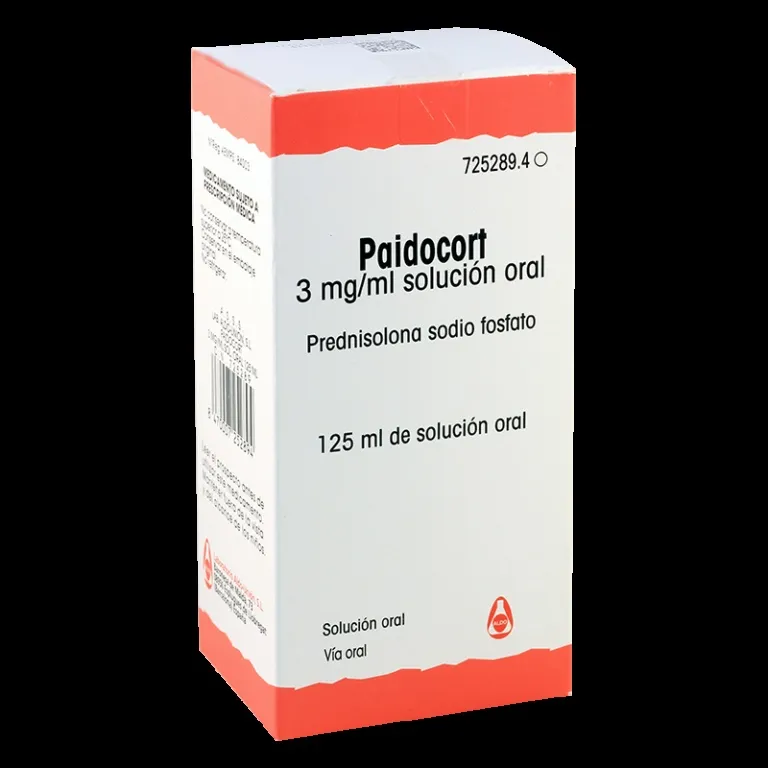
Table of Contents
Package leaflet: Information for the user
Introduction
Package leaflet: information for the user
Paidocort 3 mg/ml oral solution
Prednisolone
Read the entire leaflet carefully before you start taking this medicine, because it contains important information for you.
- Keep this leaflet, as you may need to read it again. If you have any questions, consult your doctor or pharmacist.
- This medicine has been prescribed for you only, and you should not give it to others, even if they have the same symptoms as you, because it could harm them.
- If you experience any adverse effects, consult your doctor or pharmacist, even if they are adverse effects not listed in this leaflet. See section 4.
Leaflet contents
- What Paidocort is and what it is used for
- What you need to know before taking Paidocort
- How to take Paidocort
- Possible side effects
- How to store Paidocort
- Contents of the pack and other information
1. What Paidocort is and what it is used for
Paidocort belongs to a group of hormonal preparations known as systemic corticosteroids. It contains a synthetic corticosteroid called prednisolone, which has anti-inflammatory (reduces inflammation) and immunosuppressive (reduces immune response) effects.
Prednisolone is used in the treatment of:
- Bronchial asthma.
- Allergic (allergopathies) and inflammatory disorders.
- Rheumatoid arthritis and other collagen disorders (collagenopathies).
- Dermatitis and dermatoses (subacute and chronic eczema, psoriasis, pemphigus, etc.).
2. What you need to know before taking Paidocort
Do not take Paidocort
- if you are allergic to prednisolone, other glucocorticoids, or any of the other ingredients of this medicine (listed in section 6),
- if you have gastric or duodenal ulcers,
- if you have acute or chronic bacterial infections (such as latent or active tuberculosis), acute viral infections (such as herpes simplex, herpes zoster, or varicella), or systemic fungal infections,
- if you have had a psychiatric illness,
- if you are in the period before or after vaccination,
- if you have narrow-angle or open-angle glaucoma (an eye disease),
- if you have herpetic keratitis (an eye disease),
- if you have lymphadenopathy (swollen lymph nodes) after tuberculosis vaccination,
- if you have poliomyelitis (a disease of the spinal cord).
Warnings and precautions
Talk to your doctor or pharmacist before starting to take Paidocort:
- If you currently have or have recently had intestinal disorders such as gastritis, esophagitis, diverticulitis (intestinal inflammation), ulcerative colitis (with risk of perforation or infection with pus), or recent intestinal anastomosis (surgical connection), as there is a risk of intestinal perforation with peritonitis.
- If you have any infection, as corticosteroids may reduce your body's defenses, increasing the risk of new infections or reactivating existing ones; additionally, corticosteroid treatment may mask signs of infection, making it more difficult to diagnose an existing or developing infection.
- In severe infections, Paidocort should only be used alongside specific anti-infective treatment. Some types of infection should not be treated with corticosteroids (see Do not take Paidocort), as they could worsen and become life-threatening.
- If you have hypothyroidism (reduced thyroid function) or cirrhosis (liver disease), as the effects of Paidocort (glucocorticoids) may be enhanced in these conditions.
- If you are under stressful conditions (such as trauma or surgery), you may require an increased dose.
- If you have never had chickenpox or measles, try to avoid contact with infected individuals. If you are exposed to these infections during treatment with Paidocort, contact your doctor immediately.
- Vaccination is not recommended while you are taking Paidocort.
- If you have tested positive for tuberculin (a test to detect tuberculosis), inform your doctor.
- If you have myasthenia gravis, particularly if high-dose glucocorticoid treatment is needed, your doctor will start with a low dose of Paidocort and gradually increase it.
- During prolonged treatment with high doses, ensure adequate potassium intake, limit sodium intake, and monitor blood potassium levels.
- If your treatment is long-term, your doctor will perform regular check-ups to prevent eye complications (such as cataracts and increased intraocular pressure).
- Contact your doctor if you experience blurred vision or other visual disturbances.
- If you have severe diabetes (very high blood sugar), congestive heart failure (heart unable to pump sufficient blood), or severe hypertension (excessively high blood pressure), your doctor will perform regular monitoring.
- If you have scleroderma (also known as systemic sclerosis, an autoimmune disorder), because daily doses equal to or exceeding 15 mg may increase the risk of a serious complication called scleroderma renal crisis. Signs of scleroderma renal crisis include elevated blood pressure and reduced urine output. Your doctor may advise regular monitoring of blood pressure and urine.
- If you are elderly, your doctor will monitor you regularly, especially if long-term treatment is required.
- Long-term treatment with corticosteroids may cause osteoporosis.
- To reduce the risk of corticosteroid withdrawal syndrome, treatment should not be stopped abruptly but tapered gradually. Do not stop using this medicine without consulting your doctor.
Children
Paidocort should only be used in children when there are important medical reasons. If administered long-term, it may impair growth and development. Your doctor should have considered this factor, among others, when prescribing Paidocort.
Taking Paidocort with other medicines
Inform your doctor or pharmacist if you are taking, have recently taken, or might need to take any other medicines, including those obtained without a prescription.
It is important to inform your doctor if you are taking any of the following medicines:
- amphotericin B, clarithromycin, or erythromycin (antibiotics for treating infections),
- rifampicin or rifabutin (antibiotics for treating tuberculosis),
- carbamazepine, phenytoin, phenobarbital, or primidone (for treating epilepsy),
- ketoconazole (for fungal infections),
- theophylline (for asthma and other respiratory problems),
- diltiazem (for treating high blood pressure and controlling angina),
- cyclosporine (to prevent transplant rejection),
- salicylates or other non-steroidal anti-inflammatory drugs (e.g., acetylsalicylic acid or indomethacin, for pain and inflammation),
- anticoagulants (e.g., acenocoumarol, to "thin" the blood and prevent clots),
- potassium-depleting diuretics (e.g., hydrochlorothiazide, for treating high blood pressure),
- antidiabetic agents (e.g., glibenclamide, to lower blood sugar levels),
- anticholinesterases (e.g., neostigmine or pyridostigmine, for myasthenia gravis),
- estrogens (for hormonal disorders), oral contraceptives,
- cardiac glycosides (e.g., digoxin, for heart problems),
- ion-exchange resins (e.g., cholestyramine or colestipol, for cholesterol treatment),
- neuromuscular blockers (used in anesthesia).
Some medicines may increase the effects of Paidocort, so your doctor will closely monitor you if you are taking these (including some HIV medications: ritonavir, cobicistat). Paidocort reduces the immune response to vaccines and toxoids and may enhance the replication of organisms in live attenuated vaccines.
Taking Paidocort with food, drinks, and alcohol
To facilitate proper administration, Paidocort may be taken with milk, broth, orange juice, etc. (see section 3). Avoid consuming large amounts of grapefruit juice, as it may interfere with Paidocort. Avoid alcohol during treatment with Paidocort to prevent the development of stomach or intestinal ulcers.
Pregnancy and breastfeeding
If you are pregnant, breastfeeding, think you may be pregnant, or plan to become pregnant, consult your doctor or pharmacist before using this medicine. Paidocort should not be used during pregnancy or breastfeeding unless your doctor considers it essential. Therefore, inform your doctor as soon as possible if you become pregnant during treatment.
Driving and using machines
Do not drive or operate tools or machinery during treatment with Paidocort.
Important information about some of the ingredients of Paidocort
Athletes should be aware that this medicine contains a derivative of prednisolone, which may result in a positive doping test.
Paidocort contains liquid maltitol (or hydrogenated glucose syrup) (E-965), methylparahydroxybenzoate sodium salt (E-219), and propylparahydroxybenzoate sodium salt (E-217).
This medicine contains liquid maltitol (or hydrogenated glucose syrup) (E-965). If your doctor has diagnosed you with an intolerance to certain sugars, consult him before taking this medicine.
It may cause allergic reactions (possibly delayed) as it contains methylparahydroxybenzoate sodium salt (E-219) and propylparahydroxybenzoate sodium salt (E-217).
For the indication of acute bronchial asthma in adults and adolescents aged 12 to 17 years, where the recommended dose may reach 50 mg/day (corresponding to 16.7 ml/day), this medicine contains 23.45 mg of sodium (main component of table/cooking salt) per dose unit. This corresponds to 1.17% of the maximum daily sodium intake recommended for an adult.
For the indication of severe allergic and inflammatory reactions, with an initial dose of 60 mg/day (corresponding to 20 ml/day), this medicine contains 28.08 mg of sodium (main component of table/cooking salt) per dose unit. This corresponds to 1.40% of the maximum daily sodium intake recommended for an adult.
For all other indications, this medicine contains less than 23 mg of sodium (1 mmol) per dose unit; hence, it is essentially "sodium-free".
3. How to take Paidocort
Follow exactly the instructions for use of this medicine provided by your doctor or pharmacist. If in doubt, consult your doctor or pharmacist again.
The dose depends on the type and severity of the disease, as well as on the individual patient's response. Generally, a dose of 1 mg of prednisolone (corresponding to 0.35 ml of solution) per kg of body weight per day is recommended. This dose should be administered in two divided doses every 12 hours.
Below are the recommended doses and treatment durations according to different indications, provided as a guide:
Acute bronchial asthma:
40–50 mg/day (corresponding to 13.4–16.7 ml/day) for at least 5 days.
Allergic and inflammatory disorders:
Begin treatment with a daily dose of 10–20 mg/day of prednisolone (corresponding to 3.5–6.7 ml/day), preferably administered in the morning after breakfast. This dose may be reduced after a few days, but treatment may need to continue for weeks or months.
Maintenance dose is 2.5–15 mg/day (corresponding to 0.84–5.0 ml/day).
Your doctor may recommend higher doses depending on the severity of the condition.
Rheumatoid arthritis:
7.5–10 mg/day, i.e., 2.5–3.4 ml/day.
Use in children
Acute bronchial asthma:
Children from 1 month to 11 years:
1–2 mg/kg/day (corresponding to 0.35–0.67 ml/kg/day), maximum 40 mg/day (corresponding to 13.4 ml/day) for 3 days. Treatment may be prolonged if necessary.
Adolescents from 12–17 years:
Same dose as in adults.
Allergic and inflammatory disorders:
Children from 1 month of age:
The recommended dose is 0.1–2 mg/kg/day (corresponding to 0.035–0.67 ml/kg/day), given in divided doses 1 to 4 times daily.
Method of administration
Oral use
If you take more Paidocort than you should
In case of overdose or accidental ingestion, contact your doctor or pharmacist immediately or call the Toxicology Information Service at telephone number 915 62 04 20, indicating the medicine and the amount ingested.
Symptoms of overdose may include: anxiety, depression, mental confusion, gastrointestinal spasms or bleeding, hyperglycemia (increased blood sugar), arterial hypertension (high blood pressure), and edema (swelling).
If you forget to take Paidocort
Do not take a double dose to make up for missed doses. Simply continue taking Paidocort as directed.
If you stop taking Paidocort
Do not stop treatment with this medicine without first consulting your doctor.
It is essential that treatment is not stopped abruptly; therefore, doses must be gradually reduced. Your doctor will advise you on how to do this, as rapid withdrawal of corticosteroids after prolonged treatment may lead to serious complications.
If you have any questions about the use of this medicine, ask your doctor or pharmacist.
4. Possible adverse effects
Like all medicines, this medicine can cause adverse effects, although not everybody will experience them.
The following frequency definitions have been used for classification:
Frequent (may affect up to 1 in 10 people),
Uncommon (may affect up to 1 in 100 people),
Rare (may affect up to 1 in 1,000 people),
Very rare (may affect up to 1 in 10,000 people),
Frequency not known (cannot be estimated from the available data).
Endocrine disorders:
Frequent: abnormal fat distribution (such as abdominal obesity, moon face, fat accumulation in the epidural space or thorax, which is reversible), increased blood sugar.
Uncommon: weight gain, diabetes, changes in blood fat levels (such as cholesterol or triglycerides), menstrual irregularities, increased body hair growth.
Rare: impotence, problems with adrenal cortex hormone production, growth retardation in children, increased protein metabolism (accompanied by increased blood urea levels).
Cardiac and vascular disorders:
Frequent: sodium and water retention, increased potassium excretion and low blood potassium levels. In patients with congestive heart failure (heart unable to pump sufficient blood), fluid accumulation in the lungs may increase and hypertension (high blood pressure) may occur. Allergic inflammation of blood vessels, increased intracranial pressure with optic nerve inflammation.
Frequency not known: Decreased heart rate.
Skin and subcutaneous tissue disorders:
Frequent: skin changes (atrophy, stretch marks, acne, bruising, red spots).
Rare: skin rash.
Renal disorders:
Frequency not known: Scleroderma renal crisis in patients who already have scleroderma (an autoimmune disorder). Signs of scleroderma renal crisis include increased blood pressure and decreased urine production.
Blood and lymphatic system disorders:
Frequent: delayed wound healing. Increased white blood cell count at the start of treatment, although this usually resolves over time. Increased platelet count and risk of thrombosis.
Musculoskeletal and connective tissue disorders:
Frequent: osteoporosis (loss of bone minerals), which in severe cases may carry a risk of fractures.
Rare: muscle weakness, which is usually reversible; however, in patients with myasthenia gravis, reversible worsening of muscle weakness may occur, potentially progressing to a myasthenic crisis (severe respiratory problems).
Very rare: Death of bone tissue in the hip or shoulder (avascular necrosis), tendon rupture (especially in individuals with prior tendon injury, diabetes, or high blood uric acid levels). With long-term, high-dose treatment, muscle disorders (such as loss of muscle mass) may occur.
Gastrointestinal disorders:
Rare: stomach or duodenal ulcer, with pancreatitis (inflammation of the pancreas), peritonitis (serious gastrointestinal infection), or abdominal discomfort.
Eye disorders:
Rare: eye damage such as opaque lens, increased intraocular pressure (glaucoma), cloudy or opaque area of the lens (cataracts).
Frequency not known: Blurred vision.
Immune system disorders:
Uncommon: decreased body defenses and increased risk of infection. If you have a viral disease such as chickenpox, simple herpes, or shingles, your condition could worsen, sometimes seriously affecting your health.
Nervous system disorders:
Rare: seizures, headache, dizziness, and sleep disturbances.
Psychiatric disorders:
Rare: development or worsening of psychiatric disorders (euphoria, mood and/or personality changes, severe depression, psychosis).
If treatment with Paidocort is stopped rapidly (not gradually) after prolonged use, symptoms such as muscle pain, joint pain, breathing difficulties, anorexia, nausea, vomiting, fever, low blood pressure, and low blood sugar levels may occur.
Reporting of adverse effects:
If you experience any adverse effects, consult your doctor or pharmacist, even if they are possible adverse effects not listed in this leaflet. You may also report them directly via the Spanish Pharmacovigilance System for Human Medicines: https://www.notificaram.es. By reporting adverse effects, you can help provide more information on the safety of this medicine.
5. Storage of Paidocort
Keep this medicine out of sight and reach of children.
Do not store above 25°C. Store in the original packaging. Do not refrigerate.
The medicine should be used within two months of first opening.
Do not use this medicine after the expiry date stated on the packaging after EXP. The expiry date refers to the last day of the month indicated.
Medicines must not be disposed of via wastewater drains or household waste. Dispose of unused medicines and their containers at a SIGRE Point in your pharmacy. If you are in doubt, ask your pharmacist how to properly dispose of unused medicines and their packaging. This will help protect the environment.
6. Contents of the container and additional information
Composition of Paidocort
The active substance is prednisolone (as sodium phosphate). Each ml of oral solution contains 3 mg of prednisolone (as sodium phosphate).
The other components (excipients) are: methylparahydroxybenzoate, sodium salt (E-219), propylparahydroxybenzoate, sodium salt (E-217), disodium edetate, sodium saccharin, disodium hydrogen phosphate dihydrate, sodium dihydrogen phosphate dihydrate, liquid maltitol (E-965), strawberry flavor 90044-33, and purified water.
Appearance of the product and contents of the container
Paidocort is a colourless or slightly yellowish, transparent solution. It is supplied in an amber PET (polyethylene terephthalate) bottle containing 50 ml or 125 ml, and includes a 3 ml or 5 ml dosing syringe, respectively. Bottles containing 50 ml are available in individual packs or in clinical packs of 20 units.
Marketing Authorization Holder and Manufacturer
Marketing Authorization Holder
Laboratorio Aldo-Unión, S.L
Baronesa de Maldá, 73
08950 Esplugues de Llobregat (Barcelona)
Spain
Manufacturer
Laboratorium Sanitatis, S.L. - Tecnalia
Leonardo da Vinci, 11
Álava Technology Park
Miñano (Álava) SPAIN
or
LABORATORIO ALDO-UNIÓN, S.L.
C/Baronesa de Maldá, 73
08950 Esplugues de Llobregat (Barcelona)
Spain
Date of the most recent review of this leaflet: July 2021
Detailed and up-to-date information on this medicinal product is available on the website of the Spanish Agency of Medicines and Health Products (AEMPS) http://www.aemps.gob.es