Padcev 30 mg powder for concentrate for solution for infusion
Spain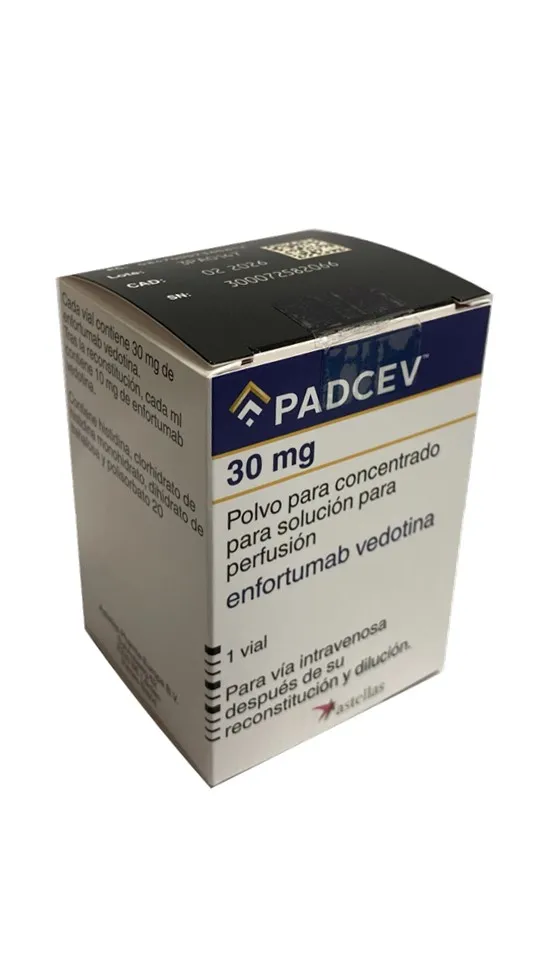
Table of Contents
Package leaflet: Information for the user
Introduction
Package leaflet: information for the patient
Padcev 20mg powder for concentrate for solution for infusion
Padcev 30mg powder for concentrate for solution for infusion
enfortumab vedotin
This medicine is subject to additional monitoring, which will allow quicker detection of new safety information. You can help by reporting any adverse reactions you may experience. Section 4 at the end of this leaflet includes information on how to report these adverse reactions.
Read the entire leaflet carefully before you are given this medicine, because it contains important information for you.
- Keep this leaflet, as you may need to read it again.
- If you have any questions, consult your doctor.
- If you experience any adverse reactions, consult your doctor, even if they are possible adverse reactions not listed in this leaflet. See section 4.
Leaflet contents
- What Padcev is and what it is used for
- What you need to know before being given Padcev
- How to use Padcev
- Possible adverse reactions
- How to store Padcev
- Contents of the pack and other information
1. What Padcev is and what it is used for
Padcev contains the active substance enfortumab vedotin, which consists of a monoclonal antibody linked to a drug designed to kill cancer cells. The monoclonal antibody recognizes certain cancer cells and releases the drug into them.
This medicine is used alone or in combination with pembrolizumab in adults to treat a type of cancer called bladder cancer (urothelial carcinoma). Padcev is given to people whose cancer has spread or cannot be removed by surgery.
When used alone, Padcev is administered to individuals who have previously received an immunotherapy medicine and also a platinum-based chemotherapy medicine.
This medicine may be administered in combination with pembrolizumab. It is important that you also read the package leaflet for this other medicine. If you have any questions, consult your doctor.
2. What you need to know before Padcev is administered to you
Do not use Padcev
- if you are allergic to enfortumab vedotin or to any of the other components of this medicine (listed in section 6).
Warnings and precautions
Contact your doctor immediately if:
-
you experience any of the following symptoms of a skin reaction:
-
rash or itching that worsens or returns after treatment,
-
blistering or peeling of the skin,
-
painful sores or ulcers in the mouth, nose, throat, or genital area,
-
fever or flu-like symptoms,
-
or swollen lymph nodes.
-
these may be signs of a serious skin reaction that can occur when receiving this medicine, particularly during the first weeks of treatment. Skin reactions may occur more frequently when this medicine is given together with pembrolizumab. If this occurs, your doctor will monitor you and may give you medication to treat your skin condition. Your doctor may pause your treatment until symptoms decrease. If the skin reaction worsens, your doctor may stop your treatment. You can also find this information in the Patient Alert Card included in the package. It is important that you carry this Patient Alert Card with you and show it to any healthcare professional treating you.
-
you have symptoms of high blood sugar levels, including frequent urination, increased thirst, blurred vision, confusion, numbness, loss of appetite, fruity-smelling breath, nausea, vomiting, or stomach pain. You may experience high blood sugar levels during treatment.
-
you have lung problems (pneumonitis/interstitial lung disease) or develop new or worsening symptoms, including difficulty breathing, shortness of breath, or cough. These lung problems may occur more frequently when this medicine is administered with pembrolizumab. If this occurs, your doctor may pause treatment until symptoms improve or may reduce your dose. If symptoms worsen, your doctor may stop your treatment.
-
you have, or think you may have, an infection. Some infections may be serious and could be life-threatening.
-
you have symptoms of a nerve problem (neuropathy), such as numbness, tingling, or a prickling sensation in the hands or feet, or muscle weakness. If this occurs, your doctor may pause treatment until symptoms improve or may reduce your dose. If symptoms worsen, your doctor may stop your treatment.
-
you develop eye problems, such as dry eyes, during treatment. Dry eye problems may develop while receiving Padcev.
Children and adolescents
This medicine must not be used in children and adolescents under 18 years of age.
Other medicines and Padcev
Tell your doctor if you are taking, have recently taken, or might need to take any other medicines.
Tell your doctor if you are taking antifungal medications (e.g., ketoconazole), as they may increase the amount of Padcev in your blood. If you regularly take such medications, your doctor may switch you to an alternative medication to take during your treatment period.
Pregnancy, breastfeeding, and fertility
If you are pregnant, think you may be pregnant, or plan to become pregnant, consult your doctor before starting this medicine.
You must not use this medicine if you are pregnant. Padcev may harm the unborn baby.
If you are a woman of childbearing potential starting this medicine, you must use effective contraception during treatment and for at least 6 months after stopping Padcev.
It is unknown whether this medicine passes into breast milk; if it does, it could cause harm to your baby. Do not breastfeed during treatment and for at least 6 months after stopping Padcev.
Men treated with this medicine are advised to freeze and store semen samples before treatment. Men are advised not to father a child during treatment with this medicine and for at least 4 months after the last dose.
3. How to use Padcev
You will receive Padcev at a hospital or clinic, under the supervision of a physician experienced in administering these treatments.
How much Padcev you will receive
When used alone, the recommended dose of this medicine is 1.25 mg/kg on days 1, 8, and 15 of every 28-day cycle. When used in combination with pembrolizumab, the recommended dose of this medicine is 1.25 mg/kg on days 1 and 8 of every 21-day cycle. Your doctor will decide how many treatments you need.
How you will receive Padcev
You will receive Padcev as an intravenous infusion into a vein over 30 minutes. Before use, Padcev will be added to an infusion bag containing glucose solution, sodium chloride solution, or Ringer's lactate solution.
If you miss a dose of Padcev
It is very important that you attend all your appointments to receive Padcev. If you miss an appointment, ask your doctor when to schedule your next dose.
If you stop receiving Padcev
Do not stop treatment with Padcev unless you have discussed it with your doctor. Stopping treatment may interrupt the medicine's effect.
4. Possible adverse effects
Like all medicines, this medicine can cause adverse effects, although not everyone will experience them.
Some possible adverse effects may be serious:
-
Skin reactions (Stevens-Johnson syndrome, toxic epidermal necrolysis, and other severe rashes, such as drug-related symmetric intertriginous and flexural exanthema). Immediately inform your doctor if you experience any of the following signs of a serious skin reaction: rash or itching that worsens or returns after treatment, skin blistering or peeling, painful sores or ulcers in the mouth, nose, throat, or genital area, fever or flu-like symptoms, or swollen lymph nodes (frequency not known).
-
High blood sugar level (hyperglycaemia). Immediately inform your doctor if you have any symptoms of high blood sugar, including: frequent urination, increased thirst, blurred vision, confusion, numbness, loss of appetite, fruity-smelling breath, nausea, vomiting, or stomach pain (may affect more than 1 in 10 people).
-
A serious complication of diabetes with high levels of ketones in the blood that may make the blood more acidic (diabetic ketoacidosis) (frequency not known).
-
Lung problems (pneumonitis/interstitial lung disease). Immediately inform your doctor if you develop new symptoms or worsening of existing symptoms, including difficulty breathing, shortness of breath, or cough (may affect up to 1 in 10 people).
-
Nerve problems (peripheral neuropathy, such as motor neuropathy, sensorimotor neuropathy, paresthesia, hypoesthesia, and muscle weakness). Immediately inform your doctor if you experience numbness, tingling, or a pins-and-needles sensation in your hands or feet, or muscle weakness (may affect more than 1 in 10 people).
-
Leakage of Padcev from the vein into surrounding tissues at the infusion site (extravasation). Immediately inform your doctor or seek medical help if you notice any redness, swelling, itching, or discomfort at the infusion site. If Padcev leaks from the injection site or vein into the skin and surrounding tissues, it may cause a reaction at the infusion site. These reactions may occur immediately after receiving an infusion, but sometimes may occur days after the infusion (may affect up to 1 in 10 people).
-
Severe infection (sepsis) when bacteria and their toxins circulate in the blood, causing organ damage (may affect up to 1 in 10 people).
-
Lung infection (pneumonia) (may affect up to 1 in 10 people).
-
Infusion-related reaction
Medicines of this type (monoclonal antibodies) may cause infusion-related reactions such as:
- low blood pressure
- tongue swelling
- difficulty breathing (dyspnoea)
- fever
- chills
- skin redness (rubor)
- itching
- rash
- vomiting
- general malaise
Generally, these types of reactions occur from minutes to several hours after completing the infusion. However, they may develop up to several hours after infusion completion, although this is uncommon. Infusion-related reactions may affect up to 1 in 10 people.
Other possible adverse effects
The following adverse effects have been reported with Padcev alone:
Very common (may affect more than 1 in 10 people):
- low red blood cells (anaemia)
- nausea, diarrhoea, and vomiting
- fatigue
- decreased appetite
- change in taste sensation
- dry eyes
- hair loss
- weight loss
- dry or itchy skin
- rash
- flat or raised red spots on the skin
- increased liver enzymes (aspartate aminotransferase [AST] or alanine aminotransferase [ALT])
Common (may affect up to 1 in 10 people):
- abnormal gait (gait disturbance)
- eye redness
- hives (urticaria) on the skin
- skin redness
- inflamed, itchy, cracked, and rough skin patches
- redness and tingling sensation on the palms of the hands or soles of the feet
- skin peeling
- mouth ulcer
- rash accompanied by symptoms: itching, redness, red bumps or red patches on the skin, fluid-filled blisters, large blisters, skin lesions
- low platelet count in the blood, which may cause bleeding and bruising (thrombocytopenia)
Uncommon (may affect up to 1 in 100 people):
- skin irritation
- burning sensation of the skin
- nerve-related problems causing unusual sensations or movement difficulties
- reduced muscle size
- blood-filled blister
- allergic skin reaction
- rash accompanied by symptoms: scaly patches resembling psoriasis, skin peeling, flat fluid-filled blister
- skin peeling over the entire body
- inflammation of skin folds, including the groin
- blister or blister-like lesions on the skin
- swelling or itching affecting only the legs and feet
Frequency not known (frequency cannot be estimated from available data):
- low white blood cell count with or without fever
- abnormal skin discoloration or darkening (skin hyperpigmentation, skin colour change, pigmentary disorder)
The following adverse effects have been reported with Padcev in combination with pembrolizumab:
Very common (may affect more than 1 in 10 people):
- low red blood cells (anaemia)
- nausea, diarrhoea, and vomiting
- fatigue
- decreased appetite
- change in taste sensation
- dry eyes
- hair loss
- weight loss
- dry or itchy skin
- flat or raised red spots on the skin
- increased liver enzymes (aspartate aminotransferase [AST] or alanine aminotransferase [ALT])
- reduced thyroid gland activity (hypothyroidism)
Common (may affect up to 1 in 10 people):
- abnormal gait (gait disturbance)
- eye redness
- hives (urticaria) on the skin
- skin redness
- rash
- inflamed, itchy, cracked, and rough skin patches
- redness and tingling sensation on the palms of the hands or soles of the feet
- skin peeling
- mouth ulcer
- rash accompanied by symptoms: scaly patches resembling psoriasis, itching, redness, red bumps or red patches on the skin, fluid-filled blisters, large blisters, skin lesions
- elevated lipase (a blood test used to check your pancreas)
- muscle inflammation (myositis)
- low platelet count in the blood, which may cause bleeding and bruising (thrombocytopenia)
Uncommon (may affect up to 1 in 100 people):
- skin irritation
- burning sensation of the skin
- nerve-related problems causing unusual sensations or movement difficulties
- allergic skin reaction
- rash accompanied by symptoms: skin peeling, flat fluid-filled blister
- skin peeling over the entire body
- inflammation of skin folds, including the groin
- blister or blister-like lesions on the skin
- swelling or itching affecting only the legs and feet
Frequency not known (frequency cannot be estimated from available data):
- low white blood cell count with or without fever
- abnormal skin discoloration or darkening (skin hyperpigmentation, skin colour change, pigmentary disorder)
Reporting of adverse effects
If you experience any adverse effects, consult your doctor, even if they are possible adverse effects not listed in this leaflet. You can also report them directly through the national reporting system included in Appendix V. By reporting adverse effects, you can help provide more information on the safety of this medicine.
5. Storage of Padcev
Keep this medicine out of the sight and reach of children.
Do not use this medicine after the expiry date which is stated on the carton and label of the vial after EXP. The expiry date refers to the last day of the month indicated.
Store in a refrigerator (between 2 °C and 8 °C). Do not freeze.
Do not store any unused perfusion solution for later use. Any unused medicine and materials that have come into contact with it must be disposed of in accordance with local regulations.
6. Contents of the pack and other information
Composition of Padcev
- The active substance is enfortumab vedotin.
- A 20 mg vial of powder for concentrate for solution for infusion contains 20 mg of enfortumab vedotin.
- A 30 mg vial of powder for concentrate for solution for infusion contains 30 mg of enfortumab vedotin.
- After reconstitution, each ml of solution contains 10 mg of enfortumab vedotin.
The other components are histidine, monohydrate monohydrochloride histidine, trehalose dihydrate, and polysorbate 20.
Appearance of the product and contents of the pack
Padcev powder for concentrate for solution for infusion is a white to off-white lyophilized powder.
Padcev is supplied in a carton containing 1 glass vial.
Marketing Authorization Holder and Manufacturer
Marketing Authorization Holder:
Astellas Pharma Europe B.V.
Sylviusweg 62
2333 BE Leiden
The Netherlands
Manufacturer:
Astellas Ireland Co. Ltd
Killorglin
Co Kerry
V93 FC86
Ireland
For more information about this medicine, please contact the local representative of the Marketing Authorization Holder:
Belgium/Belgium/Belgium Astellas Pharma B.V. Branch Tel/Tel: +32 (0) 2 5580710 | Lithuania Astellas Pharma d.o.o. Tel.: +370 37 408 681 |
| Luxembourg/Luxembourg Astellas Pharma B.V. Branch Belgium/Belgium Tel/Tel: +32 (0)2 5580710 |
| Hungary Astellas Pharma Kft. Tel.: +36 1 577 8200 |
Denmark Astellas Pharma a/s Tlf: +45 43 430355 | Malta Astellas Pharmaceuticals AEBE Tel: +30 210 8189900 |
Germany Astellas Pharma GmbH Tel.: +49 (0)89 454401 | Netherlands Astellas Pharma B.V. Tel: +31 (0)71 5455745 |
Estonia Astellas Pharma d.o.o. Tel: +372 6 056 014 | Norway Astellas Pharma Tlf: +47 66 76 46 00 |
| Austria Astellas Pharma Ges.m.b.H. Tel.: +43 (0)1 8772668 |
Spain Astellas Pharma S.A. Tel: +34 91 4952700 | Poland Astellas Pharma Sp.z.o.o. Tel.: +48 225451 111 |
France Astellas Pharma S.A.S. Tél: +33 (0)1 55917500 | Portugal Astellas Farma, Lda. Tel: +351 21 4401300 |
Croatia Astellas d.o.o Tel: +385 1670 0102 | Romania S.C. Astellas Pharma SRL Tel: +40 (0)21 361 04 95 |
Ireland Astellas Pharma Co. Ltd. Tel: +353 (0)1 4671555 | Slovenia Astellas Pharma d.o.o Tel: +386 14011400 |
Iceland Vistor hf Sími: +354 535 7000 | Slovakia Astellas Pharma s.r.o. Tel: +421 2 4444 2157 |
Italy Astellas Pharma S.p.A. Tel: +39 (0)2 921381 | Finland Astellas Pharma Puh/Tel: +358 (0)9 85606000 |
| Sweden Astellas Pharma AB Tel: +46 (0)40‑650 15 00 |
Latvia Astellas Pharma d.o.o. Tel: +371 67 619365 | United Kingdom (Northern Ireland) Astellas Pharma Co., Limited Tel: +353 (0)1 4671555 Free call from Northern Ireland: 0800783 5018 |
Date of the most recent review of this leaflet: MM/YYYY.
Other sources of information
Detailed information on this medicine is available on the website of the European Medicines Agency: https://www.ema.europa.eu.
This information is intended for healthcare professionals only:
Traceability
In order to improve the traceability of biological medicinal products, the name and batch number of the administered medicine should be clearly recorded.
Instructions for preparation and administration
Reconstitution in single-dose vial
- Follow appropriate procedures for the safe handling and disposal of anticancer medicinal products.
- Use appropriate aseptic techniques for reconstitution and preparation of solutions for administration.
- Calculate the recommended dose based on patient weight to determine the number and strength (20 mg or 30 mg) of vials required.
- Reconstitute each vial as follows: if possible, direct the stream of sterile water for injection onto the vial walls, not directly onto the lyophilized powder:
- 20 mg vial: Add 2.3 ml of sterile water for injection to obtain enfortumab vedotin 10 mg/ml.
- 30 mg vial: Add 3.3 ml of sterile water for injection to obtain enfortumab vedotin 10 mg/ml.
- Gently rotate each vial until the contents are completely dissolved. Allow reconstituted vials to stand for at least 1 minute until bubbles disappear. Do not shake the vial. Do not expose to direct sunlight.
- Visually inspect the solution for particulate matter or discoloration. The reconstituted solution should be transparent to slightly opalescent, colorless to pale yellow, and free of visible particles. Discard any vial showing visible particles or discoloration.
Dilution in infusion bag
- Withdraw the calculated dose volume of reconstituted solution from the vials and transfer it to an infusion bag.
- Dilute enfortumab vedotin with either 50 mg/ml (5%) glucose injection solution, 9 mg/ml (0.9%) sodium chloride, or Ringer's lactate. The infusion bag size should provide sufficient diluent to achieve a final concentration of enfortumab vedotin between 0.3 mg/ml and 4 mg/ml.
The diluted enfortumab vedotin solution for administration is compatible with intravenous infusion bags made of polyvinyl chloride (PVC), ethylene vinyl acetate, polyolefin such as polypropylene (PP), or IV bottles made of polyethylene (PE), polyethylene glycol modified terephthalate, and with infusion sets made of PVC with plasticizers (bis(2-ethylhexyl) phthalate (DEHP) or tris(2-ethylhexyl) trimellitate (TOTM)), PE, and with filter membranes (pore size: 0.2–1.2 μm) made of polyethersulfone, polyvinylidene fluoride, or mixed cellulose esters.
- Mix the solution by gentle inversion. Do not shake the bag. Do not expose to direct sunlight.
- Visually inspect the infusion bag for particulate matter or discoloration before use. The reconstituted solution should be transparent to slightly opalescent, colorless to pale yellow, and free of visible particles. Do not use the infusion bag if particulate matter or discoloration is observed.
- Discard any unused portion remaining in the single-dose vials.
Administration
- Administer the infusion over 30 minutes through an intravenous line. Do not administer as a rapid infusion or intravenous bolus.
No incompatibilities have been observed with closed drug transfer devices made of acrylonitrile butadiene styrene (ABS), acrylic, activated carbon, ethylene propylene diene monomer, ABS methacrylate, polycarbonate, polyisoprene, polyoxymethylene, PP, silicone, stainless steel, or thermoplastic elastomer for the reconstituted solution.
- Do not administer other medicinal products simultaneously through the same infusion line.
- During administration, in-line filters or syringe filters (pore size: 0.2–1.2 μm, recommended materials: polyethersulfone, polyvinylidene fluoride, mixed cellulose esters) are recommended.
Disposal
Padcev is for single use only.
Any unused medicine and all materials that have been in contact with it must be disposed of in accordance with local regulations.