Oxytocin Kabi 10 IU/mL solution for injection and infusion EFG
Spain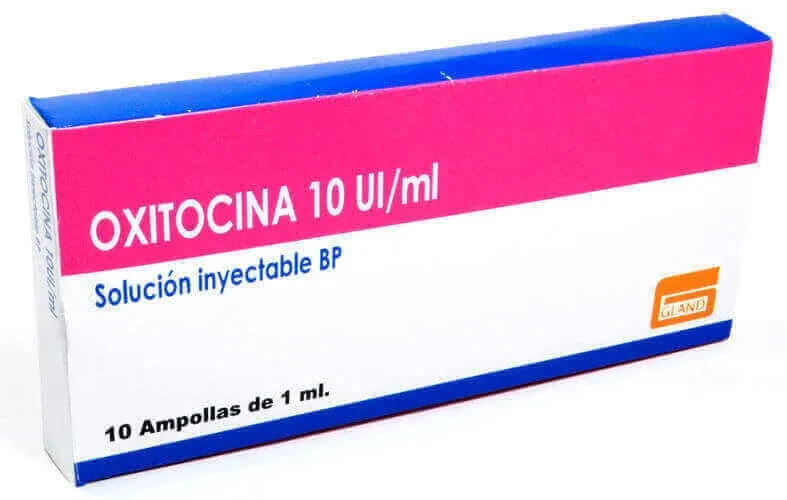
Table of Contents
Package leaflet: Information for the user
Introduction
Package leaflet: information for the user
Oxitocina Kabi 10 IU/ml solution for injection and infusion EFG
oxytocin
Read all of this leaflet carefully before you start using this medicine because it contains important information for you.
- Keep this leaflet. You may need to read it again.
- If you have any questions, ask your doctor or nurse.
- This medicine has been prescribed for you only. Do not pass it on to other people, even if they have the same symptoms as you, because it may harm them.
- If you get any side effects, talk to your doctor or nurse, even if it is not listed in this leaflet. See section 4.
Contents of this leaflet
- What Oxitocina Kabi is and what it is used for
- What you need to know before you use Oxitocina Kabi
- How to use Oxitocina Kabi
- Possible side effects
- How to store Oxitocina Kabi
- Contents of the pack and other information
1. What Oxitocina Kabi is and what it is used for
Each vial of Oxitocina Kabi contains 16.7 micrograms of oxytocin (equivalent to 10 IU). Oxytocin is a hormone that acts by contracting the smooth muscle of the uterus.
Oxitocina Kabi is used:
-
to initiate or assist uterine contractions during labour
-
during caesarean section
-
to prevent and control bleeding after your baby is born
-
to assist in the treatment of spontaneous abortion.
2. What you need to know before using Oxytocin Kabi
Do not use Oxytocin Kabi
-
if you are allergic to oxytocin or to any of the other ingredients of this medicine (listed in section 6).
-
if your doctor considers it inappropriate for you to start or increase uterine contractions, for example:
-
in cases of obstructions that may prevent childbirth
-
in cases where uterine contractions are unusually strong
-
in cases where your baby may be deprived of oxygen.
-
in cases where vaginal delivery or childbirth is not advisable, for example:
-
if your baby's head is too large to pass through your pelvis
-
if your baby is malpositioned in the birth canal
-
if the placenta is located near or covering the cervix
-
if your baby is deprived of oxygen due to blood vessels passing through the cervix
-
if the placenta separates from the uterus before the baby is born
-
if there is one or more loops of umbilical cord between the baby and the cervix, before or after rupture of membranes
-
if your abdomen is excessively distended and more likely to tear, for example, if you are carrying more than one baby or have too much amniotic fluid in your abdomen
-
if you have had five or more previous pregnancies or if your uterus has a scar from a previous caesarean section or other surgery.
-
if you have been given medications called prostaglandins (used to induce labour or to treat stomach ulcers). Oxytocin Kabi must not be used within 6 hours after vaginal prostaglandins, as the effects of both medicines may increase.
Oxytocin Kabi must not be used for prolonged periods if:
- your contractions do not increase with treatment
- you have a condition called severe pre-eclamptic toxemia (high blood pressure, presence of protein in urine, and edema)
- you suffer from severe cardiovascular disorders.
If you are in any of these situations or have any doubts, consult your doctor before using Oxytocin Kabi.
Warnings and precautions
Oxytocin Kabi must be administered only by healthcare professionals in a hospital setting.
Consult your doctor or nurse before starting to use Oxytocin Kabi if:
- you have had a previous caesarean section
- you are prone to chest pain due to pre-existing heart and/or circulatory problems
- you have a known irregular heartbeat (long QT syndrome) or related symptoms, or you are taking medicines known to cause this syndrome (see section Using Oxytocin Kabi with other medicines)
- you have high blood pressure or heart problems
- you are over 35 years of age
- you have kidney problems, as Oxytocin Kabi may cause fluid retention
- you have had complications during your pregnancy (such as diabetes, high blood pressure, thyroid hormone deficiency)
- you are more than 40 weeks pregnant.
When Oxytocin Kabi is administered to initiate or assist contractions during labour, the infusion rate must be adjusted to maintain a contraction pattern similar to normal labour and tailored to individual response. Excessively high doses may cause continuous, very strong contractions and possibly uterine rupture, with serious complications for you and your baby.
Oxytocin Kabi must not be administered as a rapid intravenous injection, as this may cause a drop in blood pressure, a sudden and brief sensation of warmth (often throughout the body), and an increased heart rate.
Oxytocin Kabi may rarely cause disseminated intravascular coagulation, which may lead to symptoms such as abnormal blood clotting, bleeding, and anemia.
High doses of Oxytocin Kabi may cause amniotic fluid to enter your bloodstream from the uterus. This is known as amniotic fluid embolism.
Administration of high doses over a long period while drinking or receiving large volumes of fluids may cause your stomach to feel very full, difficulty breathing, and low sodium levels in the blood.
Oxytocin Kabi must not be administered simultaneously with a nasal spray containing oxytocin.
If you are in any of the above circumstances or are unsure, speak with your doctor or nurse before using Oxytocin Kabi.
Latex allergy
The active substance in Oxytocin Kabi may cause a severe allergic reaction (anaphylactic reaction) in patients allergic to latex. Inform your doctor if you are allergic to latex.
Children and adolescents
Oxytocin Kabi is not intended for use in children or adolescents.
Using Oxytocin Kabi with other medicines
Tell your doctor if you are taking, have recently taken, or might need to take any other medicines.
The following medicines may interact with Oxytocin Kabi:
- prostaglandins (used to induce labour or to treat gastric ulcers) and similar medicines, as the effects of both medicines may increase
- anaesthetics (used to induce sleep during surgery), for example, cyclopropane or halothane, as their use with Oxytocin Kabi may cause heart rhythm problems
- medicines known to cause a heart rhythm disorder called 'long QT syndrome'
- epidural anaesthetics (used to relieve pain during childbirth). Oxytocin Kabi may enhance the vasoconstrictive effect and cause an increase in blood pressure.
Using Oxytocin Kabi with food and drink
You may be advised to minimize your fluid intake.
Pregnancy, breast-feeding and fertility
Oxytocin Kabi can initiate childbirth – it should only be used during pregnancy under medical supervision.
Oxytocin Kabi may be present in small amounts in breast milk, but harmful effects are not expected, as it is rapidly inactivated by your baby's digestive system.
Oxytocin Kabi will not affect your newborn baby during breastfeeding.
Driving and using machines
Oxytocin Kabi may induce labour, so caution should be exercised when driving or operating machinery.
3. How to use Oxytocin Kabi
Your doctor will decide when and how to treat you with Oxytocin Kabi. If you think the effect of Oxytocin Kabi is too strong or too weak, inform your doctor. While you are receiving Oxytocin Kabi, both you and your baby will be carefully monitored.
Oxytocin Kabi is usually diluted before use and administered as an intravenous infusion (drip) into one of your veins. To prepare the intravenous infusion, your doctor may use half a dose of Oxytocin Kabi 10 IU/ml solution for injection and infusion.
Under certain circumstances, 1 ml of Oxytocin Kabi 5–10 IU may be injected intramuscularly without dilution.
The usual dose differs under the following circumstances:
To initiate or assist contractions during labour
Oxytocin Kabi will be administered as an intravenous drip infusion or, preferably, by means of a variable-rate infusion pump. In the case of drip infusion, it is recommended to add 5 IU of Oxytocin Kabi to 500 ml of a physiological electrolyte solution (such as 0.9% sodium chloride). For patients in whom sodium chloride infusion must be avoided, a 5% dextrose solution may be used as the diluent.
The infusion rate will start at 2–8 drops per minute (1–4 milliunits per minute). This may be gradually increased up to a maximum rate of 40 drops per minute (20 milliunits per minute). The infusion can often be reduced once contractions reach an adequate level (about 3–4 contractions every 10 minutes).
If your contractions do not reach an adequate level after 0.5 ml of Oxytocin Kabi 10 IU/ml, the attempt to induce labour should be stopped and repeated the following day.
Caesarean section
The dose is 0.5 ml of Oxytocin Kabi 10 IU/ml administered as a drip infusion (5 IU diluted in physiological sodium chloride solution) or, preferably, by means of a variable-rate infusion pump over 5 minutes intravenously after delivery of your baby.
Prevention of postpartum haemorrhage
The usual dose is 5 IU by intravenous infusion (5 IU diluted in physiological saline solution) or 5 to 10 IU by intramuscular route after expulsion of the placenta.
Treatment of postpartum haemorrhage
The usual dose is 5 IU of Oxytocin Kabi by intravenous infusion (5 IU diluted in physiological saline solution) or 5 to 10 IU by intramuscular route. In some cases, this may be followed by an intravenous drip infusion of a solution containing 5–20 IU of oxytocin in 500 ml of physiological saline solution.
Spontaneous abortion
Due to lower receptor expression, the use of oxytocin is recommended from week 14 of pregnancy onwards. The dose is 5 IU or 0.5 ml of Oxytocin Kabi 10 IU/ml administered as a drip infusion (5 IU diluted in physiological sodium chloride solution) or, preferably, by means of a variable-rate infusion pump over 5 minutes intravenously, if necessary followed by an intravenous infusion at a rate of 20 to 40 milliunits/minute.
Patients with hepatic or renal impairment
There is no information on the use in patients with renal or hepatic impairment.
Elderly patients
There are no indications for the use of Oxytocin Kabi in elderly patients.
If you use more Oxytocin Kabi than you should
Since this medicine will be administered in hospital, it is very unlikely that you will receive an overdose. If someone accidentally receives this medicine, report the incident to the hospital and emergency services or to a doctor immediately. Show the medicine or the empty container to the doctor.
An overdose of Oxytocin Kabi could cause:
- harm to your baby;
- very strong uterine contractions;
- uterine damage which could include rupture;
- fluid retention, blood vessel spasms, high blood pressure.
If you forget to use Oxytocin Kabi
As this medicine is administered by a doctor, it is unlikely that a dose will be forgotten. If you have any concerns, speak with your doctor.
If you have any questions about the use of this medicine, consult your doctor or nurse.
If you stop treatment with Oxytocin Kabi
Oxytocin Kabi infusion may be gradually withdrawn once labour has progressed.
There is no information regarding adverse effects.
4. Possible adverse effects
Like all medicines, this medicine can cause adverse effects, although not everyone experiences them.
Stop taking Oxytocin Kabi and contact a doctor or go to the nearest emergency service immediately if you experience any of the following symptoms:
- A severe allergic (anaphylactic/anaphylactoid) reaction with difficulty breathing, dizziness and lightheadedness, feeling faint, nausea, cold and clammy skin, or a rapid or weak pulse. Rare – may affect up to 1 in 1,000 people
- Swelling of the face, lips, tongue, throat and/or limbs (possible signs of angioedema). Rare – may affect up to 1 in 1,000 people
Other side effects that may occur:
Common (may affect more than 1 in 100 patients):
- Headache
- Rapid heartbeat
- Slow heartbeat
- Nausea
- Vomiting
Uncommon (may affect more than 1 in 1,000 patients):
- Irregular heartbeat
Rare (may affect more than 1 in 10,000 patients):
- Skin rash, hives
Frequency not known
- Bleeding (haemorrhage)
- Chest pain (angina)
- Irregular heartbeat
- Excessive or prolonged contractions
- Uterine rupture
- Fluid retention (water intoxication). Symptoms may include headache, anorexia (loss of appetite), malaise, stomach pain, lethargy, drowsiness, unconsciousness, low levels of certain substances in the blood (e.g. sodium or potassium), seizures
- Low levels of salt in the blood
- Sudden fluid overload in the lungs
- Rapid intravenous injection of oxytocin may cause a sudden short-term drop in blood pressure, a brief and sudden sensation of warmth throughout the body
- Abnormal blood clotting, bleeding and anaemia
- Spasm of the uterine muscles
Effects on the baby:
Excessive contractions may cause low levels of salt in the blood, lack of oxygen, asphyxia and death.
Reporting of adverse effects
If you experience any type of adverse effect, consult your doctor or pharmacist, even if it is a possible adverse effect not listed in this leaflet. You can also report them directly via the Spanish Pharmacovigilance System for Human Medicinal Products: https://www.notificaram.es. By reporting adverse effects, you can help provide more information on the safety of this medicine.
5. Storage of Oxytocin Kabi
Store in a refrigerator (between 2°C and 8°C). Do not freeze.
Keep out of the sight and reach of children.
Do not use this medicine after the expiry date stated on the carton and on the label of the ampoule after EXP. The expiry date refers to the last day of the month indicated.
After first opening: the medicine should be used immediately.
After dilution for infusion: from a microbiological standpoint, unless the method of opening/reconstitution/dilution excludes the risk of microbial contamination, the medicine should be used immediately. If not used immediately, the storage times and conditions prior to use are the responsibility of the user and should normally not exceed 24 hours at a temperature of 2 to 8°C.
Do not use any container that is damaged or shows signs of tampering.
Do not use this medicine if you notice that the solution in the ampoule is cloudy or contains particles or clumps.
Medicines should not be disposed of via wastewater or household waste. If you are unsure how to dispose of unused medicines and their containers, ask your pharmacist. This will help protect the environment.
6. Contents of the pack and other information
Composition of Oxytocin Kabi
- The active substance is oxytocin.
1 ml of solution contains 16.7 micrograms of oxytocin (10 IU).
- The other components are sodium acetate trihydrate, glacial acetic acid, sodium chloride, sodium hydroxide, water for injections.
Appearance of the product and contents of the container
A clear, colourless liquid without visible particles.
The pH of the solution is 3.5–4.5.
Type I glass (borosilicate) ampoules of 1 ml with break ring or O.P.C. opening system. Pack sizes of 5, 10 or 100 ampoules.
Only certain pack sizes may be marketed.
Marketing Authorisation Holder and Manufacturer
Marketing Authorisation Holder
Fresenius Kabi España, S.A.U.
Marina 16-18, 08005 – Barcelona
Spain
Manufacturer
AS Grindeks
Krustpils iela 53,
Riga, LV-1057, Latvia
This medicinal product is authorised in the Member States of the European Economic Area under the following names:
Sweden Oxytocin Grindeks 16.7 microgram/ml injection/infusion solution
Austria Oxytocin Grindeks 16.7 micrograms/ml injection/infusion solution
Belgium Oxytocin Grindeks 10 IU/ml solution for injection/for infusion
Czech Republic Ofost 10 IU/ml injectable/infusion solution
France Oxytocine Grindeks 10 U.I./1 mL, solution injectable/pour perfusion
Germany OFOST 10 IU/ml solution for injection/infusion
Hungary Oxytocin Grindeks 10 NE/ml oldatos injekció/infúzió
Ireland Ofost 10 IU/ml concentrate for solution for infusion or solution for intramuscular injection
Italy Ossitocina Pharmexon 10 IU/ml soluzione iniettabile/per infusione
Latvia Ofost 10 IU/ml šķīdums injekcijām/infūzijām
Lithuania Ofost 10 TV/ml injekcinis ar infuzinis tirpalas
Poland Oxytocin Grindeks 16.7 mikrogramów/ml roztwór do wstrzykiwania/infuzji
Portugal Oxitocina Kabi 10 UI/ml solução injetável ou para perfusão
Romania Ofost 16.7 micrograme/ml soluție injectabilă/perfuzabilă
Slovakia Ofost 10 IU/ml injekčný a infúzny roztok (injekcia/infúzia)
Slovenia Ofost 10 i.e./ml raztopina za injiciranje/infundiranje
Spain Oxitocina Kabi 10 UI/ml solución inyectable y para perfusión EFG
This leaflet was last reviewed in October 2021.
Detailed and up-to-date information on this medicinal product is available on the website of the Spanish Agency of Medicines and Health Products (AEMPS) http://www.aemps.gob.es