Oxlumo 94.5 mg/0.5 ml solution for injection
Spain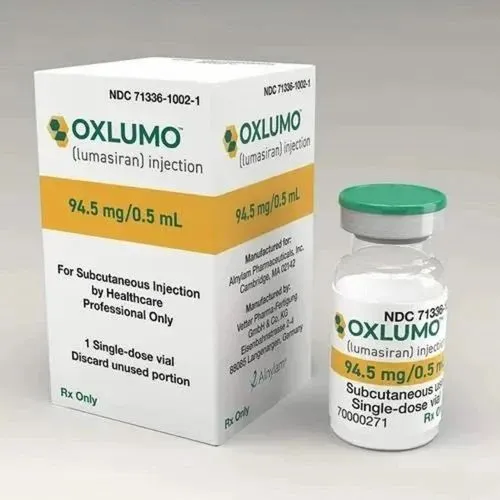
Table of Contents
Package leaflet: Information for the user
Introduction
Package leaflet: Information for the patient
Oxlumo 94.5 mg/0.5 ml solution for injection
lumasiran
Read the entire leaflet carefully before you start receiving this medicine, because it contains important information for you.
- Keep this leaflet, as you may need to read it again.
- If you have any questions, consult your doctor or nurse.
- If you experience any adverse reactions, consult your doctor or nurse, even if they are adverse reactions not listed in this leaflet. See section 4.
Leaflet contents:
- What Oxlumo is and what it is used for
- What you need to know before you are given Oxlumo
- How Oxlumo is administered
- Possible side effects
- How to store Oxlumo
Contents of the pack and other information
1. What Oxlumo is and what it is used for
What is Oxlumo
Oxlumo contains the active substance lumasiran.
What Oxlumo is used for
Oxlumo is used for the treatment of primary hyperoxaluria type 1 (PH1) in adults and children of all ages.
What is PH1
PH1 is a rare disease in which the liver produces an excess of a substance called oxalate. The kidneys remove oxalate from the body and excrete it into the urine. In people with PH1, excess oxalate can accumulate in the kidneys and cause kidney stones, as well as impair normal kidney function. Excess oxalate can also damage other parts of the body, such as the eyes, heart, skin, and bones. This is known as oxalosis.
How Oxlumo works
Lumasiran, the active substance in Oxlumo, reduces the amount of an enzyme called glycolate oxidase produced by the liver. Glycolate oxidase is one of the enzymes involved in the production of oxalate. By reducing the amount of this enzyme, the liver produces less oxalate, thereby decreasing oxalate levels in the urine and blood. This may help reduce the effects of the disease.
2. What you need to know before Oxlumo is administered to you
Do not use Oxlumo:
- if you are severely allergic to lumasiran or to any of the other ingredients of this medicine (listed in section 6).
Warnings and precautions
Talk to your doctor before starting treatment with this medicine.
Your doctor may monitor you for signs of metabolic acidosis (build-up of acid in the body) if you have severe renal impairment.
Other medicines and Oxlumo
Tell your doctor if you are taking, have recently taken, or might need to take any other medicines.
Pregnancy, breastfeeding, and fertility
Pregnancy
If you are pregnant or breastfeeding, think you may be pregnant, or plan to become pregnant, consult your doctor or nurse before using this medicine. Your doctor will decide whether you should take Oxlumo after considering the health benefits you would gain and the potential risks to your unborn baby.
Breastfeeding
This medicine may pass into breast milk and affect your baby. If you are breastfeeding, consult your doctor for advice before taking this medicine. Your doctor will help you decide whether to stop breastfeeding or stop treatment.
Driving and using machines
It is unlikely that this medicine will affect your ability to drive or operate machinery.
Oxlumo contains sodium
This medicine contains less than 1 mmol of sodium (23 mg) per ml; i.e., essentially "sodium-free".
3. How Oxlumo is administered
How much Oxlumo is administered
Your doctor will calculate the amount of medication you will receive. The dose depends on your body weight. Your doctor will adjust the dose according to changes in your weight.
You will receive your first doses (loading doses) once a month in 3 doses. After that, you will begin receiving the maintenance dose starting one month after the last loading dose.
Body weight below 10 kg
- Loading dose: 6 mg per kg of body weight, administered once a month in 3 doses.
- Maintenance dose: 3 mg per kg of body weight, administered once a month starting one month after the last loading dose.
Body weight from 10 kg to less than 20 kg
- Loading dose: 6 mg per kg of body weight, administered once a month in 3 doses.
- Maintenance dose: 6 mg per kg of body weight, administered once every 3 months starting one month after the last loading dose.
Body weight of 20 kg or more
- Loading dose: 3 mg per kg of body weight, administered once a month in 3 doses.
- Maintenance dose: 3 mg per kg of body weight, administered once every 3 months starting one month after the last loading dose.
How Oxlumo is administered
The medicine will be administered by a doctor or nurse.
- The medicine is given as an injection under the skin (subcutaneous) in the abdominal area, or in some cases, in the upper arm or thigh. The injection site will be changed each time.
- Depending on your dose, you may need to receive more than one subcutaneous injection.
- Your doctor or nursing staff will not inject the medicine into areas of skin that are scarred, red, inflamed, or swollen.
If you are given more Oxlumo than you should
In the unlikely event that your doctor or nurse administers too much medicine (an overdose), you will be monitored for adverse effects.
If you miss a dose of Oxlumo
If you miss a dose of Oxlumo, consult your doctor or nurse as soon as possible to schedule the next dose.
If you have any further questions about the use of this medicine, ask your doctor or nurse.
4. Possible adverse effects
Like all medicines, this medicine may cause adverse effects, although not everyone experiences them.
The following adverse effects may occur when Oxlumo is administered:
Very common: may affect more than 1 in 10 people
- Redness, pain, itching, swelling, discomfort, discoloration, mass, induration, rash, bruising, or peeling at the injection site (injection site reaction).
- Stomach pain or discomfort (abdominal pain)
Frequency not known: cannot be estimated from the available data
- A type of allergic reaction (hypersensitivity) with symptoms such as rash, throat irritation, and watery eyes
Reporting of adverse effects
If you experience any type of adverse effect, consult your doctor or nurse, even if it is a possible adverse effect not listed in this leaflet. You may also report them directly through the national reporting system listed in Appendix V. By reporting adverse effects, you can help provide more information on the safety of this medicine.
5. Storage of Oxlumo
Keep this medicine out of the sight and reach of children.
Do not use this medicine after the expiry date stated on the carton and vial following “CAD/EXP”. The expiry date refers to the last day of the month indicated.
This medicine is for single use only. Once the vial has been opened, use it immediately.
Do not store above 30 °C.
Keep the vial in the outer packaging to protect it from light.
Medicines should not be disposed of via wastewater or household waste. Your doctor or nurse will dispose of any unused or expired medicines and their containers appropriately. This helps protect the environment.
6. Contents of the container and other information
Composition of Oxlumo
- The active substance is lumasiran.
- Each 0.5 ml vial contains sodium lumasiran equivalent to 94.5 mg of lumasiran.
- The other components (excipients) are water for injections, sodium hydroxide (E524), and phosphoric acid (E338) (see “Oxlumo contains sodium” in section 2).
Appearance of the product and contents of the container
This medicine is a clear, colourless to yellow solution for subcutaneous injection.
Each pack contains a single-use vial containing 0.5 ml of solution.
Marketing Authorization Holder and Manufacturer
Alnylam Netherlands B.V.
Antonio Vivaldistraat 150
1083 HP Amsterdam
The Netherlands
For further information about this medicine, please contact the local representative of the Marketing Authorization Holder:
Belgium/Belgique/Belgien Alnylam Netherlands B.V. Tel/Tel: 0800 81 443 (+32 234 208 71) | Lithuania Medison Pharma Lithuania UAB Tel: +31 20 369 7861 |
Genesis Pharma Bulgaria EOOD Tel.: +359 2 969 3227 | Luxembourg/Luxemburg Alnylam Netherlands B.V. Tel/Tel: 80085235 (+352 203 014 48) |
Czech Republic Medison Pharma s.r.o. Tel: +31 20 369 7861 | Hungary Medison Pharma Hungary Kft Tel.: +31 20 369 7861 |
Denmark Alnylam Sweden AB Tlf.: 433 105 15 (+45 787 453 01) | Malta Genesis Pharma (Cyprus) Ltd Tel: +357 22765715 |
Germany Alnylam Germany GmbH Tel: 08002569526 (+49 8920190112) | Netherlands Alnylam Netherlands B.V. Tel: 08002820025 (+31 203697861) |
Estonia Medison Pharma Estonia OÜ Tel: +31 20 369 7861 | Norway Alnylam Sweden AB Tlf: 800 544 00 (+472 1405 657) |
Greece GENESIS PHARMA S.A. Tel: +30 210 87 71 500 | Austria Alnylam Austria GmbH Tel: 0800070339 (+43 720 778 072) |
Spain Alnylam Pharmaceuticals Spain SL Tel: 900810212 (+34 910603753) | Poland Medison Pharma Sp. z o.o. Tel.: +31 20 369 7861 |
France Alnylam France SAS Tél: 0805542656 (+33 187650921) | Portugal Alnylam Portugal Tel: 707201512 (+351 21 269 8539) |
Croatia Genesis Pharma Adriatic d.o.o Tel: +385 1 5530 011 | Romania Genesis Biopharma Romania SRL Tel: +40 21 403 4074 |
Ireland Alnylam Netherlands B.V. Tel: 1800 924260 (+353 818 882213) | Slovenia Genesis Biopharma SL d.o.o Tel: +386 1 292 70 90 |
Iceland Alnylam Netherlands B.V. Tel: +31 20 369 7861 | Slovakia Medison Pharma s.r.o. Tel: +31 20 369 7861 |
Italy Alnylam Italy S.r.l. Tel: 800 90 25 37 (+39 02 89 73 22 91) | Finland Alnylam Sweden AB Tel: 0800 417 452 (+358 942 727 020) |
Cyprus Genesis Pharma (Cyprus) Ltd Tel: +357 22765715 | Sweden Alnylam Sweden AB Tel: 020109162 (+46 842002641) |
Latvia Medison Pharma Latvia SIA Tel: +31 20 369 7861 |
Date of last review of this leaflet:
Other sources of information
Detailed information on this medicine is available on the European Medicines Agency website: http://www.ema.europa.eu,
This information is intended for healthcare professionals only:
Instructions for use
For subcutaneous administration only.
- Gather the materials not included in the package but necessary for administration, including a sterile syringe (0.3 ml, 1 ml, or 3 ml), an 18 gauge (G) needle, and a needle between 25 G and 31 G.
- Calculate the required volume of Oxlumo based on the recommended dose according to body weight. If the dose exceeds 0.5 ml, more than one vial will be needed. The maximum acceptable volume for a single injection is 1.5 ml. If more than 1.5 ml is required, multiple subcutaneous injections may be necessary.
- An 18 G needle should be used to withdraw Oxlumo from the vial. Keep the vial in an upright or slightly tilted position, ensuring the flat end of the needle points downward.
- Orient the syringe and needle vertically upward and gently tap the syringe to allow air bubbles to rise to the top. Once the bubbles have collected at the top, gently press the plunger to expel the air bubbles from the syringe. Confirm that the required amount of medication remains in the syringe.
- Administer the medication using a sterile syringe with a needle between 25 G and 31 G, 13 mm or 16 mm in length, for subcutaneous injection. For volumes less than 0.3 ml, a 0.3 ml sterile syringe is recommended.
- Note: Do not push the medication into the 25 G to 31 G needle. When using 0.3 ml syringes (insulin syringes), do not force air bubbles out of the syringe.
- The injection can be administered in the abdomen, upper arms, or thighs. Consider rotating injection sites. Do not administer into scarred tissue or areas that are red, inflamed, or swollen.
- Note: When administering subcutaneous injections in the abdomen, avoid a circular area with a 2 cm radius around the umbilicus.
- Clean the intended injection site with an alcohol swab and wait until it is completely dry.
- Ensure proper injection technique is used. Do not inject into a vein or muscle.
- Insert the needle at the correct angle (90 degrees) to deliver the injection just beneath the skin. In patients with minimal subcutaneous tissue, insert the needle at a 45-degree angle.
- Do not press the plunger while penetrating the skin. Once the needle is inserted into the skin, release the pinched skin and administer the dose slowly and steadily. After administering the medication, wait at least 5 seconds before removing the needle from the skin. Gently press with gauze or a cotton ball over the injection site as needed. Do not recap the needle.
- Note: Do not aspirate after inserting the needle to prevent tissue damage, bruising, and hematoma.
- If more than one injection is required for a single dose of Oxlumo, injection sites should be separated by at least 2 cm.
- Use the vial only once. After administering the dose, discard any unused medication in the vial according to local regulations.
- Use syringes, transfer needles, and injection needles only once. Dispose of all used syringes and needles according to local regulations.