Ovitrelle 250 micrograms/0.5 ml solution for injection in pre-filled syringe
Spain
Table of Contents
Package leaflet: Information for the user
Introduction
Package leaflet: information for the user
Ovitrelle 250 micrograms/0.5 ml solution for injection in pre-filled syringe
coriongonadotropin alfa
Read the entire leaflet carefully before you start using this medicine, because it contains important information for you.
- Keep this leaflet, as you may need to read it again.
- If you have any questions, ask your doctor or pharmacist.
- This medicine has been prescribed for you only, and you should not give it to other people, even if they have the same symptoms as you, because it could harm them.
- If you experience any adverse effects, consult your doctor or pharmacist, even if they are adverse effects not listed in this leaflet. See section 4.
Leaflet contents:
- What Ovitrelle is and what it is used for
- What you need to know before using Ovitrelle
- How to use Ovitrelle
- Possible side effects
- How to store Ovitrelle
- Contents of the pack and other information
1. What Ovitrelle is and what it is used for
What Ovitrelle is
Ovitrelle contains a medicine called "coriogonadotropin alfa", produced in the laboratory using a special recombinant DNA technique. Coriogonadotropin alfa is similar to a hormone naturally present in your body called "chorionic gonadotropin", which plays a role in reproduction and fertility.
What Ovitrelle is used for
Ovitrelle is used together with other medicines:
- To help develop and mature several follicles (each containing an egg) in women undergoing assisted reproductive techniques (a procedure that may help you become pregnant), such as in vitro fertilization. Other medicines will first be given to trigger the growth of several follicles.
- To help release an egg from the ovary (induction of ovulation) in women who do not produce eggs ("anovulation") or produce very few eggs ("oligoovulation"). Other medicines will first be given to develop and mature the follicles.
2. What you need to know before using Ovitrelle
Do not use Ovitrelle
- if you are allergic to choriogonadotropin alfa or to any of the other components of this medicine (listed in section 6),
- if you have a tumor in the hypothalamus or pituitary gland (both parts of the brain),
- if you have enlarged ovaries or large fluid-filled sacs in the ovaries (ovarian cysts) of unknown origin,
- if you have vaginal bleeding of unknown cause,
- if you have ovarian, uterine, or breast cancer,
- if you have severe inflammation of the veins or blood clots in the veins (active thromboembolic disorders),
- if you have any condition that generally prevents a normal pregnancy, such as menopause or premature menopause (ovarian insufficiency), or congenital malformations of the reproductive organs.
Do not use Ovitrelle if any of the above conditions apply to you. If you are unsure, consult your doctor before taking this medicine.
Warnings and precautions
Before starting treatment, your fertility and that of your partner must be evaluated by a physician experienced in the treatment of infertility.
Ovarian hyperstimulation syndrome (OHSS)
This medicine may increase your risk of developing OHSS. This occurs when follicles become overstimulated and develop into large cysts.
If you experience lower abdominal pain, rapid weight gain, nausea or vomiting, or have difficulty breathing, do not administer the Ovitrelle injection and contact your doctor immediately (see section 4). If you develop OHSS, you may be advised to abstain from sexual intercourse or to use a barrier contraceptive method for at least four days.
The risk of OHSS is reduced when the standard dose of Ovitrelle is used and when you are carefully monitored throughout the treatment cycle (e.g., through blood tests to measure estradiol levels and ultrasound scans).
Multiple pregnancy and/or congenital abnormalities
While using Ovitrelle, you have a higher chance of becoming pregnant with more than one baby at the same time (“multiple pregnancy,” usually twins) compared to natural conception. Multiple pregnancy may lead to complications for you and your babies. During assisted reproductive techniques, the risk of multiple pregnancy is related to your age and to the quality and number of fertilized eggs or embryos transferred into your body. Multiple pregnancies and certain specific characteristics of infertile couples (e.g., age) may also be associated with an increased risk of congenital abnormalities.
The risk of multiple pregnancy is reduced when you are carefully monitored throughout the treatment cycle (e.g., through blood tests to measure estradiol levels and ultrasound scans).
Ectopic pregnancy
A pregnancy outside the uterus (ectopic pregnancy) may occur in women with damage to the fallopian tubes (the ducts that carry the egg from the ovary to the uterus). Therefore, your doctor should perform an early ultrasound examination to rule out ectopic pregnancy.
Miscarriage
During treatment with assisted reproductive techniques or ovarian stimulation to produce eggs, you have a higher risk of miscarriage than the average woman.
Blood clotting problems (thromboembolic events)
Consult your doctor before using Ovitrelle if you or a family member have ever had blood clots in the leg or lung, or a heart attack or stroke. You may have an increased risk of developing serious blood clots or worsening of existing clots while receiving treatment with Ovitrelle.
Tumors of the reproductive organs
Benign and malignant tumors of the ovaries and other reproductive organs have been reported in women who have received various pharmacological treatments for infertility.
Pregnancy tests
If you take a serum or urine pregnancy test after using Ovitrelle, and up to ten days afterwards, you may get a false-positive test result. If you are unsure, consult your doctor.
Children and adolescents
Ovitrelle must not be used in children and adolescents.
Other medicines and Ovitrelle
Inform your doctor if you are taking, have recently taken, or might need to take any other medicines.
Pregnancy and breastfeeding
Do not use Ovitrelle if you are pregnant or breastfeeding.
If you are pregnant or breastfeeding, consult your doctor before using this medicine.
Driving and using machines
Ovitrelle is not expected to affect your ability to drive or use machines.
Ovitrelle contains sodium
This medicine contains less than 1 mmol of sodium (23 mg) per dose; essentially “sodium-free”.
3. How to use Ovitrelle
Follow exactly the instructions for administration of this medicine given by your doctor. If in doubt, consult your doctor or pharmacist again.
How much to use
- The recommended dose is 1 pre-filled syringe (250 micrograms/0.5 ml) as a single injection.
- Your doctor will have explained exactly when you should administer the injection.
Use of this medicine
- Ovitrelle is administered subcutaneously, i.e. by injection under the skin.
- Each pre-filled syringe is for single use only. Only use a clear solution free from particles.
- Your doctor or nurse will teach you how to use the Ovitrelle pre-filled syringe to inject the medicine.
- Inject Ovitrelle as instructed by your doctor or nurse.
- After injection, dispose of the used syringe safely.
If you are going to administer Ovitrelle yourself, carefully read the following instructions:
-
Wash your hands. It is important that your hands and materials you use are as clean as possible.
-
Gather all the items you will need. Note that alcohol swabs are not included in the packaging. Find a clean place and prepare the following:
- two alcohol swabs,
- one pre-filled syringe containing the medicine.
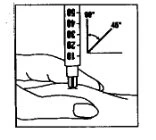
- Injection:
| Inject the solution immediately: your doctor or nurse will have indicated where you should administer the injection (e.g., abdomen, front of the thigh). Clean the selected area with a cotton ball soaked in alcohol. Firmly pinch the skin and insert the needle at an angle of 45° to 90°, using a dart-like motion. Inject under the skin, following the instructions provided. Do not inject directly into a vein. Administer the solution by gently pressing the plunger. Take all the time you need to inject the entire solution. Immediately remove the needle and clean the skin with a cotton ball soaked in alcohol using a circular motion. |
- Dispose of all used materials:
After completing the injection, immediately dispose of all needles and empty glass containers in a sharps disposal container. Any unused portion of the solution must also be discarded.
If you use more Ovitrelle than you should
The effects of an Ovitrelle overdose are unknown; however, there is a possibility of developing ovarian hyperstimulation syndrome (OHSS), which is described in more detail in section 4.
If you forget to use Ovitrelle
If you forget to use Ovitrelle, contact your doctor as soon as you realize.
If you have any further questions about the use of this medicine, ask your doctor or pharmacist.
4. Possible adverse effects
Like all medicines, this medicine can cause adverse effects, although not everyone experiences them.
If you notice any of the following serious adverse effects, stop using Ovitrelle and consult a doctor immediately; you may need urgent medical treatment:
- Allergic reactions such as rash, rapid or irregular pulse, swelling of the tongue or throat, sneezing, wheezing, or severe breathing difficulty are very rare (may affect up to 1 in 10,000 people).
- Pain in the lower abdomen, abdominal bloating, or abdominal discomfort accompanied by nausea (feeling like vomiting) or vomiting may be symptoms of ovarian hyperstimulation syndrome (OHSS). This may indicate that the ovaries have over-responded to treatment and large ovarian cysts have developed (see also section 2 under "Ovarian hyperstimulation syndrome"). These events are common (may affect up to 1 in 10 people).
- OHSS may become severe, with clearly enlarged ovaries, decreased urine production, weight gain, difficulty breathing, and possible accumulation of fluid in the stomach or chest. These events are uncommon (may affect up to 1 in 100 people).
- Serious blood clotting complications (thromboembolic events), sometimes independent of OHSS, are very rare. These could cause chest pain, shortness of breath, stroke, or heart attack (see also section 2 under "Blood clotting problems").
Other adverse effects
Common (may affect up to 1 in 10 people)
- Headache.
- Local reactions at the injection site, such as pain, redness, or swelling.
Uncommon (may affect up to 1 in 100 people)
- Diarrhea.
Reporting of adverse effects
If you experience any type of adverse effect, consult your doctor or pharmacist, even if it is a possible adverse effect not listed in this leaflet. You can also report them directly through the national reporting system included in Appendix V. By reporting adverse effects, you can help provide more information on the safety of this medicine.
5. Storage of Ovitrelle
Keep this medicine out of the sight and reach of children.
Do not use this medicine after the expiry date stated on the label and on the carton following EXP. The expiry date refers to the last day of the month indicated.
Store in a refrigerator (between 2 °C and 8 °C). Keep in the original packaging. Ovitrelle 250 micrograms solution for injection may be stored at room temperature (not above 25 °C) for a maximum of 30 days, without returning it to refrigeration during this period, and must be discarded if not used within these 30 days.
Medicines should not be disposed of via wastewater drains or household waste. Ask your pharmacist how to dispose of medicines and packaging you no longer need. This will help protect the environment.
6. Contents of the pack and other information
Composition of Ovitrelle
- The active substance is chorionic gonadotropin alfa, produced by recombinant DNA technology.
- Each pre-filled syringe contains 250 micrograms/0.5 ml (equivalent to 6,500 IU).
- The other components are mannitol, methionine, poloxamer 188, phosphoric acid, sodium hydroxide, water for injections.
Appearance of the medicinal product and contents of the pack
Ovitrelle is presented as an injectable solution.
It is available in a pre-filled syringe (pack size of 1).
Marketing Authorization Holder
Merck Europe B.V., Gustav Mahlerplein 102, 1082 MA Amsterdam, Netherlands
Manufacturer
Merck Serono S.p.A., Via delle Magnolie 15, 70026 Modugno (Bari), Italy.
Date of the most recent review of this summary:
Detailed information on this medicine is available on the European Medicines Agency website: http://www.ema.europa.eu.