Ovestinon 0.5 mg ovules
Spain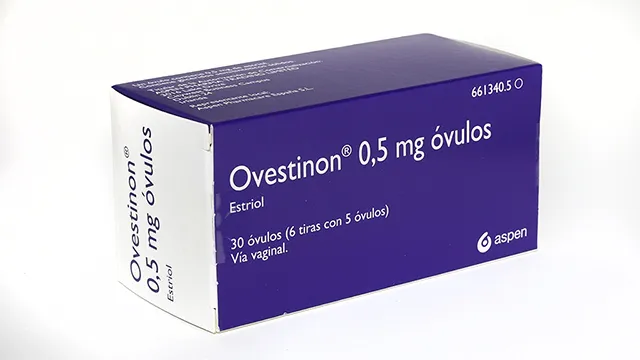
Table of Contents
- Package leaflet: Information for the user
- Introduction
- 1. What Ovestinon 0.5 mg vaginal tablets is and what it is used for
- 2. What you need to know before using Ovestinon 0.5 mg vaginal suppositories
- 3. How to use Ovestinon 0.5 mg pessaries
- 4. Possible adverse effects
- 5. Storage of Ovestinon 0.5 mg pessaries
- 6. Contents of the pack and other information
Package leaflet: Information for the user
Introduction
Package leaflet: information for the user
Ovestinon 0.5 mg pessaries
Estriol
Read the entire leaflet carefully before you start using this medicine, because it contains important information for you.
- Keep this leaflet, as you may need to read it again.
- If you have any questions, ask your doctor, pharmacist or nurse.
- This medicine has been prescribed for you only, and you should not give it to others, even if they have the same symptoms as you, because it may harm them.
- If you experience any adverse reactions, consult your doctor, pharmacist or nurse, even if they are adverse reactions not listed in this leaflet. See section 4.
Contents of the leaflet
- What Ovestinon 0.5 mg pessaries are and what they are used for
- What you need to know before using Ovestinon 0.5 mg pessaries
- How to use Ovestinon 0.5 mg pessaries
- Possible side effects
- How to store Ovestinon 0.5 mg pessaries
- Contents of the pack and other information
1. What Ovestinon 0.5 mg vaginal tablets is and what it is used for
Ovestinon belongs to a group of medicines called hormone replacement therapy (HRT). It contains the female hormone estriol (an estrogen). Ovestinon is used in postmenopausal women who have naturally ceased menstruation at least 12 months ago.
It is used to relieve menopausal symptoms in the vagina, such as dryness or irritation. Medically, this condition is known as "vaginal atrophy". It is caused by a decline in estrogen levels in the body, which occurs naturally after menopause.
If the ovaries are surgically removed (oophorectomy) before menopause, the drop in estrogen production occurs very abruptly.
Estrogen deficiency during menopause may cause the vaginal wall to become thin and dry (vaginal dryness). As a result, sexual intercourse may become painful, and irritation and vaginal infections may occur. Estrogen deficiency may also lead to symptoms such as urinary incontinence and recurrent cystitis.
Ovestinon works by replacing the estrogen that is normally produced by the ovaries. It is inserted into the vagina, so the hormone is released exactly where it is needed. This can help relieve vaginal discomfort.
It may take several days or even weeks before you notice an improvement.
In addition to the uses mentioned above, Ovestinon may also be used:
-
to aid in the healing of wounds in postmenopausal women who have undergone vaginal surgery.
-
to assist in the evaluation of cervical smears (Pap tests) in postmenopausal women.
2. What you need to know before using Ovestinon 0.5 mg vaginal suppositories
Medical history and medical check-ups
The use of hormone replacement therapy (HRT) involves risks that must be considered when deciding whether to start treatment or continue taking it.
Experience with HRT in women with premature menopause (due to ovarian failure or surgical intervention) is limited. If you have premature menopause, consult your doctor, as the risks associated with HRT may differ.
Before starting (or restarting) hormone replacement therapy, your doctor will ask about your personal and family medical history. Your doctor may decide to perform a physical examination, which may include a breast examination and/or an internal pelvic examination, if necessary.
Once you have started taking Ovestinon, you should visit your doctor regularly (at least once a year) for check-ups. During these visits, discuss with your doctor the benefits and risks of continuing Ovestinon.
Have regular mammograms as recommended by your doctor.
Do not use Ovestinon
Do not use Ovestinon if any of the following apply to you or if you have any doubts about them. Consult your doctor before using Ovestinon.
Do not use Ovestinon:
- If you are allergic to estriol or to any of the other ingredients of this medicine (listed in section 6).
- If you have or have had breast cancer or suspect you may have it.
- If you have a cancer sensitive to estrogens, such as cancer of the tissue lining the inside of the uterus (endometrium), or if you suspect you may have it.
- If you have any unexplained vaginal bleeding.
- If you have excessive growth of the tissue lining the inside of the uterus (endometrial hyperplasia) that is not being treated.
- If you have or have had a blood clot in a vein (thrombosis), in the legs (deep vein thrombosis) or in the lungs (pulmonary embolism).
- If you have a blood clotting disorder (such as protein C deficiency, protein S deficiency, or antithrombin deficiency).
- If you have or have recently had a disease caused by blood clots in the arteries, such as heart attack, stroke, or angina pectoris.
- If you have a liver disease and your liver function tests have not returned to normal.
- If you have a rare inherited blood disorder called “porphyria”.
If any of the above conditions develop for the first time while you are taking Ovestinon, stop taking it immediately and consult your doctor without delay.
Warnings and precautions
Consult your doctor before starting to use Ovestinon if you have had any of the following conditions, as they may reappear or worsen during treatment with Ovestinon. If so, you should visit your doctor more frequently for medical check-ups:
- fibroids in the uterus,
- growth of the tissue lining the inside of the uterus outside the uterus (endometriosis) or history of excessive growth of the endometrial tissue (endometrial hyperplasia),
- increased risk of developing blood clots (see “blood clots in a vein (thrombosis)”), increased risk of developing an estrogen-sensitive cancer (e.g., if your mother, sister, or grandmother had breast cancer),
- high blood pressure,
- a liver disorder, such as a benign liver tumor,
- diabetes,
- gallstones,
- migraine or severe headaches,
- an immune system disorder affecting multiple organs (systemic lupus erythematosus, SLE),
- epilepsy,
- asthma,
- a condition affecting the eardrum and hearing (otosclerosis),
- fluid retention due to heart or kidney problems,
- hereditary or acquired angioedema.
Inform your doctor if you have hepatitis C and are taking the combination therapy ombitasvir/paritaprevir/ritonavir, with or without dasabuvir. The combination of these medications with other medicines containing estrogens may cause increases in liver function blood test results (elevations in liver enzymes (ALT)). The risk of this occurring with Ovestinon is currently unknown.
Stop using Ovestinon and contact your doctor immediately
If, while taking hormone replacement therapy, you experience any of the following:
- any of the conditions listed in the section “Do not use Ovestinon”,
- yellowing of the skin or whites of the eyes (jaundice), which may be a sign of liver disease,
- swelling of the face, tongue, or throat and difficulty swallowing or hives accompanied by breathing difficulties, suggesting angioedema,
- a significant increase in blood pressure (symptoms may include headache, fatigue, dizziness),
- new-onset migraine-type headaches,
- if you become pregnant,
- signs of a blood clot, such as:
- painful swelling and redness in the legs,
- sudden chest pain,
- difficulty breathing.
For further information, see “blood clots in a vein (thrombosis)”.
Hormone replacement therapy and cancer
Excessive thickening of the tissue lining the uterus (endometrial hyperplasia) and cancer of the uterine lining
Taking oral HRT containing only estrogens over a long period may increase the risk of developing cancer of the uterine lining (endometrium).
It is unclear whether a similar risk exists with Ovestinon when used repeatedly or long-term (more than one year). However, absorption of Ovestinon into the bloodstream is very low; therefore, adding a progestogen is not necessary.
If you experience bleeding or spotting, it is usually not a cause for concern, but you should schedule an appointment with your doctor. It could be a sign that the endometrium has become thicker.
To avoid endometrial stimulation, do not exceed the maximum daily dose, and do not use this maximum dose for longer than a few weeks.
The following risks apply to systemic hormone replacement therapy (HRT) that circulates in the blood. However, Ovestinon is intended for local vaginal treatment, and its absorption into the bloodstream is very low. It is less likely that the conditions listed below will worsen or reappear during treatment with Ovestinon, but you should consult your doctor if you are concerned.
Breast cancer
Available data indicate that using Ovestinon does not increase the risk of breast cancer in women who have not previously had breast cancer. It is unknown whether Ovestinon can be used safely in women who have had breast cancer in the past.
Examine your breasts regularly. Contact your doctor if you notice any changes such as:
- skin dimpling,
- changes in the nipple,
- any lump you can see or feel.
In addition, you are advised to participate in mammography screening programs when offered.
Ovarian cancer
Ovarian cancer is rare: much rarer than breast cancer. The use of estrogen-only HRT has been associated with a slightly increased risk of ovarian cancer.
The risk of ovarian cancer varies with age. For example, among women aged 50 to 54 years who do not take HRT, approximately 2 out of 2,000 will be diagnosed with ovarian cancer over a 5-year period. For women who have taken HRT for 5 years, there will be about 3 cases per 2,000 users (i.e., about 1 additional case).
Effect of Hormone Replacement Therapy on the heart and circulation
Blood clots in a vein
The risk of blood clots in veins is approximately 1.3 to 3 times higher in women using HRT than in those who do not, especially during the first year of treatment.
Blood clots can be serious, and if one travels to the lungs, it can cause chest pain, shortness of breath, fainting, or even death.
The likelihood of developing a blood clot in a vein increases with age and if you have any of the following conditions. Inform your doctor if any of these apply to you:
- inability to walk for a prolonged period due to major surgery, injury, or illness (see also section 3 “If you need to undergo surgery”),
- significant overweight (BMI > 30 kg/m²),
- a blood clotting disorder requiring long-term treatment with anticoagulant medication,
- a close family member who has had a blood clot in the leg, lung, or another organ,
- systemic lupus erythematosus (SLE),
- cancer.
For signs of a blood clot, see the section “Stop using Ovestinon and contact your doctor immediately”.
Comparison
On average, 4 to 7 out of 1,000 women in their 50s who are not using HRT may develop a blood clot in a vein over a 5-year period. Among women in their 50s who have used estrogen-only HRT for more than 5 years, there will be 5 to 8 cases per 1,000 users (i.e., 1 additional case).
Heart disease (heart attack)
Women taking estrogen-only therapy do not have an increased risk of developing heart disease.
Stroke
The risk of stroke is about 1.5 times higher in women using HRT than in those who do not. The number of additional stroke cases due to HRT use increases with age.
Comparison
On average, 8 out of 1,000 women in their 50s who are not using HRT may have a stroke over a 5-year period. Among women of the same age using HRT for more than 5 years, there will be 11 cases per 1,000 users (i.e., 3 additional cases).
Other warnings
HRT does not prevent memory loss. There is some evidence of an increased risk of memory loss in women who start HRT after the age of 65. Consult your doctor for advice.
Note: Ovestinon is not a contraceptive and should not be used as such. If it has been less than 12 months since your last menstrual period or if you are under 50 years of age, you may still need to use a contraceptive method to avoid pregnancy. Consult your doctor for advice.
Other medicines and Ovestinon
Inform your doctor or pharmacist if you are taking, have recently taken, or might need to take any other medicines, including over-the-counter medicines, herbal remedies, or other natural products.
Some medicines may interfere with the effect of Ovestinon, or Ovestinon may interfere with the effect of other medicines. This could lead to irregular bleeding. This occurs with the following medicines:
- Medicines for epilepsy (such as phenobarbital, phenytoin, and carbamazepine).
- Medicines for tuberculosis (such as rifampicin, rifabutin).
- Medicines for HIV infection (such as nevirapine, efavirenz, ritonavir, and nelfinavir).
- Herbal remedies containing St. John’s wort (Hypericum perforatum).
Inform your doctor if you have hepatitis C and are taking the combination therapy ombitasvir/paritaprevir/ritonavir, with or without dasabuvir. The combination of these medicines with other medicines containing estrogens may cause increases in liver function blood test results (elevations in liver enzymes (ALT)). The risk of this occurring with Ovestinon is currently unknown.
Use of Ovestinon with food and drink
You may eat and drink normally during treatment with Ovestinon.
Pregnancy, breastfeeding, and fertility
If you are pregnant or breastfeeding, think you may be pregnant, or plan to become pregnant, consult your doctor or pharmacist before using this medicine.
Ovestinon is intended only for postmenopausal women. If you become pregnant, stop using Ovestinon and contact your doctor.
If you are breastfeeding, consult your doctor before using Ovestinon, as it is excreted in breast milk.
Driving and using machines
Ovestinon is not expected to affect your ability to drive or operate machinery. However, individual responses to the medicine may vary.
Laboratory tests
If you need to have a blood test, inform your doctor or laboratory staff that you are using Ovestinon, as this medicine may affect the results of certain tests.
Ovestinon contains macrogol stearic acid ether
Macrogol stearic acid ether may cause local skin reactions (e.g., contact dermatitis).
3. How to use Ovestinon 0.5 mg pessaries
Follow exactly the instructions for administration of this medicine as given by your doctor or pharmacist. If in doubt, consult your doctor or pharmacist again.
The recommended dose for vaginal discomfort is one pessary daily for the first few weeks (maximum 4 weeks), after which the dose should be gradually reduced, for example, to one pessary twice a week.
To improve wound healing in postmenopausal women undergoing vaginal surgery, the usual dose is one pessary daily for 2 weeks before surgery; after surgery, one pessary twice a week for 2 weeks.
To assist in the evaluation of vaginal smears in postmenopausal women, the usual dose is one pessary daily every day of the week before the test.
Your doctor may interrupt treatment every 2–3 months for a period of 4 weeks to assess whether continued treatment is necessary.
For other situations, a different dose may be prescribed.
Instructions for correct administration of the preparation
It is advisable to insert the pessary before going to bed. While lying down, insert one pessary into the vagina as deeply as possible. The pessaries are not intended for insertion into the rectum.
The maximum dose (1 pessary daily) should not be used for longer than 2–3 weeks.
Your doctor will aim to prescribe the lowest dose necessary to treat your symptoms for the shortest time required. If you feel that the effect of Ovestinon is too strong or too weak, inform your doctor.
If you use more Ovestinon than you should
In case of overdose or accidental ingestion, contact your doctor or pharmacist immediately or call the Toxicology Information Service at telephone number 91 562 04 20, stating the medicine and the amount ingested.
In the case of accidental ingestion of several pessaries, symptoms that may occur include nausea and vomiting; in women and girls, vaginal bleeding may also occur after a few days.
If you forget to use Ovestinon
Do not use a double dose to make up for forgotten doses.
If you forget to administer a dose, do so as soon as you remember, unless you realize this on the same day you are due to take the next dose. In this case, do not administer the missed dose and simply take the next dose as usual.
If you need to undergo surgery
If you are scheduled for surgery, inform your surgeon that you are using Ovestinon. You may need to stop using Ovestinon 4 to 6 weeks before the operation to reduce the risk of blood clots (see section 2, Blood clots in a vein). Ask your doctor when you can start using Ovestinon again.
If you have any further questions about the use of this medicine, ask your doctor or pharmacist.
4. Possible adverse effects
Like all medicines, this medicine may cause adverse effects, although not everyone experiences them.
Compared to women who do not use hormone replacement therapy, the following conditions have been reported more frequently in women using systemic hormone replacement therapy (which circulates in the bloodstream). These risks are less relevant for treatments administered vaginally, such as Ovestinon:
- ovarian cancer,
- blood clots in the veins of the legs or lungs (venous thromboembolism),
- stroke,
- possible memory loss if hormone replacement therapy is started after the age of 65.
See section 2 for more information about these adverse effects.
Depending on the dose and patient sensitivity, Ovestinon may infrequently cause adverse effects such as:
- breast swelling and breast tenderness,
- slight vaginal bleeding,
- increased vaginal discharge,
- local irritation or pruritus.
Frequency not known (cannot be estimated from available data):
- flu-like symptoms,
- nausea,
- fluid retention in tissues, usually noticeable as swollen ankles or feet,
- discomfort when urinating (dysuria),
- burning sensation in or around the genital area.
In most patients, these adverse effects disappear within the first few weeks of treatment.
The following adverse effects have been reported with other hormone replacement therapies:
-
gallbladder disease,
-
various skin disorders:
-
skin pigmentation, especially on the face or neck, known as "pregnancy mask" (chloasma),
-
painful red nodules on the skin (erythema nodosum),
- skin rash with lesions or red target-shaped papules (erythema multiforme).
Reporting of adverse effects:
If you experience any adverse effect, consult your doctor, pharmacist, or nurse, even if it is a possible adverse effect not listed in this leaflet. You may also report them directly through the Spanish Pharmacovigilance System for Human Medicines: https://www.notificaram.es. By reporting adverse effects, you can help provide more information on the safety of this medicine.
5. Storage of Ovestinon 0.5 mg pessaries
Keep this medicine out of the sight and reach of children.
Do not use this medicine after the expiry date stated on the packaging after “EXP”. The expiry date refers to the last day of the month indicated.
Do not store above 25°C.
Keep in the original packaging to protect from light and moisture.
Medicines must not be disposed of via wastewater or household waste. Return any unused medicines and their packaging to your pharmacy’s SIGRE collection point. If you are in doubt, ask your pharmacist how to properly dispose of unused medicines and their packaging. This will help protect the environment.
6. Contents of the pack and other information
Composition of Ovestinon
The active substance is estriol. Each ovule contains 0.5 mg of estriol.
The other components are solid semisynthetic glycerides.
Appearance of the product and contents of the pack
White, torpedo-shaped vaginal ovules. Ovestinon is available in boxes containing 10 or 30 ovules. Each blister contains 5 ovules.
Only certain pack sizes may be marketed.
Marketing Authorization Holder and Manufacturer
Marketing Authorization Holder
Aspen Pharma Trading Ltd
3016 Lake Drive
Citywest Business Campus
Dublin 24
Ireland
Tel: 0034 952010137
Manufacturer
Unither Industries
Zone Industrielle Le Malcourlet, 17 Avenue Des Portes Occitanes
Gannat, 03800
France
Local Representative
Aspen Pharmacare España S.L.
Avenida Diagonal, 512
Planta Interior 1, Oficina 4
08006 Barcelona, Spain
Date of the most recent revision of this leaflet: February 2026.
Detailed and up-to-date information on this medicinal product is available on the website of the Spanish Agency of Medicines and Medical Devices (AEMPS) http://www.aemps.gob.es/