Otogen Calmante ear drops solution
Spain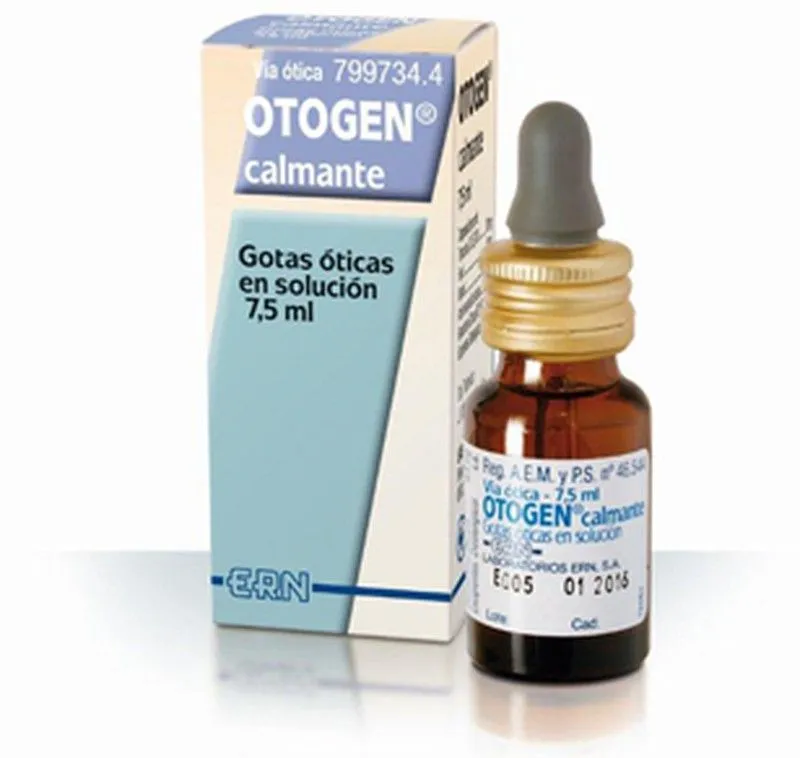
Table of Contents
Patient Information Leaflet
Introduction
Patient Information Leaflet
Otogen analgesic ear drops solution
Tetracaine hydrochloride, phenol, menthol, clove essential oil and benzalkonium chloride
Read the entire leaflet carefully before you start using this medicine, because it contains important information for you.
Follow exactly the instructions for use provided in this leaflet or those given by your doctor, pharmacist, or nurse.
-
Keep this leaflet, as you may need to read it again.
-
If you need advice or more information, consult your pharmacist.
-
If you experience any adverse effects, consult your doctor, pharmacist, or nurse, even if they are adverse effects not listed in this leaflet. See section 4.
-
You should consult a doctor if your condition worsens during treatment or if you do not improve after 5 days.
Leaflet Contents
- What Otogen analgesic is and what it is used for
- What you need to know before using Otogen analgesic
- How to use Otogen analgesic
- Possible side effects
5 Storage of Otogen analgesic
- Package contents and additional information
1. What Otogen analgesic is and what it is used for
This medicine is a combination of substances with analgesic (pain-relieving) and antiseptic (disinfectant) actions, and is used for the symptomatic treatment of pain associated with:
- conditions of the external ear
- conditions of the middle ear, with an intact eardrum.
For use in adults and children over 2 years of age.
2. What you need to know before using Otogen calmante
Do not use Otogen calmante
- If you are allergic to the active substances or to any of the other components of this medicine (listed in section 6).
- If you have known hypersensitivity to other ester-type local anesthetics, to p-aminobenzoic acid or its derivatives.
- If you have a perforated eardrum and suppurative otitis media.
- If you have inflammation of the ear canal with an open skin lesion.
- If you suffer from dermatitis or eczema of the external auditory canal.
Warnings and precautions
Consult your doctor or pharmacist before starting to use this medicine.
Avoid contact with mucous membranes or open wounds.
This medicine must not be ingested or applied to the eyes or nose. It is intended for exclusive use in the middle and external ear. If contact occurs, immediately rinse the eyes or nose thoroughly with abundant water.
If accidentally ingested, local numbness of the tongue and oral cavity may occur. This could lead to difficulty swallowing. In such case, immediately rinse the oral cavity with abundant water and consult a doctor.
Treatment without medical supervision should be limited to 5 days, as there is a risk of undetected progression of the underlying disease.
Diabetic patients, elderly patients, or those with weakened immune systems (immunocompromised) should consult their doctor before using this medicine.
Avoid using this medicine in active viral infections of the external ear, such as otic herpes zoster (Ramsay Hunt syndrome).
It may cause local reactions such as itching, redness, or inflammation. If these symptoms occur, discontinue treatment and consult your doctor.
When administering the medicine, take care to avoid contact between the dropper tip and the ear or fingers, in order to prevent the risk of contamination.
If discharge or exudate containing blood is observed, this may be a sign of eardrum perforation; consult your doctor before applying the medicine.
Children
Use with caution and only under medical recommendation in children aged 2 to 5 years.
Other medicines and Otogen calmante
Inform your doctor or pharmacist if you are taking, have recently taken, or might need to take any other medicines.
Do not use this medicine if you are undergoing treatment with sulfonamides (a type of antibiotic).
Due to incompatibility of some components of the medicine with soaps, it is recommended to wash the application area thoroughly with abundant water before applying the medicine.
Use of Otogen calmante with food, drinks, and alcohol
Not described.
Pregnancy, lactation, and fertility
If you are pregnant or breastfeeding, think you might be pregnant, or are planning to become pregnant, consult your doctor or pharmacist before using this medicine.
There are no data available on the safety of this medicine during pregnancy or breastfeeding.
Use during pregnancy or breastfeeding is not recommended.
Driving and use of machines
No clinical data are available on this topic. However, given the route of administration, it is unlikely that this medicine would affect the ability to drive or operate machinery. Nevertheless, ear occlusion and hearing loss may impair the ability to operate machinery or drive.
3. How to use Otogen calmante
Follow exactly the instructions for use provided in this leaflet or those indicated by your doctor or pharmacist. If in doubt, consult your doctor or pharmacist.
Adults and children over 2 years of age:
The recommended dose is 2 or 3 drops into the ear every 8 or 12 hours. The dose may be reduced as symptoms subside.
Place a cotton ball in the ear after each application and remove it a few minutes later.
Do not exceed the recommended dose.
Use only for the minimum time necessary to relieve acute pain. The recommended duration of treatment is up to 5 days.
This medicine is intended exclusively for administration into the ear (otic use).
Use in children
Use in children under 5 years of age should only be done under medical recommendation and supervision.
Use in children under 2 years of age is not recommended.
Special populations
In diabetic patients, elderly patients, or those with weakened immune systems (immunocompromised), consult your doctor before using this medicine.
If you use more Otogen calmante than you should
There is no available information regarding overdose. In case of accidental ingestion instead of topical application, standard measures should be taken, such as gastric lavage, seeking medical attention at a healthcare facility as soon as possible.
In case of overdose or accidental ingestion, consult your doctor or pharmacist or call the Toxicology Information Service at telephone number 91 562 04 20, indicating the medicine and the amount ingested.
If you forget to use Otogen calmante
Do not take a double dose to make up for missed doses.
If you have any further questions about the use of this medicine, ask your doctor or pharmacist.
4. Possible adverse effects
Like all medicines, this medicine can cause adverse effects, although not everyone will experience them.
The adverse reactions that may occur during treatment include: allergic reactions to any of the active substances in the formulation, irritation in the ear canal, contact dermatitis, urticaria, itching, burning, and redness. It may cause ototoxicity if administered to patients with a perforated eardrum.
Prolonged use may cause skin lesions due to keratolytic action.
Reporting of adverse effects
If you experience any type of adverse effect, consult your doctor or pharmacist, even if it is a possible adverse effect not listed in this leaflet. You may also report them directly through the Pharmacovigilance System for Human Medicinal Products: www.notificaram.es. By reporting adverse effects, you can help provide more information on the safety of this medicine.
5. Storage of Otogen soothing
No special storage conditions required.
Keep this medicine out of the sight and reach of children.
Do not use this medicine after the expiry date which is stated on the packaging after EXP. The expiry date is the last day of the month indicated.
Medicines must not be disposed of via the sewage system or in household waste. Dispose of containers and unused medicines at the SIGRE collection point at your pharmacy. If in doubt, ask your pharmacist how to dispose of containers and medicines you no longer need. This will help protect the environment.
6. Contents of the pack and other information
Composition of Otogen calmante
- The active substances are: tetracaine (hydrochloride), phenol, menthol, clove essential oil and benzalkonium chloride.
- The other component is: diethylene glycol.
Appearance of Otogen calmante and pack contents
Yellowish-tinted oily solution. It is supplied in an amber glass bottle with a metal cap and dropper (glass pipette) for administration.
Each bottle contains 7.5 ml of solution.
Marketing Authorization Holder
Laboratorios ERN, S.A.
C/Perú, 228
08020 Barcelona, Spain
Manufacturer
Laboratorios ERN, S.A.
C/Gorchs Lladó, 188
Pol. Ind. Can Salvatella
08210 Barberá del Vallés (Barcelona), Spain
Date of the most recent review of this leaflet: June 2025.
Detailed information on this medicine is available on the website of the Spanish Agency for Medicines and Health Products (AEMPS) http://www.aemps.gob.es/