Osmohale powder for inhalation (hard capsules)
SpainTable of Contents
Package leaflet: Information for the user
Introduction
Package leaflet: information for the user
Osmohale powder for inhalation (hard capsules)
mannitol
Read the entire leaflet carefully before you start taking this medicine because it contains important information for you.
- Keep this leaflet, as you may need to read it again.
- If you have any questions, ask your doctor or pharmacist.
- This medicine has been prescribed for you only and must not be given to other people, even if they have the same symptoms as you, since it could harm them.
- If you experience any adverse effects, consult your doctor or pharmacist, even if they are adverse effects not listed in this leaflet. See section 4.
Leaflet contents
- What Osmohale is and what it is used for
- What you need to know before taking Osmohale
- How to take Osmohale
- Possible side effects
- How to store Osmohale
- Contents of the pack and other information
1. What Osmohale is and what it is used for
Osmohale is a test to check whether or not you have airway sensitivity.
Osmohale contains the active substance mannitol.
Airway sensitivity may be caused by inflammation of the airways, which sometimes makes breathing difficult. People with airway sensitivity are often highly susceptible to environmental factors such as exercise, dust, smoke, and other irritants.
Your doctor or another appropriately trained healthcare professional will ask you to inhale Osmohale using a small inhaler.
- In people who do have airway sensitivity, the airways will narrow, and they may find it more difficult to breathe.
- People who do not have airway sensitivity will not experience such narrowing of the airways when inhaling Osmohale and will be able to continue breathing normally.
As part of the test, you will be asked to blow into a tube that will measure the effect of Osmohale on your lungs.
This medicine is used solely to determine whether you have airway sensitivity.
2. What you need to know before starting Osmohale
Do not take Osmohale
- if you are allergic (hypersensitive) to mannitol or any of the other ingredients;
- if your lung function is severely reduced (this will be measured before the test);
- if you currently have or have previously had a weakened or bulging blood vessel around the heart or brain (aneurysm);
- if you have hypertension that is not controlled with medication;
- if you have had a myocardial infarction within the last 6 months;
- if you have had a stroke within the last 6 months.
Warnings and precautions
Consult your doctor or pharmacist before starting Osmohale.
- if your lung function is reduced (this will be measured before the test);
- if you have previously experienced difficulty breathing, or have had wheezing or coughing during spirometry (a test in which you blow into a measuring device);
- if you cough up blood;
- if you have air in the pleural space between the chest wall and lungs, causing chest pain and shortness of breath (pneumothorax);
- if you have recently undergone eye, stomach, or chest surgery;
- if you experience chest pain (angina pectoris);
- if you have difficulty performing spirometry (the person conducting the test will inform you);
- if you have had a respiratory tract infection within the last 2 weeks.
If you experience shortness of breath, wheezing and/or coughing during spirometry, you may be given a medication to keep your airways open, and the test will be stopped.
Do not perform vigorous exercise on the day of the test, especially before the test, as it may affect the results.
Do not smoke for at least 6 hours before the test, as it may affect the results.
Do not take Osmohale on your own. Osmohale must only be administered in a properly equipped clinic or laboratory by trained professionals experienced with similar tests and their possible effects, under the supervision of an experienced physician.
Children and adolescents
Osmohale should not be administered, and the test should not be performed, in children under 6 years of age.
Osmohale is not recommended in patients aged 6 to 18 years due to limited information available on the use of the medicine in this population.
Other medicines and Osmohale
Inform your doctor or pharmacist if you are taking, have recently taken, or might need to take any other medicines.
If you are using other medications for the treatment of asthma or allergies, you may need to stop them before the test. These medicines may affect your body's response to Osmohale. Your doctor will advise you which medicine(s) to stop and for how long (generally between 6 hours and 4 days before the test).
Use of Osmohale with food and drinks
On the day of the test, do not drink coffee, tea, or cola beverages, or eat chocolate or other foods containing caffeine.
Pregnancy, breastfeeding, and fertility
Do not undergo the Osmohale test if you are pregnant.
Osmohale may be used during breastfeeding.
If you are pregnant or breastfeeding, think you may be pregnant, or plan to become pregnant, consult your doctor or pharmacist before using this medicine.
Driving and use of machines
No effects have been observed.
3. How to take Osmohale
Follow exactly the instructions for administering this medicine as given by your doctor or pharmacist. If in doubt, consult your doctor or pharmacist again.
Adults
A doctor or other specially trained healthcare professional will administer Osmohale to you using an inhaler and will supervise you throughout the test. You will not be left alone.
Do not put the Osmohale capsules in your mouth or swallow them.
Performing the test
- You will be asked to sit comfortably in a chair.
- Initially, you will be asked to blow forcefully into a tube (spirometry).
- A nose clip will then be placed on your nose so that you can only inhale and exhale through your mouth.
- After exhaling all the air, you will be asked to inhale deeply the Osmohale medication using a special inhaler.
- You will then be instructed to hold your breath for five seconds before exhaling.
- The nose clip will be removed, and you will be asked to breathe normally.
- You will then be asked to blow forcefully into the tube again. This test measures the effect of Osmohale on your lungs.
- Steps 3 to 7 may be repeated up to 9 times, with additional Osmohale depending on its effect on your lungs (as measured in step 7), until the test is complete.
- Once the study is completed, you may be given medication to help you breathe.
If you are unsure about any part of the test, or have any questions about the medicine, speak with the doctor or specially trained healthcare professional conducting the test.
If you take more Osmohale than you should
If you think you may have been given too much of the medicine, inform the doctor or healthcare professional conducting the test immediately. If you have taken too much Osmohale, you may feel unable to breathe, experience wheezing, or coughing. The doctor may give you oxygen or medications to help you breathe.
4. Possible adverse effects
Like all medicines, this medicine can cause adverse effects, although not everyone will experience them.
List of adverse effects
Frequent (may affect up to 1 in 10 people):
- Asthma
- Shortness of breath
- Chest tightness
- Cough
- Nausea
- Headache
- Nasal and throat pain, discomfort when swallowing
- Runny nose
- Vomiting
Uncommon (may affect up to 1 in 100 people):
- Cold extremities
- Diarrhea
- Dizziness
- Feeling of nervousness
- Feeling of thirst
- Feeling of fatigue
- Erythema and sweating
- Hoarseness
- Itching and skin rash
- Itching of the eyes
- Reduction in blood oxygen levels
- Mouth ulcers
- Epistaxis (nosebleed)
- Stomach pain
- Muscle and joint pain
Reporting of adverse effects
If you experience any type of adverse effect, consult your doctor or pharmacist, even if it is a possible adverse effect not listed in this leaflet. You may also report them directly through the national reporting system detailed in
Appendix V. By reporting adverse effects, you can help provide more information on the safety of this medicine.
5. Storage of Osmohale
Keep this medicine out of the sight and reach of children.
Do not use this medicine after the expiry date stated on the packaging after EXP. The expiry date is the last day of the month indicated.
Do not store above 25°C.
Medicines must not be disposed of via wastewater or household waste. Dispose of unused medicines and their containers at the Punto Sigre collection point at your pharmacy. If you are in doubt, ask your pharmacist how to dispose of medicines and containers you no longer need. This will help protect the environment.
6. Contents of the pack and other information
Composition of Osmohale
The active substance is mannitol.
The capsules used for inhalation contain mannitol powder. One capsule contains 0 mg, 5 mg, 10 mg, 20 mg, or 40 mg of mannitol.
Appearance of the product and contents of the pack
The powder is white or almost white.
The empty capsule is transparent with two white printed bands.
The 5 mg capsule is half white and half transparent, with the inscription "5 mg".
The 10 mg capsule is half yellow and half transparent, with the inscription "10 mg".
The 20 mg capsule is half pink and half transparent, with the inscription "20 mg".
The 40 mg capsules are half red and half transparent, with the inscription "40 mg".
The capsules are presented in blisters. A diagnostic kit, packaged in a box, consists of:
- 1 empty capsule
- 1 capsule of 5 mg
- 1 capsule of 10 mg
- 1 capsule of 20 mg
- 15 capsules of 40 mg
- 1 inhaler
Marketing Authorization Holder
Pharmaxis Europe Limited
108 Q House Furze Road,
Sandyford, Dublin 18,
D18AY29, Ireland
Manufacturer
MIAS Pharma Limited
Suite 1 Stafford House
Strand Road, Portmarnock
Co. Dublin, D13 WC83
Ireland
Arvato Supply Chain Solutions SE
Gottlieb-Daimler Straße 1
33428 Harsewinkel
North Rhine-Westphalia
Germany
If you have any questions about this medicine, please contact the local representative of the Marketing Authorization Holder:
Laboratorio Aldo-Unión, S.L.
Baronesa de Maldá, 73
08950 Esplugues de LL.
Barcelona
Spain
Tel: +34 93 372 71 11
Fax: +34 93 371 61 98
This medicine is authorized in the member states of the European Economic Area under the following names:
Aridol: Finland, Germany, Norway, Sweden
Osmohale: Denmark, Ireland, Netherlands, Spain, United Kingdom (Northern Ireland)
Date of the most recent review of this summary: 06/2022
Detailed and up-to-date information on this medicine is available on the website of the Spanish Agency of Medicines and Health Products (AEMPS) http://www.aemps.gob.es/
INFORMATION FOR DOCTORS OR HEALTHCARE PROFESSIONALS
This information is intended solely for doctors or healthcare professionals:
Contraindications
Known hypersensitivity to mannitol or to any of the components of the capsule.
Osmohale must not be administered to patients with severe respiratory limitation (FEV1 predicted < 50% or < 1.0 L), or conditions that may be compromised by the induction of bronchospasm or repeated blowing maneuvers. These include: cerebral or aortic aneurysm, uncontrolled hypertension, myocardial infarction or stroke within the previous six months.
Warnings and special precautions for use
Osmohale must be administered by inhalation only. Inhalation of mannitol causes bronchoconstriction. The Osmohale inhalation test must be performed only in appropriate clinics or laboratories by a doctor or other healthcare professional properly trained in bronchial provocation testing and management of acute bronchospasm, and under the supervision of an experienced physician. The responsible physician, adequately trained in managing acute bronchospasm, including appropriate use of resuscitation equipment, must be close enough to respond rapidly in an emergency. A stethoscope, sphygmomanometer, and pulse oximeter must be available. Once administration of Osmohale has begun, the patient must not be left unsupervised during the procedure.
In the testing area, medications for the treatment of severe bronchospasm must be available. These include subcutaneous injectable adrenaline, and salbutamol or other beta-agonists in metered-dose inhalers. Oxygen must be available. A small-volume nebulizer for bronchodilator administration must be readily accessible.
General precautions for spirometry and bronchial provocation testing must be observed, including additional precautions in patients with the following conditions: respiratory insufficiency (baseline FEV1 below 70% of predicted normal values or an absolute value of 1.5 L or less in adults), bronchoconstriction induced by spirometry, unexplained hemoptysis, pneumothorax, recent abdominal or thoracic surgery, recent intraocular surgery, unstable angina, inability to perform acceptable quality spirometry, or lower or upper respiratory tract infection within the previous 2 weeks.
If the patient experiences spirometry-induced asthma, or if the FEV1 drop exceeds 10% following continuous administration after the 0 mg capsule, a standard dose of bronchodilator should be administered and Osmohale provocation should be discontinued.
Exercise: Vigorous physical exercise must be completely avoided on the day of the test, as it may affect test results.
Smoking: Since smoking may affect test results, patients are advised to abstain from smoking for at least 6 hours prior to the test.
The Osmohale test must not be used in patients under 6 years of age due to their inability to provide reproducible spirometric measurements.
Information on the use of Osmohale in patients aged 6 to 18 years is limited; therefore, the use of Osmohale is not recommended in this population.
The effects of repeated Osmohale testing over a short period have not been investigated; therefore, repeated use of Osmohale should be given special consideration.
Instructions for the inhaler device
These instructions show how to use the inhaler
- Remove the cap: With both hands, hold the inhaler vertically and remove the cap.
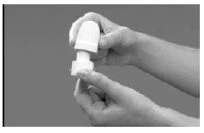
- Open: Firmly hold the base of the inhaler with one hand and open the device by rotating the mouthpiece in the direction of the arrow, as shown in the image.
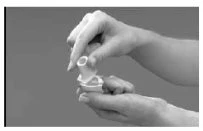
- Load: Ensure your hands are dry; remove one capsule from the inhaler pack and place it into the inhaler as shown in the illustration.
It does not matter which side of the capsule is inserted into the chamber.
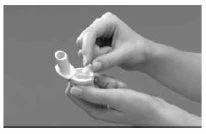
- Close: Keeping the device vertical, rotate the mouthpiece to the closed position until you hear a "click".
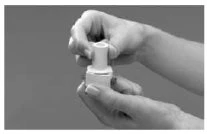
- Perforate the capsule: Keep the inhaler vertical and press down fully on both perforation buttons located on the sides of the device simultaneously.
Do this only once, as perforating the capsule more than once may cause it to break or fragment. Perforation creates openings in the capsule, allowing the powder to be released during inhalation.
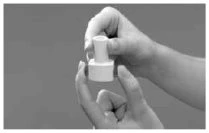
- Prepare for inhalation: Tilt the inhaler so that the mouthpiece is slightly downward at a 45-degree angle, as shown in the following figure, until the capsule falls into the rotating chamber. Keep the device tilted in this position and instruct the patient to exhale fully (away from the inhaler).
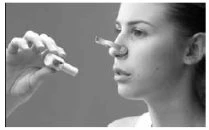
- Inhalation: The patient should tilt the head slightly backward and, holding the inhaler at a 45-degree angle, bring it to the mouth and seal the lips around the mouthpiece. Instruct the patient to inhale rapidly and deeply to fill the lungs. The patient should then hold their breath for five seconds.
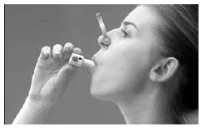
Note: During correct inhalation, a "rattling" sound should be heard as the capsule rotates inside the inhaler.
- Exhalation: Remove the inhaler from the patient's mouth and allow them to exhale and resume normal breathing.
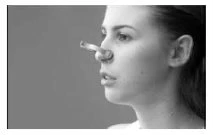
- Verification: For Osmohale capsules to empty properly, the capsule must rotate inside the inhaler. If after inhalation the capsule has not emptied, a second inhalation (with the same capsule) may be required. Check the capsule after each inhalation.
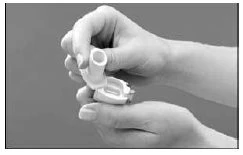
Please note:
The inhaler is designed for SINGLE USE (one device per provocation test) and must not be cleaned during the test procedure.
Discard the inhaler after each Osmohale provocation. The inhaler must not be sterilized or reused, as this could compromise the integrity of subsequent test results.
……………………………………………………………………………………………………..
READ THE FULL PRODUCT CHARACTERISTICS SUMMARY BEFORE PERFORMING THIS PROVOCATION TEST.
For further information, contact:
Marketing Authorization Holder:
Pharmaxis Europe Limited
108 Q House Furze Road,
Sandyford, Dublin 18,
D18AY29, Ireland
Local representative:
Laboratorio Aldo-Unión, S.L.
Baronesa de Maldá, 73
08950 Esplugues de LL.
Barcelona
Spain
Tel: +34 93 372 71 11
Fax: +34 93 371 61 98
……………………………………………………………………………………………………..
{Logo}
Instructions for the Osmohale provocation test
……………………………………………………………………………………………………..
Osmohale provocation test
Inhaler
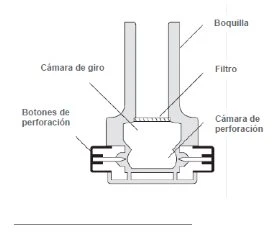
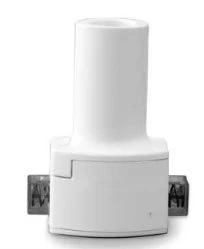
Provocation test results
Positive result in the Osmohale provocation test
A positive response with Osmohale is determined in two ways:
- a ≥ 15% decrease in FEV1 from baseline (using the FEV1 value after administration of the 0 mg capsule as comparator)
- an incremental ≥ 10% decrease in FEV1 (between consecutive Osmohale doses)
Negative result in the Osmohale provocation test
The Osmohale provocation test is considered negative when the patient has received a cumulative dose of 635 mg of Osmohale and their FEV1 has not decreased by ≥ 15% from baseline.
Equipment
Osmohale kit (contains Osmohale capsules, inhaler, and package leaflet with instructions)
Spirometer and mouthpiece
Nose clip
Timer (capable of being set to 60 seconds)
Calculator
Bronchodilator (e.g., salbutamol)
Availability of oxygen and other relevant emergency equipment must be ensured, in accordance with standard protocols for bronchial provocation testing.
Important points to remember
-
The inhaler is for SINGLE USE (one device per provocation test) and must not be cleaned during the test. Discard the inhaler after each Osmohale provocation. The inhaler must not be sterilized or reused, as this could compromise the integrity of subsequent test results.
-
When the patient exhales during the Osmohale provocation test, ensure they do so AWAY from the inhaler to minimize moisture inside the device.
-
When perforating the capsule, do so only once (by fully pressing both buttons simultaneously), as repeated perforation may cause the capsule to break or fragment.
-
Wearing rubber gloves during test administration and handling of Osmohale capsules may increase static electricity and inhibit capsule movement within the inhaler.
-
If you suspect a static problem or notice that the capsule noise is not heard during Osmohale inhalation, firmly tap the base of the inhaler with one hand while holding the inhaler with the other (with the mouthpiece oriented downward at a 45° angle). This will ensure the capsule "dislodges" from the perforation chamber and enters the rotating chamber.
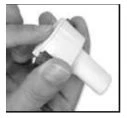
- Inhalation of Osmohale may cause cough and/or throat dryness. These are routine adverse effects of the bronchial provocation test.
You may offer the patient a glass of water after completion of the test.
- In this provocation test, timing is crucial and requires the establishment and maintenance of an osmotic gradient. Prolonged intervals between doses may affect the validity of results and must be avoided.
……………………………………………………………………………………………………..
Guidelines for the procedure
STEP 1: Verify that the patient has discontinued the following medications (See table below).
Recommended withdrawal periods for medications.
Failure to discontinue these medications may affect the results of the Osmohale provocation test.
Recommended withdrawal periods are generally based on the duration of their action.
Withdrawal period | Medication |
6-8 hours | INHALED NON-STERoidal ANTI-INFLAMMATORY AGENTS for example sodium cromoglicate, sodium nedocromil |
8 hours | SHORT-ACTING BETA2 AGONISTS, for example salbutamol, terbutaline |
12 hours | INHALED CORTICOSTEROIDS, for example beclomethasone, budesonide, fluticasone |
12 hours | IPRATROPIUM BROMIDE |
24 hours | INHALED CORTICOSTEROIDS PLUS LONG-ACTING BETA2 AGONISTS for example fluticasone and salmeterol, budesonide and formoterol |
24 hours | LONG-ACTING BETA2 AGONISTS for example salmeterol, formoterol |
24 hours | THEOPHYLLINE |
72 hours | TIOTROPIUM BROMIDE |
72 hours | ANTIHISTAMINES for example cetirizine, fexofenadine, loratadine |
4 days | LEUKOTRIENE RECEPTOR ANTAGONISTS for example montelukast |
Foods: Ingestion of significant amounts of coffee, tea, cola drinks, chocolate, or other foods containing caffeine may reduce bronchial reactivity and should be completely avoided on the day of the test.
Other factors that may affect results: On the day of the test, the patient should not smoke or perform vigorous physical exercise, as these may affect test results.
STEP 2: For the test, the patient should be seated. Explain the procedure, including the requirements for a forced vital capacity (FVC) maneuver and measurement of FEV1, as well as the type of inspiratory flow required for the inhaler. Demonstrate if necessary.
STEP 3: Enter patient data into the spirometer (age, height, race, date of birth, sex, etc.).
STEP 4: Determine pre-challenge FEV1. Ask the patient to perform an FVC maneuver according to ATS/ERS guidelines. Perform three acceptable maneuvers, of which two must be reproducible. Use the highest value as the pre-challenge FEV1. The patient's FEV1 must be ≥ 70% of the predicted value.
Extra caution is required for patients with an FEV1 less than 70% of the predicted value.
STEP 5: Measure baseline FEV1 (0 mg)
-
Remove the 0 mg Osmohale capsule from the blister pack, open the inhaler (by rotating as indicated by the arrow on the device), insert the capsule, and close the device.
-
Perforate the capsule once only by pressing the colored buttons on both sides of the inhaler.
-
Ask the patient to place the nose clip on and breathe through the mouth.
-
Tilt the inhaler at a 45° angle (with the mouthpiece downward). Confirm that the capsule has moved from the perforation chamber into the spinning chamber, closer to the mouthpiece.
This is often audible as the capsule falls forward, or may be visible through the openings on both sides of the device. Hand the inhaler to the patient, ensuring it is maintained at the same angle.
-
Verify that the patient is sitting upright. Instruct the patient to exhale (away from the inhaler), seal the lips around the inhaler mouthpiece, and take a rapid, deep inhalation until the lungs are fully filled. During correct inhalation, a "rattling" sound should be heard as the capsule spins inside the device.
-
At the end of the patient's inhalation, start a 60-second timer and instruct the patient to hold their breath for 5 seconds. After 5 seconds, instruct the patient to exhale through the mouth (away from the inhaler), remove the nose clip, and resume normal breathing.
-
When the 60-second timer sounds, immediately instruct the patient to perform two acceptable FEV1 measurements. These measurements should be within 0.15 L (150 mL) of each other. If variability between readings exceeds 0.15 L, instruct the patient to perform another FEV1 measurement. Record the highest reading as the baseline FEV1 value. If the highest FEV1 value is ≥ 10% lower than the pre-challenge FEV1, do not proceed with the challenge test.
-
Calculate the target FEV1
A positive result in the Osmohale challenge test is defined as a drop in FEV1 of ≥ 15% from baseline. To calculate the target FEV1, multiply the baseline value (the highest reading obtained with the 0 mg dose) by 0.85. Record this value.
STEP 6: 5 mg capsule
-
Insert the 5 mg capsule into the inhaler and perforate it as described in Step 5.
-
Repeat steps 5c–f above.
-
After inhalation, remove the capsule from the inhaler and verify that it has been completely emptied; if not, a second inhalation must be performed immediately.
-
Load the 10 mg capsule in preparation for the next dose.
-
At 60 seconds after inhalation, immediately measure the patient's FEV1 twice (acceptable criteria must be met). Use the higher of these two values to calculate the change in FEV1.
-
Compare the FEV1 value obtained with this dose to the target FEV1. If the FEV1 value is less than or equal to the target value, or if there is an incremental drop of ≥ 10% from the previous dose, the challenge test is positive and complete. If not, proceed immediately to the next dosing step.
STEP 7: 10 mg, 20 mg, and 40 mg capsules
Administer the 10 mg, 20 mg, and 40 mg doses following the same instructions as for the 5 mg dose (Step 6).
STEP 8: 80 mg dose (2 × 40 mg capsules)
-
Insert and perforate the first 40 mg capsule comprising the 80 mg dose.
-
The patient should inhale the dose in the same manner as before, hold their breath for 5 seconds, and then exhale.
-
Remove the first 40 mg capsule from the device and verify that it has been completely emptied; if not, a second inhalation must be performed immediately. Perform this check after administration of each capsule.
-
After inhalation, load the second 40 mg capsule and immediately offer it to the patient after exhalation.
-
Instruct the patient to inhale the second capsule immediately to ensure the osmotic effect of Osmohale is cumulative.
-
Start the timer at the end of inhalation of the second capsule.
-
Instruct the patient to hold their breath for 5 seconds before exhaling.
-
At 60 seconds after inhalation of the second capsule, immediately measure the patient's FEV1 twice (acceptable criteria must be met). Use the higher of these two values to calculate the change in FEV1.
-
Compare the FEV1 value obtained with this dose to the target FEV1. If the FEV1 value is less than or equal to the target, or if there is an incremental drop of ≥ 10%, the challenge test is positive and complete. If not, proceed immediately to the next dosing step.
STEP 9: First 160 mg dose (4 × 40 mg capsules)
-
Insert and perforate the first 40 mg capsule comprising the 160 mg dose.
-
The patient should inhale the dose in the same manner as before, hold their breath for 5 seconds, and then exhale.
-
Remove the capsule from the device and verify that it has been completely emptied; if not, a second inhalation must be performed immediately. Perform this check after administration of each capsule.
-
After inhalation, load the second 40 mg capsule and immediately offer it to the patient after exhalation.
-
The patient should inhale the contents of the second capsule, hold their breath for 5 seconds, and then exhale.
-
After inhalation, load the third 40 mg capsule and immediately offer it to the patient after exhalation.
-
The patient should inhale the contents of the third capsule, hold their breath for 5 seconds, and then exhale.
-
After inhalation, load the fourth 40 mg capsule and immediately offer it to the patient after exhalation.
-
Instruct the patient to inhale the fourth capsule immediately to ensure the osmotic effect of Osmohale is cumulative.
-
Start the timer at the end of inhalation of the fourth capsule.
-
Instruct the patient to hold their breath for 5 seconds before exhaling.
-
At 60 seconds after inhalation of the fourth capsule, immediately measure the patient's FEV1 twice (acceptable criteria must be met). Use the higher of these two values to calculate the change in FEV1.
-
Compare the FEV1 value obtained with this dose to the target FEV1. If the FEV1 value is less than or equal to the target, or if there is an incremental drop of ≥ 10% from the previous dose, the challenge test is positive and complete. If not, proceed immediately to the next dosing step.
STEP 10: Second 160 mg dose (4 × 40 mg capsules)
Administer the second 160 mg dose following the instructions in Step 9 above.
STEP 11: Third 160 mg dose (4 × 40 mg capsules)
Administer the third 160 mg dose following the instructions in Step 9 above.
After completion of this dose, a total of 635 mg will have been administered. If no positive response has been obtained, the challenge test should be considered complete with a negative result.
STEP 12: After completion of the challenge test, administer a bronchodilator to the patient and monitor for 15 minutes to ensure that the FEV1 has returned to within 5% of the pre-test level. (In case of a negative result, administration of a bronchodilator is optional.)