Oroxelam 2.5 mg oromucosal solution
Spain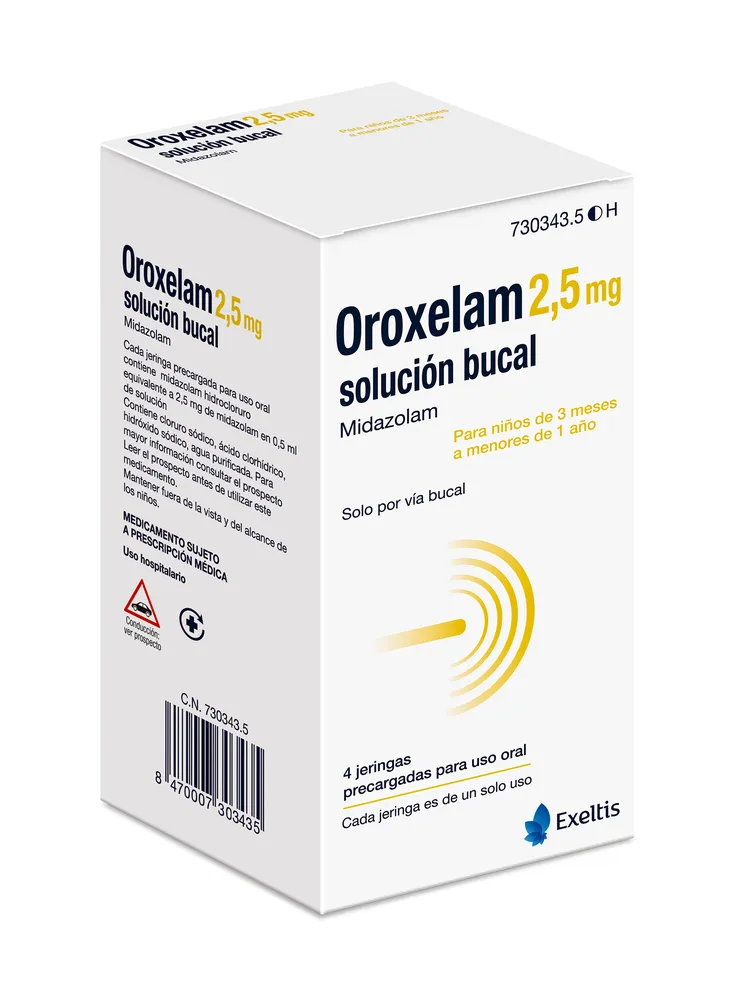
Table of Contents
- Package leaflet: Information for the user
- Introduction
- 1. What Oroxelam is and what it is used for
- 2. What you need to know before using Oroxelam
- 3. How to administer Oroxelam
- 4. Possible adverse effects
- 5. Storage of Oroxelam
- **Disposal of oral syringes**
- 6. Contents of the pack and other information
Package leaflet: Information for the user
Introduction
Package leaflet: information for the user
Oroxelam 2.5 mg oral solution
Oroxelam 5 mg oral solution
Oroxelam 7.5 mg oral solution
Oroxelam 10 mg oral solution
midazolam
Read all of this leaflet carefully before you start using this medicine, because it contains important information for you.
- Keep this leaflet, as you may need to read it again.
- If you have any questions, ask your doctor or pharmacist.
- This medicine has been prescribed for you only, and you should not give it to other people, even if they have the same symptoms as you, because it may harm them.
- If you experience any adverse effects, consult your doctor or pharmacist, even if they are adverse effects not listed in this leaflet. See section 4.
Contents of this leaflet
- What Oroxelam is and what it is used for
- What you need to know before using Oroxelam
- How to use Oroxelam
- Possible adverse effects
- How to store Oroxelam
- Contents of the pack and other information
1. What Oroxelam is and what it is used for
Oroxelam oral solution contains a medicine called midazolam. Midazolam belongs to a group of medicines known as benzodiazepines.
Oroxelam is used to stop sudden, prolonged seizures in infants from 3 months of age through adults.
In infants from 3 months to less than 6 months of age, treatment should be administered only in a hospital setting where the patient can be monitored and resuscitation equipment is available.
This medicine should only be used by parents/caregivers when the patient has been diagnosed with epilepsy.
2. What you need to know before using Oroxelam
- Do not use Oroxelam if the patient has:
- an allergy to midazolam, benzodiazepines (such as diazepam), or any of the other ingredients of this medicine (listed in section 6);
- a nerve and muscle disease causing muscle weakness (myasthenia gravis);
- severe breathing difficulties at rest (Oroxelam may worsen breathing difficulties);
- a condition causing frequent interruptions in breathing during sleep (sleep apnea syndrome);
- severe liver problems.
Warnings and precautions:
Children:
Consult your doctor or pharmacist before starting to use Oroxelam if the patient:
- Has a renal, hepatic or cardiac condition;
- Has a lung condition causing periodic breathing difficulty.
Adults:
Consult your doctor or pharmacist before starting to use Oroxelam if:
- You are over 60 years of age.
- You suffer from a chronic disease (such as respiratory failure, or renal, hepatic or cardiac insufficiency).
- You are debilitated (have an illness that makes you feel very weak, exhausted and without energy).
This medicine may cause individuals to forget events that occurred after administration. Patients should be closely observed after receiving this medicine.
This medicine should be avoided in patients with a history of alcoholism or drug addiction.
Potentially life-threatening events are more likely to occur in patients with respiratory difficulties or cardiac problems, especially when higher doses of Oroxelam are administered.
Children under 3 months: Oroxelam must not be administered to children under 3 months of age due to lack of information in this age group.
Elderly patients:
Elderly patients are more sensitive to the effects of benzodiazepines.
If you have any doubts whether any of the above applies to the patient, consult your
doctor or pharmacist before administering this medicine.
Other medicines and Oroxelam
Inform your doctor or pharmacist if the patient is taking, has recently taken, or might need to take any other medicines. If you have any doubts about any medication the patient is taking that could affect the use of Oroxelam, consult your doctor or pharmacist.
This is extremely important, as using more than one medicine at the same time may enhance or weaken the effects of the medicines taken.
The effects of Oroxelam may be intensified by the following medicines:
- antiepileptics (for treating epilepsy), e.g.: phenytoin
- antibiotics, e.g.: erythromycin, clarithromycin
- antifungals, e.g.: ketoconazole, voriconazole, fluconazole, itraconazole, posaconazole
- medicines for ulcers, e.g.: cimetidine, ranitidine and omeprazole
- medicines used to treat blood pressure, e.g.: diltiazem, verapamil
- some medicines used for HIV and AIDS, e.g.: saquinavir, lopinavir/ritonavir combination
- narcotic analgesics (very strong painkillers), e.g.: fentanyl
- medicines used to reduce blood fat, e.g.: atorvastatin
- medicines used to treat nausea, e.g.: nabilone
- hypnotics (medicines to induce sleep)
- sedative antidepressants (medicines to treat depression that cause drowsiness)
- sedatives (medicines to help relax)
- anesthetics (medicines to relieve pain)
- antihistamines (medicines to treat allergies)
The effects of Oroxelam may be reduced by the following medicines:
- rifampicin (used to treat tuberculosis)
- xanthines (used to treat asthma)
- St. John’s wort (a herbal medicine). This should be avoided in patients taking Oroxelam.
Oroxelam may increase the effect of certain muscle relaxants, e.g.: baclofen (resulting in increased drowsiness). This medicine may also cause some medicines to become less effective, e.g.: levodopa (a medicine used to treat Parkinson’s disease).
Consult your doctor or pharmacist for further information about medicines the patient should avoid while taking Oroxelam.
Use of Oroxelam with food and drink
The patient must not drink alcohol while taking Oroxelam. Alcohol can increase the sedative effects of this medicine and cause excessive drowsiness.
The patient must not drink grapefruit juice while taking Oroxelam. Grapefruit juice can increase the sedative effects of this medicine and cause excessive drowsiness.
Pregnancy
If the patient who is to receive this medication is pregnant or breastfeeding, thinks she might be pregnant, or intends to become pregnant, consult your doctor before using this medication.
Administration of high doses of Oroxelam during the last 3 months of pregnancy may cause abnormal heartbeats in the fetus. Infants born after administration of this medication during labor may also experience difficulty breastfeeding, respiratory difficulties, and poor muscle tone at birth.
Breastfeeding
Inform the doctor if the patient is breastfeeding. Although small amounts of Oroxelam may pass into breast milk, it may not be necessary to interrupt breastfeeding. The doctor will advise whether the patient should breastfeed after receiving a single dose of this medicine.
Driving and use of machines
Oroxelam may cause drowsiness, memory impairment, or affect concentration and coordination. This may interfere with the ability to perform tasks requiring skill, such as driving, riding a bicycle, or operating machinery.
After receiving this medicine, the patient must not drive, ride a bicycle, or operate machinery until fully recovered. Ask your doctor if you need further information.
Oroxelam contains sodium
This medicine contains less than 1 mmol of sodium (23 mg) per oral syringe, i.e., essentially “sodium-free”.
3. How to administer Oroxelam
Follow exactly the administration instructions for this medicine as given by your doctor. If in doubt, consult your doctor or pharmacist again.
Dosage
Your doctor will prescribe the appropriate dose of Oroxelam, which normally depends on the patient's age. Each dose is a different color, shown on the box, tube, and syringe containing the medicine.
Depending on age, the patient will receive one of the following doses, in a container specifically labeled by colors:
Age Range | Dosage | Label Color |
3 months to less than 1 year | 2.5 mg | Yellow |
1 year to less than 5 years | 5 mg | Blue |
5 years to less than 10 years | 7.5 mg | Purple |
10 years to adults | 10 mg | Orange |
An oral syringe contains a single full dose. Do not administer more than one dose.
Infants from 3 months up to but less than 6 months of age should only be treated in a hospital setting where the patient can be monitored and resuscitation equipment is available.
Preparation for administration of this medicine
If the patient has a convulsive seizure, allow their body to move freely; do not attempt to restrain them. Only move them if they are in danger due to proximity to, for example, deep water, fire, or sharp objects.
Support the patient's head on a padded surface such as a cushion or your lap. Check that the medicine contains the correct dose for the patient according to their age.
How to administer this medicine
Ask a doctor, pharmacist, or nurse to show you how to take or administer this medicine. If in doubt, always consult your doctor, pharmacist, or nurse.
Information on how to administer this medicine is also shown on the tube label.
Oroxelam must not be injected. Do not attach any needle to the syringe.
Step 1 | |
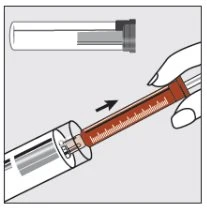
| Hold the plastic tube, break the seal at one end and remove the closure cap. Remove the syringe from the tube. |
Step 2 | |
| Remove the transparent closure cap from the tip of the syringe and dispose of it safely. |
Step 3 | |
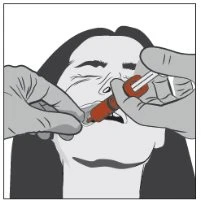
| Using your index finger and thumb, gently pinch and pull back the patient's cheek. Place the tip of the syringe at the back of the space between the inside of the cheek and the lower gum. |
Step 4 | |
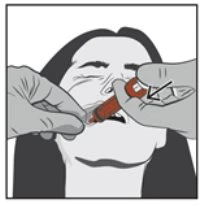
| Slowly press the plunger of the syringe until it stops. The entire solution should be slowly administered into the space between the gum and the cheek (oral cavity). If directed by your doctor (for larger volumes and/or smaller patients), approximately half of the dose may be slowly administered on one side of the mouth, followed by the other half on the opposite side of the patient's mouth. |

When to call an ambulance
ALWAYS follow the treatment recommendations provided by the patient's doctor or as instructed by a healthcare professional. If in doubt, seek urgent medical assistance if:
- The seizure does not stop within 10 minutes.
- You are unable to empty the contents of the syringe or spill some of the medication.
- The patient's breathing slows down or stops (e.g., slow or shallow breathing, or blue lips).
- Signs of myocardial infarction are observed, which may include chest pain or pain radiating to the neck and shoulders and extending to the left arm.
- The patient vomits and the seizure does not stop within 10 minutes.
- You administer too much Oroxelam and observe signs of overdose, including:
- Drowsiness, tiredness, fatigue
- Confusion or disorientation
- Absence of knee reflex or response to pinching
- Breathing difficulties (slow or shallow breathing)
- Low blood pressure (dizziness and feeling faint)
- Coma
Keep the syringe to show it to the ambulance personnel or doctor.
Do not administer more medication than prescribed by the doctor for the patient.
If the patient vomits
- Do not administer another dose of Oroxelam to the patient.
- If the seizure does not subside within 10 minutes, call an ambulance.
If you have any further questions about the use of this medicine, ask your doctor or pharmacist.
4. Possible adverse effects
Like all medicines, this medicine can cause adverse effects, although not everyone will experience them.
Serious adverse reactions
Seek immediate medical attention or call for an ambulance if the patient experiences the following adverse reactions:
- Severe breathing difficulty, e.g.: slow or shallow breathing, or blue lips. In very rare cases, breathing may stop.
- Myocardial infarction. Signs may include chest pain that may spread to the patient's neck and shoulders and extend to the left arm.
- Swelling of the face, lips, tongue, or throat causing difficulty swallowing or breathing, or pale skin, weak and rapid pulse, or feeling faint. The patient may be experiencing a severe allergic reaction.
Other adverse effects
If the patient experiences any type of adverse effect, consult your doctor, pharmacist, or nurse, even if it is a possible adverse effect not listed in this leaflet.
Frequent adverse effects (may affect up to 1 in 10 people):
- Feeling sick and vomiting (nausea and vomiting)
- Drowsiness or reduced level of consciousness
Uncommon adverse effects (may affect up to 1 in 100 people):
- Skin rash, urticaria (hives), itching
Very rare adverse effects (may affect up to 1 in 10,000 people):
- Agitation, restlessness, hostility, anger or aggression, excitement, confusion, euphoria (excessive feeling of happiness or excitement), or hallucinations (seeing and possibly hearing things that are not real)
- Muscle spasms and muscle tremors (uncontrollable shaking of muscles)
- Reduced level of alertness
- Headache
- Dizziness
- Difficulty coordinating muscles
- Seizures (convulsions)
- Transient memory loss. Duration depends on the amount of Oroxelam administered.
- Low blood pressure, slow heart rate, or redness of the face and neck (flushing)
- Laryngospasm (contraction of the vocal cords causing breathing difficulty and noisy breathing)
- Constipation
- Dry mouth
- Fatigue
- Hiccups
Reporting of adverse reactions
If you experience any type of adverse reaction, consult your doctor, pharmacist, or nurse, even if it is a possible adverse reaction not listed in this leaflet. You may also report them directly through the Spanish Pharmacovigilance System for Human Medicinal Products: www.notificaram.es. By reporting adverse reactions, you can help provide more information on the safety of this medicine.
5. Storage of Oroxelam
Keep this medicine out of the sight and reach of children.
Do not use this medicine after the expiry date stated on the packaging and on the labels of the tube and the oral syringe, indicated after EXP. The expiry date refers to the last day of the month shown.
Store below 30 °C.
Keep the oral syringe in the protective plastic tube. Do not use this medicine if the packaging is open or damaged.
Disposal of oral syringes
Medicines must not be disposed of via drains or in household waste. Dispose of containers and unused or expired medicines at the SIGRE Point in your pharmacy. Ask your pharmacist how to properly dispose of containers and medicines you no longer need. This will help protect the environment.
6. Contents of the pack and other information
Composition of Oroxelam
The active substance is midazolam.
- Oroxelam 2.5 mg – Each oral single-dose pre-filled syringe contains midazolam hydrochloride equivalent to 2.5 mg of midazolam in 0.5 ml of solution.
- Oroxelam 5 mg – Each oral single-dose pre-filled syringe contains midazolam hydrochloride equivalent to 5 mg of midazolam in 1 ml of solution.
- Oroxelam 7.5 mg – Each oral single-dose pre-filled syringe contains midazolam hydrochloride equivalent to 7.5 mg of midazolam in 1.5 ml of solution.
- Oroxelam 10 mg – Each oral single-dose pre-filled syringe contains midazolam hydrochloride equivalent to 10 mg of midazolam in 2 ml of solution.
The other components are sodium chloride, purified water, hydrochloric acid, and sodium hydroxide (to adjust pH).
Appearance of the product and contents of the pack
Oroxelam 2.5 mg – Pack with yellow label
Oroxelam 5 mg – Pack with blue label
Oroxelam 7.5 mg – Pack with purple label
Oroxelam 10 mg – Pack with orange label
Oroxelam oral solution is a clear, colourless liquid.
It is supplied in an amber-coloured, needle-free, oral single-dose pre-filled syringe with plunger and cap. Each oral syringe is individually packaged in a plastic protective tube.
Oroxelam is available in cartons containing 2 or 4 oral single-dose pre-filled syringes (of the same strength).
Only certain pack sizes may be marketed.
Marketing Authorization Holder and Manufacturer
Marketing Authorization Holder
Exeltis Healthcare, S.L.
Avenida de Miralcampo, 7
Polígono Industrial Miralcampo
19200 Azuqueca de Henares
Guadalajara
Spain
Manufacturer
Laboratorios Liconsa S.A.
Av. de Miralcampo, 7
19200 Azuqueca de Henares
Guadalajara.
Spain.
This medicinal product is authorized in the European Economic Area member states under the following names:
SE: Midazolam medical valley 2.5 mg, 5 mg, 7.5 mg, 10 mg munhålelösning.
FI: Midazolam medical valley 2.5 mg, 5 mg, 7.5 mg, 10 mg liuos suuonteloon.
DE: Midazaxiro 2.5 mg, 5 mg, 7.5 mg, 10 mg Lösung zur Anwendung in der Mundhöhle.
NO: Midazolam medical valley 2.5 mg, 5 mg, 7.5 mg, 10 mg munnvæske, oppløsning.
NL: Midazolam xiromed 2.5 mg, 5 mg, 7.5 mg, 10 mg oplossing voor oromucosaal gebruik.
DK: Midazolam medical valley 2.5 mg, 5 mg, 7.5 mg, 10 mg mundhulevæske, opløsning.
IS: Midazolam medical valley 2.5 mg, 5 mg, 7.5 mg, 10 mg munnholslaust.
FR: Midazolam Liconsa 2.5 mg, 5 mg, 7.5 mg, 10 mg solution buccale.
IE: Midazolam Liconsa 2.5 mg, 5 mg, 7.5 mg, 10 mg oromucosal solution.
RO: Midazolam Desitin 2.5 mg, 5 mg, 7.5 mg, 10 mg soluție bucofaringiană.
ES: Oroxelam 2,5 mg, 5 mg, 7,5 mg, 10 mg solución bucal.
PL: Soloxelam.
IT: Oroxelam.
Date of the most recent review of this leaflet: March 2025
Detailed information on this medicinal product is available on the website of the Spanish Agency for Medicines and Health Products (AEMPS): http://www.aemps.gob.es