Oracea 40 mg modified-release hard capsules
Spain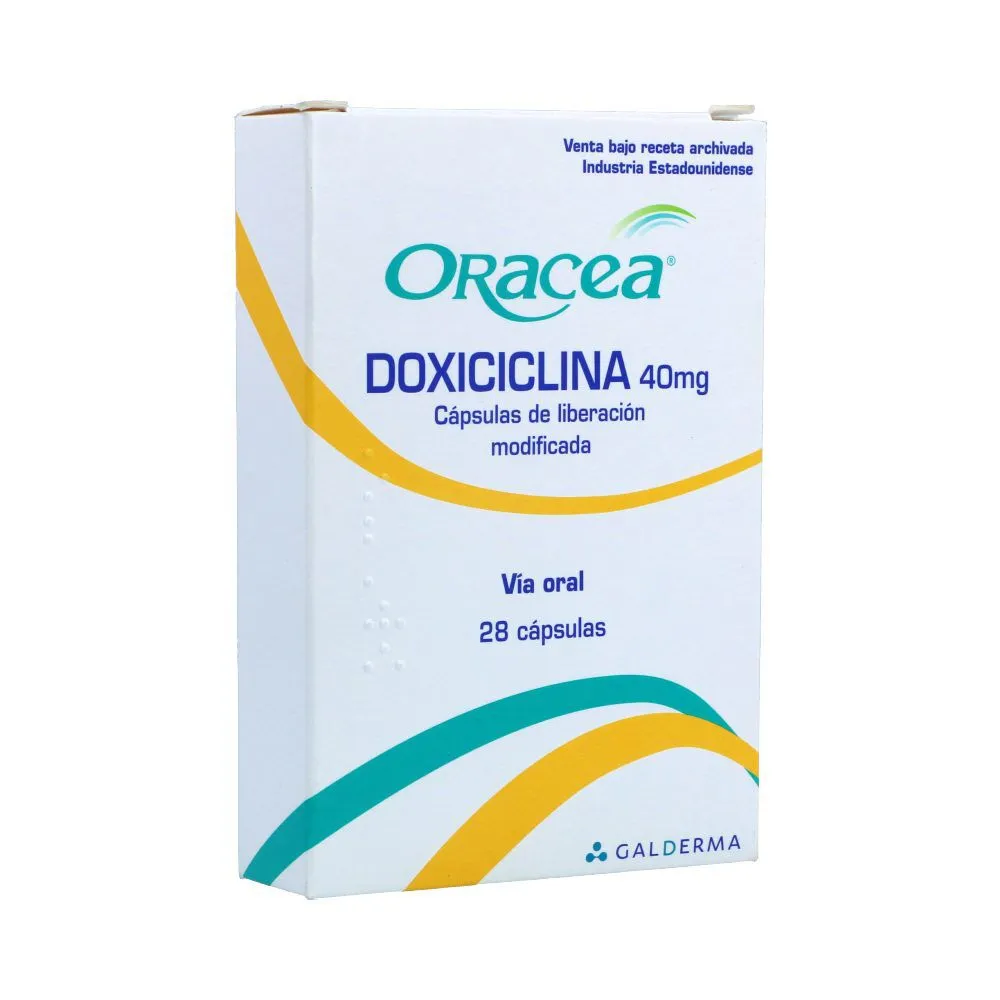
Table of Contents
Patient Information Leaflet
Introduction
Patient Information Leaflet
ORACEA 40mg modified-release hard capsules
Doxycycline
Read the entire leaflet carefully before you start taking this medicine, because it contains important information for you.
- Keep this leaflet as you may need to read it again.
- If you have any questions, ask your doctor or pharmacist.
- This medicine has been prescribed for you only, and you should not give it to others, even if they have the same symptoms as you, because it may harm them.
- If you experience any adverse effects, consult your doctor or pharmacist, even if they are effects not listed in this leaflet. See section 4.
Contents of the leaflet:
- What Oracea is and what it is used for
- What you need to know before taking Oracea
- How to take Oracea
- Possible side effects
- How to store Oracea
- Contents of the pack and other information
1. What Oracea is and what it is used for
Oracea is a medicine that contains doxycycline as its active substance. It is used in adults to reduce pimples and red bumps on the face caused by a condition called rosacea.
2. What you need to know before starting Oracea
Do not take Oracea
- if you are allergic (hypersensitive) to any medicine in the tetracycline group, including doxycycline or minocycline, or to any of the other ingredients of this medicine (listed in section 6)
- if you are pregnant, you must not use Oracea from the 4th month of pregnancy, as it may harm the fetus. If you suspect or find out you are pregnant while taking Oracea, contact your doctor immediately.
- in combination with retinoids (medicines used in the treatment of certain skin conditions such as severe acne) taken orally (see section "Use with other medicines").
- if you have a condition causing lack of stomach acid (achlorhydria) or if you have had surgery on the upper part of the intestine (called the duodenum).
Oracea must not be given to infants or children under 12 years of age, as it may cause permanent changes in tooth color or problems in tooth development.
Warnings and precautions
Oracea must not be used to treat infections caused by bacteria.
Consult your doctor or pharmacist before starting Oracea if:
- you have liver disease
- you have a history of or are currently prone to candidiasis, or have an oral or vaginal fungal or yeast infection
- you have a muscle disorder called myasthenia gravis
- you suffer from colitis
- you have irritation or ulceration of the esophagus
- you have a type of rosacea that affects the eyes
- you expose your skin to intense sunlight or artificial sunlight, as some people taking doxycycline may experience more severe sunburns. You should use sunscreen cream or sunblock to reduce the risk of burns and should stop Oracea treatment if your skin starts to burn.
- your doctor has told you that you have an intolerance to certain sugars
Oracea may cause permanent tooth discoloration.
During treatment with Oracea, consult your doctor or pharmacist if:
- you develop severe or prolonged diarrhea, or diarrhea with blood, during or after taking Oracea—contact your doctor immediately, as treatment may need to be stopped. This could be a sign of intestinal inflammation (pseudomembranous colitis), which may occur after antibiotic treatment.
Take Oracea exactly as prescribed by your doctor. Taking more than the prescribed dose may increase the likelihood that an intestinal bacterium becomes resistant to Oracea.
Taking Oracea with other medicines
Inform your doctor or pharmacist if you are taking, have recently taken, or might need to take any other medicines.
Oracea and certain medicines may not work properly if taken at the same time. Inform your doctor about all medicines you are taking or plan to take during Oracea treatment.
- Oracea must not be used at the same time as isotretinoin due to the risk of increased pressure in the brain. Isotretinoin is prescribed for patients with severe acne.
- Do not take antacids, multivitamins, or other products containing calcium (such as milk and dairy products, or fruit juices containing calcium), aluminum, magnesium (including quinapril tablets, used for high blood pressure), iron, bismuth, or colestyramine, activated charcoal, or sucralfate until 2 to 3 hours after taking Oracea. These medicines may reduce the effectiveness of Oracea if taken simultaneously.
- Other treatments for ulcers or acid reflux may also reduce the effectiveness of Oracea and should not be taken until at least 2 hours after taking Oracea.
- If you are taking anticoagulants, your doctor may need to adjust their dose.
- If you are taking certain diabetes treatments, your doctor may need to consider whether to adjust your diabetes medication.
- Oracea may make some antibiotics, including penicillins, less effective.
- The use of barbiturates (sleeping pills or fast-acting analgesics), rifampicin (for tuberculosis), carbamazepine (for epilepsy), diphenylhydantoin and phenytoin (for seizures), primidone (anticonvulsants), or cyclosporine (for organ transplant) may reduce the time Oracea remains active in your body.
- The use of Oracea with the general anesthetic methoxyflurane may cause serious kidney damage.
Taking Oracea with food and drink
Take Oracea with a sufficient amount of water to help you swallow the capsule properly, as this reduces the risk of irritation or ulceration in the throat or esophagus.
Do not take milk or dairy products at the same time as Oracea, as these products contain calcium, which may reduce the effectiveness of Oracea. Wait 2 to 3 hours after taking your daily dose of Oracea before consuming dairy products.
Pregnancy, breastfeeding, and fertility
Oracea must not be used during pregnancy, as it may cause permanent changes in tooth color in the fetus.
Oracea must not be used for prolonged periods by breastfeeding mothers, as it may cause tooth discoloration and reduced bone growth in the nursing infant.
If you are pregnant or breastfeeding, think you might be pregnant, or plan to become pregnant, consult your doctor or pharmacist before using this medicine.
Driving and using machines
Oracea has no effect, or an insignificant effect, on the ability to drive and use machines.
Important information about some of the ingredients of Oracea
Oracea contains sucrose. If your doctor has informed you that you have an intolerance to certain sugars, consult with him before taking this medicine.
The ink used to print on the capsule contains Red Allura AC aluminum lake (E129), which may cause allergic reactions. It may cause asthma, especially in patients allergic to acetylsalicylic acid.
3. How to take Oracea
Follow exactly the instructions given by your doctor for taking this medicine. If in doubt, consult your doctor or pharmacist again.
The recommended dose is one Oracea capsule daily in the morning, on an empty stomach, preferably at least one hour before or two hours after food. Swallow the capsule whole and do not chew it.
Take the Oracea capsule with a full glass of water, while sitting or standing, to avoid irritation of the throat.
If you take more Oracea than you should
If you take an overdose of Oracea, there is a risk of damage to the liver, kidneys, or pancreas.
If you take more Oracea capsules than you should, consult your doctor immediately.
In case of overdose or accidental ingestion, contact your doctor or pharmacist immediately or call the Toxicology Information Service at telephone number 91 562 04 20, indicating the medicine and the amount taken.
If you forget to take Oracea
Do not take a double dose to make up for missed doses.
If you stop taking Oracea
You should continue taking Oracea until your doctor tells you to stop.
If you have any further questions about the use of this medicine, ask your doctor or pharmacist.
4. Possible adverse effects
Like all medicines, this medicine can cause adverse effects, although not everyone experiences them.
If any of the side effects listed below occur, contact your doctor as soon as possible:
- Jarisch-Herxheimer reaction causing fever, chills, headache, muscle pain, and skin rash, which is usually self-limiting. This occurs shortly after starting doxycycline treatment for spirochetal infections such as Lyme disease.
Frequent adverse effects
The following adverse effects may occur frequently (affecting 1 to 10 out of every 100 patients) during treatment with Oracea:
- Inflammation of the nose and throat
- Sinusitis (inflammation of the facial sinuses)
- Fungal infection
- Anxiety
- Headache caused by sinusitis
- Hypertension or increased blood pressure
- Diarrhea
- Pain in the upper part of the abdomen
- Dry mouth
- Back pain
- Pain
- Changes in certain blood test parameters (blood glucose levels or liver function tests).
Adverse effects of unknown frequency (cannot be estimated from the available data). The following adverse effects may occur during treatment with Oracea:
- Increased pressure in the brain
- Headache
Rare adverse effects
The following adverse effects may occur rarely (affecting 1 to 10 out of every 10,000 patients) during treatment with the class of medicines to which Oracea belongs (the tetracyclines):
- Allergic reactions (hypersensitivity) anywhere in the body*
- Changes in the number or type of certain blood cells
- Increased pressure in the brain
- Inflammation of the membrane surrounding the heart
- Nausea, vomiting, diarrhea, anorexia
- Liver damage
- Skin rash or hives
- Abnormal skin reaction to sunlight
- Increased blood urea levels
Very rare adverse effects
The following adverse effects may occur very rarely (affecting fewer than 1 in 10,000 patients) during treatment with the class of medicines to which Oracea belongs (the tetracyclines):
- Allergic reactions causing swelling of the eyes, lips, or tongue*
- Yeast infections around the anus or genitals
- Abnormalities in red blood cells (hemolytic anemia)
- Following long-term administration, tetracyclines have been reported to cause microscopic brown-black discoloration of the thyroid gland. Thyroid function remains normal.
- Inflammation of the tongue
- Difficulty swallowing
- Inflammation of the intestine
- Inflammation or ulceration of the throat
- Skin inflammation causing peeling
- Worsening of the immune system known as systemic lupus erythematosus (SLE)
Adverse effects of unknown frequency (cannot be estimated from the available data).
The following adverse effects may occur during treatment with the class of medicines to which Oracea belongs (the tetracyclines):
-
Separation of the nail from the nail bed after sun exposure
-
Inform your doctor immediately or seek medical help if you experience adverse effects such as swelling of the face, lips, tongue, or throat, difficulty breathing, hives, skin or eye irritation, rapid heartbeat (palpitations), or feeling faint. These effects may be symptoms of serious allergic reactions (hypersensitivity).
Reporting of adverse effects
If you experience any type of adverse effect, consult your doctor or pharmacist, even if they are possible side effects not listed in this leaflet. You can also report them directly via the Spanish Pharmacovigilance System for Human Medicines: https://www.notificaRAM.es. By reporting adverse effects, you can help provide more information on the safety of this medicine.
5. Storage of Oracea
Keep this medicine out of the sight and reach of children.
Do not use this medicine after the expiry date which is stated on the packaging after EXP:. The expiry date refers to the last day of the month indicated.
Store in the original packaging to protect from light.
Medicines should not be disposed of via wastewater or household waste. Return any unused medicines and their containers to the SIGRE Point at your pharmacy. If you are unsure, ask your pharmacist how to dispose of medicines and containers you no longer need. This will help protect the environment.
6. Contents of the pack and other information
Composition of Oracea
The active substance is doxycycline. Each capsule contains 40 mg of doxycycline (as monohydrate).
The other components are:
Hypromellose (E464), methacrylic acid-ethyl acrylate copolymer (1:1), triethyl citrate, talc (E553b), titanium dioxide (E171), macrogol 400, yellow iron oxide (E172), red iron oxide (E172), polysorbate 80 (E433), sugar spheres (corn starch, sucrose).
Capsule shells: gelatin, black iron oxide (E172), red iron oxide (E172), yellow iron oxide (E172), titanium dioxide (E171).
Printing ink: shellac, propylene glycol (E1520), black iron oxide (E172), carmine aluminium lake, Allura Red AC aluminium lake (E129), brilliant blue FCF aluminium lake, D & C Yellow No. 10 aluminium lake.
See end of section 2 for information on sugar (sucrose) and Allura Red AC (E129).
Appearance of the product and contents of the pack
Oracea is presented as modified-release hard capsules.
The capsules are beige in colour and marked with the inscription “GLD 40”.
Oracea is available in packs containing 56, 28 or 14 capsules.
Only certain pack sizes may be marketed.
Marketing Authorisation Holder and Manufacturer
Marketing Authorisation Holder:
Laboratorios Galderma, S.A.
Serrano Galvache, 56
28033 Madrid
Spain
Manufacturers:
LABORATOIRES GALDERMA
Zone Industrielle - Montdesir (Alby Sur Cheran) - F-74540 – France
CATALENT UK SWINDON ZYDIS LTD.
Frankland Road, Blagrove, Swindon (Wiltshire) - SN5 8RU - United Kingdom
GALDERMA LABORATORIUM GMBH
Toulouser Allee 23a
40211 Düsseldorf
Germany
PATHEON FRANCE
40 Boulevard de Champaret
38300 Bourgoin Jallieu
France
This medicinal product is authorised in the European Economic Area member states under the following names:
Denmark, Greece, Finland, Iceland, Norway, Sweden: Oracea 40 mg modified release hard capsules
Austria, Germany: ORAYCEA 40 mg modified release hard capsules
Belgium, France, Ireland, Italy, Netherlands, Poland, Portugal, England, Luxembourg: EFRACEA 40 mg modified release hard capsules
Spain: Oracea 40 mg cápsulas duras de liberación modificada
This leaflet was approved in June 2019
Detailed and up-to-date information on this medicinal product is available on the website of the Spanish Agency of Medicines and Health Products (AEMPS) http://www.aemps.es