Optispring 0.5 mg/ml eye drops solution
Spain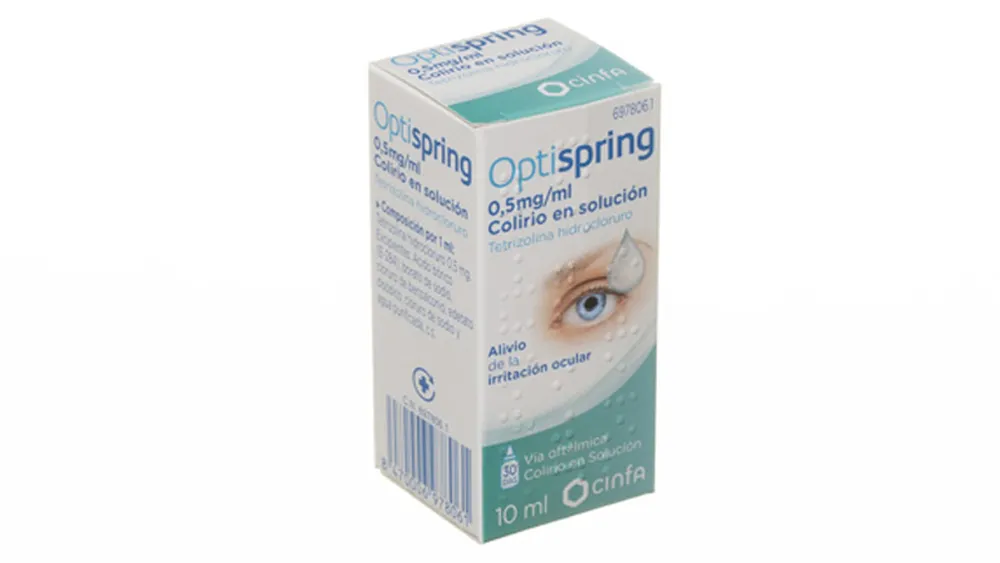
Table of Contents
Package leaflet: Information for the user
Introduction
Package leaflet: information for the user
Optispring 0.5 mg/ml eye drops, solution
Tetrizoline Hydrochloride
Read all of this leaflet carefully before you start using this medicine, because it contains important information for you.
Follow exactly the instructions for use provided in this leaflet or those given by your doctor or pharmacist.
- Keep this leaflet, as you may need to read it again.
- If you need advice or more information, consult your pharmacist.
- If you experience any adverse effects, consult your doctor or pharmacist, even if these are effects not listed in this leaflet. See section 4.
- You should consult a doctor if your condition worsens or if you do not improve after 2 days of treatment.
Contents of the leaflet
- What Optispring is and what it is used for
- What you need to know before using Optispring
- How to use Optispring
- Possible adverse effects
- How to store Optispring
- Contents of the pack and other information
1. What Optispring is and what it is used for
This medicine belongs to a group of decongestant medicines called sympathomimetics. It is an ophthalmic decongestant medicine containing tetrizoline as the active substance. When administered by the ophthalmic route, tetrizoline produces local constriction of blood vessels, thereby reducing ocular congestion.
It is indicated for the temporary relief of mild eye irritation in adults and children over 6 years of age. You should consult a doctor if symptoms worsen or do not improve after 2 days of treatment.
2. What you need to know before using Optispring
Do not use Optispring
- If you are allergic to tetrahydrozoline or to any of the other ingredients of this medicine (listed in section 6).
- If you have increased intraocular pressure (narrow-angle glaucoma).
- If you have heart disease or high blood pressure (hypertension).
- If you have a tumour of the adrenal glands (pheochromocytoma).
- If you have an overactive thyroid gland (hyperthyroidism).
- If you have diabetes controlled with insulin.
- If you are being treated with antidepressants of the monoamine oxidase inhibitor class or other medicines that increase blood pressure.
- If you have dry rhinitis.
- If you have inflammation of the cornea and conjunctiva (keratoconjunctivitis).
- In children under 2 years of age.
Warnings and precautions
Consult your doctor or pharmacist before using Optispring.
- If you experience eye pain, headache, changes in vision, sudden appearance of floating spots, persistent redness or irritation of the eye, pain after exposure to light, or double vision. If any of these occur, or if symptoms worsen, persist, or new symptoms appear, stop using the medicine and consult your doctor.
- If you are over 65 years of age.
When this product is used, the pupils may temporarily dilate.
If you wear contact lenses, they must be removed before administering the medicine (see warnings regarding excipients).
Excessive or prolonged use of this product may lead to increased eye redness.
To avoid contamination of the product, do not let the tip of the container touch any surface. Replace the cap after use. Do not use the product if the solution changes colour or becomes cloudy.
Children and adolescents
Do not use in children under 2 years of age.
Other medicines and Optispring
Inform your doctor or pharmacist if you are taking, have recently taken, or might need to take any other medicines.
Optispring must not be used if you are being treated with:
- Antidepressant monoamine oxidase inhibitor medicines, or
- Medicines that increase blood pressure.
And particularly, if you are taking the following medicine, as it may be necessary to adjust the dose of one or both medicines:
- Tricyclic antidepressant medicines.
Before administering any other eye medication, wait at least 5 minutes between applications.
Pregnancy, breastfeeding and fertility
If you are pregnant or breastfeeding, think you may be pregnant, or are planning to become pregnant, consult your doctor or pharmacist before using this medicine.
Driving and using machines
This medicine has minor or no influence on the ability to drive and use machines. In rare cases, the ability to drive and use machines may be impaired due to blurred vision or glare.
Optispring contains benzalkonium chloride.
This medicine contains 0.2 mg of benzalkonium chloride per ml.
Benzalkonium chloride may be absorbed by soft contact lenses, altering their colour. Remove contact lenses before using this medicine and wait 15 minutes before reinserting them.
Benzalkonium chloride may cause eye irritation, especially if you have dry eye or other corneal diseases (the transparent layer at the front of the eye). Consult your doctor if you experience a foreign body sensation, stinging, or pain in the eye after using this medicine.
Optispring contains sodium.
This medicine contains less than 23 mg of sodium (1 mmol) per ml; therefore, it is essentially "sodium-free".
3. How to use Optispring
Follow exactly the instructions for administering this medicine as described in this leaflet or as directed by your doctor or pharmacist. If in doubt, consult your doctor or pharmacist.
Recommended dose:
Adults and children over 6 years of age
Apply 1 or 2 drops into each eye 2 or 3 times a day as needed, up to a maximum of 4 times daily.
Children aged 2 to 6 years
Use only under strict medical supervision.
How to use
This medicine is administered by ophthalmic route.
Before application, wash your hands and dry your eyes.
Unscrew the cap by breaking the security ring. Tilt your head backwards. Using your index finger, pull down the lower eyelid to separate it from the eyeball. Instill the prescribed number of drops into the eye by gently pressing the container. After application, it is advisable to blink gently for a few seconds to help evenly distribute the drops.
Do not rinse or clean the dropper tip, as it must not come into contact with anything, not even the eye. To avoid contamination, immediately close the container with its cap after use and keep it in an upright position when not in use.
Each container must be used by only one person.
Use this medicine only for minor eye irritations.
It should be used only until symptoms disappear and never for longer than one week.
If symptoms worsen or do not improve after 2 days of treatment, discontinue treatment and consult your doctor.
Use in children
Do not use in children under 2 years of age. It is contraindicated.
Elderly patients (over 65 years of age)
Consult your doctor or pharmacist before using this medicine.
If you use more Optispring than you should
Excessive use or oral ingestion may lead to cardiovascular instability, central nervous system depression including drowsiness and coma, and respiratory depression including apnea.
There is a particular risk in neonates and children due to product absorption, for example from ingestion.
Symptoms associated with overdose include pupil dilation of the eye, bluish discoloration of the skin and mucous membranes, vomiting, sedation, drowsiness, stupor, drooling, nausea, fever, cramps, heart rhythm disturbances, cardiac arrest, increased blood pressure, pulmonary edema, and respiratory and mental disturbances.
In case of overdose or accidental ingestion, contact your doctor or pharmacist immediately or call the Toxicology Information Service at telephone number 91 562 04 20, indicating the medicine and the amount ingested.
If you forget to use Optispring
Do not use a double dose to make up for missed doses.
If you have any further questions about the use of this medicine, ask your doctor or pharmacist.
4. Possible adverse effects
Like all medicines, this medicine can cause adverse effects, although not everyone will experience them.
Frequent (may affect up to 1 in 10 patients): Eye irritation (pain, stinging, burning), visual disturbances.
Uncommon (may affect up to 1 in 100 people): Burning sensation in the ocular mucosa, dry eye, rebound redness (hyperemia), palpitations, headache, tremor, weakness, sweating, and increased blood pressure.
Rare (may affect up to 1 in 1,000 patients): Blurred vision, irritation of the ocular conjunctiva, and pupil dilation (mydriasis).
Very rare (may affect up to 1 in 10,000 people): Reactions at the application site (including ocular or periocular burning, erythema, irritation, edema, pain, and itching).
Frequency not known (cannot be estimated from available data): Increased lacrimation. Prolonged and frequent use may lead to dry eye syndrome.
Reporting of adverse effects
If you experience any type of adverse effect, consult your doctor or pharmacist, even if it is a possible adverse effect not listed in this leaflet. You may also report them directly via the Spanish Pharmacovigilance System for Human Medicines: https://www.notificaram.es. By reporting adverse effects, you can help provide more information on the safety of this medicine.
5. Storage of Optispring
Keep this medicine out of the sight and reach of children.
Do not use this medicine after the expiry date stated on the packaging after EXP. The expiry date refers to the last day of the month indicated.
Do not store above 30°C.
Discard the product 30 days after unsealing and opening the container.
Medicines must not be disposed of via wastewater or household waste. Return unused medicines and their packaging to the SIGRE collection point at your pharmacy. If you are unsure, please ask your pharmacist how to properly dispose of unused medicines and their packaging. This will help protect the environment.
6. Contents of the pack and other information
Composition of Optispring
- The active substance is tetrizoline hydrochloride. Each ml of eye drops contains 0.5 mg of tetrizoline hydrochloride.
- The other components (excipients) are: boric acid (E-284), sodium borate, sodium chloride, disodium edetate, benzalkonium chloride, and purified water.
Appearance of the product and contents of the container
Optispring 0.5 mg/ml eye drops solution is a clear eye drop solution supplied in low-density polyethylene bottles with a white high-density polyethylene cap, containing 10 ml of eye drop solution.
Marketing Authorization Holder and Manufacturer
Marketing Authorization Holder
Laboratorios Cinfa, S.A.
Carretera Olaz-Chipi, 10. Polígono Industrial Areta
31620 Huarte (Navarre) - Spain
Manufacturer
FARMIGEA S.p.A.
Via G.B. Oliva, 8
56121 Pisa, ITALY
Date of the most recent revision of this leaflet: May 2021
Detailed and up-to-date information on this medicinal product is available on the website of the Spanish Agency of Medicines and Medical Devices (AEMPS) http://www.aemps.gob.es/
You can access detailed and up-to-date information about this medicine by scanning with your mobile phone (smartphone) the QR code included in the package leaflet and outer packaging. You may also access this information at the following internet address: https://cima.aemps.es/cima/dochtml/p/77461/P_77461.html
QR code to: https://cima.aemps.es/cima/dochtml/p/77461/P_77461.html