Onpattro 2 mg/ml concentrate for solution for infusion
Spain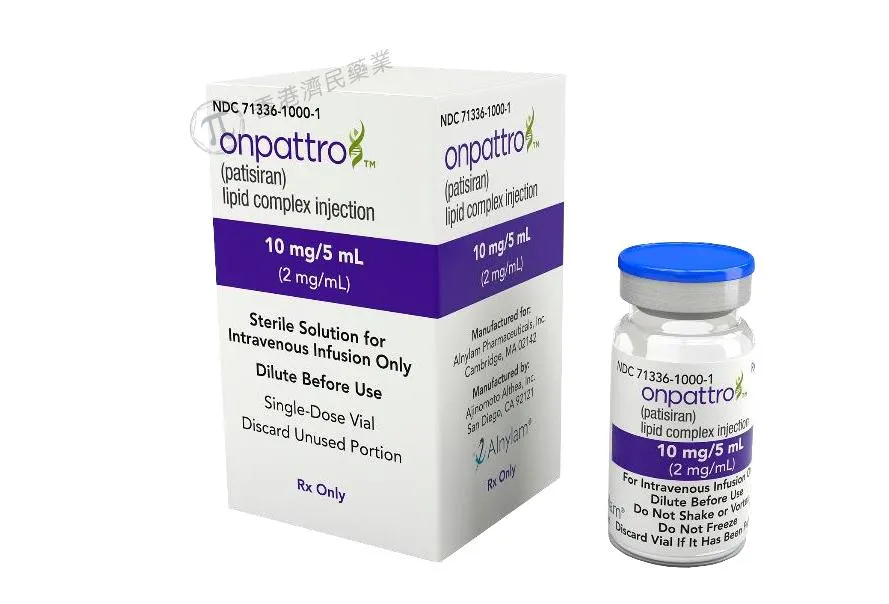
Table of Contents
Patient Information Leaflet
Introduction
Package leaflet: Information for the patient
Onpattro 2 mg/ml concentrate for solution for infusion
patisiran
Read this entire leaflet carefully before you are given this medicine, because it contains important information for you.
- Keep this leaflet as you may need to read it again.
- If you have any questions, ask your doctor or nurse.
- If you experience any side effects, talk to your doctor or nurse, even if it is a side effect not listed in this leaflet. See section 4.
Leaflet contents:
- What Onpattro is and what it is used for
- What you need to know before receiving Onpattro
- How Onpattro is administered
- Possible side effects
- How to store Onpattro
- Contents of the pack and other information
1. What Onpattro is and what it is used for
The active substance in Onpattro is patisiran.
Onpattro is a medicine that treats a hereditary disease called hereditary transthyretin amyloidosis (hATTR amyloidosis).
hATTR amyloidosis is caused by problems with a protein in the body called "transthyretin" (TTR).
- This protein is mostly produced in the liver and transports vitamin A and other substances throughout the body.
- In people with this disease, abnormal TTR proteins clump together to form deposits called "amyloid".
- Amyloid can accumulate around nerves, the heart, and other parts of the body, interfering with their normal function. This causes the symptoms of the disease.
Onpattro works by reducing the amount of TTR protein produced by the liver.
- As a result, there is less TTR protein in the blood available to form amyloid.
- This may help reduce the effects of the disease.
Onpattro is only used in adults.
2. What you need to know before receiving Onpattro
Do not receive Onpattro
- if you have ever had a severe allergic reaction to patisiran or to any of the other ingredients of this medicine (listed in section 6). If you are unsure, consult your doctor or nurse before receiving Onpattro.
Warnings and precautions
Infusion-related reactions
Onpattro is administered as an intravenous infusion (a drip into a vein). During treatment with Onpattro, you may experience reactions related to this infusion. Before each infusion, you will be given medications to reduce the likelihood of infusion-related reactions (see “Medicines administered during treatment with Onpattro” in section 3).
Immediately inform your doctor or nurse if you experience any signs of an infusion-related reaction. These signs are listed at the beginning of section 4.
If you experience an infusion-related reaction, your doctor or nurse may slow down the infusion rate, and you may need to take additional medications to manage the symptoms. Once these reactions have stopped or improved, your doctor or nurse may decide to resume the infusion.
Vitamin A deficiency
Treatment with Onpattro reduces the amount of vitamin A in the blood. Your doctor will monitor your vitamin A levels. If your vitamin A levels are low, your doctor will wait until they return to normal and any symptoms due to vitamin A deficiency have resolved before starting treatment with Onpattro. Symptoms of vitamin A deficiency may include:
- Decreased night vision, dry eyes, poor vision, or blurred or cloudy vision.
If you experience vision problems or any other eye-related issues while using Onpattro, consult your doctor. Your doctor may refer you to an ophthalmologist for an eye examination if necessary.
Your doctor will instruct you to take a daily vitamin A supplement during treatment with Onpattro.
Abnormally high or low levels of vitamin A can harm fetal development. Therefore, women of childbearing potential must not be pregnant when starting treatment with Onpattro and must use effective contraception (see section “Pregnancy, breastfeeding and fertility” below).
Inform your doctor if you plan to become pregnant. Your doctor may advise you to stop taking Onpattro. Your doctor will ensure that your vitamin A levels have returned to normal before you attempt to become pregnant.
Inform your doctor if you become pregnant unexpectedly. Your doctor may advise you to stop taking Onpattro. During the first 3 months of pregnancy, your doctor may advise you to stop taking the vitamin A supplement. During the last 6 months of pregnancy, you should resume taking the vitamin A supplement if your blood vitamin A levels have not yet returned to normal, due to the increased risk of vitamin A deficiency during the final 3 months of pregnancy.
Children and adolescents
Onpattro is not recommended for children and adolescents under 18 years of age.
Other medicines and Onpattro
Inform your doctor or nurse if you are taking, have recently taken, or might need to take any other medicines. It is important to inform your doctor or nurse if you are taking any of the following medicines, as your doctor may need to adjust the dose:
- Bupropion, a medicine used to treat depression or to help stop smoking.
- Efavirenz, a medicine used to treat HIV infection and AIDS.
Pregnancy, breastfeeding and contraception
If you are pregnant or breastfeeding, think you might be pregnant, or plan to become pregnant, consult your doctor before using this medicine.
Women of childbearing potential
Onpattro will reduce the level of vitamin A in your blood, which is important for normal fetal development. If you are a woman of childbearing potential, you must use an effective method of contraception during treatment with Onpattro. Consult your doctor or nurse about appropriate contraceptive methods. Pregnancy must be ruled out before starting treatment with Onpattro.
Pregnancy
Do not use Onpattro if you are pregnant, unless your doctor specifically advises it. If you are of childbearing potential and plan to use Onpattro, you must use effective contraception.
Breastfeeding
Components of Onpattro may pass into breast milk. Consult your doctor about whether to discontinue breastfeeding or treatment with Onpattro.
Driving and using machines
Onpattro is considered to have no or negligible influence on the ability to drive or use machines. Your doctor will advise you whether your medical condition allows you to drive or operate machinery safely.
Onpattro contains sodium
This medicine contains 3.99 milligrams (mg) of sodium (the main component of table/cooking salt) per milliliter (ml). This corresponds to 0.2% of the maximum daily recommended sodium intake for an adult.
3. How Onpattro is administered
How much Onpattro is administered
- Your doctor will calculate the amount of Onpattro to be administered based on your body weight.
- The usual dose of Onpattro is 300 micrograms per kilogram (kg) of body weight given once every 3 weeks.
How Onpattro is administered
- Onpattro will be administered by a doctor or nurse.
- It is given as an intravenous infusion (a “drip” into a vein), usually lasting about 80 minutes.
If you do not have problems with infusions at the clinic, your doctor may discuss the possibility of having a healthcare professional administer the infusions at your home.
Medications administered during treatment with Onpattro
Approximately 60 minutes before each Onpattro infusion, you will be given medications to reduce the risk of infusion-related reactions (see section 4). These include antihistamines, a corticosteroid (a medicine that reduces inflammation), and an analgesic.
How long you should use Onpattro
Your doctor will tell you how long you need to receive Onpattro. Do not stop treatment with Onpattro unless your doctor instructs you to do so.
If you receive more Onpattro than you should
This medicine will be administered by your doctor or nurse. In the unlikely event that you receive too much (an overdose), your doctor or nurse will monitor you for any adverse effects.
If you missed your Onpattro dose
If you miss an appointment for Onpattro, ask your doctor or nurse when to schedule your next treatment.
If you have any further questions about the use of this medicine, ask your doctor or nurse.
4. Possible adverse effects
Like all medicines, this medicine can cause adverse effects, although not everyone experiences them.
Infusion-related reactions
Infusion-related reactions are very common (may affect more than 1 in 10 people).
Inform your doctor or nurse immediately if you experience any of the following signs of an infusion-related reaction during treatment. It may be necessary to slow down or stop the infusion, and you may need to take other medicines to treat the reaction.
- Stomach pain
- Nausea
- Body pain, such as in the back, neck, or joints
- Headache
- Feeling of tiredness (fatigue)
- Chills
- Dizziness
- Cough, shortness of breath, or other breathing problems
- Redness of the face or body (flushing), skin warmth, rash, or itching
- Chest discomfort or pain
- Rapid heart rate
- Low or high blood pressure; some patients have fainted during infusion due to hypotension
- Pain, redness, sensation of heat, or swelling at or near the infusion site
- Swelling of the face
- Changes in sound or tone of voice (hoarseness)
Other adverse effects
Inform your doctor or nurse immediately if you notice any of the following adverse effects:
Very common: may affect more than 1 in 10 people
- Swelling of the arms or legs (peripheral edema)
Common: may affect up to 1 in 10 people
- Joint pain (arthralgia)
- Muscle spasms
- Indigestion (dyspepsia)
- Shortness of breath (dyspnea)
- Redness of the skin (erythema)
- Feeling of dizziness or fainting (vertigo)
- Stuffy or runny nose (rhinitis)
- Irritation or infection of the respiratory tract (sinusitis, bronchitis)
Uncommon: may affect up to 1 in 100 people
- Leakage of the medicine into the surrounding tissue at the infusion site, which may cause swelling or redness
Inform your doctor or nurse immediately if you notice any of the adverse effects listed above.
Reporting of adverse effects
If you experience any type of adverse effect, consult your doctor or nurse, even if it is a possible adverse effect not listed in this leaflet. You can also report them directly through the national reporting system detailed in Appendix V. By reporting adverse effects, you can help provide more information on the safety of this medicine.
5. Storage of Onpattro
Keep this medicine out of the sight and reach of children.
Do not use this medicine after the expiry date stated on the carton after EXP. The expiry date refers to the last day of the month indicated.
Store in a refrigerator (between 2 °C and 8 °C). Do not freeze.
If refrigeration is not available, Onpattro can be stored at room temperature (up to 25 °C) for a maximum of 14 days.
Medicines should not be disposed of via wastewater or household waste. Your healthcare professional will dispose of any unused medicines. This helps protect the environment.
6. Contents of the container and other information
Composition of Onpattro
- The active substance is patisiran.
- Each ml contains sodium patisiran equivalent to 2 mg of patisiran.
- Each vial contains sodium patisiran equivalent to 10 mg of patisiran.
- The other components are DLin-MC3-DMA ((6Z,9Z,28Z,31Z)-heptatriaconta-6,9,28,31-tetraen-19-yl-4-(dimethylamino) butanoate), PEG2000-C-DMG (α-(3’-{[1,2-di(myristoryloxy)propoxy]carbonylamino}propyl)-ω-methoxy, polyethylene glycol), DSPC (1,2-distearoyl-sn-glycero-3-phosphocholine), cholesterol, disodium hydrogen phosphate heptahydrate, potassium dihydrogen phosphate anhydrous, sodium chloride, and water for injections (see “Onpattro contains sodium” in section 2).
Appearance of Onpattro and contents of the container
- Onpattro is a sterile, homogeneous, opalescent white or almost white concentrate for infusion solution.
- Onpattro is supplied in cardboard boxes containing one vial each.
Marketing Authorization Holder and Manufacturer
Alnylam Netherlands B.V.
Antonio Vivaldistraat 150
1083 HP Amsterdam
The Netherlands
For further information about this medicinal product, please contact the local representative of the Marketing Authorization Holder:
Belgium/Belgium/Belgium Alnylam Netherlands B.V. Tel/Tel: 0800 81 443 (+32 234 208 71) | Luxembourg/Luxembourg Alnylam Netherlands B.V. Tel/Tel: 80085235 (+352 203 014 48) |
Genesis Pharma Bulgaria EOOD Tel: +359 2 969 3227 | Lithuania Medison Pharma Lithuania UAB Tel: +370 37 213824 |
Czech Republic Medison Pharma s.r.o. Tel: +420 221 343 336 | Hungary Medison Pharma Hungary Kft Tel.: +36 1 293 0955 |
Denmark Alnylam Sweden AB Tlf.: 433 105 15 (+45 787 453 01) | Malta Genesis Pharma (Cyprus) Ltd Tel: +357 22765715 |
Germany Alnylam Germany GmbH Tel: 0800 2569526 (+49 89 20190112) | Netherlands Alnylam Netherlands B.V. Tel: 0800 282 0025 (+31 20 369 7861) |
Estonia Medison Pharma Estonia OÜ Tel: +372 679 5085 | Norway Alnylam Sweden AB Tlf: 800 544 00 (+472 1405 657) |
Greece GENESIS PHARMA S.A. Tel: +30 210 87 71 500 | Austria Alnylam Austria GmbH Tel: 0800 070 339 (+43 720 778 072) |
Spain Alnylam Pharmaceuticals Spain SL Tel: 900810212 (+34 910603753) | Poland Medison Pharma Sp. z o.o. Tel.: +48 22 152 49 42 |
France Alnylam France SAS Tél: 0805 542 656 (+33 187650921) | Portugal Alnylam Portugal Tel: 707201512 (+351 21 269 8539) |
Croatia Genesis Pharma Adriatic d.o.o Tel: +385 1 5530 011 | Romania Genesis Biopharma Romania SRL Tel: +40 21 403 4074 |
Ireland Alnylam Netherlands B.V. Tel: 1800 924260 (+353 818 882213) | Slovenia Genesis Biopharma SL d.o.o. Tel: +386 1 292 70 90 |
Iceland Alnylam Netherlands B.V. Tel: +31 20 369 7861 | Slovakia Medison Pharma s.r.o. Tel: +421 2 201 109 65 |
Italy Alnylam Italy S.r.l. Tel: 800 90 25 37 (+39 02 89 73 22 91) | Finland Alnylam Sweden AB Tel/Puh: 0800 417 452 (+358 942 727 020) |
Cyprus Genesis Pharma (Cyprus) Ltd Tel: +357 22765715 | Sweden Alnylam Sweden AB Tel: 020109162 (+46 842002641) |
Latvia Medison Pharma Latvia SIA Tel: +371 67 717 847 |
Date of the most recent review of this summary: 05/2024
Other sources of information
Detailed information on this medicine is available on the European Medicines Agency website: http://www.ema.europa.eu/.
This information is intended for healthcare professionals only:
Premedication required
All patients must receive premedication prior to Onpattro infusion to reduce the risk of infusion-related reactions (IRRs). On the day of Onpattro infusion, at least 60 minutes before the start of the infusion, the following medications should be administered:
- Intravenous corticosteroid (10 mg dexamethasone or equivalent)
- Oral paracetamol (500 mg)
- Intravenous H1 blocker (50 mg diphenhydramine or equivalent)
- Intravenous H2 blocker (20 mg famotidine or equivalent)
If intravenous premedication is unavailable or not tolerated, an equivalent oral regimen may be administered.
If clinically indicated, the corticosteroid dose may be gradually reduced in decrements of no more than 2.5 mg down to a minimum dose of 5 mg dexamethasone (intravenous, IV) or equivalent. The patient must receive at least 3 consecutive Onpattro infusions without experiencing IRRs before each corticosteroid premedication reduction.
Additional or higher doses of one or more premedication agents may be administered as needed to reduce the risk of IRRs.
Preparation of the infusion solution
This medicinal product is for single use only.
Onpattro must be diluted with 9 mg/mL (0.9%) sodium chloride solution prior to intravenous infusion. The diluted infusion solution must be prepared by a healthcare professional using aseptic technique as follows:
- Remove Onpattro from the refrigerator. Do not shake or agitate.
- Discard the vial if it has been frozen.
- Perform a visual inspection for particles and discoloration. Do not use if discoloration or foreign particles are observed. Onpattro is a homogeneous, opalescent white or off-white solution. A white or off-white film may be observed on the inner surface of the vial, typically at the liquid-air interface. The presence of this film does not affect the product quality.
- Calculate the required volume of Onpattro based on the recommended weight-based dosing.
- Withdraw the entire contents of one or more vials into a single sterile syringe.
- Filter Onpattro using a sterile polyethersulfone (PES) syringe filter (0.45 micrometers) into a sterile container.
- Withdraw the required volume of filtered Onpattro from the sterile container using a sterile syringe.
- Dilute the required volume of filtered Onpattro in an infusion bag containing 9 mg/mL (0.9%) sodium chloride solution to a total volume of 200 mL. Use infusion bags that are free of di(2-ethylhexyl) phthalate (DEHP).
- Gently invert the bag to mix the solution. Do not shake. Do not mix or dilute with other medicinal products.
- Dispose of any unused portions of Onpattro. Any unused medicinal product and waste materials that have come into contact with the product must be disposed of in accordance with local requirements.
- Onpattro does not contain preservatives. The diluted solution should be administered immediately after preparation. If not used immediately, the diluted solution in the infusion bag may be stored at room temperature (up to 30°C) or between 2°C and 8°C for up to 16 hours (including infusion time). Do not freeze.
Administration
Onpattro is for intravenous use only.
- Onpattro must be diluted prior to intravenous infusion.
- A dedicated intravenous line must be used with an infusion set containing an integrated 1.2-micrometer polyethersulfone (PES) in-line filter. Infusion sets must not contain di(2-ethylhexyl) phthalate (DEHP).
- The diluted Onpattro solution should be administered intravenously over approximately 80 minutes, starting at an initial infusion rate of approximately 1 mL/min for the first 15 minutes, followed by an increase to approximately 3 mL/min for the remainder of the infusion. The infusion duration may be extended in the event of IRRs.
- Onpattro should be administered through a secure, free-flowing venous access. The infusion site must be monitored for possible infiltration during administration. If extravasation is suspected, manage according to local standard practice for non-vesicant agents.
- The patient should be monitored during the infusion and, if clinically indicated, after the infusion.
- At the end of the infusion, the intravenous administration set should be flushed with 9 mg/mL (0.9%) sodium chloride solution to ensure complete delivery of the medicinal product.