Ongentys 50 mg hard capsules
Spain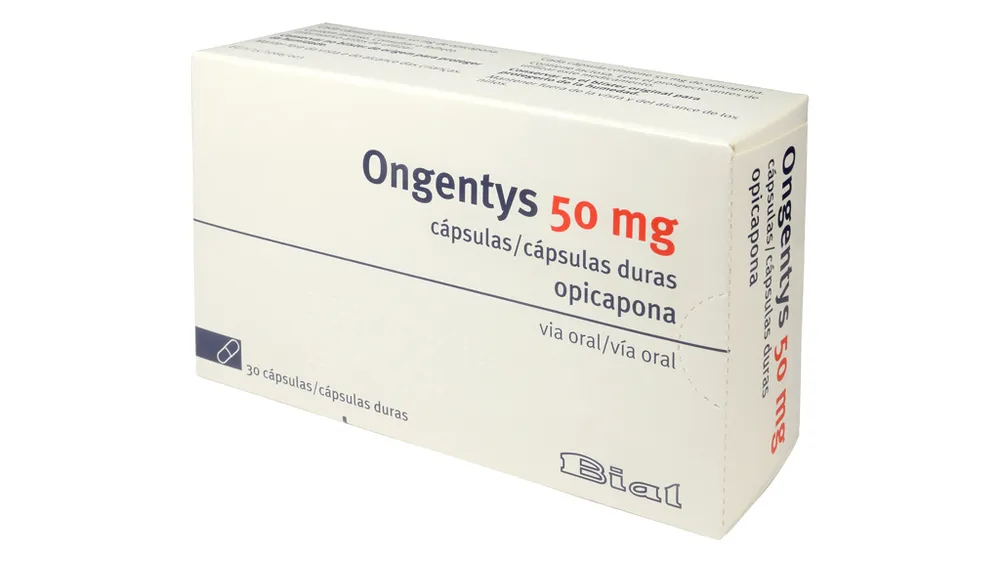
Table of Contents
Package leaflet: Information for the user
Introduction
Package leaflet: information for the patient
Ongentys 50 mg hard capsules
opicapone
Read the entire leaflet carefully before you start taking this medicine, because it contains important information for you.
- Keep this leaflet, as you may need to read it again.
- If you have any questions, ask your doctor or pharmacist.
- This medicine has been prescribed for you only, and you must not pass it on to other people, even if they have the same symptoms as you, because it may harm them.
- If you experience any adverse effects, consult your doctor or pharmacist, even if they are adverse effects not listed in this leaflet. See section 4.
Contents of the leaflet
- What Ongentys is and what it is used for
- What you need to know before taking Ongentys
- How to take Ongentys
- Possible adverse effects
- How to store Ongentys
- Contents of the pack and other information
1. What Ongentys is and what it is used for
Ongentys contains the active substance opicapone. It is used to treat Parkinson's disease and associated movement problems. Parkinson's disease is a progressive disorder of the nervous system that causes tremor and affects movement.
Ongentys is used in adults who are already taking medications containing levodopa and DOPA decarboxylase inhibitors. It enhances the effects of levodopa and helps relieve the symptoms of Parkinson's disease and movement problems.
2. What you need to know before taking Ongentys
Do not take Ongentys:
- if you are allergic to opicapone or to any of the other components of this medicine (listed in section 6);
- if you have a tumor of the adrenal gland (known as a pheochromocytoma), or of the nervous system (known as a paraganglioma), or any other tumor that increases the risk of severe high blood pressure;
- if you have ever experienced neuroleptic malignant syndrome, which is a rare reaction to antipsychotic medicines;
- if you have ever had a rare muscle disorder called rhabdomyolysis that was not caused by injury;
- if you are taking certain antidepressants known as monoamine oxidase inhibitors (MAOIs) (for example, phenelzine, tranylcypromine or moclobemide). Ask your doctor or pharmacist whether you can take your antidepressant together with Ongentys.
Warnings and precautions
Talk to your doctor or pharmacist before starting Ongentys:
- if you have severe liver problems and experience loss of appetite, weight loss, weakness or exhaustion over a short period of time. Your doctor may need to reconsider your treatment.
Tell your doctor or pharmacist if you, or your family/caregiver, notice that you are developing urges or impulses to behave in a way that is unusual for you or that you cannot resist the urge, drive or temptation to carry out certain activities that could cause harm to yourself or others. These behaviors are known as 'impulse control disorders' and may include: gambling addiction, abnormally increased sex drive, or increased preoccupation with sexual thoughts or feelings. Behaviors such as these have been reported in patients taking other medicines for Parkinson's disease.
Your doctor may need to review your treatment.
Children and adolescents
Children and adolescents under 18 years of age must not take this medicine. It has not been studied in these age groups, as treatment of Parkinson's disease is not relevant in children and adolescents.
Other medicines and Ongentys
Tell your doctor or pharmacist if you are taking, have recently taken, or might need to take any other medicines.
Tell your doctor if you are taking:
- medicines for depression or anxiety, such as venlafaxine, maprotiline and desipramine. Taking Ongentys with these medicines may increase the risk of side effects. Your doctor may need to adjust your treatment;
- safinamide, used for Parkinson's disease. There is no experience with taking Ongentys and safinamide together. Your doctor may need to adjust your treatment;
- medicines to treat asthma, such as rimiterol or isoprenaline. Ongentys may increase their effects;
- medicines used to treat allergic reactions, such as adrenaline. Ongentys may increase their effects;
- medicines used to treat heart failure, such as dobutamine, dopamine or dopexamine. Ongentys may increase their effects;
- medicines for high cholesterol, such as rosuvastatin, simvastatin, atorvastatin or pravastatin. Ongentys may increase their effects;
- medicines that affect the immune system, such as methotrexate. Ongentys may increase their effects;
- medicines containing quinidine, a medicine used to treat abnormal heart rhythms or malaria. Taking Ongentys and quinidine together, i.e. at the same time, may reduce the effect of Ongentys.
Pregnancy and breastfeeding
If you are pregnant or breastfeeding, think you may be pregnant or are planning to become pregnant, consult your doctor or pharmacist before using this medicine.
Ongentys is not recommended if you are pregnant. You should use an effective method of contraception if you are able to become pregnant.
It is unknown whether Ongentys passes into breast milk. Because the risk to the newborn/infant cannot be excluded, you must discontinue breastfeeding during treatment with Ongentys.
Driving and using machines
Taking Ongentys with levodopa may make you feel dizzy, lightheaded or drowsy.
Do not drive or operate machinery if you experience any of these side effects.
Ongentys contains lactose and sodium
Lactose: If your doctor has informed you that you have an intolerance to certain sugars, consult with them before taking this medicine.
Sodium: This medicine contains less than 1 mmol of sodium (23 mg) per capsule; this is essentially “sodium-free”.
3. How to take Ongentys
Follow exactly the instructions for administering this medicine given by your doctor. If in doubt, consult your doctor or pharmacist again.
The recommended dose is 50 mg once daily.
Ongentys should preferably be taken at bedtime.
Take Ongentys at least one hour before or one hour after taking levodopa.
Dosage of other medicines for treating Parkinson's disease
It may be necessary to adjust the dose of other Parkinson's disease medications when you start taking Ongentys. Follow your doctor's instructions.
Method of administration
Ongentys is taken orally.
Swallow the capsule whole with a glass of water.
If you take more Ongentys than you should
In case of overdose or accidental ingestion, consult your doctor or pharmacist immediately or go to a hospital. Take the medicine package and this leaflet with you. This will help the doctor identify what has been taken.
If you forget to take Ongentys
If you forget to take a dose, continue treatment and take the next dose at the usual time. Do not take a double dose to make up for a missed dose.
If you stop taking Ongentys
Do not stop taking Ongentys unless your doctor tells you to, as your symptoms may worsen.
If you stop taking Ongentys, your doctor may need to adjust the dose of other Parkinson's disease medications you are taking.
If you have any further questions about the use of this medicine, ask your doctor or pharmacist.
4. Possible adverse effects
Like all medicines, this medicine can cause adverse effects, although not everyone experiences them.
The adverse effects caused by Ongentys are generally mild to moderate and occur mainly during the first weeks of treatment. Some adverse effects may be due to increased effects from using Ongentys together with levodopa.
Contact your doctor immediately if you experience any adverse effects at the start of treatment. Many of these adverse effects can be managed by your doctor adjusting your levodopa medication.
Tell your doctor as soon as possible if you notice any of the following adverse effects:
Very common: may affect more than 1 in 10 people
- involuntary, uncontrollable, or difficult or painful body movements
Common: may affect up to 1 in 10 people
- constipation
- dry mouth
- feeling unwell (nausea)
- vomiting (feeling sick)
- increased levels of an enzyme in your blood (creatine kinase)
- muscle spasms
- dizziness
- headache
- somnolence (sleepiness)
- difficulty falling or staying asleep
- strange dreams
- experiencing or seeing things that are not real (hallucinations)
- drop in blood pressure upon standing, causing dizziness, lightheadedness, or fainting
Uncommon: may affect up to 1 in 100 people
- palpitations and irregular heartbeat
- blocked sensation in the ear
- dry eye
- pain or swelling in the abdomen
- indigestion
- weight loss
- loss of appetite
- increased levels of triglycerides (fats) in the blood
- muscle fasciculations, stiffness, or pain
- pain in arms and legs
- altered sense of taste
- excessive body movements
- fainting
- anxiety
- depression
- hearing things that are not real
- nightmares
- sleep disorder
- abnormal urine color
- need to wake up and urinate during the night
- shortness of breath
- high or low blood pressure
Reporting of adverse effects
If you experience any adverse effect, consult your doctor or pharmacist, even if it is a possible adverse effect not listed in this leaflet. You may also report them directly via the Spanish Pharmacovigilance System for Human Medicines at www.notificaRAM.es. By reporting adverse effects, you can help provide more information on the safety of this medicine.
5. Storage of Ongentys
Keep this medicine out of the sight and reach of children.
Do not use this medicine after the expiry date stated on the bottle/blister pack/carton after EXP. The expiry date is the last day of the month indicated.
This medicine does not require any special storage temperature. Blister packs: Keep in the original blister pack to protect from moisture.
Bottles: Keep the bottle tightly closed to protect from moisture.
Medicines should not be disposed of via wastewater or household waste. Ask your pharmacist how to dispose of medicines and packaging you no longer need. This will help protect the environment.
6. Contents of the pack and other information
Composition of Ongentys
- The active substance is opicapone. Each hard capsule contains 50 mg of opicapone.
- The other components are:
- capsule contents: lactose monohydrate, sodium starch glycolate (Type A), pregelatinized corn starch and magnesium stearate.
- capsule shell: gelatin, indigotine (E132), erythrosine (E127) and titanium dioxide (E171).
- printing ink: shellac, titanium dioxide (E171), propylene glycol, concentrated ammonia solution, simethicone.
Appearance of the product and contents of the pack
- Ongentys 50 mg hard capsules are dark blue capsules, approximately 19 mm in length, printed with “OPC 50” and “Bial”.
The capsules are packed in bottles or blister packs.
Bottles: 10, 30 or 90 capsules.
Blister packs: 10, 30 or 90 capsules.
Only certain pack sizes may be marketed.
Marketing Authorization Holder and Manufacturer
Bial - Portela & Cª, S.A.
Av. da Siderurgia Nacional
4745-457 S. Mamede do Coronado
Portugal
tel: +351 22 986 61 00
fax: +351 22 986 61 90
e-mail: [email protected]
You can request further information about this medicinal product by contacting the local representative of the Marketing Authorization Holder:
Belgium/Belgique/Belgien/Белгия/Česká republika/ Germany/Estonia/Greece/France/ Croatia/Ireland/Italy/Cyprus/Latvia/ Lithuania/Luxembourg/Luxemburg/Hungary/ Malta/Netherlands/Austria/Poland/Portugal/ Romania/Slovenia/Slovakia/United Kingdom BIAL - Portela & Cª, S.A. Tel/Tel/Tel./Tlf/Τηλ: + 351 22 986 61 00 | Spain Laboratorios BIAL, S.A. Tel: + 34 91 562 41 96 Denmark Nordicinfu Care AB Tlf: +45 (0) 70 28 10 24 Finland Nordicinfu Care AB Puh/Tel: +358 (0) 207 348 760 Iceland/Sweden Nordicinfu Care AB Tel / Sími: +46 (0) 8 601 24 40 Norway Nordicinfu Care AB Tlf: +47 (0) 22 20 60 00 |
Date of the most recent review of this leaflet: 03/2022
Other sources of information
Detailed information on this medicinal product is available on the European Medicines Agency website: http://www.ema.europa.eu.