Oncotice 2-8 x 10(8) CFU powder for intravesical suspension
Spain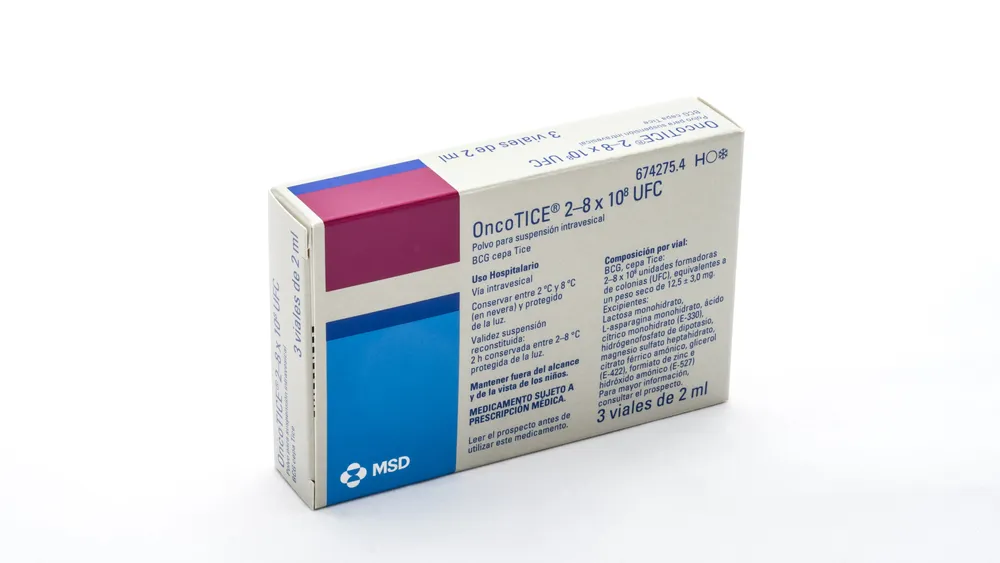
Table of Contents
Package leaflet: Information for the user
Introduction
Package leaflet: information for the user
OncoTICE 2-8 x 10⁸ CFU
powder for intravesical suspension
BCG Tice strain
Read all of this leaflet carefully before you start using this medicine, because it contains important information for you.
- Keep this leaflet, as you may need to read it again.
If you have any questions, ask your doctor, pharmacist, or nurse.
- This medicine has been prescribed for you only, and you should not give it to other people, even if they have the same symptoms as you, because it may harm them.
- If you experience any adverse effects, consult your doctor, pharmacist, or nurse, even if they are adverse effects not listed in this leaflet. See section 4.
Contents of the leaflet
- What OncoTICE is and what it is used for
- What you need to know before using OncoTICE
- How to use OncoTICE
- Possible side effects
- How to store OncoTICE
- Contents of the pack and other information
1. What OncoTICE is and what it is used for
OncoTICE belongs to a group of medicines called immunostimulants, which act on the body's defense system. Specifically, this medicine can stimulate your immune system.
OncoTICE is used for the treatment of superficial bladder cancer. It is also used to prevent the disease from recurring after bladder surgery.
2. What you need to know before using OncoTICE
Do not use OncoTICE:
- if you are allergic to Bacillus Calmette-Guérin (BCG) or to any of the other components of this medicine (listed in section 6).
- if you have a urinary tract infection. If you have cystitis (inflammation of the bladder), you will first be treated with antibiotics before starting OncoTICE. Antibiotic treatment must be completed before beginning treatment with OncoTICE.
- if you have blood in your urine.
- if you currently have tuberculosis.
- if you are being treated with anti-tuberculosis drugs such as streptomycin, para-aminosalicylic acid, isoniazid, rifampicin, and ethambutol.
- if you have a compromised immune system (reduced immunity against infectious diseases), whether congenital, acquired, induced, medication-related, or due to other treatments.
- if you are HIV positive.
- if you are pregnant or breastfeeding.
- if you have a fever of unknown origin.
- if you have recently undergone any medical or surgical procedure involving the bladder within the previous week, due to the risk of systemic infection with Calmette-Guérin bacillus (BCG).
Warnings and precautions
Talk to your doctor or pharmacist before starting treatment with OncoTICE.
- Before the first instillation of OncoTICE into the bladder, your doctor will likely perform a skin test (the tuberculin test) to check whether you have a tuberculosis infection.
- If the bladder wall or urethra is injured or damaged during catheter insertion, treatment must be postponed until the injury has healed. Precautions are taken during administration of OncoTICE to avoid introducing contaminants into the urinary tract or causing undue trauma to the urinary mucosa.
- It is important to rule out HIV infection. A blood sample may be required for this purpose. Your doctor may also ask you about risk factors such as unprotected sexual intercourse, use of contaminated needles, drug use, or prior blood transfusions.
- To protect your partner from transmission of the BCG bacterium, sexual intercourse should be avoided during the week following treatment with OncoTICE. If a condom is used, sexual intercourse may be permitted, provided the condom is used correctly and does not break.
- You will be monitored after each instillation of OncoTICE to prevent toxicity and systemic BCG infection.
- If accidental contamination with OncoTICE is suspected, you will likely undergo tuberculosis testing at the time of the incident and again 6 weeks later.
- If the tuberculin skin test is performed after treatment, the result may be positive.
- If you experience symptoms such as fever and unexplained weight loss, contact your doctor immediately, as these may indicate a late-onset BCG infection. These symptoms may appear months or even years after the last dose of OncoTICE.
Use of OncoTICE with other medicines
Inform your doctor or pharmacist if you are taking, have recently taken, or might need to take any other medicines.
The following medicines or therapies may reduce the effect of OncoTICE:
- Antibiotics, particularly anti-tuberculosis drugs such as streptomycin, para-aminosalicylic acid (PAS), isoniazid, rifampicin, and ethambutol.
- Medicines that suppress the immune system (immunosuppressants).
- Medicines that suppress bone marrow cell production (bone marrow suppressants).
- Radiotherapy.
If you are taking any of these medicines or undergoing such treatments, your doctor will likely delay treatment with OncoTICE until your current treatment has ended.
Please note that these instructions may also apply to medicines taken or used before or after treatment with OncoTICE.
Pregnancy and breastfeeding
If you are pregnant or breastfeeding, think you may be pregnant, or are planning to become pregnant, consult your doctor or pharmacist before using this medicine.
OncoTICE must not be administered during pregnancy.
OncoTICE must not be administered during breastfeeding.
Driving and using machines
Very rarely, the ability to drive or operate machinery may be affected. Nevertheless, avoid performing tasks requiring special attention until you know how you tolerate the medicine.
3. How to use OncoTICE
OncoTICE must not be administered intravenously, subcutaneously, or intramuscularly.
OncoTICE must be administered directly into the bladder. OncoTICE should be administered by a physician or nurse.
OncoTICE is given as intravesical instillations, usually once a week for 6 weeks, followed by weekly instillations for 3 consecutive weeks at months 3, 6, and 12 after the start of treatment. If necessary, the 3-week treatment schedule may be repeated every 6 months after the first year of treatment, but not for more than three years.
To administer OncoTICE, the contents of one vial, previously reconstituted, will be mixed with 50 ml of physiological saline. First, your bladder will be emptied through the same catheter used to instill the OncoTICE solution into the bladder. It is important that you do not drink any fluids during the 4 hours prior to the start of treatment. The OncoTICE solution must remain in the bladder for two hours to achieve optimal treatment results. This way, the medication will come into contact with the entire bladder wall. For this reason, you will be asked to change position periodically. It is very important not to urinate until the two-hour treatment period has passed.
It is important that during the 6 hours after treatment you urinate while sitting down, and that you add two cups of household bleach to the toilet after each urination. The bleach and urine should be left in the toilet for 15 minutes before flushing.
If you receive more OncoTICE than you should
The OncoTICE suspension is prepared from one vial by medical personnel, so it is unlikely that you would receive an overdose of OncoTICE. However, if this occurs, your doctor will carefully monitor you for signs of BCG infection. If necessary, you will receive anti-tuberculosis medications.
In case of accidental exposure, contact your doctor, pharmacist, or call the Toxicology Information Service immediately at 91.562.04.20, indicating the medication.
If you have any further questions about the use of this medicine, ask your doctor, pharmacist, or nurse.
4. Possible adverse effects
Like all medicines, this medicine can cause adverse effects, although not everyone will experience them.
Very common adverse effects (may affect more than 1 in 10 people):
- inflammation of the bladder
- pain when urinating, frequent urination, and blood in the urine. In general, these symptoms disappear within two days.
- flu-like symptoms, such as fever, fatigue, and malaise (feeling unwell). These symptoms may even appear 4 hours after treatment and last from 24 to 48 hours.
Common adverse effects (may affect up to 1 in 10 people):
- joint pain
- arthritis
- muscle pain
- nausea and vomiting
- abdominal pain
- diarrhea
- lung inflammation
- anemia
- urinary incontinence
- urinary tract infection
- urinary urgency
- abnormalities in urine tests
- febrile chills
Uncommon adverse effects (may affect up to 1 in 100 people):
- skin rash
- hepatitis with jaundice (yellowing of the skin or eyes)
- abnormalities in liver function tests
- decrease in the number of red blood cells or platelets, possibly associated with symptoms such as fatigue and/or bruising
- decrease in white blood cells
- pus in the urine
- difficulty urinating
- bladder contraction and blockage of urine flow
- BCG infection in the body (tuberculosis-like infections), with possible late onset. Symptoms may appear months to years after the last dose.
Rare adverse effects (may affect up to 1 in 1,000 people):
- cough
- inflammation of the epididymis (a duct located in the testicles)
Very rare adverse effects (may affect up to 1 in 10,000 people):
- hair loss
- increased sweating
- dizziness (sensation of spinning)
- headache
- increased muscle tension
- abnormal sensations such as itching, burning, tingling, or rash
- conjunctivitis
- loss of appetite
- indigestion and gas
- confusion
- somnolence
- weight loss
- low blood pressure
- bronchitis
- difficulty breathing
- sore throat
- runny nose
- swollen lymph nodes
- kidney function impairment
- granuloma (nodule in an organ)
- inflammation of the glans
- inflammation of the testicles
- Reiter's syndrome (inflammation of the eyes, joints, and genitourinary system)
- lupus vulgaris (skin tuberculosis)
- inflammation of the prostate
- elevation of prostate-specific antigen (PSA) (prostate test)
- burning, itching, and pain in the female genital area
- back pain
- chest pain
- fluid retention in the limbs
Other adverse effects observed with frequency not known (cannot be estimated from available data):
- allergic reactions
- inflammation of blood vessels, including those in the brain (vasculitis)
- abnormal arterial dilation due to bacterial infection (infectious aneurysm)
- eye inflammation (infectious endophthalmitis)
- hemophagocytic lymphohistiocytosis, a disorder in which the immune system produces excessive amounts of normal cells that fight infections, called histiocytes and lymphocytes. This may cause symptoms such as fever, rash, swollen lymph nodes, difficulty breathing, and easy bruising.
If you experience any of these adverse effects, or any new symptoms, or if symptoms worsen, consult your doctor or pharmacist immediately.
Reporting of adverse effects:
If you experience any type of adverse effect, consult your doctor or pharmacist, even if they are possible adverse effects not listed in this leaflet. You may also report them directly via the Spanish Pharmacovigilance System for Human Medicines: https://www.notificaram.es. By reporting adverse effects, you can help provide more information on the safety of this medicine.
5. Storage of OncoTICE
Store in a refrigerator (between 2°C and 8°C). Keep in the original packaging to protect from light.
Keep this medicine out of the sight and reach of children.
OncoTICE is stored in the hospital according to the manufacturer's instructions on the packaging. The expiry date is printed on it.
Do not use this medicine after the expiry date stated on the packaging after EXP.
6. Contents of the pack and other information
Composition of OncoTICE
- The active substance is Calmette-Guerin bacillus (BCG). It is a strain adapted for OncoTICE. Each glass vial contains 2–8 x 10⁸ colony-forming units (CFU).
- The other components are lactose monohydrate, L-asparagine monohydrate, citric acid monohydrate (E-330), dipotassium hydrogen phosphate, magnesium sulfate heptahydrate, ammonium iron citrate, glycerol (E-422), zinc formate, and ammonium hydroxide (E-527).
Presentation of the product and contents of the pack
OncoTICE is presented as a powder for solution for intravesical instillation, which once reconstituted is introduced into the bladder through a catheter.
OncoTICE is available in packs of 1 and 3 vials, each containing approximately 2–8 x 10⁸ colony-forming units of Calmette-Guerin bacilli.
Marketing Authorization Holder and Manufacturer
Marketing Authorization Holder
Merck Sharp & Dohme de España, S.A.
Josefa Valcárcel, 42
28027 Madrid, Spain
Tel.: 91 3210600
Manufacturer
N.V. Organon
Kloosterstraat 6
5349 AB Oss, The Netherlands
Merck Sharp & Dohme B.V.
Waarderweg 39
2031 BN Haarlem, The Netherlands
Date of the most recent revision of this summary: 12/2025.
Detailed and up-to-date information on this medicinal product is available on the website of the Spanish Agency of Medicines and Health Products (AEMPS) http://www.aemps.gob.es/