Oncaspar 750 U/ml powder for injection and for infusion
Spain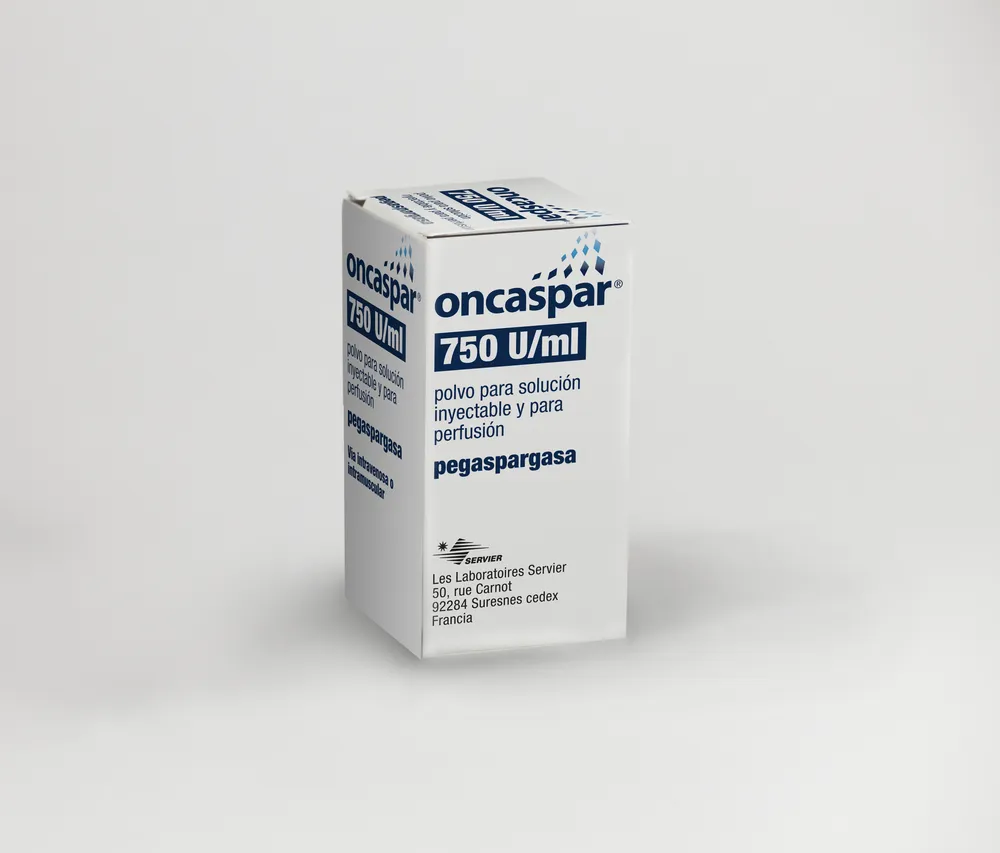
Table of Contents
Package leaflet: Information for the user
Introduction
Package leaflet: information for the user
Oncaspar 750U/ml powder for injectable solution and for infusion
pegaspargase
Read all of this leaflet carefully before you are given this medicine because it contains important information for you.
- Keep this leaflet. You may need to read it again.
- If you have any questions, ask your doctor.
- If you get any side effects, talk to your doctor. This includes any side effects not listed in this leaflet. See section 4.
Contents of the leaflet
- What Oncaspar is and what it is used for
- What you need to know before you are given Oncaspar
- How Oncaspar is administered
- Possible side effects
- How to store Oncaspar
- Contents of the pack and other information
1. What Oncaspar is and what it is used for
Oncaspar contains pegaspargase, an enzyme (asparaginase) that reduces the level of asparagine, an important component of proteins, without which cells cannot survive. Normal cells are able to synthesize asparagine themselves, whereas certain cancer cells cannot. Oncaspar reduces the level of asparagine in cancerous blood cells and thereby prevents the growth of cancer cells.
Oncaspar is used in combination with other medicines to treat acute lymphoblastic leukemia (ALL) in children from birth up to 18 years of age and in adults. ALL is a type of leukemic cancer in which certain immature white blood cells (called lymphoblasts) begin to grow uncontrollably, thereby interfering with the production of functional blood cells. Oncaspar is used together with other medications.
2. What you need to know before Oncaspar is administered to you
Do not use Oncaspar
- if you are allergic to pegaspargase or to any of the other components of this medicine (listed in section 6).
- if you have severe liver disease.
- if you have ever had pancreatitis.
- if you have experienced severe bleeding after treatment with asparaginase.
- if you have ever developed blood clots after treatment with asparaginase.
Inform your doctor if you have any of the conditions listed above. If you are a parent of a child being treated with Oncaspar, inform the doctor if your child has any of these conditions.
Warnings and precautions
Talk to your doctor before receiving Oncaspar. This medicine may not be suitable for you:
- if you have had severe allergic reactions to other forms of asparaginase, such as itching, flushing, or swelling of the airways, as Oncaspar may cause serious allergic reactions.
- if you have a bleeding disorder or have had severe blood clots.
- if you have a fever. This medicine may make you more susceptible to infections.
- if you have impaired liver function or are taking other medicines that may harm the liver.
- if Oncaspar is used together with other cancer treatments, liver damage may occur (including severe and potentially fatal cases of hepatic veno-occlusive disease (VOD)).
- if Oncaspar is used in combination therapy, it may cause damage to the central nervous system.
- if you have abdominal pain. Treatment with Oncaspar may cause inflammation of the pancreas (pancreatitis), which in some cases can be fatal.
This medicine may alter blood clotting factors and may increase the risk of bleeding and/or blood clots.
During post-marketing surveillance, an adverse effect known as osteonecrosis (bone damage) has been reported in children and adolescents treated with Oncaspar (with higher incidence in girls), when administered concomitantly with glucocorticoids (e.g., dexamethasone).
If you are the parent of a minor receiving Oncaspar, consult your doctor if your child has any of these conditions.
During treatment with Oncaspar
While receiving Oncaspar, you will be closely monitored for one hour after the start of treatment for any signs of a severe allergic reaction. Medical equipment necessary to treat allergic reactions must be readily available.
Additional monitoring tests
You will undergo frequent blood glucose (sugar in blood), urine glucose (sugar in urine), liver and pancreatic function tests, and other laboratory tests to monitor your health during and after treatment, as this medicine may affect the blood and certain organs.
Using Oncaspar with other medicines
Tell your doctor if you are taking, have recently taken, or might need to take any other medicines. This is important because Oncaspar may increase the adverse effects of other medicines due to its effect on the liver, the organ responsible for eliminating medicines from the body. It is especially important to inform your doctor if you are also taking any of the following:
- vaccination with live microorganism vaccines within three months after completing leukemia treatment. This may increase the risk of developing serious infections.
- vincristine, another anticancer medicine. When used together with Oncaspar, the risk of adverse effects or allergic reactions increases.
- medicines that reduce blood clotting ability, such as anticoagulants (e.g., coumarin/warfarin and heparin), dipyridamole, acetylsalicylic acid, and/or non-steroidal anti-inflammatory drugs (such as ibuprofen or naproxen). When used together with Oncaspar, the risk of bleeding disorders increases.
- medicines that depend on cell division for their effect, such as methotrexate (a medicine used for cancer and also to treat arthritis), as their effectiveness may be reduced.
- prednisone, a steroid medicine. When used together with Oncaspar, its effects on blood clotting ability are increased.
- glucocorticoids, when taken simultaneously as part of the recommended leukemia treatment, Oncaspar may increase the risk of steroid-induced osteonecrosis (bone damage) in children and adolescents, with a higher incidence observed in girls. Therefore, if you experience any new bone pain (e.g., hip, knee, or back pain), please inform your doctor as soon as possible.
- cytarabine, a medicine that may be used in cancer treatment and which may interfere with the effects of Oncaspar.
Oncaspar may also alter liver function, which may affect how other medicines work.
Pregnancy and breastfeeding
If you are pregnant or breastfeeding, think you may be pregnant, or are planning to become pregnant, consult your doctor before using this medicine.
You must not use Oncaspar during pregnancy, as its effects during pregnancy have not been studied. Your doctor will decide whether treatment is necessary for your condition. Women who could become pregnant must use effective contraception during treatment and for at least 6 months after completing treatment with Oncaspar.
Oral contraceptives are not an effective method of contraception during treatment with Oncaspar. Consult your doctor to determine the most appropriate contraceptive method for you. Men must also use an effective method of contraception while they or their partners are being treated with Oncaspar.
It is unknown whether pegaspargase is excreted in breast milk. As a precaution, breastfeeding should be discontinued during treatment with Oncaspar and should not be resumed until treatment with Oncaspar has been stopped.
Driving and using machines
Do not drive or operate machinery while taking this medicine, as it may cause drowsiness, fatigue, or confusion.
Oncaspar contains sodium
This medicine contains less than 1 mmol of sodium per dose, i.e., essentially "sodium-free".
3. How Oncaspar is administered
Before administration, you may receive a combination of medications to help reduce your chances of developing allergic reactions. Your doctor will decide whether this premedication is necessary.
Oncaspar has been prescribed by a doctor experienced in using anticancer medications. Your doctor will determine the required dose and how often you should receive it, based on your age and body surface area, which is calculated from your height and weight.
The medicine is administered as a solution by injection into a muscle, or, if more convenient, into a vein.
If you are given more Oncaspar than you should
Since the medicine will be administered by a doctor, it is highly unlikely that you will receive more than the required amount.
In the unlikely event of an accidental overdose, medical staff will closely monitor you and provide appropriate treatment.
If you have any further questions about the use of this medicine, ask your doctor.
4. Possible adverse effects
Like all medicines, this medicine can cause adverse effects, although not everyone will experience them.
Serious adverse effects
Inform your doctor immediately if you experience any of the following serious adverse effects:
Very common (may affect more than 1 in 10 patients)
- inflammation or other abnormalities of the pancreas (pancreatitis) accompanied by severe stomach pain that may extend to the back, vomiting, and increased blood sugar levels;
- severe allergic reactions with symptoms such as rash, itching, swelling, hives, difficulty breathing, abnormally rapid pulse, and low blood pressure;
- blood clots;
- fever with low white blood cell counts.
Common (may affect up to 1 in 10 patients)
- severe bleeding or bruising;
- violent seizures (convulsive seizures) and loss of consciousness;
- serious infection with high fever;
- liver problems (for example, change in skin, urine or stool color, and increased liver enzymes or bilirubin in laboratory results).
Rare (may affect up to 1 in 1,000 patients)
- liver failure;
- jaundice;
- blockage of bile flow from the liver (cholestasis);
- destruction of liver cells (hepatic necrosis).
Frequency not known (frequency cannot be estimated from available data)
- a severe skin reaction called toxic epidermal necrolysis;
- loss of kidney function (for example, change in urine volume, swelling of feet and ankles);
- stroke;
- severe allergic reaction that may lead to loss of consciousness and could be potentially fatal (anaphylactic shock);
- bone damage (osteonecrosis);
- a serious type of liver damage called hepatic veno-occlusive disease (VOD): symptoms may include rapid weight gain, fluid retention in the abdomen (ascites) causing abdominal swelling, and enlargement of the liver (hepatomegaly).
Other adverse effects
Consult your doctor if you experience any of the following symptoms:
Very common (may affect more than 1 in 10 patients)
- changes in pancreatic activity;
- weight loss;
- leg pain (which could be a sign of thrombosis), chest pain or difficulty breathing (which may indicate blood clots in the lungs, known as pulmonary embolism);
- loss of appetite, general weakness, vomiting, diarrhea, nausea;
- increased blood sugar levels;
- decreased number of white blood cells.
Common (may affect up to 1 in 10 patients)
- decreased number of red blood cells;
- fluid accumulation in the abdomen (ascites);
- fever and flu-like symptoms;
- mouth ulcers;
- back, joint or abdominal pain;
- elevated levels of fat and cholesterol in the blood; low blood potassium.
Rare (may affect up to 1 in 1,000 patients)
- posterior reversible encephalopathy syndrome (PRES), characterized by symptoms such as headache, confusion, seizures, and vision loss, which resolves after some time.
Frequency not known (frequency cannot be estimated from available data)
- decreased number of platelets;
- fever;
- cysts in the pancreas, swelling of the salivary glands;
- elevated blood urea levels; antibodies against Oncaspar; elevated blood ammonia; decreased blood sugar levels;
- drowsiness, confusion, mild muscle twitching (spasms) in the fingers.
Reporting of adverse effects
If you experience any adverse effect that you think may be related to chemotherapy, consult your doctor, even if the adverse effect is not listed in this leaflet. You may also report them directly through the national reporting system included in Appendix V. By reporting adverse effects, you can help provide more information on the safety of this medicine.
5. Storage of Oncaspar
Keep this medicine out of the sight and reach of children.
Do not use this medicine after the expiry date stated on the label and container after EXP. The expiry date refers to the last day of the month indicated.
Store in a refrigerator (between 2 °C and 8 °C).
Do not freeze.
Once reconstituted and diluted, the solution should be used immediately. If this is not possible, the diluted solution may be stored at a temperature between 2 °C and 8 °C for up to 48 hours.
Do not use this medicine if the reconstituted solution appears cloudy or contains visible particles.
Medicines should not be disposed of via wastewater. Ask your pharmacist how to dispose of medicines that are no longer required. This helps protect the environment.
6. Contents of the pack and other information
Composition of Oncaspar
The active substance is pegaspargase. Each vial contains 3,750 U of pegaspargase.
After reconstitution, 1 ml of solution contains 750 U of pegaspargase (750 U/ml).
The other components are: disodium phosphate heptahydrate, sodium dihydrogen phosphate (monohydrate), sodium chloride, sucrose, sodium hydroxide (for pH adjustment), hydrochloric acid (for pH adjustment) (see section 2: "Oncaspar contains sodium").
Appearance of Oncaspar and contents of the pack
Oncaspar is a white to off-white powder. After reconstitution, the solution is clear, colourless, and free from foreign particles.
Each pack contains 1 glass vial with 3,750 U of pegaspargase.
Marketing Authorization Holder
Les Laboratoires Servier
50, rue Carnot
92284 Suresnes cedex
France
Manufacturer
Les Laboratoires Servier Industrie
905 Route de Saran
45520 Gidy
France
For more information about this medicinal product, please contact the local representative of the Marketing Authorization Holder:
Belgium/Belgium/Belgium S.A. Servier Benelux N.V. Tel: +32 (0)2 529 43 11 | Lithuania UAB “SERVIER PHARMA” Tel: +370 (5) 2 63 86 28 |
| Luxembourg/Luxembourg S.A. Servier Benelux N.V. Tel: +32 (0)2 529 43 11 |
Czech Republic Servier s.r.o. Tel: +420 222 118 111 | Hungary Servier Hungaria Kft. Tel: +36 1 238 7799 |
Denmark Servier Danmark A/S Tlf: +45 36 44 22 60 | Malta V.J. Salomone Pharma Ltd Tel: + 356 21 22 01 74 |
Germany Servier Deutschland GmbH Tel: +49 (0)89 57095 01 | Netherlands Servier Nederland Farma B.V. Tel: +31 (0)71 5246700 |
Estonia Servier Laboratories OÜ Tel:+ 372 664 5040 | Norway Servier Danmark A/S Tlf: +45 36 44 22 60 |
Greece SERVIER ELLAS PHARMACEUTICAL EPE Tel: +30 210 939 1000 | Austria Servier Austria GmbH Tel: +43 (1) 524 39 99 |
Spain Laboratorios Servier S.L. Tel: +34 91 748 96 30 | Poland Servier Polska Sp. z o.o. Tel: +48 (0) 22 594 90 00 |
France Les Laboratoires Servier Tel: +33 (0)1 55 72 60 00 | Portugal Servier Portugal, Lda Tel.: +351 21 312 20 00 |
Croatia Servier Pharma, d. o. o. Tel.: +385 (0)1 3016 222 | Romania Servier Pharma SRL Tel: +4 021 528 52 80 |
Ireland Servier Laboratories (Ireland) Ltd. Tel: +353 (0)1 663 8110 | Slovenia Servier Pharma d. o. o. Tel.: +386 (0)1 563 48 11 |
Iceland Servier Laboratories c/o Icepharma hf Tel: +354 540 8000 | Slovakia Servier Slovensko spol. s r.o. Tel.: +421 (0) 2 5920 41 11 |
Italy Servier Italia S.p.A. Tel: +39 06 669081 | Finland/Finland Servier Finland Oy
|
Cyprus C.A. Papaellinas Ltd. Tel: +357 22741741 | Sweden Servier Sverige AB Tel : +46 (0)8 522 508 00 |
Latvia SIA Servier Latvia Tel: +371 67502039 | United Kingdom (Northern Ireland) Servier Laboratories (Ireland) Ltd. Tel: +44 (0)1753 666409 |
Date of the most recent review of this summary: <{MM/YYYY}><{month YYYY}>.
Detailed information on this medicine is available on the European Medicines Agency website: http://www.ema.europa.eu.
This information is intended for healthcare professionals only:
It is strongly recommended to record the name and batch number of the product each time Oncaspar is administered to a patient, in order to maintain a traceability link between the patient and the product batch.
Due to the unpredictable nature of adverse reactions, Oncaspar must be administered only by physicians and healthcare professionals experienced in the use of chemotherapeutic agents for cancer treatment.
Hypersensitivity reactions to Oncaspar may occur during treatment (e.g., anaphylaxis), particularly in patients with confirmed hypersensitivity to other forms of L-asparaginase. A standard precaution is to monitor patients for one hour with cardiopulmonary resuscitation equipment and other necessary resources immediately available to treat anaphylaxis (epinephrine, oxygen, intravenous corticosteroids, etc.).
Patients should be informed about the possible hypersensitivity reactions to Oncaspar, including immediate-type anaphylaxis. Patients receiving Oncaspar are at increased risk of hemorrhage and thrombotic events. Patients should be advised that Oncaspar must not be used concomitantly with other medications associated with an increased risk of bleeding (see section 2: "Use of Oncaspar with other medicines").
This medicine may cause contact irritation. Therefore, the powder must be handled and administered with special care. Inhalation of vapors and contact with skin and mucous membranes, especially the eyes, must be avoided. If the product comes into contact with the eyes, skin, or mucous membranes, rinse immediately with abundant water for at least 15 minutes.
Disposal of unused medicine and of all materials that have come into contact with it must be carried out in accordance with local regulations.
Instructions for preparation, storage, and disposal of Oncaspar:
Handling instructions
- Personnel must be trained in the handling and transfer of the medicine (pregnant women among the personnel should avoid working with this medicine).
- Aseptic technique must be used.
- Procedures for the safe handling of antineoplastic drugs must be followed.
- Disposable gloves and protective clothing are recommended during handling of Oncaspar.
- All administration or cleaning materials, including gloves, must be placed in high-risk waste disposal bags for high-temperature incineration.
Reconstitution
- Inject 5.2 ml of water for injection into the vial using a syringe and a 21-gauge needle.
- Gently rotate the vial until the powder is fully reconstituted.
- After reconstitution, the solution should be clear, colorless, and free from visible foreign particles. Do not use if the solution is cloudy or if a precipitate has formed. Do not shake.
- The solution must be used within 24 hours after reconstitution when stored at less than 25 °C.
Administration
- Parenteral medicines should be inspected visually for particulate matter before administration; only clear, colorless solutions free from visible foreign particles should be used.
- The medicine should be administered intravenously or intramuscularly. The solution should be administered slowly. For intramuscular injection, the volume should not exceed 2 ml in children and adolescents and 3 ml in adults.
For intravenous administration, the reconstituted solution should be diluted in 100 ml of 0.9% sodium chloride injection (9 mg/ml) or 5% dextrose solution.
The diluted solution may be administered over a period of 1 to 2 hours, concurrently with an ongoing intravenous infusion of either 0.9% sodium chloride (9 mg/ml) or 5% dextrose. Do not infuse any other medication through the same intravenous line during administration of Oncaspar (see section 4.2).
After dilution, the solution should be used immediately. If this is not possible, the diluted solution may be stored at 2 °C to 8 °C for up to 48 hours.
Disposal
Oncaspar is for single use only. Disposal of unused medicine and of all materials that have come into contact with it must be carried out in accordance with local regulations.
Detailed information can be found in the product's package leaflet or summary of product characteristics.