Omvoh 200 mg solution for injection in pre-filled pen
Spain
Table of Contents
Package leaflet: Information for the user
Introduction
Package leaflet: information for the patient
Omvoh 200mg injection solution in a pre-filled pen
mirikizumab
This medicine is subject to additional monitoring, which will allow quicker detection of new safety information. You can help by reporting any side effects you may experience. Information on how to report side effects is included at the end of section 4.
Read the entire leaflet carefully before you start using this medicine, because it contains important information for you.
- Keep this leaflet, as you may need to read it again.
- If you have any questions, consult your doctor, pharmacist, or nurse.
- This medicine has been prescribed for you only and must not be given to other people, even if they have the same symptoms as you, since it could harm them.
- If you experience any side effects, consult your doctor, pharmacist, or nurse, even if they are side effects not listed in this leaflet. See section 4.
Leaflet contents
- What Omvoh is and what it is used for
- What you need to know before using Omvoh
- How to use Omvoh
- Possible side effects
- How to store Omvoh
- Contents of the pack and other information
1. What Omvoh is and what it is used for
Omvoh contains the active substance mirikizumab, a monoclonal antibody. Monoclonal antibodies are proteins that specifically identify and bind to certain target proteins in the body. Omvoh works by binding to and blocking a protein in the body called IL-23 (interleukin-23), which is involved in inflammation. By blocking the action of IL-23, Omvoh reduces inflammation and other symptoms associated with ulcerative colitis.
Ulcerative colitis
Ulcerative colitis is a chronic inflammatory disease of the large intestine. If you have ulcerative colitis, you will first be given other medications. If you do not respond adequately or cannot tolerate these medications, Omvoh may be given to reduce the signs and symptoms of ulcerative colitis, such as diarrhea, abdominal pain, urgency, and rectal bleeding.
2. What you need to know before starting to use Omvoh
Do not use Omvoh
- if you are allergic to mirikizumab or to any of the other components of this medicine (listed in section 6). If you think you may be allergic, consult your doctor before using Omvoh.
- if you have serious active infections (active tuberculosis).
Warnings and precautions
- Consult your doctor or pharmacist before starting to use this medicine.
- Your doctor will assess your health status before treatment.
- Make sure to inform your doctor about any illness you have before treatment.
Infections
- Omvoh may potentially cause serious infections. Treatment with Omvoh should not be started if you have an active infection until the infection has resolved.
- After starting treatment, inform your doctor immediately if you experience any symptoms of infection, such as:
fever | difficulty breathing |
chills | nasal discharge |
muscle aches | sore throat |
cough | pain during urination |
- Also inform your doctor if you have recently been in close contact with someone who might have tuberculosis.
- Your doctor will examine you and perform a test for tuberculosis before you start using Omvoh.
- If your doctor believes you are at risk of having active tuberculosis, they may prescribe medications to treat it.
Vaccines
Your doctor will check whether you need any vaccines before starting treatment. Inform your doctor, pharmacist, or nurse if you have recently been vaccinated or are scheduled to receive a vaccine. Some types of vaccines (live vaccines) should not be given while you are using Omvoh.
Allergic reactions
- Omvoh may potentially cause serious allergic reactions.
- Stop using Omvoh and seek immediate medical attention if you experience any of the following symptoms of a severe allergic reaction:
|
|
|
|
|
|
Liver blood tests
Your doctor will perform a blood test before starting treatment with Omvoh and during treatment to check whether your liver is functioning normally. If blood test results are abnormal, your doctor may interrupt treatment with Omvoh and carry out additional tests on your liver to determine the cause.
Children and adolescents
Omvoh is not recommended for use in children and adolescents under 18 years of age, as it has not been studied in this age group.
Other medicines and Omvoh
Inform your doctor, pharmacist, or nurse
- if you are taking, have recently taken, or might need to take any other medicines.
- if you have recently been vaccinated or are due to be vaccinated. Certain types of vaccines (live vaccines) must not be given while you are receiving Omvoh.
Pregnancy and breastfeeding
If you are pregnant, think you might be pregnant, or plan to become pregnant, consult your doctor before using this medicine. It is preferable to avoid using Omvoh during pregnancy. The effects of Omvoh in pregnant women are unknown. If you are a woman of childbearing potential, you are advised to avoid becoming pregnant and to use an appropriate contraceptive method while taking Omvoh and for at least 10 weeks after the last dose of Omvoh.
If you are breastfeeding or planning to breastfeed, consult your doctor before using this medicine.
Driving and use of machines
It is unlikely that Omvoh will affect your ability to drive or operate machinery.
Omvoh contains sodium
This medicine contains less than 1 mmol of sodium (23 mg) per dose; essentially, it is “sodium-free”.
Omvoh contains polysorbate
This medicine contains 0.3 mg/ml of polysorbate 80 in each pen, equivalent to 0.6 mg for the maintenance dose used to treat ulcerative colitis. Polysorbates may cause allergic reactions. Inform your doctor if you have any known allergies.
3. How to use Omvoh
Follow exactly the instructions for administering this medicine as given by your doctor or nurse. If in doubt, consult your doctor, nurse, or pharmacist again.
What dose of Omvoh is administered and for how long
Your doctor will decide the dose of Omvoh you need and the duration of treatment. Omvoh is intended for long-term treatment. Your doctor or nurse will periodically monitor your condition to ensure the treatment is having the desired effect.
Ulcerative colitis
- Induction of treatment: the first dose of Omvoh is 300 mg, administered by your doctor as an intravenous infusion (a drip into a vein in your arm) over at least 30 minutes. After the first dose, you will receive another 300 mg dose of Omvoh 4 weeks later, and again 4 weeks after that.
If you do not have an adequate therapeutic response after these 3 infusions, your doctor may consider continuing with intravenous infusions at weeks 12, 16, and 20.
- Maintenance treatment: 4 weeks after the last intravenous infusion, a maintenance dose of 200 mg of Omvoh will be administered by subcutaneous injection ("subcutaneously") and then every 4 weeks thereafter. The 200 mg maintenance dose will be given as one 200 mg injection of Omvoh.
If you lose response after receiving the maintenance dose of Omvoh, your doctor may decide to administer 3 doses of Omvoh via intravenous infusions.
Your doctor or nurse will inform you when to switch to subcutaneous injections.
During maintenance treatment, you and your doctor or nurse should decide whether you should self-inject Omvoh after receiving training in subcutaneous injection technique. It is important that you do not attempt to self-inject until your doctor or nurse has trained you. Your doctor or nurse will provide the necessary training.
A caregiver may also administer the Omvoh injection after receiving appropriate training.
Use a reminder method, such as notes on a calendar or diary, to help you remember when to administer your next dose, to avoid missing or repeating a dose.
If you receive more Omvoh than you should
If you have received more Omvoh than you should, or if the dose was administered earlier than prescribed, inform your doctor.
If you forget to use Omvoh
If you have forgotten to inject a dose of Omvoh, inject it as soon as possible. After that, resume administration every 4 weeks.
If you stop treatment with Omvoh
You must not stop treatment with Omvoh without first consulting your doctor. If you stop treatment, symptoms of ulcerative colitis may return.
If you have any further questions about the use of this medicine, ask your doctor, pharmacist, or nurse.
4. Possible adverse effects
Like all medicines, this medicine can cause adverse effects, although not everyone experiences them.
Very common (may affect more than 1 in 10 people):
- Reactions at the injection site (e.g.: redness of the skin, pain)
Common (may affect up to 1 in 10 people):
- Upper respiratory tract infections (infections of the nose and throat)
- Joint pain
- Headache
- Skin rash
Uncommon (may affect up to 1 in 100 people):
- Herpes
- Allergic reaction related to infusion (e.g.: itching, urticaria)
- Increased levels of liver enzymes in the blood
Reporting of adverse effects
If you experience any type of adverse effect, consult your doctor, pharmacist or nurse, even if it is a possible adverse effect not listed in this leaflet. You may also report them directly through the national reporting system detailed in Appendix V. By reporting adverse effects, you can help provide more information on the safety of this medicine.
5. Storage of Omvoh
Keep this medicine out of the sight and reach of children.
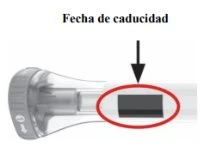
Do not use this medicine after the expiry date stated on the label and outer packaging following “EXP”. The expiry date refers to the last day of the month indicated.
Store in a refrigerator (between 2 °C and 8 °C). Do not freeze.
Do not heat the pen in a microwave, do not soak it in hot water, and do not expose it to direct sunlight.
Do not shake the prefilled pen.
Store in the original packaging to protect from light.
Omvoh may be stored unrefrigerated for up to 2 weeks at a temperature not exceeding 30 °C.
If these conditions are exceeded, Omvoh must be discarded.
Do not use this medicine if you notice that the prefilled pen is damaged, or if the solution is cloudy, considerably brown, or contains particles.
This medicine is for single use only.
Medicines must not be disposed of via wastewater. Ask your doctor, nurse, or pharmacist how to properly dispose of any unused medicines and their containers. This will help protect the environment.
6. Contents of the pack and other information
Composition of Omvoh
- The active substance is mirikizumab.
Each pre-filled pen contains 200 mg of mirikizumab in 2 ml of solution.
- The other components are histidine; histidine monohydrochloride; sodium chloride; mannitol (E 421); polysorbate 80 (E 433); water for injections.
Nature of the product and contents of the pack
Omvoh is a solution in a clear glass cartridge contained within a single-use, disposable pen. Its colour may vary from colourless to slightly yellow.
Omvoh is available in packs containing 1 pre-filled pen of 200 mg, and in multiple packs of 3 cartons, each containing 1 pre-filled pen of 200 mg.
Only some pack sizes may be marketed.
Marketing Authorisation Holder
Eli Lilly Nederland B.V.,
Papendorpseweg 83
3528 BJ Utrecht
The Netherlands
Manufacturer
Lilly France S.A.S.
Rue du Colonel Lilly
67640 Fegersheim
France
For more information about this medicine, please contact the local representative of the Marketing Authorisation Holder:
Belgium/Belgium/Belgium Eli Lilly Benelux S.A./N.V. Tel/Tel: + 32-(0)2 548 84 84 | Lithuania Eli Lilly Lietuva Tel. +370 (5) 2649600 |
| Luxembourg/Luxembourg Eli Lilly Benelux S.A./N.V. Tél/Tel: + 32-(0)2 548 84 84 |
Czech Republic ELI LILLY CR, s.r.o. Tel: + 420 234 664 111 | Hungary Lilly Hungária Kft. Tel: + 36 1 328 5100 |
Denmark Eli Lilly Danmark A/S Tlf.: +45 45 26 60 00 | Malta Charles de Giorgio Ltd. Tel: + 356 25600 500 |
Germany Lilly Deutschland GmbH Tel. + 49-(0) 6172 273 2222 | Netherlands Eli Lilly Nederland B.V. Tel: + 31-(0) 30 60 25 800 |
Estonia Eli Lilly Nederland B.V. Tel: +372 6 817 280 | Norway Eli Lilly Norge A.S. Tlf: + 47 22 88 18 00 |
Greece PHARMASERV-LILLY S.A. Tel: +30 210 629 4600 | Austria Eli Lilly Ges.m.b.H. Tel: + 43-(0) 1 711 780 |
Spain Lilly S.A. Tel: + 34-91 663 50 00 | Poland Eli Lilly Polska Sp. z o.o. Tel: +48 22 440 33 00 |
France Lilly France Tél: +33-(0) 1 55 49 34 34 | Portugal Lilly Portugal Produtos Farmacêuticos, Lda Tel: + 351-21-4126600 |
Croatia Eli Lilly Hrvatska d.o.o. Tel: +385 1 2350 999 | Romania Eli Lilly România S.R.L. Tel: + 40 21 4023000 |
Ireland Eli Lilly and Company (Ireland) Limited Tel: + 353-(0) 1 661 4377 | Slovenia Eli Lilly farmacevtska družba, d.o.o. Tel: +386 (0)1 580 00 10 |
Iceland Icepharma hf. Sími + 354 540 8000 | Slovakia Eli Lilly Slovakia, s.r.o. Tel: + 421 220 663 111 |
Italy Eli Lilly Italia S.p.A. Tel: + 39- 055 42571 | Finland Oy Eli Lilly Finland Ab Puh/Tel: + 358-(0) 9 85 45 250 |
Cyprus Phadisco Ltd Tel: +357 22 715000 | Sweden Eli Lilly Sweden AB Tel: + 46-(0) 8 7378800 |
Latvia Eli Lilly (Suisse) S.A. Representative Office Latvia Tel: +371 67364000 |

Date of the most recent review of this leaflet:
Other sources of information
Detailed information on this medicine is available on the website of the European Medicines Agency: https://www.ema.euopa.eu, and on the website of the Spanish Agency of Medicines and Medical Devices (AEMPS) (https://www.aemps.gob.es/).
Instructions for use Omvoh 200mg solution for injection in pre-filled pen mirikizumab
|
Read this before injecting Omvoh. Follow all instructions step by step.
Important information you need to know before injecting Omvoh:
- Your healthcare provider must teach you how to prepare and inject Omvoh using the pen. Do not inject yourself or inject another person until you have been shown how to inject Omvoh.
- The pre-filled pen contains 1 dose of Omvoh. The Omvoh pen is for single use only. Do not share or reuse your pen. You could transmit or receive an infection.
- Your healthcare provider can help you decide which area of your body to inject your dose. You may also read the section "Choose your injection site" in these instructions to help you select the best area for you.
- If you have vision or hearing problems, do not use the Omvoh pen without the help of a caregiver.
- Keep these instructions for use and review them again as needed.
Before using the Omvoh pen, read and carefully follow all step-by-step instructions.
Parts of the Omvoh pen
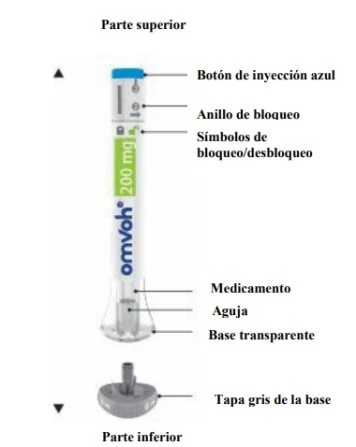
Preparing to inject Omvoh
Remove the pen from the refrigerator | Leave the grey base cap on until you are ready to inject. Allow the pen to sit at room temperature for 45 minutes before injecting. Do not heat the pen in the microwave, do not soak it in hot water, and do not expose it to direct sunlight. Do not use the pen if the medication has been frozen. Do not shake. |
Gather the necessary supplies | Supplies needed:
|
Inspect the pen and medication
| Make sure you have the correct medication. The solution inside should be clear. The color may range from colorless to slightly yellow. Do not use the pen, and dispose of it according to your healthcare provider's instructions if:
|
Prepare to inject | Wash your hands with soap and water before injecting Omvoh. |
Choose your injection site
| Your healthcare provider can help you choose the best injection site for you.
Clean the injection site with an alcohol wipe. Allow the area to dry before injecting your medication. |
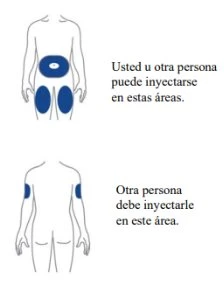
Inject Omvoh
1 Uncover the pen
locked. Leave the grey base cap on until you are ready to inject.
dispose of it in your household waste.
this could damage the needle.
|
|
2 Place and unlock
flat and firmly against your skin.
locking ring to the unlocked position. |
|
3 Hold down for 15 seconds
button. You will hear a loud click (start of injection).
base firmly against your skin. You will hear a second loud click approximately 15 seconds after the first (injection complete). |
|
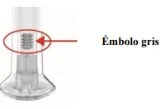
when you see the grey plunger.
site, press a cotton ball or gauze over the injection site.
|
|
 Make sure the pen is
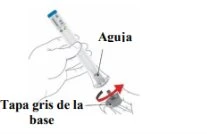
 Keep the base against your skin and turn the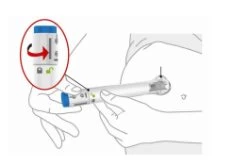
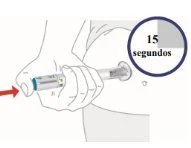
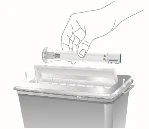
Remove the Omvoh pen | |
Dispose of used pens
|
|
-
If you do not have a sharps disposal container, you may use a household container that is:
-
made of heavy-duty plastic,
-
can be tightly closed with a puncture-resistant lid, preventing sharp objects from coming out,
-
upright and stable during use,
-
leak-resistant,
-
properly labeled to warn of the presence of hazardous waste inside the container.
-
When your sharps disposal container is almost full, follow your community's guidelines for proper disposal. There may be local regulations regarding the disposal of needles and pens.
-
Do not recycle your used sharps disposal container.
-
For more information on how to properly dispose of the container, ask your healthcare professional about available options in your area.
Frequently Asked Questions
-
What if I let my pens temper for more than 45 minutes before injection?
-
Your pen may remain at room temperature up to 30 °C for up to 2 weeks.
-
What if I see air bubbles in the pen?
-
It is normal to have air bubbles in the pen. They will not harm you or affect your dose.
-
What if there is a drop of liquid at the needle tip when I remove the grey base cap?
-
A drop of liquid at the needle tip is normal. It will not harm you or affect your dose.
-
What if I unlock the pen and press the blue injection button until the injection is complete?
A. No. Do not remove the grey base cap. Do not use the pen. Consult your doctor or pharmacist to obtain a new one.
Q. Do I need to keep pressing the blue injection button until the injection is complete?
- It is not necessary to keep holding down the blue injection button, but doing so may help keep the pen stable and steady against your skin.
Q. What if the needle does not retract after my injection?
A. Do not touch the needle or replace the grey base cap. Store the pen in a safe place to avoid accidental needle sticks and contact your doctor, pharmacist, or nurse.
-
What if there is a drop of liquid or blood on my skin after the injection?
-
This is normal. Press a cotton ball or gauze over the injection site. Do not rub the injection site.
-
What if I heard more than 2 clicks during my injection—2 loud clicks and one soft click? Did I receive my full injection?
-
Some patients may hear a soft click just before the second loud click. This is the normal functioning of the pen. Do not remove the pen from your skin until you hear the second loud click.
-
How can I tell if my injection is complete?
-
After pressing the blue injection button, you will hear 2 loud clicks. The second loud click indicates that your injection is complete. You will also see the grey plunger at the top of the transparent base.
To learn more about your medicine, read the complete Omvoh package leaflet inside this package.
Last review in