Omnimoza PF 5 mg/ml eye drops solution in single-dose container
SpainTable of Contents
Package Leaflet: Information for the User
Introduction
Package leaflet: information for the user
Omnimoxa PF 5 mg/ml eye drops solution in single-dose container
Read the entire leaflet carefully before you start using this medicine, because it contains important information for you.
- Keep this leaflet, as you may need to read it again.
- If you have any questions, ask your doctor or pharmacist.
- This medicine has been prescribed for you only; do not give it to other people, even if they have the same symptoms as you, because it could harm them.
- If you experience any adverse effects, consult your doctor or pharmacist, even if they are effects not listed in this leaflet. See section 4.
Leaflet contents
- What Omnimoxa PF is and what it is used for
- What you need to know before using Omnimoxa PF
- How to use Omnimoxa PF
- Possible side effects
- How to store Omnimoxa PF
- Contents of the pack and other information
1. What Omnimoxa PF is and what it is used for
This medicine is used to treat bacterial eye infections (conjunctivitis). The active substance is moxifloxacin, an ophthalmic anti-infective.
Antibiotics are used to treat bacterial infections and are not effective against viral infections.
It is important that you follow your doctor's instructions regarding dosage, dosing interval, and duration of treatment.
Do not store or reuse this medicine. If you have any antibiotic left over after completing the treatment, return it to the pharmacy for proper disposal. Do not dispose of medicines via the drain or in household waste.
2. What you need to know before starting to use Omnimoxa PF
Do not use Omnimoxa PF
If you are allergic (hypersensitive) to moxifloxacin, to other quinolones, or to any of the other components of this medicine (listed in section 6).
Warnings and precautions
Consult your doctor or pharmacist before using this medicine:
-
If you experience an allergic reaction to this medicine. Allergic reactions occur infrequently, and severe reactions are rare. If you experience any allergic reaction (hypersensitivity) or any adverse effect, refer to section 4.
-
If you wear contact lenses – if you have signs or symptoms of an eye infection, stop using contact lenses and wear glasses instead. Do not use contact lenses until signs and symptoms of infection have resolved and you have completed treatment with this medicine.
-
Tendon inflammation and rupture have been observed in individuals taking oral or intravenous fluoroquinolones, particularly in elderly patients and in those receiving concomitant corticosteroid therapy. Discontinue treatment with this medicine if you develop tendon pain or inflammation (tendinitis).
As with any antibiotic, prolonged use of this medicine may lead to development of other infections.
Other medicines and Omnimoxa PF
Inform your doctor or pharmacist if you are taking, have recently taken, or might need to take any other medicines, including those obtained without a prescription.
Pregnancy, breastfeeding, and fertility
If you are pregnant or breastfeeding, think you may be pregnant, or plan to become pregnant, consult your doctor or pharmacist before using this medicine.
Driving and using machines
You may experience blurred vision immediately after using this medicine. Do not drive or operate machinery until these effects have disappeared.
3. How to use Omnimoxa PF
Follow exactly the administration instructions for this medicine as given by your doctor. If in doubt, consult your doctor or pharmacist again.
Recommended dose:
Adults, including elderly patients and children: 1 drop in the affected eye(s), 3 times a day (in the morning, in the afternoon, and at night).
This medicine may be used in children, in patients over 65 years of age, and in patients with kidney or liver problems. Information on the use of this medicine in newborns is very limited; therefore, its use is not recommended in these patients.
Method of administration
This medicine is for ophthalmic use only as eye drops. This medicine should only be applied to both eyes if your doctor has specifically instructed you to do so.
|
|
|
|
Figure 1 | Figure 2 | Figure 3 | Figure 4 |

- Wash your hands.
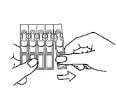
- Remove a single-dose container from the aluminum pouch and separate one single-dose container. (Figure 1).
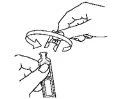
- Open the single-dose container by twisting the top end. (Figure 2).
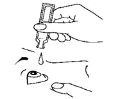
- Tilt your head slightly backward, look upward, and gently pull down the lower eyelid with your finger.
- Apply one drop into the lower conjunctival sac by gently squeezing the bottom of the container (Figure 3).
- Close your eyes slowly and press your finger against the inner corner of the eye for approximately 2–3 minutes. This will prevent the drop from entering the tear duct and flowing into the throat, ensuring most of the drop remains in the eye (Figure 4).
- Discard the single-dose container after use.
- Return the remaining single-dose containers to the aluminum pouch, close it by folding the edge, and place the pouch back into the carton. If any single-dose containers remain 3 months after opening the pouch, they should be properly discarded.
The contents of one single-dose container are sufficient for application in both eyes.
Do not let the dropper touch the eye, eyelid, surrounding areas, or any other surface. This could contaminate the eye drops.
If drops are applied to both eyes, wash your hands before repeating steps 1–6 for the other eye. This helps prevent the spread of infection from one eye to the other.
A new single-dose container must be used for each administration.
If a drop misses the eye, try again.
If too much moxifloxacin has been applied, remove it by rinsing the eyes with lukewarm water. Do not apply additional drops until it is time for the next dose.
If this medicine is accidentally swallowed, contact your doctor or pharmacist.
If you forget to use this medicine, continue with the next scheduled dose. Do not apply a double dose to make up for the missed dose.
If you are using other eye drops, wait at least 5 minutes between applying this medicine and the other drops.
Duration of use
The infection usually improves within 5 days. If you do not see improvement, consult your doctor. You should continue using the drops for 2–3 days after symptoms resolve, or for the entire duration specified by your doctor.
If you have any further questions about the use of this medicine, ask your doctor or pharmacist.
4. Possible adverse effects
Like all medicines, this medicine can cause adverse effects, although not everyone will experience them.
In general, you may continue using the drops, unless the effects are severe or you experience a serious allergic reaction.
If you experience a serious allergic reaction and develop any of the following symptoms, stop using this medicine immediately and contact your doctor immediately: swelling of the hands, feet, ankles, face, lips, mouth or throat, which may cause difficulty swallowing or breathing, rash or hives, large fluid-filled blisters, sores and ulceration.
Frequent adverse effects (may affect up to 1 in 10 people)
- Eye effects: eye pain, eye irritation
Uncommon adverse effects (may affect up to 1 in 100 people)
-
Eye effects: dry eye, eye itching, eye redness, inflammation or scarring of the eye surface, broken blood vessel in the eye, abnormal sensation in the eye, abnormality, itching, redness or swelling of the eyelid
-
Other effects: headache, bad taste
Rare adverse effects (may affect up to 1 in 1,000 people)
-
Eye effects: corneal disorder, blurred or reduced vision, inflammation or infection of the conjunctiva, eye fatigue, eye swelling
-
Other effects: vomiting, nasal discomfort, sensation of throat tightness, decreased iron in blood, abnormal liver function test results, abnormal skin sensation, pain, throat irritation
Frequency not known (cannot be estimated from available data)
-
Eye effects: eye infection, clouding of the eye surface, corneal swelling, deposits on the eye surface, increased eye pressure, scratch on the eye surface, eye allergy, eye discharge, increased tear production, light sensitivity
-
Other effects: shortness of breath, irregular heartbeat, dizziness, worsening of allergic symptoms, itching, rash, skin redness, nausea and hives
Reporting of adverse effects
If you experience any type of adverse effect, consult your doctor or pharmacist, even if it is a possible adverse effect not listed in this leaflet. You may also report them directly via the Spanish Pharmacovigilance System for Human Medicinal Products: https://www.notificaRAM.es. By reporting adverse effects, you can help provide more information on the safety of this medicine.
5. Storage of Omnimoxa PF
Keep out of the sight and reach of children.
Store the single-dose containers in the aluminum pouch and in the outer carton to protect them from light.
Do not use the eye drops after the expiry date stated on the bottle and on the carton after "EXP". The expiry date refers to the last day of the month indicated.
Do not use for more than 3 months after first opening the aluminum pouch.
Once opened, the contents of the single-dose container should be used immediately and must not be stored. Any remaining solution in the single-dose container must be discarded after administration.
Medicines must not be disposed of via wastewater or household waste. Return unused medicines and their containers to the SIGRE collection point at your pharmacy. Ask your pharmacist how to dispose of medicines and containers you no longer need. This will help protect the environment.
6. Contents of the pack and other information
Composition of Omnimoxa PF
- The active substance is moxifloxacin. One ml of eye drops contains 5 mg of moxifloxacin (as moxifloxacin hydrochloride, 5.45 mg). One drop of eye drops contains 160 micrograms of moxifloxacin.
- The other components are: sodium chloride, boric acid, hydrochloric acid and/or sodium hydroxide (to adjust pH), and water for injections.
Appearance of the product and contents of the pack
This medicine is a liquid (a clear, pale yellow solution).
One single-dose container contains 0.4 ml.
Omnimoxa PF is available in packs containing 10 or 30 single-dose containers.
Only certain pack sizes may be marketed.
Marketing Authorization Holder and Manufacturer
Marketing Authorization Holder
OmniVision GmbH
Lindberghstraße 9
82178 Puchheim
Germany
Manufacturer
Pharma Stulln GmbH
Werksstrasse 3
92551 Stulln
Germany
For further information about this medicine, please contact the local representative of the Marketing Authorization Holder:
OmniVision Farma España S.L.
C/ Josep Irla i Bosch, 1-3
Pl: 6 Pt: 2
08034 Barcelona
Spain
This medicine is authorized in the Member States of the European Economic Area under the following names:
Austria Moxifloxacin Stulln sine 5 mg/ml Augentropfen, Lösung im Einzeldosisbehältnis
Germany Moxifloxacin Stulln sine 5 mg/ml Augentropfen, Lösung im Einzeldosisbehältnis
Greece MOFLOTREX UD 5 mg/ml Οφθαλμικής σταγόνες, διάλυμα σε περιέκτη μονής δόσης
Italy Moxidrop
Netherlands Moxifloxacine Stulln zonder conserveermiddel 5 mg/ml oogdruppels, oplossing in verpakking voor éénmalig gebruik
Poland Moxifloxacinum Stulln
Spain Omnimoxa PF 5 mg/ml eye drops solution in single-dose container
Date of the most recent revision of this leaflet: 09/2024.
Detailed information on this medicine is available on the website of the Spanish Agency of Medicines and Health Products (AEMPS): http://www.aemps.gob.es