Olfen 11.6 mg/g gel
Spain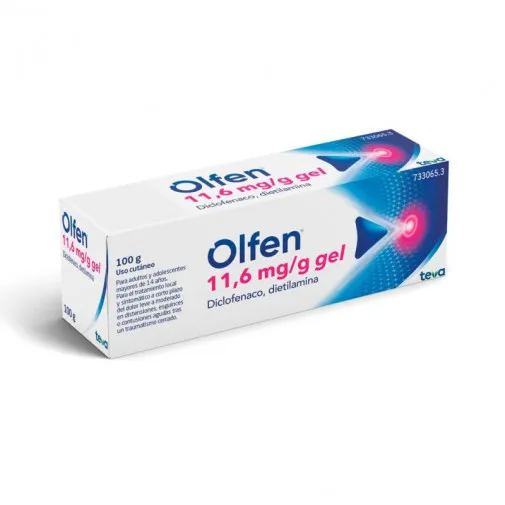
Table of Contents
Package leaflet: Information for the user
Introduction
Package leaflet: Information for the user
Olfen 11.6 mg/g gel
diclofenac (as diethylamine salt)
For adults and adolescents over 14 years of age
Read this entire leaflet carefully before you start using the medicine, because it contains important information for you.
Follow exactly the instructions for use provided in this leaflet or those given by your doctor or pharmacist.
- Keep this leaflet, as you may need to read it again.
- If you need advice or further information, consult your pharmacist.
- If you experience any adverse effects, consult your doctor or pharmacist, even if they are effects not listed in this leaflet. See section 4.
- You should consult a doctor if your condition worsens or if you do not improve within 3–5 days.
Contents of the leaflet:
- What Olfen is and what it is used for
- What you need to know before using Olfen
- How to use Olfen
- Possible side effects
- How to store Olfen
- Contents of the pack and other information
1. What Olfen is and what it is used for
Olfen contains the active substance diclofenac, which belongs to a group of medicines called non-steroidal anti-inflammatory drugs (NSAIDs).
Olfen is indicated in adults and adolescents over 14 years of age.
For adults and adolescents over 14 years of age
For local, short-term symptomatic treatment of mild to moderate pain in sprains, strains or contusions following acute closed trauma.
2. What you need to know before using Olfen
Do not use Olfen
- if you are allergic to diclofenac or to any of the other ingredients of this medicine listed in section 6,
- if you have ever developed respiratory problems (asthma, bronchospasm), skin reactions (urticaria), nasal discharge, or swelling of the face or tongue after taking/using acetylsalicylic acid or another non-steroidal anti-inflammatory drug (e.g., ibuprofen),
- on open wounds, inflamed or infected skin areas, or on eczema or mucous membranes,
- if you are in the last 3 months of pregnancy (“see Pregnancy”),
- in children and adolescents under 14 years of age.
Warnings and precautions
Talk to your doctor or pharmacist before using this medicine.
You may be more likely than other patients to experience asthma attacks (known as analgesic intolerance/analgesic-induced asthma), local skin or mucosal swelling (known as Quincke's edema), or urticaria if you have asthma, allergic rhinitis, nasal mucosa inflammation (nasal polyps), chronic obstructive pulmonary disease, chronic respiratory tract infections (particularly associated with symptoms resembling allergic rhinitis), or hypersensitivity to other analgesics and anti-rheumatic drugs of any kind.
In such patients, this medicine should be used only under certain precautions (emergency preparedness) and under direct medical supervision. The same applies to patients who are also allergic to other substances, for example, those who experience skin reactions, itching, or urticaria.
When this medicine is applied over a large area of skin and for prolonged periods, systemic adverse effects cannot be ruled out. These side effects are similar to those that may occur when taking other medicines containing diclofenac. Therefore, the gel should be used with caution in patients with reduced kidney function, reduced heart function, or reduced liver function, as well as in patients with active peptic ulcer in the stomach or duodenum.
Apply this medicine only on intact, healthy, and undamaged skin. Avoid contact with eyes and mucous membranes. The gel must not be taken orally.
After applying the gel to the skin, you may use a permeable (non-occlusive) dressing, but allow the gel to dry on the skin for a few minutes first. Do not use it with an occlusive, airtight dressing.
If symptoms worsen or do not improve within 3 to 5 days, consult a doctor.
The use of this medicine should be discontinued if you develop a skin rash.
If you are exposed to direct sunlight or artificial UV light, there is a risk of skin reactions. You should avoid sunlight or artificial tanning during treatment and for two weeks after stopping treatment.
Precautions should be taken to prevent children from touching the area where the gel has been applied.
Children and adolescents
This medicine is contraindicated in children and adolescents under 14 years of age.
Other medicines and Olfen
Tell your doctor or pharmacist if you are taking/using, have recently taken/used, or might need to take/use any other medicines.
No interactions have been reported to date with the intended topical use of this medicine.
Pregnancy and breastfeeding
If you are pregnant or breastfeeding, think you may be pregnant, or plan to become pregnant, consult your doctor or pharmacist before using this medicine.
Pregnancy
Do not use this medicine during the last trimester of pregnancy, as it may harm the fetus or cause problems during delivery. This medicine should not be used during the first 6 months of pregnancy unless clearly necessary and advised by your doctor. If treatment is required during this period, the lowest effective dose should be used for the shortest possible duration.
Oral forms (e.g., tablets) of diclofenac may cause adverse effects on the fetus. It is unknown whether the same risk applies to this medicine when used on the skin.
Breastfeeding
Use this medicine only if specifically instructed by your doctor, as diclofenac passes into breast milk in small amounts. This medicine should not be applied to the breast area during breastfeeding, nor to other skin areas or for prolonged periods.
Driving and using machines
This medicine has no or negligible influence on your ability to drive or operate machinery.
Olfen contains propylene glycol (E1520)
This medicine contains 50 mg of propylene glycol in 1 gram of gel.
Olfen contains fragrances
This medicine contains fragrances including benzyl alcohol (0.15 mg/g gel), citral, citronellol, coumarin, eugenol, farnesol, geraniol, d-limonene, and linalool, which may cause allergic reactions.
In addition, benzyl alcohol may cause mild local irritation.
3. How to use Olfen
Follow exactly the instructions for use provided in this leaflet or those given by your doctor or pharmacist. If in doubt, ask your doctor or pharmacist.
Adults and adolescents over 14 years of age
This medicine is used 3 to 4 times daily.
Depending on the size of the affected area to be treated, apply an amount the size of a cherry or walnut, corresponding to 1–4 g of gel.
The maximum daily dose is 16 grams of gel.
If symptoms worsen or do not improve after 3–5 days, you should consult a doctor.
Elderly patients
No special dose adjustment is required. If you are elderly, you should pay particular attention to adverse effects and, if necessary, consult your doctor or pharmacist.
Renal or hepatic impairment
Dose reduction is not necessary.
Use in children and adolescents (under 14 years of age)
There are insufficient data on safety and efficacy in children and adolescents under 14 years of age (see section 2 "Do not use Olfen").
Use in adolescents (14 years and older)
In adolescents aged 14 years and older, if the medicine is needed to relieve pain for more than 7 days or if symptoms worsen, patients/parents should be advised to consult a doctor.
Before first use, open as follows:
- Unscrew the cap from the tube. To open the tamper-evident seal, invert the cap and press it onto the nozzle. Do not use scissors or other sharp objects.
- Twist and remove the plastic seal from the tube. Use the gel as described in this leaflet. Do not use if the seal is broken.
How to apply:
This medicine is for cutaneous use only.
Apply the gel to the affected areas of the body in a thin layer and gently rub it in until it penetrates the skin. Afterwards, clean your hands with a paper towel and then wash them, unless the hands are the area being treated.
If too much gel is accidentally applied, wipe off the excess with a paper towel.
The paper towel should be disposed of in household waste to prevent unused product from entering aquatic environments.
If applying a dressing, allow the gel to dry on the skin for a few minutes first.
Duration of treatment:
The duration of use depends on the symptoms and underlying condition. This medicine should not be used for longer than 1 week without medical advice.
If you use more Olfen than you should
An overdose is unlikely if you use more Olfen than recommended, as absorption into the bloodstream is low when applied to the skin.
If you accidentally ingest this medicine, contact your doctor, who will decide on appropriate measures.
In case of overdose or accidental ingestion, contact your doctor or pharmacist immediately or call the Toxicology Information Service at 91 562 04 20, indicating the medicine and the amount used.
If you forget to use Olfen
Do not apply a double dose to make up for missed doses.
If you have any further questions about using this medicine, ask your doctor or pharmacist.
4. Possible adverse effects
Like all medicines, this medicine may produce adverse effects, although not everyone will experience them.
Some rare and very rare adverse effects may be serious.
If you experience any of the following signs of allergy, stop using this medicine and consult your doctor or pharmacist immediately.
- Skin rash with blisters; hives (may affect up to 1 in 1,000 people).
- Wheezing, shortness of breath, or tightness in the chest (asthma) (may affect up to 1 in 10,000 people).
- Swelling of the face, lips, tongue, or throat (may affect up to 1 in 10,000 people).
Other adverse effects are possible:
Frequent (may affect up to 1 in 10 people)
Skin rash, itching, redness, eczema, dermatitis (inflammation of the skin), including contact dermatitis.
Uncommon (may affect up to 1 in 100 people)
Peeling, skin dehydration, swelling (edema).
Very rare (may affect up to 1 in 10,000 people)
Pustular rash, gastrointestinal discomfort, hypersensitivity reactions (including hives), photosensitivity with skin reactions after exposure to sunlight.
Not known (frequency cannot be estimated from available data)
Burning sensation at the application site, dry skin.
When this medicine is applied over a wide area of skin and for a prolonged period, the possibility of systemic adverse effects (e.g., renal, hepatic, or gastrointestinal adverse effects, systemic hypersensitivity reactions) cannot be completely ruled out, such as those possibly occurring after systemic administration of medicines containing diclofenac.
Reporting of adverse effects
If you experience any type of adverse effect, consult your doctor or pharmacist, even if it is a possible adverse effect not listed in this leaflet. You may also report them directly via the Spanish Pharmacovigilance System for Human Medicines: https://www.notificaram.es. By reporting adverse effects, you can help provide more information on the safety of this medicine.
5. Olfen Storage
Keep this medicine out of the sight and reach of children.
Do not use this medicine after the expiry date stated on the packaging and tube after EXP or CAD. The expiry date refers to the last day of the month indicated.
This medicine does not require any special storage temperature conditions.
Store in the original tube to protect it from light.
Medicines must not be disposed of via wastewater or household waste. Unused medicines and their containers should be taken to the SIGRE Point at your pharmacy. If you are in doubt, ask your pharmacist how to dispose of medicines and containers you no longer need. This will help protect the environment.
6. Contents of the pack and other information
Composition of Olfen
- The active substance is diclofenac.
- 1 gram contains 11.6 mg of diethylamine diclofenac, equivalent to 10 mg of sodium diclofenac.
- The other ingredients are carbomer, cocoil caprylocaprate, macrogol cetearyl ether, liquid paraffin, diethylamine, isopropyl alcohol, propylene glycol (E1520), fragrance (containing benzyl alcohol (E1519), citral, citronellol, coumarin, eugenol, farnesol, geraniol, d-limonene and linalool), purified water.
Appearance of the product and contents of the pack
Olfen is a white or almost white, homogeneous gel, packaged in laminated aluminium tubes closed with a PE seal and polypropylene screw caps, in pack sizes of: 30 grams, 50 grams, 60 grams, 100 grams, 120 grams, 150 grams per tube.
Only some pack sizes may be commercially available.
Marketing Authorization Holder and Manufacturer
Holder
Teva B.V.
Swensweg 5
2031 GA Haarlem
The Netherlands
Manufacturer
Merckle GmbH
Graf Arco Strasse 3
89079 Ulm (Germany)
For further information about this medicinal product, contact the local representative of the Marketing Authorization Holder:
Teva Pharma, S.L.U
C/ Anabel Segura, 11, Edificio Albatros B, 1st floor,
Alcobendas 28108
Madrid (Spain)
This medicinal product is authorized in the Member States of the European Economic Area under the following names:
Germany: Diclofenac AbZ Schmerzgel
France: DICLOFENAC TEVA SANTE CONSEIL 1%, gel
Spain: Olfen 11.6 mg/g gel
Sweden: Diklofenak Teva
United Kingdom (Northern Ireland): Diclofenac diethylamine 1.16% w/w gel
Date of the most recent review of this summary: September 2025
Detailed and up-to-date information on this medicinal product is available on the website of the Spanish Agency for Medicines and Health Products (AEMPS) http://www.aemps.gob.es