Obgemsa 75 mg film-coated tablets
Spain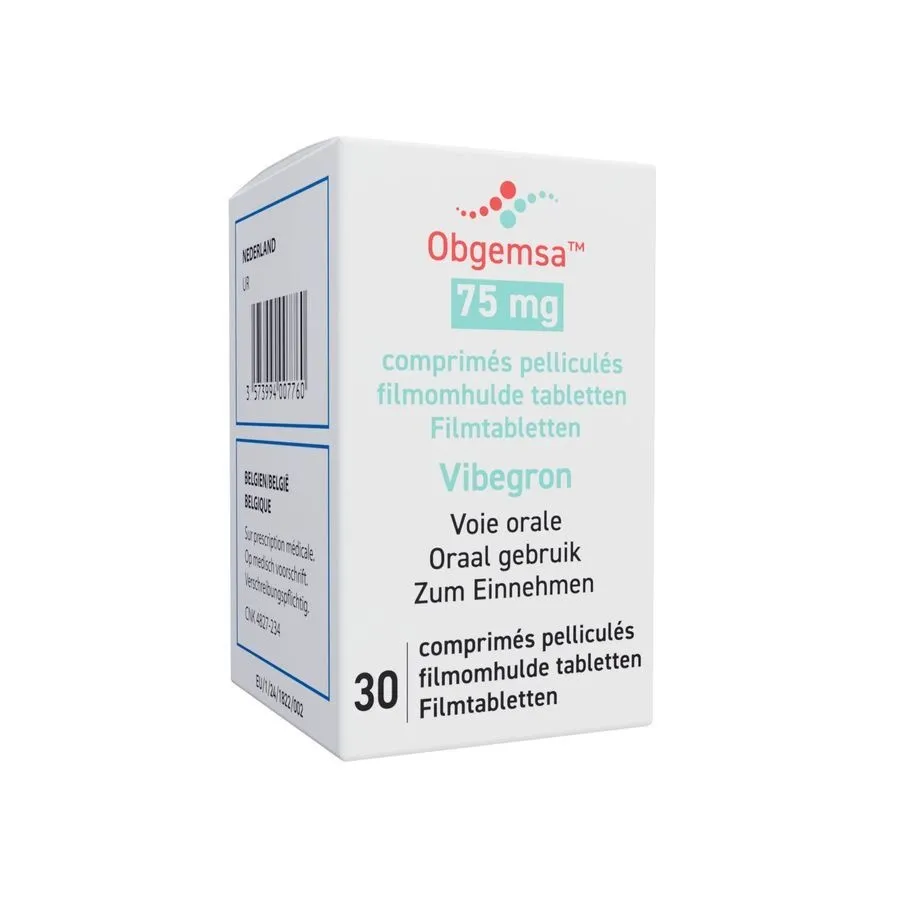
Table of Contents
Package leaflet: Information for the user
Introduction
Package leaflet: information for the patient
Obgemsa 75 mg film-coated tablets
vibegron
This medicinal product is subject to additional monitoring, which will allow for quicker detection of new safety information. You can help by reporting any side effects you may experience. Section 4 at the end includes information on how to report these side effects.
Read this entire leaflet carefully before you start taking this medicine, because it contains important information for you.
- Keep this leaflet, as you may need to read it again.
- If you have any questions, consult your doctor or pharmacist.
- This medicine has been prescribed for you only and must not be given to other people, even if they have the same symptoms as you, since it could harm them.
- If you experience any side effects, consult your doctor or pharmacist, even if they are side effects not listed in this leaflet. See section 4.
Leaflet contents:
- What Obgemsa is and what it is used for
- What you need to know before taking Obgemsa
- How to take Obgemsa
- Possible side effects
- How to store Obgemsa
- Contents of the pack and other information
1. What Obgemsa is and what it is used for
Obgemsa contains the active substance vibegron. It is a medicine that relaxes the bladder muscle (known as a beta 3 adrenergic receptor agonist) which reduces symptoms associated with overactive bladder and treats related symptoms.
Obgemsa is used to treat symptoms of overactive bladder in adults who:
- suddenly need to empty their bladder (called urgency)
- need to empty their bladder more often than normal (called increased urinary frequency)
- are unable to control urination when their bladder is full and pass urine involuntarily (called urgency incontinence)
2. What you need to know before starting to take Obgemsa
Do not take Obgemsa
- if you are allergic to vibegrón or to any of the other components of this medicine (listed in section 6).
Warnings and precautions
Talk to your doctor or pharmacist before starting to take Obgemsa:
- if you have problems emptying your bladder or have a weak urine stream, or if you are taking other medicines for overactive bladder such as anticholinergic medicines, for example, oxybutynin, diphenhydramine, solifenacin.
If you have severe liver problems or if you have end-stage renal disease, as Obgemsa should not be used in these cases.
Children and adolescents
Do not give this medicine to children and adolescents under 18 years of age, as the safety and efficacy of Obgemsa in this age group have not been established.
Other medicines and Obgemsa
Tell your doctor or pharmacist if you are taking, have recently taken, or might need to take any other medicines.
Inform your doctor if you are taking digoxin (a medicine for heart failure or heart rhythm disorders). Your doctor will monitor blood levels of this medicine. If blood levels are outside the acceptable range, your doctor will adjust the digoxin dose.
Inform your doctor if you are taking dabigatran etexilate (an anticoagulant), apixaban (an anticoagulant), or rivaroxaban (an antithrombotic agent). These medicines may require dose adjustments by your doctor.
Pregnancy and breastfeeding
Women of childbearing potential
If you think you may be pregnant or plan to become pregnant, you should not take Obgemsa. It is unknown how this medicine may affect the fetus.
Pregnancy
If you are pregnant, you should not take Obgemsa. It is unknown how this medicine may affect the baby.
Breastfeeding
This medicine may pass into breast milk, but the risks to the baby are unknown. Therefore, you must not breastfeed while taking Obgemsa.
Driving and using machines
The effect of Obgemsa on the ability to drive and use machines is none or negligible.
Obgemsa contains lactose
If your doctor has informed you of an intolerance to certain sugars, consult with him before taking this medicine.
Obgemsa contains sodium
This medicine contains less than 1 mmol of sodium (23 mg) per tablet; i.e., essentially "sodium-free".
3. How to take Obgemsa
Follow exactly the instructions for use of this medicine as given by your doctor. If in doubt, consult your doctor or pharmacist again.
The recommended dose is 1 tablet per day.
You should swallow the tablet with a glass of water. If necessary, the tablet may be crushed and mixed with 1 tablespoon (approximately 15 ml) of soft food (for example, apple puree). Eat the mixture and then drink a glass of water. Once mixed with food, it should be taken immediately. You may take the tablet with or without food.
If you take more Obgemsa than you should
If you take more tablets than you were instructed to, or if someone accidentally takes your tablets, seek immediate advice from your doctor, pharmacist, or hospital. Symptoms of overdose may include gastrointestinal problems, headache, and difficulty breathing.
If you forget to take Obgemsa
If you miss a dose, take the next dose as usual the following day. Do not take a double dose to make up for missed doses. If you miss several doses, consult your doctor and follow their recommendations.
If you stop taking Obgemsa
Do not stop treatment with Obgemsa prematurely if you do not see an immediate effect. Your bladder may need time to adjust, and you should continue taking your tablets.
Do not stop taking Obgemsa when your symptoms improve, as symptoms of overactive bladder may return. Consult your doctor before stopping treatment with Obgemsa.
If you have any further questions about the use of this medicine, ask your doctor or pharmacist.
4. Possible side effects
Like all medicines, this medicine can cause side effects, although not everybody gets them.
An uncommon side effect (may affect up to 1 in 100 people) is the inability to empty the bladder (urinary retention). Obgemsa may increase the likelihood of being unable to empty the bladder, especially if you have bladder outlet obstruction or are taking other medicines for overactive bladder. If you are unable to empty your bladder, inform your doctor immediately.
Other side effects are:
Frequent side effects (may affect up to 1 in 10 people)
- headache
- diarrhoea
- nausea (feeling unwell)
- constipation
- urinary tract infection (infection of the structures that carry urine)
- increased residual urine volume (increased amount of urine remaining in the bladder after voluntary urination)
Uncommon side effects (may affect up to 1 in 100 people)
- hot flushes
- urinary retention, including severe straining to urinate (inability to empty the bladder)
- rash (including itchy rash and red rash)
Reporting of side effects
If you get any side effects, talk to your doctor or pharmacist, even if it is a possible side effect not listed in this leaflet. You can also report them directly through the national reporting system listed in Appendix V. By reporting side effects, you can help provide more information on the safety of this medicine.
5. Conservation of Obgemsa
Keep this medicine out of the sight and reach of children.
Do not use this medicine after the expiry date stated on the carton or vial following EXP. The expiry date is the last day of the month indicated.
This medicine does not require any special storage conditions.
Medicines should not be disposed of via wastewater or household waste. Ask your pharmacist how to dispose of medicines and packaging you no longer need. This will help protect the environment.
6. Contents of the container and other information
Composition of Obgemsa
-
The active substance is vibegron. Each film-coated tablet contains 75 mg of vibegron.
-
The other excipients are:
-
Tablet core: mannitol, microcrystalline cellulose, sodium croscarmellose, hydroxypropylcellulose and magnesium stearate. See section 2 "Obgemsa contains sodium".
-
Film coating: indigo carmine aluminium lake (E132), hypromellose, yellow iron oxide (E172), lactose, titanium dioxide (E171) and triacetin. See section 2 "Obgemsa contains lactose".
Appearance of the product and contents of the container
The film-coated tablets (tablets) are light green, oval-shaped, with the inscription V75 on one side and smooth on the other. The tablet measures approximately 9 mm (length) x 4 mm (width) x 3 mm (height).
Obgemsa is supplied in white plastic bottles, square or round, with a child-resistant plastic closure.
Pack sizes of 7, 30 or 90 film-coated tablets.
Only some pack sizes may be marketed.
Marketing Authorization Holder
PIERRE FABRE MEDICAMENT
Les Cauquillous
81500 Lavaur
France
Manufacturer responsible
PATHEON FRANCE
40 boulevard de Champaret
38300 Bourgoin Jallieu
France
PIRAMAL PHARMA SOLUTIONS (DUTCH) B.V.
Bargelaan 200
Leiden, 2333 CW
The Netherlands
Date of the most recent review of this leaflet:
Other sources of information
Detailed information on this medicinal product is available on the website of the European Medicines Agency: http://www.ema.europa.eu.
This leaflet can be found on the European Medicines Agency website in all languages of the European Union/European Economic Area.