Nutrineal PD4 with 1.1% amino acids with integrated disconnect system, solution for peritoneal dialysis
Spain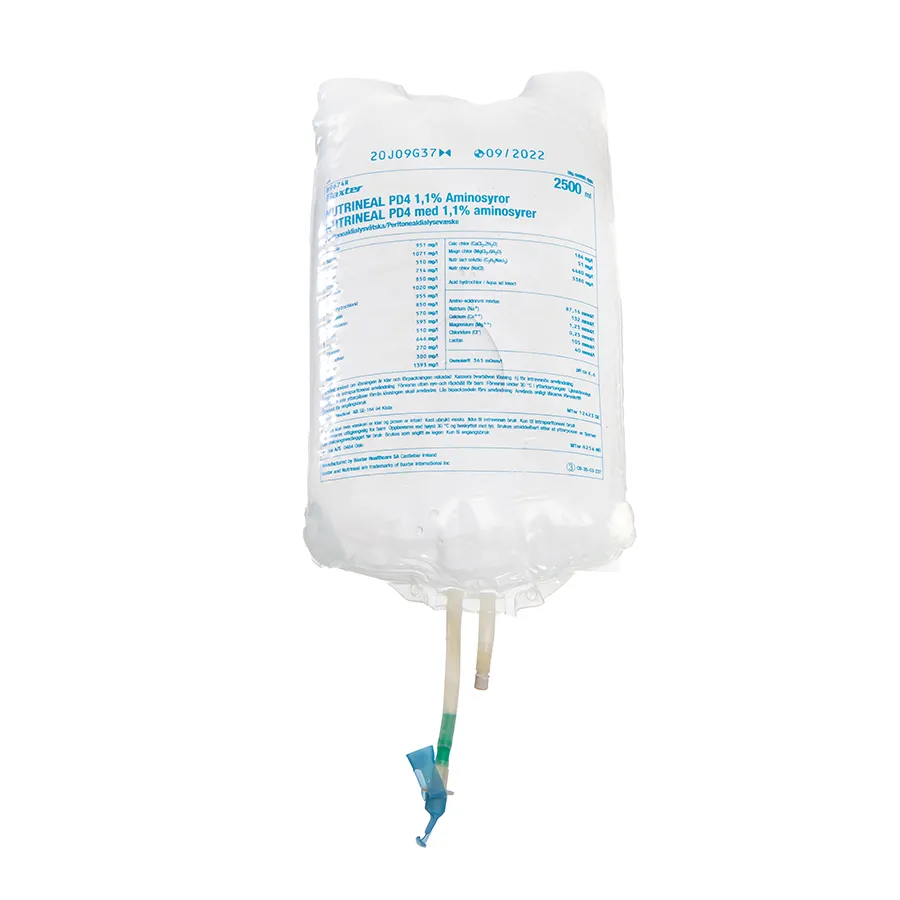
Table of Contents
Package leaflet: Information for the user
Introduction
Package leaflet: information for the user
Nutrineal PD4 with 1.1% amino acids with Integrated Disconnect System, solution for peritoneal dialysis
Read this entire leaflet carefully before you start using this medicine, because it contains important information for you.
- Keep this leaflet, as you may need to read it again.
- If you have any questions, consult your doctor.
- If you experience any adverse reactions, consult your doctor, even if they are not listed in this leaflet. See section 4.
Leaflet contents:
- What Nutrineal is and what it is used for
- What you need to know before using Nutrineal
- How to use Nutrineal
- Possible adverse effects
- How to store Nutrineal
- Contents of the pack and other information
1. What Nutrineal is and what it is used for
Nutrineal is a glucose-free peritoneal dialysis solution. It removes water and waste products from the blood and corrects abnormal levels of various blood components.
Nutrineal may be prescribed for you:
- if you have renal failure requiring peritoneal dialysis
- particularly, if you are malnourished.
2. What you need to know before starting to use Nutrineal
Your doctor will assess whether Nutrineal is an appropriate solution for your peritoneal dialysis treatment. They will take into account any factors in your medical history that might contraindicate the use of peritoneal dialysis solutions.
Do not use Nutrineal
You must not use Nutrineal:
- if you are allergic to the active substances or to any of the other components of this medicine (listed in section 6)
- if your blood urea level is above 38 mmol/l
- if you have a disorder affecting amino acid metabolism
- if your blood potassium level is too low
- if you have symptoms of hyperuricemia such as loss of appetite, nausea, or vomiting
- if your blood bicarbonate levels are too low
- if you have liver failure
- if you have severe lactic acidosis (excess acid in the blood)
- if you have an uncorrectable surgical abnormality affecting your abdominal wall or abdominal cavity, or an uncorrectable condition increasing the risk of abdominal infections.
Warnings and precautions
Consult your doctor before starting to use Nutrineal:
-
if you experience loss of appetite, nausea, or vomiting. Your doctor may need to reduce the number of Nutrineal exchanges or discontinue treatment with Nutrineal
-
if you have abdominal pain or notice that the drainage fluid is cloudy, contains clumps, or particles. This may be a sign of peritonitis (inflamed peritoneum) or infection. You must contact your medical team urgently. Note down the batch number and bring it along with the bag of drained fluid to your medical team. The medical team will decide whether treatment should be interrupted or corrective treatment initiated. For example, if you have an infection, your doctor may perform several tests to determine which antibiotic is most suitable for you. Your doctor may give you an antibiotic effective against a wide range of different bacteria until the specific infection is identified. This type of antibiotic is known as a broad-spectrum antibiotic
-
if you experience a hypersensitivity reaction (an allergic reaction) – see also section 4. Your doctor may need to stop treatment with Nutrineal
-
during peritoneal dialysis, your body may lose proteins, amino acids, and vitamins. Your doctor will determine whether you need to replace these losses
-
if you have conditions affecting the integrity of the abdominal wall or cavity. For example, in case of hernia, chronic infection, or inflammatory bowel disease
-
if you have had an aortic graft
-
if you have severe lung disease, such as emphysema
-
if you have breathing difficulties
-
if you are using insulin or any other treatment to correct hyperglycemia. Your doctor may need to adjust your dose
-
if you are being treated for secondary hyperparathyroidism, your doctor will decide whether you can use a dialysis solution with a low calcium content
-
You should also be aware that a condition called encapsulating peritoneal sclerosis (EPS) is a known, rare complication of peritoneal dialysis therapy. You and your doctor should remain vigilant for this possible complication. EPS may cause:
-
inflammation of the abdomen (belly)
-
growth of fibrous tissue layers covering and binding organs, affecting their normal movement. In rare cases, this has been fatal
-
your doctor will check your potassium levels regularly. If your levels become too low, you may be given potassium chloride to compensate.
-
Your doctor will inform you of any specific precautions applicable to you. Your doctor will monitor blood parameters at regular intervals and ensure they remain appropriate during treatment.
-
You, likely together with your doctor, will keep a record of your dietary protein intake, fluid balance, and body weight.
Use of Nutrineal with other medicines
-
Inform your doctor if you are taking, have recently taken, or might need to take any other medicines. If you are taking other medicines, your doctor may need to increase your dosage, as peritoneal dialysis treatment increases the elimination of certain medicines.
-
Be cautious if you are taking heart medications called cardiac glycosides (e.g., digoxin). Your heart medications may become less effective or their toxicity may increase. You may:
-
require potassium and calcium supplements
-
develop disturbances in heart rhythm (arrhythmia)
-
Your doctor will closely monitor you during treatment, especially your potassium and magnesium levels.
Pregnancy and breastfeeding
If you are pregnant or breastfeeding, think you may be pregnant, or are planning to become pregnant, consult your doctor before using this medicine. The use of Nutrineal is not recommended during pregnancy or breastfeeding unless otherwise directed by your doctor.
Driving and use of machines:
This treatment may cause weakness, general malaise, or reduced body fluid volume (hypovolemia). Do not drive or operate machinery if affected.
3. How to use Nutrineal
Nutrineal must be administered into your peritoneal cavity. This cavity is located in the abdomen (belly), between the skin and the peritoneum. The peritoneum is the membrane that surrounds internal organs such as the intestines or liver.
Nutrineal is not for intravenous use.
Follow exactly your doctor's instructions for administering this medicine. If in doubt, consult your doctor. If the bag is damaged, it must be discarded.
Dosage and frequency
Your doctor will determine the appropriate number of bags you should use. Normally, this ranges from one 2.0-liter bag to one 2.5-liter bag per day.
Use in children and adolescents
If you are under 18 years of age, your doctor will carefully evaluate whether Nutrineal should be administered to you.
Your doctor will reassess the treatment after 3 months if your nutritional status has not improved.
Method of administration
Before use:
- Warm the bag to 37 °C. Use the heating plate specifically designed for this purpose. Never immerse the bag in water to warm it. Do not ever use a microwave oven to heat the bag.
- Remove the overpouch and administer the solution immediately.
- Use the solution only if it is clear and the container is undamaged.
- Each bag must be used only once. Discard any unused solution.
You must use an aseptic technique throughout the administration of the solution, as you have been instructed.
Compatibility with other medicines
Your doctor may prescribe other injectable medicines to be added directly to the Nutrineal bag. In this case, add the medicine through the medication addition site. Use the product immediately after adding the medicine. Consult your doctor if you are unsure.
If you use more than one Nutrineal bag in 24 hours
If you are administered an excessive dose of Nutrineal, you may experience:
-
abdominal distension
-
stomach heaviness
Contact your doctor immediately. They will advise you on what to do.
If you interrupt treatment with Nutrineal
Do not interrupt peritoneal dialysis without your doctor's consent. Stopping treatment may have life-threatening consequences.
If you have any further questions about the use of this medicine, ask your doctor.
4. Possible adverse effects
Like all medicines, this medicine can cause adverse effects, although not everyone will experience them.
If you experience any adverse effects, consult your doctor, even if they are adverse effects not listed in this leaflet.
If you notice any of the following effects, inform your doctor or peritoneal dialysis unit immediately:
- Abdominal pain
Very common adverse effects (affect more than 1 in 10 patients treated with Nutrineal):
- Nausea, vomiting
- Anorexia (a prolonged eating disorder due to loss of appetite)
- Gastritis (inflammation of the stomach)
- Feeling of weakness
- Increase in body fluid volume (hypervolemia)
- High levels of acidic substances in the body (acidosis)
Common adverse effects (affect more than 1 in 100 patients treated with Nutrineal):
- Anaemia
- Depression
- Difficulty breathing
- Abdominal pain
- Decrease in body fluid volume (hypovolemia)
- Decrease in blood potassium salt levels (hypokalaemia)
- Infection
Adverse effects that have been reported (affect an unknown number of patients treated with Nutrineal):
- Peritonitis
- Cloudy peritoneal effluent
- Abdominal discomfort
- Fever
- General malaise
- Itching
- Hypersensitivity reaction (an allergic reaction)
- Severe allergic reactions causing swelling of the face or throat (angioedema)
Other adverse effects related to the peritoneal dialysis procedure:
- Infection around the exit site of your catheter
- Catheter-related complication
- Decrease in blood calcium salt levels (hypocalcaemia).
Reporting of adverse effects
If you experience any type of adverse effect, consult your doctor, pharmacist or nurse, even if they are possible adverse effects not listed in this leaflet. You may also report them directly through the Spanish Pharmacovigilance System for Human Medicinal Products*. By reporting adverse effects, you can help provide more information on the safety of this medicine.
5. Storage of Nutrineal
- Keep this medicine out of the sight and reach of children.
- Store in the original container.
- Store below 30 °C and protect from light.
- Do not use this medicine after the expiry date stated on the carton and bag after EXP. The expiry date is the last day of the month indicated.
Dispose of Nutrineal as instructed.
Medicines should not be disposed of via wastewater or household waste. Ask your pharmacist how to dispose of medicines and containers you no longer need. This will help protect the environment.
6. Contents of the pack and other information
This leaflet does not contain all the information about this medicine. If you have any questions, ask your doctor.
Composition of Nutrineal PD4 with 1.1% amino acids
The active substances are:
Nutrineal PD4 with 1.1% amino acids Composition in mg/l | |
Blend of amino acids: | |
Alanine | 951 |
Arginine | 1071 |
Glycine | 510 |
Histidine | 714 |
Isoleucine | 850 |
Leucine | 1020 |
Lysine, HCl | 955 |
Methionine | 850 |
Phenylalanine | 570 |
Proline | 595 |
Serine | 510 |
Threonine | 646 |
Tryptophan | 270 |
Tyrosine | 300 |
Valine | 1393 |
Sodium chloride | 5380 |
Calcium chloride dihydrate | 184 |
Magnesium chloride hexahydrate | 51 |
Sodium lactate | 4480 |
Composition in mmol/l | |
Amino acids | 87.16 |
Sodium | 132 |
Calcium | 1.25 |
Magnesium | 0.25 |
Lactate | 40 |
Chloride | 105 |
The other components are:
- Water for injections
- Concentrated hydrochloric acid.
Appearance of the medicinal product and content of the container
- Nutrineal is packed in a PVC plastic bag with a capacity of 1.5, 2.0 or 2.5 litres.
- Each bag is enclosed in an overpouch and supplied in cardboard boxes.
Volume | Number of units per box | Product presentation |
1.5 l | 6 | Double bag |
2.0 l | 5 | Double bag |
2.0 l | 6 | Double bag |
2.0 l | 8 | Double bag |
2.5 l | 4 | Double bag |
Some types of bags may not be commercially available.
Marketing Authorization Holder and Manufacturer
Marketing Authorization Holder:
VANTIVE HEALTH S.L.
Calle Pouet de Camilo, 2 - Polígono Industrial Sector 14
46394 Ribarroja del Turia (Valencia), Spain
Manufacturer:
Vantive Manufacturing Limited
Moneen Road
Castlebar
County Mayo, Ireland
Date of the most recent review of this leaflet: May 2016.
Detailed and up-to-date information on this medicinal product is available on the website of the Spanish Agency of Medicines and Medical Devices (AEMPS): http://www.aemps.gob.es/