Numeta G16%E, emulsion for infusion
Spain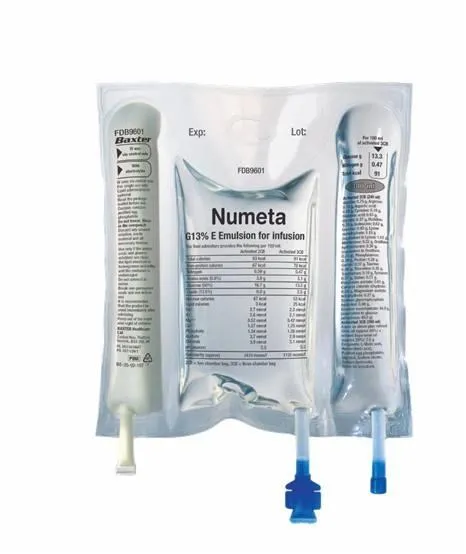
Table of Contents
- Package leaflet: Information for the user
- Introduction
- 1. What Numeta G16%E is and what it is used for
- 2. What you need to know before Numeta G16%E is administered to your child
- 3. How Numeta G16%E will be administered to your child
- **Age Range**
- **Administration**
- **Dosage and duration of treatment**
- **If your child is given more NumetaG16%Ed than they should**
- **Symptoms**
- 4. Possible adverse effects
- 5. Storage of Numeta G16%E
- 6. Contents of the pack and other information
- **Composition of Numeta G16%E**
Package leaflet: Information for the user
Introduction
Package leaflet: information for the user
NUMETA G16%E emulsion for infusion
Read all of this leaflet carefully before your child starts using this medicine, because it contains important information for you.
- Keep this leaflet, as you may need to read it again.
- If you have any questions, consult your child's doctor, pharmacist or nurse.
- If your child experiences any adverse reactions, consult your child's doctor, pharmacist or nurse, even if they are adverse reactions not listed in this leaflet. See section 4.
Contents of this leaflet:
- What Numeta G16%E is and what it is used for
- What you need to know before Numeta G16%E is administered to your child
- How Numeta G16%E will be administered to your child
- Possible side effects
- How to store Numeta G16%E
- Contents of the pack and other information
1. What Numeta G16%E is and what it is used for
Numeta G16%E is a specialized nutritional preparation intended for full-term newborn infants and children up to 2 years of age. It is administered through a tube inserted into your child's vein when they are unable to take all their food orally.
Numeta is supplied as a three-compartment bag containing three separate chambers with the following solutions:
a 50% glucose solution
a 5.9% pediatric amino acid solution with electrolytes
a 12.5% lipid (fat) emulsion
Depending on your child's needs, two (or three) of these solutions are mixed within the bag before administration.
Numeta G16%E must only be used under medical supervision.
2. What you need to know before Numeta G16%E is administered to your child
Do not use Numeta G16%E in the following cases:
With 2 solutions mixed in the bag ("2-in-1"):
- If your child is allergic to any of the proteins in egg, soy, or peanuts, or to any ingredient in the glucose or amino acid bag (listed in section 6).
- If your child's body has difficulty metabolizing components of proteins.
- If your child has high blood concentrations of any of the electrolytes included in Numeta G16%E.
- If your child is a newborn (≤ 28 days of age), Numeta G16%E (or other solutions containing calcium) must not be administered at the same time as ceftriaxone (an antibiotic), even if separate infusion lines are used. There is a risk of forming particles in the newborn's blood, which may be fatal.
- If your child has hyperglycemia (especially high blood sugar levels).
With 3 solutions mixed in the bag ("3-in-1"):
- All situations listed under "2-in-1" plus the following:
- If your child has particularly high levels of fats in the blood.
In all cases, your doctor will decide whether this medicine should be given to your child based on factors such as age, weight, clinical condition, and results of all tests performed.
Warnings and precautions
Talk to your child's doctor or nurse before Numeta G16%E is administered.
When used in newborns and children under 2 years of age, the emulsion (in bags and administration sets) must be protected from light exposure until administration is complete. Exposure of Numeta G16%E to ambient light, especially after mixing with trace elements or vitamins, may generate peroxides and other degradation products. These can be minimized by protecting the product from light.
Allergic reactions
Infusion must be stopped immediately if any signs or symptoms of an allergic reaction occur (such as fever, sweating, chills, headache, skin rash, or difficulty breathing). This medicine contains soybean oil, which may rarely cause hypersensitivity reactions. In rare cases, individuals who are allergic to peanut proteins may also be allergic to soybean seed proteins.
Numeta G16%E contains glucose derived from corn starch and should therefore be used with caution in patients with a known allergy to corn or corn products.
Risk of particle formation with ceftriaxone (antibiotic):
Ceftriaxone, a specific antibiotic, must not be mixed or administered at the same time as a solution containing calcium (including Numeta G16%E) via intravenous infusion.
Your doctor is aware of this and will not administer them together, even through separate lines or different infusion sites.
However, your doctor may administer calcium and ceftriaxone sequentially (one after the other) if different infusion sites are used, or if infusion lines are replaced or thoroughly flushed with physiological saline solution to prevent precipitate formation.
Formation of small particles in the lung blood vessels:
Difficulty breathing may also be a sign of small particles forming and blocking blood vessels in the lungs (pulmonary vascular precipitates). If your child experiences difficulty breathing, inform your child's doctor or nurse. They will determine the necessary actions.
Infection and sepsis
Your doctor will closely monitor your child for signs of infection. Using an "aseptic technique" (germ-free technique) when placing and maintaining the catheter, as well as when preparing the nutritional formula, can reduce the risk of infection.
Sometimes, children may develop infections and sepsis (bacteria in the blood) when a tube is connected to a vein (intravenous catheter). Certain medications and medical conditions may increase the risk of developing sepsis or infection. Patients requiring parenteral nutrition (nutrition delivered through a tube connected to your child's vein) are at higher risk of infection due to their clinical condition.
Fat overload syndrome
Cases of fat overload syndrome have been reported with similar products. A reduced ability to clear the lipids contained in Numeta G16%E, or an overdose, may lead to "fat overload syndrome" (see sections 3 and 4, Possible side effects).
Changes in blood chemical levels
Your doctor will monitor and adjust fluid levels, blood chemical levels, and other blood values in your child, as refeeding a severely malnourished individual may lead to changes in blood chemistry. Excess fluid in tissues and swelling may also occur. It is recommended to start parenteral nutrition slowly and under close supervision.
Elevated magnesium levels in blood
The amount of magnesium in Numeta G16%E may lead to high magnesium levels in the blood. Signs of high magnesium levels include weakness, reduced reflexes, nausea, vomiting, low blood calcium levels, breathing difficulties, low blood pressure, and irregular heartbeats. Since these signs may be difficult to detect, your doctor may monitor your child's blood levels, especially if your child has risk factors for high magnesium levels, including impaired kidney function. If blood magnesium levels are high, the infusion will be stopped or reduced.
Monitoring and adjustment
Your doctor will monitor and adjust the dose of Numeta G16%E to meet your child's individual needs if they have any of the following conditions:
- Severe post-traumatic state
- Severe diabetes mellitus
- Shock
- Myocardial infarction
- Severe infection
- Certain types of coma
Use with caution:
Numeta G16%E should be used with caution if your child has:
- Pulmonary edema (fluid in the lungs) or heart failure,
- Severe liver problems,
- Difficulty absorbing nutrients,
- High blood sugar levels,
- Kidney problems,
- Severe metabolic disorders (when the body cannot normally eliminate substances),
- Blood coagulation disorders.
Fluid levels in your child's body, liver function tests, and/or blood values will be carefully monitored.
Use of Numeta G16%E with other medicines
Inform your doctor if your child is taking, has recently taken, or might need to take any other medicines.
Numeta G16%E must not be administered at the same time as:
- Ceftriaxone (an antibiotic), even through separate infusion lines, due to the risk of particle formation.
- Blood through the same infusion line, due to the risk of pseudoagglutination (red blood cells clumping together).
- Ampicillin, fosphenytoin, and furosemide through the same infusion line, due to the risk of particle formation.
Coumarin and warfarin (anticoagulants)
Your doctor will monitor your child closely if they are taking coumarin or warfarin. Olive and soybean oils contain vitamin K1. Vitamin K1 may interfere with the action of medications such as coumarin and warfarin. These medications are anticoagulants used to prevent blood clotting.
Laboratory tests
The lipids in this emulsion may interfere with the results of certain laboratory tests. Laboratory tests should be performed after a 5 to 6-hour interval if no further lipids are administered.
Interaction of Numeta G16%E with medicines that may affect potassium levels/metabolism:
Numeta G16%E contains potassium. High potassium levels in the blood may cause abnormal heart rhythms. Special attention should be given to patients taking diuretics (medications that reduce fluid retention), ACE inhibitors, angiotensin II receptor antagonists (all used to treat high blood pressure), or immunosuppressants (medications that may reduce the body's natural defenses). These types of medications may increase potassium levels.
3. How Numeta G16%E will be administered to your child
Numeta G16%E will always be administered to your child exactly as directed by your doctor. If you have any doubts, consult your doctor.
Age Range
Numeta G16%E is designed to meet the nutritional needs of full-term newborns and children up to two years of age.
The physician will determine whether this medication is suitable for your child.
Administration
This medicine is an emulsion for infusion. It is administered through a plastic tube connected to a vein in your child's arm or a large vein in the chest.
Your child's doctor may decide not to administer lipids to your child. The design of the Numeta G16%E bag allows only the non-permanent seal between the amino acids/electrolytes and glucose compartments to be broken, if necessary. In this case, the seal between the amino acid and lipid compartments remains intact. The contents of the bag may thus be infused without lipids.
When used in newborns and children under 2 years of age, the emulsion (in the bags and administration sets) must be protected from exposure to light until administration is complete (see section 2).
Dosage and duration of treatment
Your child's doctor will decide the dose your child needs and how long it will be administered. The dose depends on your child's nutritional needs and will be based on weight, medical condition, and your child's body's ability to digest and absorb the ingredients in Numeta G16%E. Additional protein or nutrition may also be given orally or via intestinal administration.
If your child is given more NumetaG16%Ed than they should
In case of overdose or accidental ingestion, contact the Toxicology Information Service. Telephone 915.620.420
Symptoms
Receiving too much medication or receiving it too quickly could cause:
- nausea (feeling unwell)
- vomiting
- chills
- electrolyte disturbances (inappropriate levels of electrolytes in the blood)
- signs of hypervolemia (increased blood circulation volume)
- acidosis (increased blood acidity)
In such cases, the infusion must be stopped immediately. Your child's doctor will decide whether further actions are necessary.
An overdose of the fats contained in Numeta G16%E may cause a "fat overload syndrome," which is usually reversible once the infusion is discontinued. In newborns (neonates) and young children (infants), fat overload syndrome has been associated with respiratory disorders leading to reduced oxygen levels in the body (respiratory distress) and conditions causing increased blood acidity (acidosis).
To prevent these reactions, your doctor will regularly monitor your child's condition and perform blood tests during treatment.
4. Possible adverse effects
Like all medicines, this medicine may cause adverse effects, although not all children will experience them.
If you notice any change in how your child feels during or after treatment, inform the doctor or nurse immediately.
The tests that the doctor will perform on your child during treatment with this medicine are intended to minimize the risk of adverse effects.
If symptoms of an allergic reaction occur, the infusion must be stopped and the doctor contacted immediately. This may be serious, and symptoms may include:
- Sweating.
- Chills.
- Headache.
- Skin rash.
- Difficulty breathing.
Other adverse effects that have been observed are:
Common: may affect up to 1 in 10 people
- Low blood phosphate levels (hypophosphatemia).
- High blood sugar levels (hyperglycemia).
- High blood calcium levels (hypercalcemia).
- High blood triglyceride levels (hypertriglyceridemia).
- Electrolyte disturbances (hyponatremia).
Uncommon: may affect up to 1 in 100 people
- High blood lipid levels (hyperlipidemia).
- A disorder in which bile cannot flow from the liver to the duodenum (cholestasis). The duodenum is part of the intestine.
Unknown frequency: frequency cannot be estimated from available data ( these adverse effects have been reported with Numeta G13%E and G16%E when administered peripherally with insufficient dilution)
- Skin necrosis
- Soft tissue damage
- Extravasation
The following adverse effects have been reported with other parenteral nutrition products:
- Reduced or limited ability to eliminate the lipids contained in Numeta may lead to a "fat overload syndrome". The following signs and symptoms of this syndrome are usually reversible when the lipid emulsion infusion is stopped:
-
- Sudden and abrupt worsening of the patient's medical condition.
- High levels of fat in the blood (hyperlipidemia).
- Fever.
- Fatty infiltration of the liver (hepatomegaly).
- Worsening of liver function.
- Decrease in red blood cells, which may cause paleness, weakness, or difficulty breathing (anemia).
- Low white blood cell count, which may increase the risk of infection (leukopenia).
- Low platelet count, which may increase the risk of bruising and/or bleeding (thrombocytopenia).
- Coagulation disorders, affecting the blood's ability to clot.
- Respiratory disorder causing reduced oxygen levels in the body (dyspnea).
- Conditions causing increased blood acidity (acidosis).
- Comatose state requiring hospitalization.
- Formation of small particles that may cause blockage of blood vessels in the lungs (pulmonary vascular precipitates) or difficulty breathing.
-
Reporting of adverse effects:
If your child experiences any adverse effects, consult your doctor or nurse, even if they are possible adverse effects not listed in this leaflet. You may also report them directly through the Spanish Pharmacovigilance System for Human Medicines: https://www.notificaram.es. By reporting adverse effects, you can help provide more information on the safety of this medicine.
5. Storage of Numeta G16%E
Keep this medicine out of the sight and reach of children when not in use.
When used in newborns and children under 2 years of age, the emulsion (in the bags and administration sets) must be protected from exposure to light until administration is complete (see section 2).
Do not use this medicine after the expiry date stated on the bag and outer packaging (MM/YYYY). The expiry date refers to the last day of the month indicated.
Do not freeze.
Store inside the overpouch.
Medicines should not be disposed of via wastewater or household waste. Ask your pharmacist how to dispose of unused medicines and their containers. This helps protect the environment.
6. Contents of the pack and other information
Appearance of the product and contents of the pack
Numeta G16%E is supplied as a three-compartment bag. Each bag contains a sterile combination of a glucose solution, a pediatric amino acid solution with electrolytes, and a lipid emulsion, as described below:
Package size | 50% glucose solution | 5.9% amino acid solution with electrolytes | 12.5% lipid emulsion |
500 ml | 155 ml | 221 ml | 124 ml |
Appearance before reconstitution:
- The solutions in the amino acid and glucose compartments are clear, colorless or slightly yellowish.
- The lipid emulsion compartment has a milky, whitish appearance.
Appearance after reconstitution:
- The "2-in-1" solution is clear, colorless or slightly yellowish.
- The "3-in-1" infusion emulsion has a uniform milky, whitish appearance.
The three-compartment bag is a multilayer plastic bag.
To avoid contact with air, Numeta is packaged inside an oxygen-barrier overpouch containing an oxygen-absorbing sachet and an oxygen indicator.
Pack sizes
500 ml bag: 6 units per carton
1 bag of 500 ml
Only certain pack sizes may be marketed.
Marketing Authorization Holder and Manufacturer
Marketing Authorization Holder
Baxter, S.L.
Pouet de Camilo 2, 46394 Ribarroja del Turia (Valencia)
Manufacturer
Baxter S.A.
Boulevard Rene Branquart, 80
7860 Lessines
Belgium
This medicinal product is authorized in the Member States of the European Economic Area under the following names:
Austria Germany | Numeta G16 % E Emulsion for Infusion |
Belgium Luxembourg | Numetzah G16%E, emulsion for perfusion |
France | Numetah G16 %E emulsion for perfusion |
Denmark Norway Sweden | Numeta G16E |
Czech Republic Greece | Numeta G16 % E |
Netherlands | Numeta G16%E emulsion for infusion |
Ireland United Kingdom | Numeta G16%E, Emulsion for Infusion |
Italy | Numeta G16%E emulsion for infusion |
Finland | Numeta G16E infusion concentrate, emulsion |
Poland | Numeta G16 % E |
Portugal | Numeta G16%E |
Spain | Numeta G16%E, emulsion for infusion |
Date of the most recent review of this summary: May 2024
Detailed and up-to-date information on this medicine is available on the website of the Spanish Agency of Medicines and Health Products (AEMPS) http://www.aemps.gob.es/
This information is intended exclusively for healthcare professionals:*
(*) Please note that in certain cases these medicines may be administered at home by parents or other caregivers. In such cases, parents/caregivers should read the following information.
No medication should be added to the bag without first checking compatibility. Particulate matter may form or the lipid emulsion may break down, which could block blood vessels.
Numeta G16%E must be at room temperature before use.
Before administering Numeta G16%E, the bag must be prepared as shown below.
Ensure the bag is undamaged and use only if no damage is present. An undamaged bag looks like this:
- The non-permanent seals are intact. This is evident because there is no mixing between the three chambers.
- The amino acid and glucose solution is clear, colourless or slightly yellowish, and free from visible particles.
- The lipid emulsion is a milky, whitish-looking liquid.
Before opening the overpouch, examine the colour of the oxygen absorber.
- Compare it with the reference colour printed next to the OK symbol and shown in the printed area of the indicator label.
- Do not use the product if the colour of the oxygen absorber does not match the reference colour printed next to the OK symbol.
Figures 1 and 2 illustrate how to remove the overpouch. Discard it together with the oxygen indicator and the oxygen absorber.
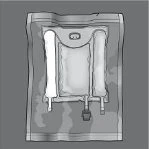
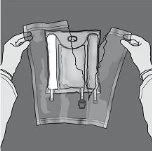
Figure 1 Figure 2
Preparation of the mixture
- Ensure the product is at room temperature before breaking the non-permanent seals.
- Place the bag on a clean, flat surface.
Activation of the 3-chamber bag (breaking the two non-permanent seals)
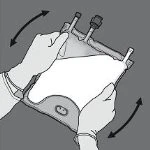
Step 1: Roll the bag from the D-hanger side
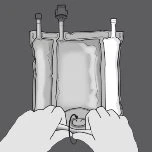
Step 2: Press until the non-permanent seals open.

Step 3: Reverse direction and roll the bag towards the D-hanger until the seal is completely open. Follow the same steps to open the second non-permanent seal.

Step 4: Turn the bag over at least three times to thoroughly mix the contents. The appearance of the mixed solution should be a milky white emulsion.
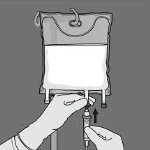
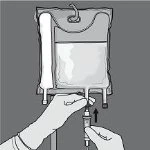
Step 5: Remove the protective cap from the administration port and insert the intravenous administration set.
Activation of the 2-chamber bag (breaking the non-permanent seal between the amino acid and glucose chambers)
Step 1: To break only the non-permanent amino acid/glucose seal, begin rolling the bag from the D-hanger corner of the seal separating the amino acid and glucose chambers, and press to open the seal between the two compartments.
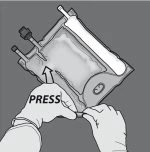
Step 2: Position the bag so that the lipid emulsion compartment faces the operator, and roll the bag while protecting the lipid emulsion compartment in the palms of your hands.
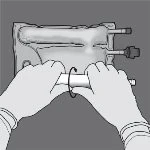
Step 3: With one hand, apply pressure by rolling the bag toward the tubes.
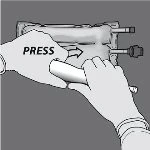
Step 4: Then reverse direction and roll the bag toward the D-hanger, pressing with the other hand until the seal separating the amino acid and glucose solutions is fully open.

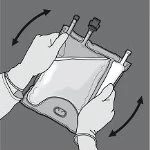
Step 5: Turn the bag over at least three times to thoroughly mix the contents. The appearance of the mixed solution should be clear, colourless or slightly yellowish.
Step 6: Remove the protective cap from the administration port and insert the intravenous administration set.
The infusion rate should be gradually increased during the first hour and adjusted according to the following factors:
The dose to be administered
The intake of daily volume
The duration of the infusion.
Method of administration
When used in newborns and children under 2 years of age, the emulsion (in the bag and in the administration set) must be protected from exposure to light until administration is complete.
The use of a 1.2-micron filter is recommended for the administration of Numeta G16%E.
Due to its high osmolarity, Numeta G16%E can only be administered undiluted via a central vein; however, appropriate dilution of Numeta G16%E with water for injections reduces osmolarity and allows peripheral infusion.
The following formula indicates the effect of dilution on the osmolarity of the bags.
Final osmolarity | = | Bag volume x initial osmolarity |
Added water + Bag volume |
The following table shows examples of osmolarity for the additions to the 2- and 3-chamber bags after the addition of water for injectable preparations:
Amino acids and glucose (activated B2C) | Amino acids, glucose and lipids (activated B3C) | |
Initial volume in the bag (ml) | 376 | 500 |
Initial osmolarity (mOsm/l approx) | 1585 | 1230 |
Volume of added water (ml) | 376 | 500 |
Final volume after addition (ml) | 752 | 1000 |
Osmolarity after addition (mOsm/l approx) | 792.5 | 615 |
Addition of medication
Mixtures containing trace elements and vitamins must be protected from light from the point of administration and during administration. Exposure to ambient light generates peroxides and other degradation products, which can be reduced by photoprotection.
Compatible medications may be added to the reconstituted mixture (after opening the non-permanent seals and mixing the contents of the two or three chambers) via the injection port.
Vitamins may also be added to the glucose chamber prior to reconstituting the mixture (before opening the non-permanent seals and mixing the solutions and emulsion).
Tables 1–6 show possible additions of commercially available trace element solutions (identified as TE1, TE2, and TE4), vitamins (identified as lyophilisate V1 and emulsion V2), and electrolytes in defined quantities.
1 Compatibility with TE4, V1, and V2
Table 1: Compatibility of 3-in-1 (activated B3C) with or without dilution in water
Per 500 ml (3-in-1 mixture with lipids) | ||||||
Undiluted mixture | Diluted mixture | |||||
Additives | Level included | Maximum addition | Total maximum level | Level included | Maximum addition | Total maximum level |
Sodium (mmol) | 12.0 | 25.6 | 37.6 | 12.0 | 25.6 | 37.6 |
Potassium (mmol) | 11.4 | 26.2 | 37.6 | 11.4 | 26.2 | 37.6 |
Magnesium (mmol) | 1.6 | 3.6 | 5.2 | 1.6 | 3.6 | 5.2 |
Calcium (mmol) | 3.1 | 16.4 | 19.5 | 3.1 | 8.2 | 11.3 |
Phosphate* (mmol) | 4.4 | 6.9 | 11.3 | 4.4 | 6.9 | 11.3 |
Trace elements and vitamins | - | 10 ml TE4 + 1 vial V1 + 30 ml V2 | 10 ml TE4 + 1 vial V1 + 30 ml V2 | - | 5 ml TE4 + ½ vial V1 + 5 ml V2 | 5 ml TE4 + ½ vial V1 + 5 ml V2 |
Water for injections | - | - | - | - | 350 ml | 350 ml |
- Organic phosphate
Table 2: Compatibility of 2-in-1 (activated B2C) with or without dilution in water
Per 376 ml (2-in-1 mixture without lipids) | ||||||
Undiluted mixture | Diluted mixture | |||||
Additives | Level included | Maximum addition | Total maximum level | Level included | Maximum addition | Total maximum level |
Sodium (mmol) | 11.6 | 26.0 | 37.6 | 11.6 | 0.0 | 11.6 |
Potassium (mmol) | 11.4 | 26.2 | 37.6 | 11.4 | 0.0 | 11.4 |
Magnesium (mmol) | 1.6 | 3.6 | 5.2 | 1.6 | 0.0 | 1.6 |
Calcium (mmol) | 3.1 | 8.2 | 11.3 | 3.1 | 0.0 | 3.1 |
Phosphate* (mmol) | 3.2 | 8.1 | 11.3 | 3.2 | 0.0 | 3.2 |
Trace elements and vitamins | - | 5 ml TE4 + ½ vial V1 | 5 ml TE4 + ½ vial V1 | - | 5 ml TE4 + ½ vial V1 | 5 ml TE4 + ½ vial V1 |
Water for injectable preparations | - | - | - | - | 450 ml | 450 ml |
- Organic phosphate
2 Compatibility with TE1, V1 and V2
Table 3: Compatibility of 3-in-1 (activated B3C) with or without dilution in water
Per 500 ml (3-in-1 mixture with lipids) | ||||||
Undiluted mixture | Diluted mixture | |||||
Additives | Level included | Maximum addition | Total maximum level | Level included | Maximum addition | Total maximum level |
Sodium (mmol) | 12.0 | 4.0 | 16.0 | 12.0 | 0.0 | 12.0 |
Potassium (mmol) | 11.4 | 6.2 | 17.6 | 11.4 | 0.0 | 11.4 |
Magnesium (mmol) | 1.6 | 0 | 1.6 | 1.6 | 0.0 | 1.6 |
Calcium (mmol) | 3.1 | 2.1 | 5.2 | 3.1 | 0.0 | 3.1 |
Phosphate* (mmol) | 4.4 | 2.0 | 6.4 | 4.4 | 0.0 | 4.4 |
Trace elements and vitamins | - | 5 ml TE1 + ½ vial V1 + 5 ml V2 | 5 ml TE1 + ½ vial V1 + 5 ml V2 | - | 5 ml TE1 + ½ vial V1 + 5 ml V2 | 5 ml TE1 + ½ vial V1 + 5 ml V2 |
Water for injections | - | - | - | - | 350 ml | 350 ml |
- Organic phosphate
Table 4: Compatibility of 2-in-1 (activated B2C) with or without dilution in water
Per 376 ml (2-in-1 mixture without lipids) | ||||||
Undiluted mixture | Diluted mixture | |||||
Additives | Level included | Maximum addition | Total maximum level | Level included | Maximum addition | Total maximum level |
Sodium (mmol) | 11.6 | 26.0 | 37.6 | 11.6 | 0.0 | 11.6 |
Potassium (mmol) | 11.4 | 26.2 | 37.6 | 11.4 | 0.0 | 11.4 |
Magnesium (mmol) | 1.6 | 3.6 | 5.2 | 1.6 | 0.0 | 1.6 |
Calcium (mmol) | 3.1 | 8.2 | 11.3 | 3.1 | 0.0 | 3.1 |
Phosphate* (mmol) | 3.2 | 8.1 | 11.3 | 3.2 | 0.0 | 3.2 |
Trace elements and vitamins | - | 5 ml TE1 + ½ vial V1 | 5 ml TE1 + ½ vial V1 | - | 5 ml TE1 + ½ vial V1 | 5 ml TE1 + ½ vial V1 |
Water for injectable preparations | - | - | - | - | 450 ml | 450 ml |
- Organic phosphate
3 Compatibility with TE2, V1 and V2
Table 5: Compatibility of 3-in-1 (activated B3C) with or without dilution in water
Per 500 ml (3-in-1 mixture with lipids) | ||||||
Undiluted mixture | Diluted mixture | |||||
Additives | Level included | Maximum addition | Total maximum level | Level included | Maximum addition | Total maximum level |
Sodium (mmol) | 12.0 | 4.0 | 16.0 | 12.0 | 0.0 | 12.0 |
Potassium (mmol) | 11.4 | 6.2 | 17.6 | 11.4 | 0.0 | 11.4 |
Magnesium (mmol) | 1.6 | 0 | 1.6 | 1.6 | 0.0 | 1.6 |
Calcium (mmol) | 3.1 | 2.1 | 5.2 | 3.1 | 0.0 | 3.1 |
Phosphate* (mmol) | 4.4 | 2.0 | 6.4 | 4.4 | 0.0 | 4.4 |
Trace elements and vitamins | - | 5 ml TE2 + ½ vial V1 + 5 ml V2 | 5 ml TE2 + ½ vial V1 + 5 ml V2 | - | 5 ml TE2 + ½ vial V1 + 5 ml V2 | 5 ml TE2 + ½ vial V1 + 5 ml V2 |
Water for injections | - | - | - | - | 350 ml | 350 ml |
- Organic phosphate
Table 6: Compatibility of 2-in-1 (activated B2C) with or without dilution in water
Per 376 ml (2-in-1 mixture without lipids) | ||||||
Undiluted mixture | Diluted mixture | |||||
Additives | Level included | Maximum addition | Total maximum level | Level included | Maximum addition | Total maximum level |
Sodium (mmol) | 11.6 | 26.0 | 37.6 | 11.6 | 0.0 | 11.6 |
Potassium (mmol) | 11.4 | 26.2 | 37.6 | 11.4 | 0.0 | 11.4 |
Magnesium (mmol) | 1.6 | 3.6 | 5.2 | 1.6 | 0.0 | 1.6 |
Calcium (mmol) | 3.1 | 8.2 | 11.3 | 3.1 | 0.0 | 3.1 |
Phosphate* (mmol) | 3.2 | 8.1 | 11.3 | 3.2 | 0.0 | 3.2 |
Trace elements and vitamins | - | 5 ml TE2 + ½ vial V1 | 5 ml TE2 + ½ vial V1 | - | 5 ml TE2 + ½ vial V1 | 5 ml TE2 + ½ vial V1 |
Water for injectable preparations | - | - | - | - | 450 ml | 450 ml |
- Organic phosphate
The composition of vitamin and trace element preparations is illustrated below in Tables 7 and 8:
Table 7: Composition of the commercial trace element preparation used:
Composition per 10 ml | TE1 | TE2 | TE4 |
Iron | - | 8.9 µmol or 0.5 mg | - |
Zinc | 38.2 µmol or 2.5 mg | 15.3 µmol or 1 mg | 15.3 µmol or 1 mg |
Selenium | 0.253 µmol or 0.02 mg | 0.6 µmol or 0.05 mg | 0.253 µmol or 0.02 mg |
Copper | 3.15 µmol or 0.2 mg | 4.7 µmol or 0.3 mg | 3.15 µmol or 0.2 mg |
Iodine | 0.0788 µmol or 0.01 mg | 0.4 µmol or 0.05 mg | 0.079 µmol or 0.01 mg |
Fluoride | 30 µmol or 0.57 mg | 26.3 µmol or 0.5 mg | - |
Molybdenum | - | 0.5 µmol or 0.05 mg | - |
Manganese | 0.182 µmol or 0.01 mg | 1.8 µmol or 0.1 mg | 0.091 µmol or 0.005 mg |
Cobalt | - | 2.5 µmol or 0.15 mg | - |
Chromium | - | 0.4 µmol or 0.02 mg | - |
Table 8: Composition of the commercial vitamin preparations used:
Composition per vial | V1 | V2 |
Vitamin B1 | 2.5 mg | - |
Vitamin B2 | 3.6 mg | - |
Nicotinamide | 40 mg | - |
Vitamin B6 | 4.0 mg | - |
Pantothenic acid | 15.0 mg | - |
Biotin | 60 µg | - |
Folic acid | 400 µg | - |
Vitamin B12 | 5.0 µg | - |
Vitamin C | 100 mg | - |
Vitamin A | - | 2300 IU |
Vitamin D | - | 400 IU |
Vitamin E | - | 7 IU |
Vitamin K | - | 200 µg |
To perform an addition:
- Must be carried out under aseptic conditions.
- Prepare the injection site on the bag.
- Pierce the injection site and inject additives using an injection needle or a reconstitution device.
- Mix the contents of the bag and the additives.
Preparation of the infusion:
- Must be carried out under aseptic conditions.
- Hang the bag.
- Remove the plastic protector from the administration outlet.
- Firmly insert the tip of the infusion set into the administration outlet.
Administration of the infusion:
- For single use only.
- Administer the product only after breaking the non-permanent seals between the two or three chambers and mixing the contents of the two or three chambers.
- Ensure that the final activated three-chamber bag emulsion for infusion shows no signs of phase separation and that the final two-chamber bag solution for infusion shows no signs of particles.
- Immediate use is recommended after breaking the non-permanent seals. It must not be stored for subsequent infusion.
- Do not connect a partially used bag.
- Do not connect bags in series to avoid the risk of gas embolism due to residual air in the primary bag.
- Use of a 1.2-micron filter is recommended for the administration of Numeta G16%E.
- When used in newborns and children under 2 years of age, protect from light exposure until administration is complete. Exposure of Numeta G16%E to ambient light, especially after mixing with trace elements or vitamins, may generate peroxides and other degradation products, which can be minimized by protecting the product from light.
- Unused product, materials that have come into contact with it, and all necessary disposable devices must be properly discarded.
Stability period after mixing solutions
Use the product immediately after breaking the non-permanent seals between the two or three chambers. Studies have demonstrated the stability of the mixtures for 7 days at a temperature between 2 °C and 8 °C, followed by 48 hours at a temperature not exceeding 30 °C.
Stability period after supplementation (electrolytes, trace elements, vitamins, water):
For certain additions, physical stability of Numeta formulation has been demonstrated for 7 days at a temperature between 2 °C and 8 °C, followed by 48 hours at 30 °C.
From a microbiological standpoint, the product should be used immediately. If not used immediately, the conditions and duration of storage prior to use are the responsibility of the user and normally should not exceed 24 hours at 2 °C to 8 °C, unless reconstitution/dilution/addition has been performed under controlled and validated aseptic conditions.
Do not use Numeta G16%E if the bag is damaged. A damaged bag has the following characteristics:
- The non-permanent seals are broken.
- One of the chambers already contains a mixture of any of the solutions.
- The amino acid and glucose solution is not clear, colorless, or slightly yellowish and/or contains visible particles.
- The lipid emulsion does not appear milky and whitish.
Medicines must not be disposed of via wastewater or household waste. Ask your pharmacist how to dispose of medicines and packaging that you no longer need. This will help protect the environment.
Composition of Numeta G16%E
The active substances are:
Composition | 500 ml | |
Active ingredient | Activated B2C (376 ml) | Activated B3C (500 ml) |
Amino acid compartment | ||
Active ingredient | ||
Alanine | 1.03 g | 1.03 g |
Arginine | 1.08 g | 1.08 g |
Aspartic acid | 0.77 g | 0.77 g |
Cysteine | 0.24 g | 0.24 g |
Glutamic acid | 1.29 g | 1.29 g |
Glycine | 0.51 g | 0.51 g |
Histidine | 0.49 g | 0.49 g |
Isoleucine | 0.86 g | 0.86 g |
Leucine | 1.29 g | 1.29 g |
Lysine monohydrate (equivalent to Lysine) | 1.59 g (1.42 g) | 1.59 g (1.42 g) |
Methionine | 0.31 g | 0.31 g |
Ornithine HCl (equivalent to Ornithine) | 0.41 g (0.32 g) | 0.41 g (0.32 g) |
Phenylalanine | 0.54 g | 0.54 g |
Proline | 0.39 g | 0.39 g |
Serine | 0.51 g | 0.51 g |
Taurine | 0.08 g | 0.08 g |
Threonine | 0.48 g | 0.48 g |
Tryptophan | 0.26 g | 0.26 g |
Tyrosine | 0.10 g | 0.10 g |
Valine | 0.98 g | 0.98 g |
Sodium chloride | 0.30 g | 0.30 g |
Potassium acetate | 1.12 g | 1.12 g |
Calcium chloride dihydrate | 0.46 g | 0.46 g |
Magnesium acetate tetrahydrate | 0.33 g | 0.33 g |
Sodium glycerophosphate hydrate | 0.98 g | 0.98 g |
Glucose compartment | ||
Anhydrous glucose monohydrate (equivalent to anhydrous glucose) (equivalent to anhydrous glucose) | 85.25 g (77.50 g) | 85.25 g (77.50 g) |
Lipid compartment | ||
Refined soybean oil (approx. 80%) + refined olive oil (approx. 20%) | - | 15.5 g |
The reconstituted solution/emulsion provides the following:
Composition | ||||
B2C activated | B3C activated | |||
Per unit volume (ml) | 376 | 100 | 500 | 100 |
Nitrogen (g) | 2.0 | 0.52 | 2.0 | 0.39 |
Amino acids (g) | 13.0 | 3.5 | 13.0 | 2.6 |
Glucose (g) | 77.5 | 20.6 | 77.5 | 15.5 |
Lipids (g) | 0 | 0 | 15.5 | 3.1 |
Energy | ||||
Total calories (kcal) | 362 | 96 | 517 | 103 |
Non-protein calories (kcal) | 310 | 82 | 465 | 93 |
Glucose calories (kcal) | 310 | 82 | 310 | 62 |
Lipid calories (kcal) | 0 | 0 | 155 | 31 |
Non-protein calories / nitrogen (kcal/g N) | 158 | 158 | 237 | 237 |
Lipid calories (% non-protein calories) | N/A | N/A | 33 | 33 |
Lipid calories (% total calories) | N/A | N/A | 30 | 30 |
Electrolytes | ||||
Sodium (mmol) | 11.6 | 3.1 | 12.0 | 2.4 |
Potassium (mmol) | 11.4 | 3.0 | 11.4 | 2.3 |
Magnesium (mmol) | 1.6 | 0.41 | 1.6 | 0.31 |
Calcium (mmol) | 3.1 | 0.82 | 3.1 | 0.62 |
Phosphateb (mmol) | 3.2 | 0.85 | 4.4 | 0.87 |
Acetate (mmol) | 14.5 | 3.9 | 14.5 | 2.9 |
Malate (mmol) | 4.3 | 1.1 | 4.3 | 0.86 |
Chloride (mmol) | 13.8 | 3.7 | 13.8 | 2.8 |
pH (approx.) | 5.5 | 5.5 | 5.5 | 5.5 |
Approximate osmolarity (mOsm/L) | 1585 | 1585 | 1230 | 1230 |
(a) Includes calories from egg phospholipids for perfusion.
(b) Includes phosphate provided by egg phospholipids for perfusion.
Other components are:
Malic acid, L- |
Hydrochloric acida |
Egg phospholipids for perfusion |
Glycerol |
Sodium oleate |
Sodium hydroxidea |
Water for injections |
a for pH adjustment
Baxter and Numeta are registered trademarks of Baxter International Inc.